
The invitation to return to the mansion came from Michael rather than Eleanor. He called on a Saturday afternoon and asked whether I would be willing to collect a few personal items I had left behind. He had found a box of books in the study and a folder of photographs in the bedroom closet. He offered to bring them to my apartment, but I told him I could collect them myself.
“Are you sure?” he asked.
“Yes. I don’t want to avoid the house forever. I just don’t want to live there.”
He was quiet for a moment. “I’ll make sure Mom knows you’re coming. I’ll ask her to leave the conversation to us unless you want to speak to her.”
I appreciated the offer, but I made one condition.
“I’ll come in the afternoon. If she decides she wants to discuss our relationship or the estate, I’ll leave.”
“Understood.”
I drove to the mansion after lunch. The sky was overcast, and the stone driveway looked darker than I remembered. The front garden had been trimmed recently, the hedges cut into their usual precise lines. I parked near the side entrance, where I used to carry grocery bags into the kitchen, and sat for a moment before getting out.
I had imagined returning to the house would stir up anger or sadness. Instead, I felt alert, as though I were entering a place I had once known well but could no longer trust myself to navigate automatically.
Michael opened the door before I rang the bell. He was wearing jeans and a gray sweater, and he looked nervous.
“Hi,” he said.
“Hi.”
He stepped aside and let me enter. The hallway smelled of furniture polish and the faint floral fragrance Eleanor used in the living room. The runner had been replaced with a newer one, though the same narrow table stood against the wall. My suitcases were gone, of course. The space beside the door looked almost aggressively ordinary.
“I put your things in the study,” Michael said. “There are two boxes. I wasn't sure which books you wanted, so I packed everything that looked like yours.”
“Thank you.”
He led me toward the study. I followed him past the dining room, where sunlight fell across the polished table. The chairs were arranged evenly, and the silver coffee service had been removed. I stopped at the doorway for a second.
This was where Charles had opened the brown folder. Where Eleanor had read Jonathan’s signature and gone still. Where Margaret had asked Michael whether he had packed my things, and he had finally answered without trying to disguise what he had done.
The room looked no different, yet I could no longer see it as a neutral part of the house. It had become the place where the family’s private rules had been measured against the written ones.
Michael noticed me looking.
“I think about that day a lot,” he said.
“So do I.”
“I should have told you about the decision before I packed anything.”
“Yes.”
He waited, perhaps expecting me to say more. I did not. He had already acknowledged what he had done, and I did not need to repeat the entire conversation to prove that I remembered it.
The boxes were stacked beside the desk. I opened the first and found several novels, two notebooks, and a framed photograph of my parents. The second held old tax papers, a folder of receipts, and the photographs Michael had mentioned. He had arranged them carefully, separating personal documents from things that could be thrown away.
I began checking the contents. One of the photographs showed Michael and me standing in the garden on our first anniversary. He had his arm around my shoulders, and I was smiling at the camera. Behind us, Eleanor stood near the terrace doors, her expression composed. I remembered the afternoon clearly. I had spent hours preparing lunch for the family, and Michael had promised we would go for a walk afterward. Eleanor had asked him to help with a problem in the garage, then called him back inside when he tried to leave.
We never took the walk.
I placed the photograph in the box rather than setting it aside. It belonged to a time when I had been happy, and I did not need to pretend the happiness had never existed simply because the marriage had later become painful.
“Do you want me to carry these to your car?” Michael asked.
“I can manage.”
He nodded, but stayed nearby. He seemed to understand that offering help was different from assuming I needed it.
I found the last item at the bottom of the second box: a small ceramic dish I had bought at a local craft fair during my first year in the house. It was blue and white, with a slightly uneven rim. I had kept it on my dresser for years, using it to hold earrings and spare buttons.
I had not noticed it was missing until that moment.
I turned it over in my hands. “I thought I’d lost this.”
“I found it in the bedroom drawer when I was looking for the photographs,” Michael said. “I packed it because I thought you’d want it.”
“I do.”
I set it carefully among the books.
For several minutes, we worked in silence. The task was simple, and neither of us tried to turn it into a conversation about reconciliation. When the boxes were nearly full, Michael asked whether I wanted to look through the photographs before leaving.
“I think I’ll take them home and sort them there.”
“All right.”
He carried one box to the front hall before remembering my earlier preference. He stopped, looked at me, and asked, “Would you like help getting these to the car?”
“Yes, thank you.”
He lifted the heavier box, and I carried the other. We walked down the hallway together. When we reached the front door, I paused beside the place where my suitcases had stood that night.
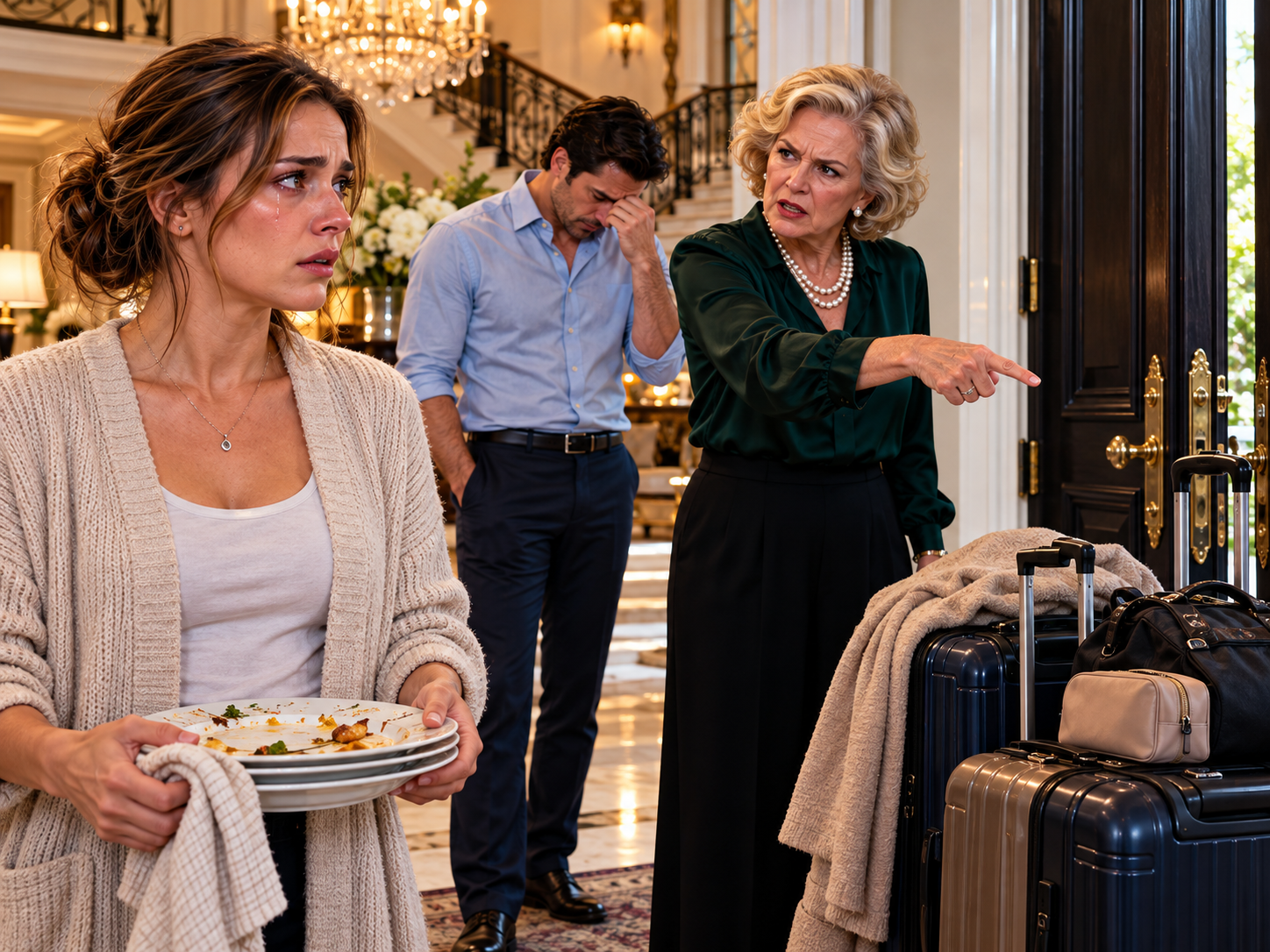
I had remembered the scene so often that it had become almost separate from the house itself. The two cases, the coat folded on top, Michael’s eyes lowered, Eleanor’s satisfied expression. I had spent weeks trying to understand why he had been willing to help his mother remove me before giving me the chance to speak.
Standing there now, I realized I no longer needed an answer that made his choice less painful. He had been afraid of his mother’s anger. He had valued his own temporary comfort above my security. He had made a choice, and he was responsible for it.
He was also responsible for what he did next.
I carried my box outside and set it on the back seat. Michael placed the other beside it, then closed the car door gently.
“Would you like to come in for coffee before you go?” he asked.
I looked at the house. Through the window, I could see the dining room table and the neatly arranged chairs. Somewhere upstairs, a door closed. The familiar sounds no longer made me feel that I had to be careful.
“Not today,” I said.
He nodded. “I understand.”
I expected him to look disappointed, and he did. But he did not ask me to reconsider. He did not tell me that his mother would be hurt or that it would be easier if I stayed. He let the answer remain what it was.
Before I got into the car, I turned toward him.
“How are things with your mother?”
He considered the question. “We’re speaking again. She still gets upset when I disagree with her, but I’m trying not to treat that as a reason to change my mind.”
“Does she understand why?”
“Sometimes. Other times she says I’ve become distant.”
“And what do you tell her?”
“That I can love her without agreeing with everything she wants.”
I looked at him for a long moment. “Keep saying it, then. Not just when I’m watching.”
“I will.”
I drove away without looking back at the mansion. The boxes shifted slightly when I turned onto the main road, and the ceramic dish made a soft clicking sound against the side of a book. I pulled over at the next safe place and wrapped it in a scarf so it would not break.
The small interruption made me smile. It was an ordinary problem, one I could solve without asking permission or worrying that someone would criticize how I handled it.
Back at the apartment, I unpacked the books and put the photograph of my parents on the shelf. I set the ceramic dish on the dresser, exactly where I wanted it. Then I sat on the floor and sorted through the photographs.
Some showed good memories. Others reminded me of how often I had been smiling for a camera while privately wondering whether I had done something wrong. I kept them all. They were evidence of a life that had contained affection and disappointment, generosity and control, genuine happiness and long stretches of uncertainty.
I did not need to erase the past to move forward.
Later that evening, Michael sent a message asking whether everything had arrived safely. I told him it had, and thanked him for packing the boxes carefully. He replied that he was glad I had my belongings back.
There was no request to meet again, no hint that he expected gratitude to lead to forgiveness. I put the phone away and made dinner.
As I ate at my small table, I thought about the woman who had stood in the mansion’s kitchen five years earlier, trying to learn the family’s routines. She had believed that patience would earn respect, that kindness would eventually be returned, and that if she made herself useful enough, no one would want her gone.
I did not despise that woman. She had been trying to build a marriage with the information she had and the hopes she carried. But I would no longer ask her to keep sacrificing herself to prove she deserved a place in someone else’s home.
The legal review had established the limits of Eleanor’s authority. It had required the estate’s obligations to be followed and the financial records to be corrected. It had not decided whether Michael and I should stay married, whether Eleanor could become kinder, or whether our family could find a healthier way to live with one another.
Those questions remained, but they were no longer mine to solve alone.
A few days later, Michael asked if I would consider having dinner with him at a restaurant. He specified that it would be just the two of us and that we could leave whenever I wanted. I agreed to meet him the following week, not because I had decided to return to the marriage, but because I wanted to see whether we could spend time together without slipping back into our old roles.
When I put my phone down, I glanced at the ceramic dish on the dresser. It was ordinary, inexpensive, and slightly imperfect. I had brought it into the mansion as a small piece of my own life. Now it sat in a room where no one could tell me it was in the wrong place.
I turned off the light and went to bed.
I still did not know what would happen to my marriage. But I was no longer waiting for Eleanor to grant me a place in the family, or for Michael to decide whether I deserved one. Whatever came next would have to be built on choices freely made, not on the fear of being sent away.
Click here to continue reading: PART 9: The First Dinner Michael and I Shared Outside His Family’s House Forced Us to Face the Difference Between Missing Each Other and Being Ready to Begin Again
My Mother-in-Law Had Packed My Life Into Two Suitcases, but the Question My Husband Refused to Answer Was Only the Beginning
Part 8 of 20

