
Charles smoothed the folded letter with the side of his hand. The paper had been kept in the file for years, but the creases were still sharp, and the ink had faded slightly where Jonathan’s pen had pressed less firmly against the page.
“I suggest we read it in full before discussing what it means,” Charles said.
Eleanor’s expression suggested she had no intention of granting the letter that much importance. Nevertheless, she sat still while he began.
“Eleanor, Michael, and whoever may eventually need to understand these instructions,” Charles read, “I am putting these matters in writing because I have learned that good intentions are not enough to protect a family from its own habits. A house can be maintained, insured, and passed from one generation to another while the people living inside it are made to feel they have no secure place there.”
I recognized Jonathan’s voice in the words. He had spoken with that same quiet precision when discussing things he cared about deeply. He never rushed to make a point. He laid it down and allowed silence to do the rest.
Charles continued.
“I want the Richardson residence preserved. It represents work, history, and responsibility. But preserving the building must not become an excuse for one person to control everyone else. No one should be made to believe that their home can be taken from them at another person’s whim simply because the deed carries a particular name.”
Eleanor’s fingers tightened around the handle of her coffee cup.
“This is a private letter,” she said.
“It was placed with the estate documents for a reason,” Charles replied. “I’ll finish reading it, and then we can discuss any questions.”
She did not interrupt again.
The letter went on to describe Jonathan’s concern that family arrangements could become unfair when financial authority and emotional authority rested in the same hands. He wrote that a person might obey a rule not because it was reasonable, but because the consequences of challenging it were too frightening. He wanted the agreement to provide a process that could be examined by someone independent of the household.
Then he mentioned me.
“I have come to respect Lisa for the way she treats people when she has no reason to expect anything in return. She does not need to be the loudest person in a room to notice when someone is being diminished. I have watched her make an effort to build a home here, and I have also watched her learn when to remain quiet because speaking would only make another person angrier.”
I lowered my eyes. I had not known Jonathan had noticed those things. I had been careful around him, as I had been around Eleanor, though his kindness had made the caution less exhausting. It was strange to hear my own behavior described by someone who had died before I realized how much I had needed him to see it.
Charles read the next paragraph more slowly.
“If Lisa becomes part of this household, I do not want her security to depend entirely on whether another person approves of her. She must be treated fairly under the arrangements that govern the residence. If those conditions are challenged, the agreement should be reviewed by the independent person named in the accompanying documents. I am not giving her ownership of the house. I am asking that the obligations attached to its management be honored.”
Michael looked down at his hands.
The letter was not a declaration that I deserved a mansion. It was not a promise that I could never be asked to leave. It was something less dramatic and, in that moment, far more meaningful: Jonathan had recognized that a person could be made vulnerable without being formally deprived of anything. He had tried to prevent that vulnerability from becoming a tool.
Charles continued to the final paragraph.
“I cannot decide how this family will treat one another after I am gone. I can only make the consequences of certain decisions clearer. If the residence is preserved at the cost of someone’s dignity, then we will have preserved the wrong thing.”
He stopped reading.
No one spoke. Outside, a gardener’s hose clicked against the stone edging of the flower beds. Water ran briefly, then stopped. The ordinary sound seemed strangely intrusive in the still room.
Eleanor set her cup down. “Jonathan was sick. He was worried about everything toward the end. You know that, Charles.”
“Yes,” he said. “I also know that he was assessed as capable of making these arrangements, that the agreement was properly prepared, and that he took care to document his intentions.”
“He would never have wanted a stranger interfering in the running of this house.”
“Margaret Ellis was selected by Jonathan himself.”
Eleanor turned to Michael. “You knew your father was upset about the family finances. You know how he became near the end. He worried about the smallest things.”
Michael’s jaw moved before he answered. “I knew he worried about the house.”
“Exactly.”
“But I didn’t know about this agreement.”
His mother stared at him, and I saw the familiar pressure beginning to build between them. It was a look I had witnessed countless times at family dinners: Eleanor waiting for Michael to retreat, Michael searching for the quickest way to stop the discomfort. Usually, he would change the subject or make a joke. Sometimes he would promise to speak to me later. This time, he remained silent long enough for her expression to change.
Charles removed a third set of papers from the folder. “There is one other matter we need to address. The agreement established a reserve for designated expenses related to the property. Jonathan wanted the house maintained without creating financial pressure that could later be used to justify decisions against the people living there.”
“I know about the reserve,” Eleanor said sharply. “I managed it.”
“Then you’ll understand why a complete reconciliation is necessary.”
“I have records.”
“Some records are present in the file. Others appear incomplete, and several withdrawals require clarification.”
Eleanor’s face became very still. “What withdrawals?”
Charles did not accuse her. He laid a statement on the table and turned it so everyone could see the columns. There were dates, transaction references, amounts, and brief descriptions. I could not follow every line, but I recognized the categories: property insurance, contractor payments, taxes, plumbing repairs, landscaping, and other costs I remembered discussing with Eleanor.
Several entries had no clear supporting invoice attached.
“Those were expenses for the house,” Eleanor said. “You cannot expect every receipt from every year to be immediately available.”
“I don’t,” Charles replied. “That is why an accounting process exists. Some of these entries may be perfectly legitimate. Others need documentation. We should not assume either that every withdrawal was proper or that any particular transaction was improper until the records have been examined.”
Michael leaned over the statement. “How much money are we talking about?”
“I’m not going to give you a final figure based on an incomplete reconciliation,” Charles said. “The amount, if any, that must be restored will be established through the review.”
Eleanor pushed the page away. “This is an attempt to humiliate me in my own home.”
“No,” Charles said. “The review is required because questions have been raised under a written agreement. It is not a judgment on you.”
“Who raised the questions?”
“The agreement itself provides for review when compliance is disputed. The circumstances of last night are relevant, and the financial records must be examined as part of the same process.”
I looked at the statement again. I remembered Jonathan’s careful habits. He kept maintenance receipts in labeled folders, wrote dates on the backs of photographs showing repairs, and once spent an entire afternoon checking a contractor’s estimate because two items seemed to overlap. He had never been careless with money. But I had not been involved in managing the reserve, and I had no way of knowing whether the missing documentation meant anything beyond disorganization.
I did know that Eleanor had often used the cost of maintaining the mansion to remind me that I owed her gratitude. Whenever I suggested that Michael and I should find a place of our own, she would list the taxes, the insurance, the repairs, and the expense of keeping the property in good condition. She spoke as though the house’s financial demands made her authority unquestionable.
If the reserve had not been properly managed, the question would be more serious than a family argument about who belonged in which bedroom.
Charles turned to a separate page. “Jonathan also named Margaret Ellis as the independent reviewer. I spoke with her this morning. She has agreed to meet with us and examine the agreement, the circumstances of Lisa’s removal, and the financial records.”
Eleanor rose from her chair.
“I will not have my entire life put on trial because Lisa is unhappy.”
“I’m not asking you to accept any allegation without evidence,” Charles said. “But the agreement is binding, and its review procedure cannot be ignored simply because you dislike the possibility of scrutiny.”
Eleanor looked at me. “You have no idea what it costs to keep this house standing. You have no idea what your father-in-law expected of me.”
“I know you’ve worked to maintain it,” I said. “I’m not claiming otherwise.”
“Then why are you doing this?”
I held her gaze. “Because you ordered me out last night, and Michael packed my belongings before I even knew it was happening. If the agreement was meant to protect the way people are treated in this house, then I think we need to find out what it says.”
Her eyes narrowed. “You could have spoken to me.”
“I have spoken to you for five years.”
For once, she had no immediate answer. The silence did not feel like victory. It felt like a door that had been closed so often that neither of us remembered what was on the other side.
Michael pushed his chair back. “Mom, maybe we should let Charles explain the process before we decide what any of this means.”
Eleanor turned on him. “Now you want to be reasonable?”
He looked as though she had struck him. “I should have been reasonable last night.”
It was the first thing he had said that did not attempt to protect himself.
I waited for him to continue, but he looked down again. An apology had begun to form, then stalled behind the same hesitation that had governed so many moments in our marriage. I was not going to help him finish it.
Charles closed the folder halfway. “Margaret will review the documents and speak with each of you. She will determine whether the agreement’s conditions were followed and what steps are required. Until then, no one should attempt to alter the residence arrangement, pressure Lisa to sign anything, or make changes to the designated reserve outside the ordinary, documented expenses.”
“Are you telling me I can’t manage my own home?” Eleanor demanded.
“I’m telling you to follow the agreement while the review is underway. The house remains subject to its existing ownership and legal arrangements. Nothing today changes the deed.”
That distinction mattered. I had come into the room hoping for an answer, not expecting a miracle. Charles was not offering me the mansion. He was not even promising that I could return to live there. He was making sure that Eleanor’s decision would be measured against the terms Jonathan had established rather than treated as unquestionable simply because she had announced it.
Margaret arrived shortly before noon. She was a woman in her early sixties, with short gray hair, a plain navy jacket, and a leather case that looked well used. She introduced herself to each of us and asked for a quiet room in which to review the documents. Eleanor objected to being questioned in her own home, but Margaret explained that the agreement gave her authority to examine the relevant records and interview the people involved.
“I’m not here to decide who is a good person,” Margaret said. “I’m here to determine whether the written terms were followed and what needs to happen next.”
She spoke without hostility, and without the reassuring warmth people sometimes use to disguise a decision they have already made. I found that comforting. No one was going to solve five years of family conflict by declaring one person virtuous and another wicked. There would be records, explanations, and consequences.
Margaret began with the agreement. She checked the signatures, reviewed the clauses governing the residence, and asked Charles to explain how the safeguards were supposed to operate. Then she turned to the events of the previous evening.
“Lisa, did anyone give you written notice that your residence was ending?”
“No.”
“Were you asked to sign anything?”
“No.”
“Were you told there was an immediate safety concern or an urgent reason you could not remain in the house that night?”
“No. Eleanor told me the house belonged to her family. Michael said they needed space.”
Margaret made a note. “Michael, did you pack Lisa’s belongings?”
He swallowed. “Yes.”
“Did she ask you to pack them?”
“No.”
“Did you discuss the decision with her before doing so?”
“No.”
Margaret wrote something else on her pad. She did not scold him or ask why he had done it. Her questions were simple, and his answers left very little room for interpretation.
Then she examined the financial records. Some expenses had matching invoices and appeared consistent with the purpose of the reserve. Others had descriptions that were too vague to verify. Margaret asked Eleanor for supporting documents and gave her a reasonable period to produce them. She also requested statements from the relevant accounts so that the review would not depend solely on papers selected by one person.
Eleanor insisted that every dollar had gone toward the property. Margaret replied that she would consider any explanation supported by the records. She did not suggest that a missing receipt was proof of wrongdoing, but she would not treat confidence as a substitute for documentation.
By late afternoon, the house felt different. The furniture had not moved. The silver tray remained on the island, and the coffee cups still sat on the dining table. Yet the familiar arrangement of power had been interrupted. Eleanor could no longer end a discussion simply by declaring that the house belonged to her. Michael could no longer pretend that silence had no consequences.
Before Margaret left, she asked Charles to arrange a follow-up meeting once the accounting had been completed.
“We have enough information to establish that the residence safeguards require serious attention,” she said. “The financial review is not finished. I won’t make findings about the reserve until I’ve seen the full record.”
Eleanor’s lips pressed together. Michael stared at the table.
I stood by the window as Charles gathered the papers. The afternoon light had moved across the floor, leaving the dining room dimmer than it had been when we arrived. I had come back to the mansion because I wanted answers. I was leaving with a process instead, and for the first time, the process did not depend on Eleanor deciding whether I deserved one.
At the door, Charles asked me to stay in touch while the review continued. Margaret reminded me not to sign any new agreement without independent advice. Neither promised a particular result.
I thanked them both.
As I stepped outside, Michael followed me onto the porch.
“Lisa, can we talk?”
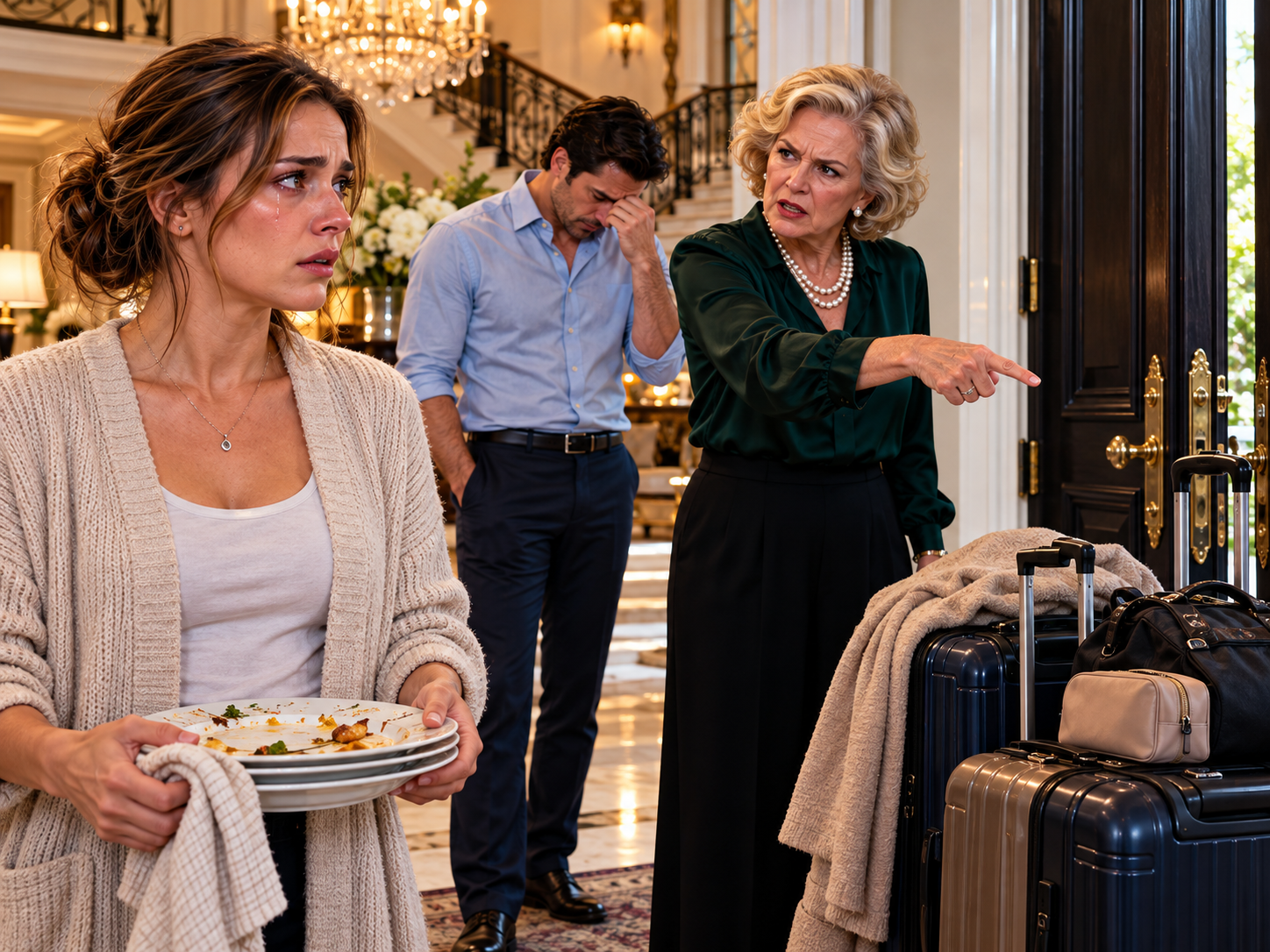
I turned. Behind him, the open doorway framed the hallway where my suitcases had stood the night before.
“We can talk,” I said. “But not because you suddenly need me to make you feel better about what happened.”
He looked down, then nodded.
“I understand.”
I was not sure he did. But at least he had stopped pretending that the problem was my reaction.
Click here to continue reading: PART 4: The Final Review Exposed the Difference Between Owning a Mansion and Having the Right to Decide Who Deserved a Home
My Mother-in-Law Had Packed My Life Into Two Suitcases, but the Question My Husband Refused to Answer Was Only the Beginning
Part 3 of 20

