
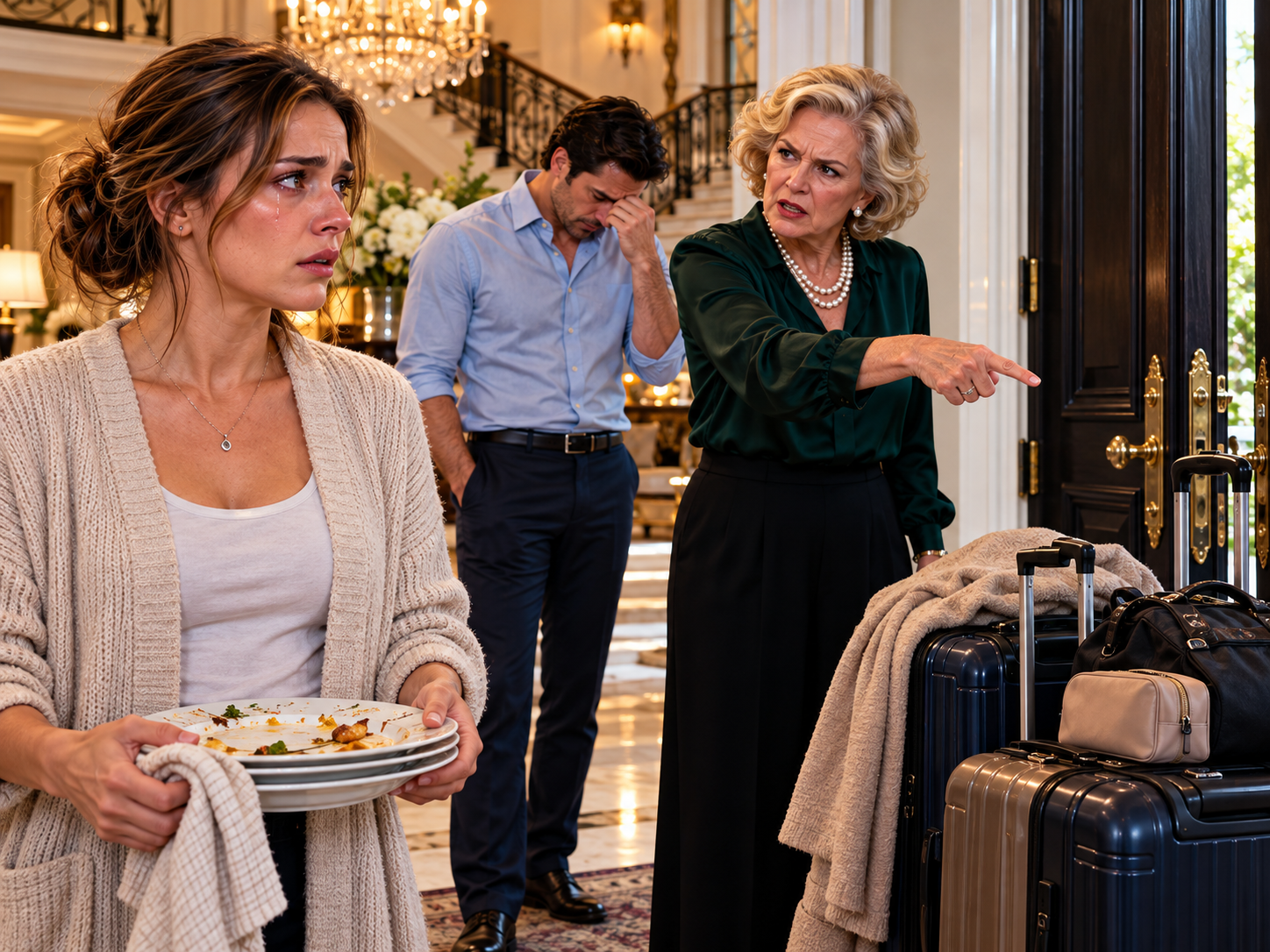
I woke before the alarm and lay still, listening to the muted traffic outside the hotel window. For several seconds, I could not remember why I was there. Then I saw the suitcase standing beside the dresser, its handle raised, and the previous evening returned in fragments: Eleanor’s voice, Michael’s lowered eyes, the cold weight of my wedding ring against my finger.
I showered, changed into a dark blue blouse and black trousers, and tied my hair back. I chose clothes that made me feel composed rather than clothes intended to impress anyone. I had spent enough years adjusting myself to the Richardson household. I was not going to spend the morning dressing for Eleanor’s approval.
Before leaving, I checked my handbag. My identification, marriage certificate, wallet, and the small envelope Jonathan had once given me were all there. I had found the envelope among the papers I kept in a drawer at home before moving into the mansion. It had never seemed important enough to open. Jonathan had handed it to me one afternoon when Michael was outside taking a telephone call, telling me simply to keep it somewhere safe.
“If you ever find yourself in a position where someone tells you that you have no place in this family,” he had said, “speak with Charles before you make any decisions.”
I had asked him what he meant.
He had smiled without looking particularly happy. “I hope you never need to find out.”
At the time, I assumed he was referring to Eleanor’s temper. Now I wondered whether he had understood something more specific about the family’s arrangements.
The drive back to the mansion took twenty minutes. I passed the bakery where Michael and I used to buy pastries on Sunday mornings, the little park where we had walked after Jonathan’s funeral, and the hardware store where I had once spent an entire afternoon comparing outdoor lights because Eleanor wanted the front entrance repaired without changing its original appearance.
Ordinary places. Ordinary memories. They had all belonged to a life I was not sure I still had.
When I turned into the driveway, the mansion looked exactly as it had the night before. The stone façade was clean beneath the morning light, and the flower beds along the entrance had been trimmed into neat, symmetrical borders. Nothing in the house’s appearance suggested that a marriage had been injured there or that a woman had been sent away with her clothes packed by someone who had promised to love her.
I parked behind Charles’s sedan.
He was standing beside the front steps, holding a thick brown folder under one arm. His silver hair was combed back, and he wore a charcoal suit with a narrow tie. I had met him several times at family gatherings, usually in the company of Jonathan, who had trusted him with matters that were never discussed at dinner.
“Good morning, Lisa,” he said.
“Thank you for coming.”
“Of course.”
He did not ask whether I had slept well. He looked at my face for a moment, as though checking that I was steady enough for what we were about to do, then glanced toward the front door.
“Before we go in,” he said, “I want you to understand something. I can explain what the documents say, but I’m not going to promise you an outcome before we have reviewed them with everyone involved. The law is not improved by guessing.”
“I understand.”
“And whatever Eleanor says, don't agree to sign anything today. If a question comes up that requires a separate review, we will take the time to do it properly.”
I nodded. My hands felt cold, so I tucked them into my coat pockets.
Charles rang the bell.
Eleanor opened the door herself. She wore a cream blouse, a narrow skirt, and the pearl necklace she seemed to consider appropriate for any situation in which she wanted to appear untroubled. Her expression was composed until she saw Charles standing beside me. Then her smile tightened at the corners.
“Charles. I wasn’t expecting you.”
“I imagine not,” he replied. “May we come in?”
She looked at me. “I thought you were coming to collect the rest of your things.”
“I’ve brought everything I need,” I said.
“That wasn’t what I meant.”
Charles stepped forward before the exchange could grow into another argument. “We have some matters concerning Jonathan’s estate that require clarification. I thought it would be best to discuss them in person.”
Eleanor’s fingers settled on the edge of the door. For an instant, I saw something move across her face—not surprise exactly, but recognition followed by a quick effort to conceal it.
“My husband’s estate was settled years ago.”
“The principal administration was completed,” Charles said. “There were also additional instructions and related documents that need to be considered in light of recent events.”
“What recent events?”
“I’ll explain once we’re seated.”
She stood aside, but the movement was reluctant. As I passed her, I caught the scent of her perfume, the same floral fragrance she had worn at Jonathan’s funeral. It brought back the image of her accepting condolences while Michael stood beside her, looking too stunned to speak. I had held his hand through that day. He had cried in the car afterward, and I had promised that we would get through the loss together.
I wondered when, exactly, his grief had become another reason for him to avoid confronting his mother.
We entered the dining room. Sunlight fell across the polished table, illuminating the faint scratches near the place where Jonathan used to sit. A silver coffee service stood on a tray. Eleanor had clearly been preparing for a normal morning, and the sight of Charles’s folder seemed to disrupt the arrangement more than my return did.
Michael appeared from the adjoining study. His shirt was wrinkled, and his eyes were rimmed with red. When he saw me, he stopped.
“Lisa.”
“Michael.”
Neither of us moved closer.
He looked at Charles. “What’s going on?”
“That,” Charles said, “is what we need to establish.”
Eleanor pulled out a chair and sat at the head of the table. “I don’t appreciate people arriving at my home and implying there is some secret business to be settled.”
“No one has accused you of anything,” Charles replied. “We are here because a set of documents exists, and the circumstances of last night may have a bearing on them.”
He placed the folder on the table and opened its clasp.
I sat near the window. Michael took the chair opposite me but kept his hands folded in front of him. Eleanor did not offer me coffee. Charles declined the cup she set beside him and removed a series of papers held together by a paper clip. The top page was slightly yellowed along its edges. A date had been typed near the upper right corner, and several signatures appeared near the bottom.
“I want to begin with the document Jonathan signed seven years ago,” Charles said. “It was prepared as part of a broader set of arrangements concerning the family residence and certain estate funds.”
Eleanor reached for the page. Charles placed it in front of her.
She adjusted her glasses, then began to read. At first, her face carried the impatience of someone forced to sit through an unnecessary meeting. Her eyes moved steadily down the page. When they reached the signature at the bottom, her hand stopped.
Jonathan Richardson’s name was written in the same slanted script I remembered from birthday cards and handwritten notes. Beneath it was the signature of Charles as the attorney who had witnessed and prepared the document. Another name appeared farther down, belonging to an independent professional who had participated in the arrangement.
Eleanor lifted her eyes.
“What is this?”
“It is an agreement concerning the conditions under which the family residence was to be managed, the protection of certain people living there, and the use of a designated estate reserve,” Charles said. “It was executed before Jonathan’s health began to decline.”
“That isn’t how I remember it.”
“Then we should examine the wording together.”
Michael reached for the page. Eleanor kept her hand on its lower edge for a second, then released it. He read the first paragraph, frowned, and moved on. When he reached my name, his eyes flicked toward me.
“Lisa Morgan Richardson,” he said.
My full name looked unfamiliar on the official page, as though it belonged to someone whose life had been arranged without her knowledge.
“What does she have to do with my father’s estate?” Eleanor asked.
Charles turned to a second sheet. “The agreement was designed to prevent the family residence from becoming a source of coercion or instability for anyone whose continued presence had been acknowledged under the arrangement. Jonathan wanted the property preserved, but he also wanted the people living in it to be treated according to clearly defined conditions rather than the personal wishes of whoever happened to control the household.”
Eleanor’s jaw tightened. “You make it sound as if I was a danger to my own family.”
“I’m explaining the document, not interpreting your character.”
“Jonathan never intended me to lose control of my home.”
“He did not transfer ownership of the mansion to Lisa,” Charles said. “That is not what this agreement does. The title remains a separate matter. But ownership does not mean every other obligation disappears.”
He pointed to a paragraph near the middle of the page. It described safeguards relating to a person’s established residence in the house. Any decision to end that arrangement had to follow the procedures set out in the agreement. It could not be carried out through intimidation, arbitrary demands, or pressure to sign away rights without independent advice.
The language was formal, dense, and full of references I did not understand. Yet its purpose was clear enough. Jonathan had anticipated that the person with the most power in the house might use that power to decide who belonged there.
My throat tightened. I remembered the garden conversation, his apology, and the way he had told me not to confuse another person’s authority with my own lack of worth. Perhaps he had not merely been trying to comfort me.
Eleanor tapped the page with one polished fingernail. “This is a family matter. Surely Jonathan expected us to use common sense.”
“He expected the family to follow a written agreement,” Charles replied. “That is precisely why it was written.”
Michael was still reading. “Why didn’t I know about this?”
“You were informed of the general estate arrangements,” Charles said. “The supplementary agreement was handled separately. Your father had reasons for keeping the number of people involved limited while the details were being finalized.”
“So you knew,” Michael said, turning to his mother.
“I knew your father was making plans. He was ill, and he wanted everything organized. He was always signing things.”
“That is not an answer,” Charles said, his tone still measured. “The important point is that the agreement exists, it was properly executed, and it contains conditions that must be respected.”
Eleanor leaned back. The coffee cup beside her remained untouched. “And what exactly do you believe I’ve done to violate it?”
Charles did not answer immediately. He took another document from the folder and laid it beside the first.
“Before we address last night, I want to explain the financial provision connected to the property. Jonathan established a reserve intended for specified long-term expenses—taxes, insurance, approved repairs, and other costs associated with maintaining the residence. The agreement required records to be kept and certain expenditures to be documented.”
“I have maintained this house for years,” Eleanor said. “No one knows its expenses better than I do.”
“I’m not disputing that you have managed the property. I’m saying that the records must be reconciled under the terms of the agreement.”
“Are you suggesting I took money?”
“I’m suggesting that the accounting needs to be reviewed before anyone draws conclusions.”
Her expression hardened. “This is absurd.”
Charles turned a page. “Jonathan also named an independent reviewer to examine questions arising from the agreement if there was a dispute about compliance. That reviewer is Margaret Ellis. She has already confirmed that she is available to begin a formal review.”
The room went quiet.
I had never met Margaret, but I recognized the name from Jonathan’s handwritten note. It was tucked into the envelope I had brought with me. My fingers moved toward my handbag before I caught myself. I had not shown Charles the envelope yet.
Eleanor looked from Charles to Michael. “You’ve brought an outsider into this family?”
“The agreement names her,” Charles said. “She was appointed for precisely this purpose.”
“And you expect me to sit here while a stranger questions how I run my own house?”
“No one is asking you to surrender the house,” Charles replied. “We are asking you to comply with an agreement your husband signed.”
Michael put down the papers. “I still don’t understand why Lisa is named. Why would Dad make arrangements involving her before we were even married?”
Charles folded his hands on the table. “Jonathan had been thinking about the long-term stability of the household. He was concerned that family disagreements could turn into pressure on someone who had less control over the property. The agreement anticipated that Lisa might become part of the household and established safeguards if she did.”
Eleanor gave a small, disbelieving laugh. “So he expected me to mistreat her?”
“He expected the arrangement to work even when people disagreed. Good agreements do not depend on everyone always being kind.”
That sentence landed more heavily than any accusation could have. Michael looked at his mother, then at me. For once, he seemed unable to find an excuse that would make the situation comfortable.
Charles turned to me. “Lisa, you mentioned that Jonathan gave you something to keep. Do you have it with you?”
I took the cream envelope from my handbag and placed it on the table. Its flap had softened over the years, and Jonathan’s handwriting remained visible on the front.
Eleanor stared at it.
“You’ve had that all this time?” she asked.
“Yes.”
“What is it?”
“I don’t know. I never opened it.”
Charles examined the envelope without removing its contents. “This may be the personal letter Jonathan referred to in his file. We should read it, but before we do, I want to make sure everyone understands why we are here. The document does not make Lisa the owner of this house. It does not automatically give her the right to remain forever regardless of circumstances. What it does is establish conditions, safeguards, and a process for resolving disputes.”
Eleanor looked at the page again. Her face had lost some of its color, but her voice remained controlled.
“Then why did Jonathan never tell me that this would happen?”
Charles rested one hand on the folder.
“That is a question I can’t answer for him. But I can show you what he wrote about the reason he made these arrangements.”
He opened the envelope carefully and slid out a folded sheet of paper.
Michael leaned forward. Eleanor did not move. I watched Charles unfold the letter, and for the first time since the previous evening, I felt that the room’s attention was no longer fixed on what Eleanor wanted.
It was fixed on what Jonathan had left behind.
Click here to continue reading: PART 3: Jonathan’s Letter Explained Why He Had Put My Name Into the Agreement, but the Records Behind It Raised a More Serious Question
My Mother-in-Law Had Packed My Life Into Two Suitcases, but the Question My Husband Refused to Answer Was Only the Beginning
Part 2 of 20

