
The invitation arrived on a Tuesday morning, written in a message so brief that I read it three times before deciding how to respond.
“Lisa, I would like to speak with you privately. No lawyers and no discussion of the estate. Please let me know if you are willing.”
There was no greeting beyond my name and no explanation of what she wanted to say. Eleanor had always preferred to set the terms of a conversation before it began. The request was no different, though the words were more restrained than I expected.
I considered ignoring it. I also considered agreeing, if only to hear what she would say without Michael sitting between us. I did not want to spend the rest of my life avoiding every place where Eleanor might be present. But I had no intention of returning to the mansion and allowing her to turn the meeting into another discussion about how grateful I should be.
I replied that I would meet her at a public café for half an hour. I added that I would not discuss the estate documents, which had already been handled through the agreed process.
She answered within minutes.
“That is acceptable.”
The café was near a small park, far enough from the mansion that I would not feel as though I were entering her territory. I arrived five minutes early and chose a table near the front window. When Eleanor came in, she looked around until she saw me, then approached with her handbag held in both hands.
She was dressed neatly, as always. Her pearl necklace rested above the collar of a pale gray jacket. Yet she seemed less certain of where to sit than I had ever seen her. She paused beside the chair opposite me, waiting for me to indicate it.
“Please,” I said. “Sit down.”
She placed her handbag on the floor and folded her hands on the table. A server came by, and Eleanor ordered tea. I asked for coffee. Neither of us spoke until the server had left.
“I’m glad you agreed to meet,” Eleanor began.
“You asked to speak privately. I’m listening.”
She looked at me, then toward the window. “I have been thinking about what happened.”
I waited. I had learned that if I filled every silence, Eleanor would use my words to steer the conversation away from whatever she had started to say.
“I think things became unnecessarily adversarial,” she continued. “The lawyers made a difficult family matter feel like a formal dispute.”
“The dispute became formal because there was an agreement that needed to be followed.”
“I understand that now.”
Her tone suggested that she wanted credit for the acknowledgment. I kept my expression neutral.
She lifted her cup when the tea arrived, then set it down again without drinking. “I was under a great deal of pressure. The house requires constant attention, and after Jonathan died, everything seemed to fall to me. Michael was grieving, and I had to keep things functioning.”
“I know the house is a responsibility.”
“I don't think you ever fully understood how much responsibility.”
I looked at her. “I helped maintain the house for five years.”
“Yes, but managing a property and being responsible for it are different things.”
The old argument had returned so quickly that I almost felt relieved. I had wondered whether this meeting might be different. Now I could see that Eleanor was still trying to establish a hierarchy in which her burden outweighed anything I had experienced.
“I’m not asking you to say my responsibilities were the same as yours,” I replied. “I’m asking you to understand that being responsible for a house doesn’t give you the right to humiliate someone who lives in it.”
She pressed her lips together.
“I did not intend to humiliate you.”
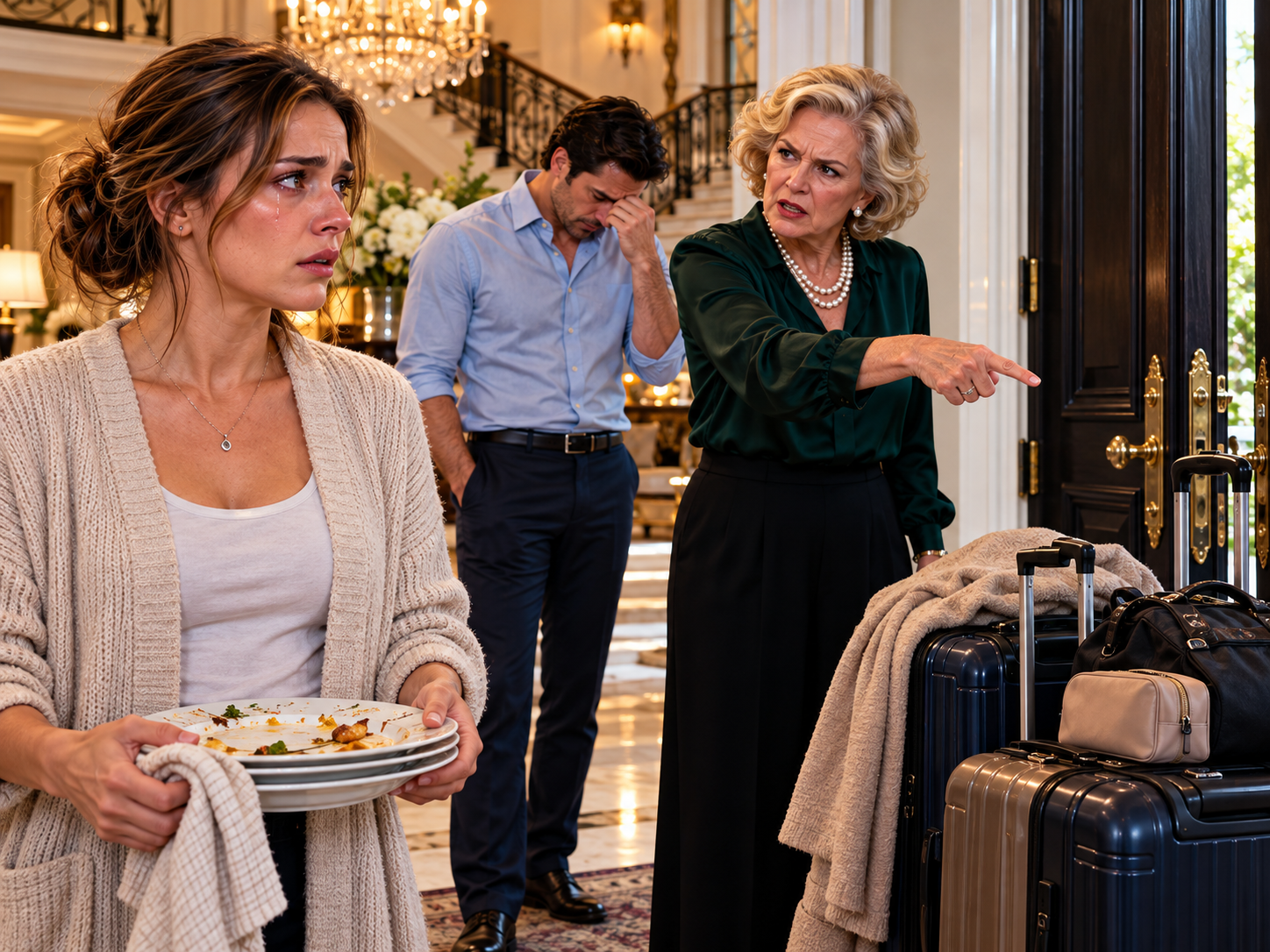
“You packed my belongings without speaking to me. You told me to leave while Michael sat at the table. Then you told the family I had chosen to go somewhere else.”
“I was trying to avoid a public argument.”
“You could have spoken to me privately before making the decision.”
“I thought you would object.”
“Of course I would have objected. You were asking me to leave my home.”
She flinched slightly at the word home, and I realized that even now, she could not hear it without thinking of ownership. To Eleanor, the word belonged to the person whose name appeared on the deed. To me, it described the place where I had lived, cooked, slept, and tried to build a marriage.
“You always seemed unhappy there,” she said.
“I was unhappy because I never knew whether I was welcome.”
“You had a room. You had access to everything you needed.”
“Except the ability to disagree with you without being reminded that I was living under your roof.”
She looked down at her hands. The skin around her knuckles was pale where she pressed her fingers together.
“I suppose I could have handled certain things differently,” she said.
“Certain things?”
She lifted her eyes, and for a moment I saw genuine irritation. “Lisa, I came here because I wanted to speak to you, not because I wanted to be cross-examined.”
“I’m not cross-examining you. I’m answering what you’ve said.”
The server passed our table, carrying a tray of plates. Eleanor waited until she was gone.
“I thought that once the legal matter was settled, we could return to normal.”
“What does normal mean to you?”
She seemed surprised by the question. “It means that we can be civil. That Michael can visit me without feeling he has to choose sides. That family occasions don’t become uncomfortable.”
“And what does normal mean for me?”
She opened her mouth, then closed it.
I continued before she could redirect the conversation. “Does it mean I return to the mansion and behave as though you never packed my clothes? Does it mean I come to family dinners and let you speak about me as if I’m a guest who should be grateful? Or does it mean you accept that what happened changed the way I see you?”
Eleanor’s expression became guarded. “I never said you had to return.”
“You asked me to come back for lunch.”
“I was trying to make an effort.”
“An effort would have been to acknowledge what you did without explaining why you thought it was necessary.”
She stared at me for a long moment. Then, almost reluctantly, she asked, “What would you have wanted me to say?”
The question was so direct that I nearly answered too quickly. For years, I had rehearsed conversations with Eleanor in my head. I had imagined telling her exactly how she had made me feel, listing every slight and every occasion when Michael’s silence had left me alone. But sitting across from her, I understood that a list would give her too many details to dispute.
“I would have wanted you to say that you were wrong to order me out without speaking to me. That you were wrong to have Michael pack my belongings. That you were wrong to tell the family I had chosen to leave. And that you understood why I no longer trusted you.”
She looked toward the window again. “I can see that you were hurt.”
“That isn’t the same as saying you understand what you did.”
“I’m trying, Lisa.”
“I believe you may be trying. But I cannot do the work for you.”
She picked up her tea and took a small sip. It had cooled enough that she could drink without blowing on it. When she put the cup down, her hand trembled slightly against the saucer.
“Jonathan always thought I was too controlling,” she said.
I had not expected her to mention him. The words sounded less like a defense than a confession she had not intended to make.
“He believed that keeping the house in order was the same as keeping the family together,” she continued. “I thought he was criticizing me for doing the work no one else wanted to do. After he died, I told myself I had to hold everything together.”
“Did he ever tell you that you were making people afraid to disagree with you?”
She did not answer immediately.
“He said I expected people to agree because I was the one responsible for everything.”
“That sounds like something he would have said.”
Eleanor’s eyes sharpened. “You hardly knew him.”
“No. But I remember how he spoke to people. He could disagree without making them feel small.”
For the first time during the meeting, she seemed unable to find a quick response. Her gaze dropped to the table, and the silence between us changed. It was no longer simply an argument over who had the right to speak. It carried the weight of a man who was no longer alive to explain what he had intended.
“I don't want to lose Michael,” she said at last.
“Then you need to stop treating his independence as a threat.”
She looked up sharply. “I have never tried to keep him from his wife.”
I held her gaze. “You asked him to pack my belongings, and he did it because he was afraid to disappoint you. You may not have told him to destroy our marriage, but you made it easier for him to hurt me than to tell you no.”
Her face flushed. She looked away, then back again.
“I didn't realize he felt that way.”
“Did you ever ask?”
The question settled between us.
Eleanor did not cry or apologize. She did not confess to a lifetime of deliberate cruelty. Instead, she sat quietly, turning her teaspoon between her fingers, as though the small movement might give her time to find an answer that did not make her feel exposed.
“I thought he understood,” she said eventually.
“Understanding isn't the same as agreeing.”
She gave a faint, tired nod.
Our half hour had nearly ended. I checked the time, and she noticed.
“You have somewhere to be?”
“I have plans this afternoon.”
She looked as though she wanted to ask what they were, then seemed to reconsider. It was a small change, but I noticed it.
“I’m sorry about the way I handled that evening,” she said. “I should have spoken to you before deciding what was going to happen.”
I waited, giving her a chance to continue.
“I should not have told the family that you chose to leave,” she added. “That was not fair.”
The apology was narrow. It did not cover the years before that evening, nor did it explain what she intended to do differently. But it named two actions she had previously defended, and she did not immediately attach an excuse to either one.
“Thank you for acknowledging that,” I said.
She looked almost relieved, as if she had expected me to reject the apology entirely. I did not accept more than she had offered, and I did not punish her for failing to say more.
“I don't know whether things between us will ever be the same,” I told her. “I’m not asking you to agree with everything I say. I’m asking you to respect me even when you don’t.”
“I can try.”
“That is your choice.”
I stood, put on my coat, and gathered my handbag. Eleanor remained seated for a moment before rising too.
At the door, she said, “Michael tells me he is seeing someone to talk about the family.”
“He is working on things he needs to understand.”
“He seems different.”
“He may be learning to make his own decisions.”
She nodded slowly. “I suppose that is something I should have encouraged.”
I did not answer. It was the closest she had come to acknowledging her part in the pattern, but I was not going to turn the sentence into a promise about the future.
We said goodbye outside the café. Eleanor walked toward her car, and I headed in the opposite direction. I did not feel triumphant. I felt tired, but the tiredness was clean and uncomplicated. I had said what I needed to say without shouting, pleading, or asking her to approve of my feelings.
That evening, Michael called.
“Mom told me you met.”
“Yes.”
“How did it go?”
“She apologized for ordering me out and telling the family I had chosen to leave.”
He was quiet. “That’s more than I expected.”
“It’s less than what needs to change.”
“I know.”
I told him that Eleanor had admitted she feared losing him and that I had encouraged her to let him make his own decisions. I did not give him a detailed transcript. He listened, then thanked me for being willing to meet her.
“I didn’t do it for you,” I said gently. “I did it because I wanted to know whether we could speak honestly.”
“I understand.”
After we hung up, I sat by the window and watched the streetlights come on. I did not know whether Eleanor’s apology would lead to a different relationship or whether it would be the best she could offer. I did know that I had not promised to return to the mansion, and she had not demanded that I do so.
For once, the conversation had ended without either of us pretending that everything was settled.
Click here to continue reading: PART 8: I Returned to the Mansion for the First Time Since Leaving, and One Familiar Room Showed Me Why I Could Never Go Back to Being the Woman I Had Been
My Mother-in-Law Had Packed My Life Into Two Suitcases, but the Question My Husband Refused to Answer Was Only the Beginning
Part 7 of 20

