
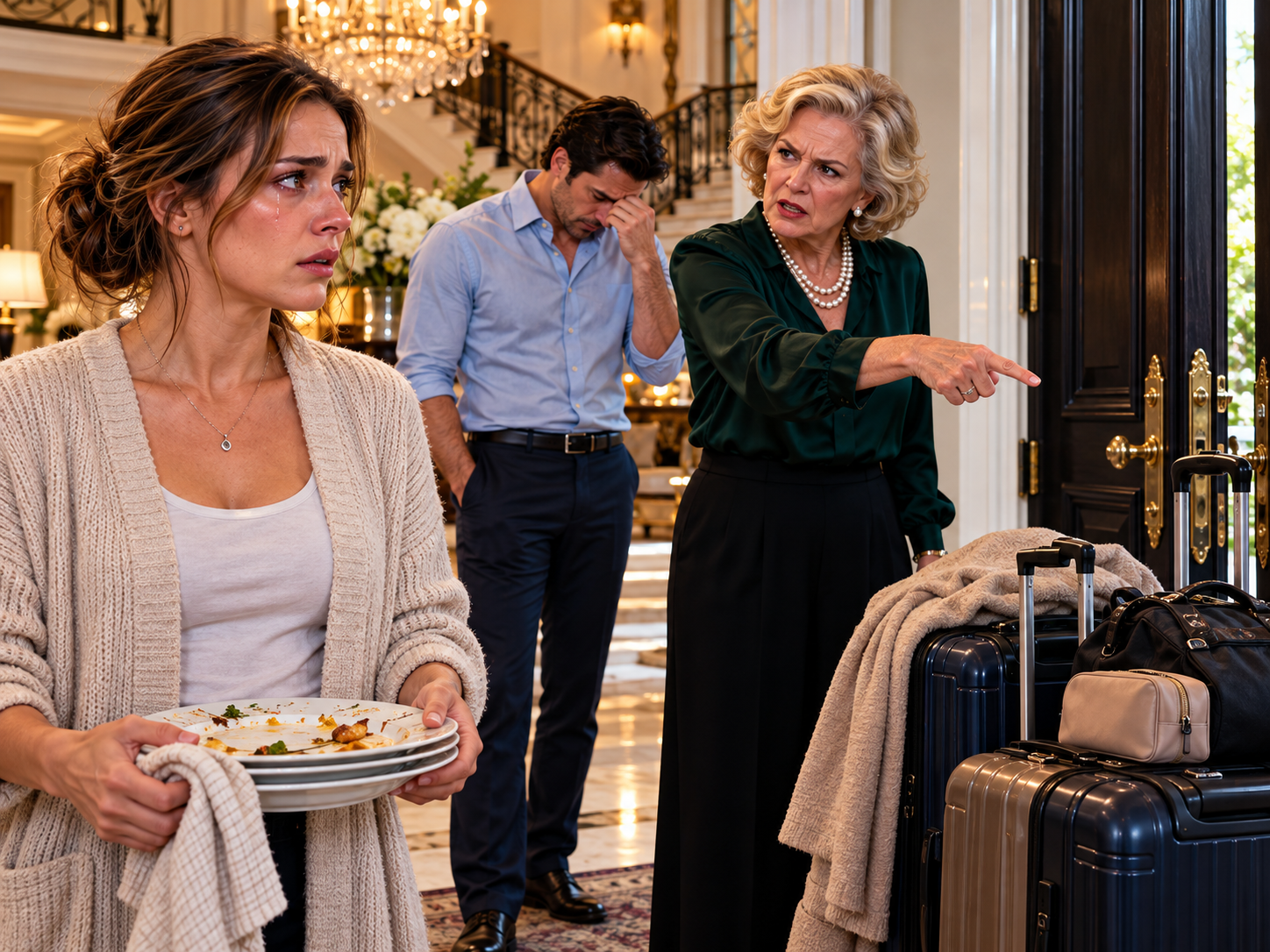
The letter arrived on a Thursday, tucked between a utility bill and a small envelope from the bank. Eleanor’s handwriting was precise, each line carefully aligned with the next. I recognized it immediately from the notes she used to leave on the kitchen counter at the mansion: reminders about the laundry schedule, instructions about the dining room, comments about which groceries should be replaced.
For several minutes, I left the envelope unopened.
I had no reason to believe the letter would change anything. Eleanor had already apologized for ordering me out without a discussion and for telling the family I had chosen to leave. She had also tried to persuade me to support a version of events that made her more comfortable. I could not know which version of her intentions had led her to write again, and I did not want curiosity to become an obligation.
Eventually, I took a letter opener from the drawer and carefully broke the seal.
She began by saying that she had been thinking about our conversation at the café. She wrote that she had initially believed the most important issue was the legal confusion surrounding Jonathan’s agreement. She had wanted the review to end because she disliked the uncertainty and resented having her authority questioned.
Then she acknowledged that she had treated my place in the house as something she could decide for herself, even though the agreement required a different process.
The next paragraph was shorter.
I told myself that I was protecting the home your father-in-law and I built as a family. I did not consider how often I used that idea to justify making decisions for everyone else.
I read the sentence twice. It was the closest Eleanor had come to naming the pattern without immediately defending it.
She wrote that she had been angry when I left without arguing. At the time, she had interpreted my silence as stubbornness, perhaps even as a deliberate attempt to make her look cruel. Only later had she considered that I might have been too exhausted to continue pleading for a place she had already decided I did not deserve.
There was no dramatic confession. She did not describe herself as a monster or ask me to absolve her. She did not suddenly praise me as the daughter she had always wanted. Her letter was restrained, imperfect, and limited to what she seemed able to acknowledge.
Near the end, she wrote that she could not promise she would always respond well when she felt challenged. She had spent so many years believing that keeping the household orderly was the same as keeping the family together that she did not yet know how to separate the two.
I understand that you are not required to return to the house, forgive me on my schedule, or help me explain what happened to other people. I am sorry that I treated you as though you were.
I lowered the letter to my lap.
For a moment, I felt the old instinct to rush toward the apology and make it easier for her. I wanted to write back immediately, to assure her that I understood, that she had not meant to cause so much pain, that we could put the whole thing behind us.
But I stopped myself.
Eleanor had finally acknowledged something real. I did not need to diminish it by pretending the harm was smaller than it had been. Nor did I need to turn her letter into a promise that our relationship would become warm and uncomplicated.
I placed the pages on the table and went for a walk.
The neighborhood was busy with the ordinary movement of late afternoon. A delivery truck blocked part of the sidewalk. Two children argued over a scooter near the corner. Someone was carrying a bouquet wrapped in brown paper, the flowers bright against the gray sky. Nothing in the world had shifted because Eleanor had written an honest sentence, and I found that comforting.
Her acknowledgment mattered. It simply did not have the power to determine what happened next.
When I returned, I sat at the small desk beside my window and began a reply.
I thanked her for writing and said that I appreciated her willingness to acknowledge the decisions she had made. I told her I hoped the family could build relationships that did not depend on one person having the final word. I also made clear that I was not ready to return to the mansion or resume the old arrangement.
I did not promise that I would eventually come back. I did not tell her that everything was forgiven. I wrote that I wanted any future contact between us to be respectful and voluntary, without pressure to reassure other relatives or pretend that the past had been harmless.
I read the message once before sending it. Then I closed the laptop and made dinner.
The next day, Michael called. Eleanor had told him she had written to me, though she had not shared the letter’s contents. He sounded cautious when he asked whether I had received it.
“I have,” I said.
“Was it all right?”
“It was honest in ways her earlier messages weren’t.”
He exhaled. “I’m glad.”
“I don’t want you to interpret that as everything being fixed.”
“I won’t.” His answer came quickly, but he did not sound defensive. “I know that her writing something different doesn’t erase what happened. And it doesn’t change what I did.”
“No, it doesn’t.”
“I’m still working on that.”
“I know you are.”
We were quiet for a moment. I could hear the muted sounds of traffic through his end of the call.
“Do you think you’ll ever come back?” he asked.
It was the first time in several weeks that he had asked the question directly. I appreciated that he did not disguise it as a practical matter about furniture or belongings.
“I don’t know,” I said. “And I don’t want either of us to treat that uncertainty as a problem we have to solve immediately.”
“Okay.”
“If we ever decide to rebuild our marriage, it can’t be because you’re afraid of disappointing your mother or because I’m afraid of losing you. We would have to choose each other freely. And I would need to know that our home would actually be ours to build together.”
“I understand.”
“I hope you do. Because I won’t move back into a situation where I have to earn permission to exist.”
“You shouldn’t have had to do that in the first place,” he said.
I let the words settle. They were true, and they were long overdue. But I had learned not to mistake the recognition of a truth for the completion of the work it demanded.
After we hung up, I placed Eleanor’s letter in the same drawer where I kept the estate correspondence. I did not hide it away as though it were shameful, and I did not leave it on display as though it were proof of a reconciliation. It was a letter from a woman who had finally begun to recognize the consequences of her choices.
That was what it was.
Over the next few days, life continued in its ordinary way. I paid my bills, answered messages, bought groceries, and met a friend for lunch. Michael and I exchanged a few texts. Eleanor did not call to ask whether I had told the family about her apology. I did not volunteer to explain it on her behalf.
The formal estate process reached its conclusion without another confrontation. Charles sent the final correspondence, confirming that the review had been documented and the required steps were being handled under the agreement. Margaret Ellis’s role as independent reviewer was complete unless a new matter required her attention. The safeguards Jonathan had put in place remained part of the arrangement governing the house.
The mansion stayed Eleanor’s home. I had never sought to take it from her.
What changed was the assumption that her ownership gave her unlimited authority over everyone who lived there. The agreement had established boundaries, and the review had made those boundaries harder to ignore. The financial records had been examined through the proper process; the unsupported items had been addressed without turning questions into accusations that the evidence did not justify.
I was relieved to have no further reason to involve myself in the matter.
One evening, I stood at the window and watched the sky turn from pale gold to blue-gray. The apartment was quiet, and the crooked bookcase cast a narrow shadow against the wall. On the shelf, the photographs I had taken from the mansion showed a mixture of years: Michael and me laughing at a summer picnic, Jonathan sitting in the garden, a holiday gathering in which everyone looked happy because the camera had caught us before the arguments began.
I did not need to tear up the photographs to prove I had moved on. The happy moments had happened. So had the painful ones. I could keep both truths without letting either one dictate what I owed anyone.
I touched the edge of the blue-and-white dish, then picked up my keys and set them down again. The gesture was pointless, almost playful, but it made me smile. No one was going to tell me where the keys belonged. No one was going to inspect the room and decide whether I had earned the right to remain in it.
My home was small, and my future was uncertain. Michael and I had not repaired our marriage. Eleanor and I had not become close. An apology had not transformed years of control into affection, and a legal agreement had not taught a family how to love one another well.
But I was no longer waiting for a decision to be made about me.
I could meet Michael again if I wanted to. I could accept another letter from Eleanor without promising a closer relationship. I could choose to forgive something in my own time, or decide that a particular boundary needed to remain. I did not have to settle every question simply because other people were uncomfortable with an unanswered one.
For five years, I had believed that belonging meant staying quiet enough to be tolerated. I had thought that if I were patient, useful, and undemanding, eventually the people around me would stop treating my presence as a favor.
Now I understood that a place in someone’s life could not be secured by disappearing inside it.
Whatever happened with Michael, whatever relationship Eleanor and I might have in the future, I would not return to being the woman who waited for permission to feel safe.
I turned off the kitchen light, carried my tea into the living room, and sat down beside the window.
For the first time in a long while, I did not need to know exactly what tomorrow would bring.
I only needed to know that when it arrived, the choice of how to meet it would be mine.
Click here to continue reading: PART 13: A Quiet Invitation to the Mansion Reminded Me How Easily Old Habits Could Return, Until I Realized I No Longer Had to Accept an Invitation Just to Prove I Was Family
My Mother-in-Law Had Packed My Life Into Two Suitcases, but the Question My Husband Refused to Answer Was Only the Beginning
Part 12 of 20

