
The first invitation came two weeks after Eleanor sent her letter. It arrived by text, without the careful formality of her handwritten notes, and it was brief enough that I read it several times before deciding what it meant.
I’m having a small dinner on Sunday. Michael will be here, and I thought you might like to join us. There is no pressure if you would rather not.
I sat at my kitchen table with my phone beside my cup of tea. Outside, a delivery van was reversing into the narrow street, its warning beeps echoing between the buildings. Somewhere upstairs, a child was running from one room to another. It was an ordinary afternoon, and I had been thinking about whether to buy another bookcase when Eleanor’s message brought the mansion back into my thoughts.
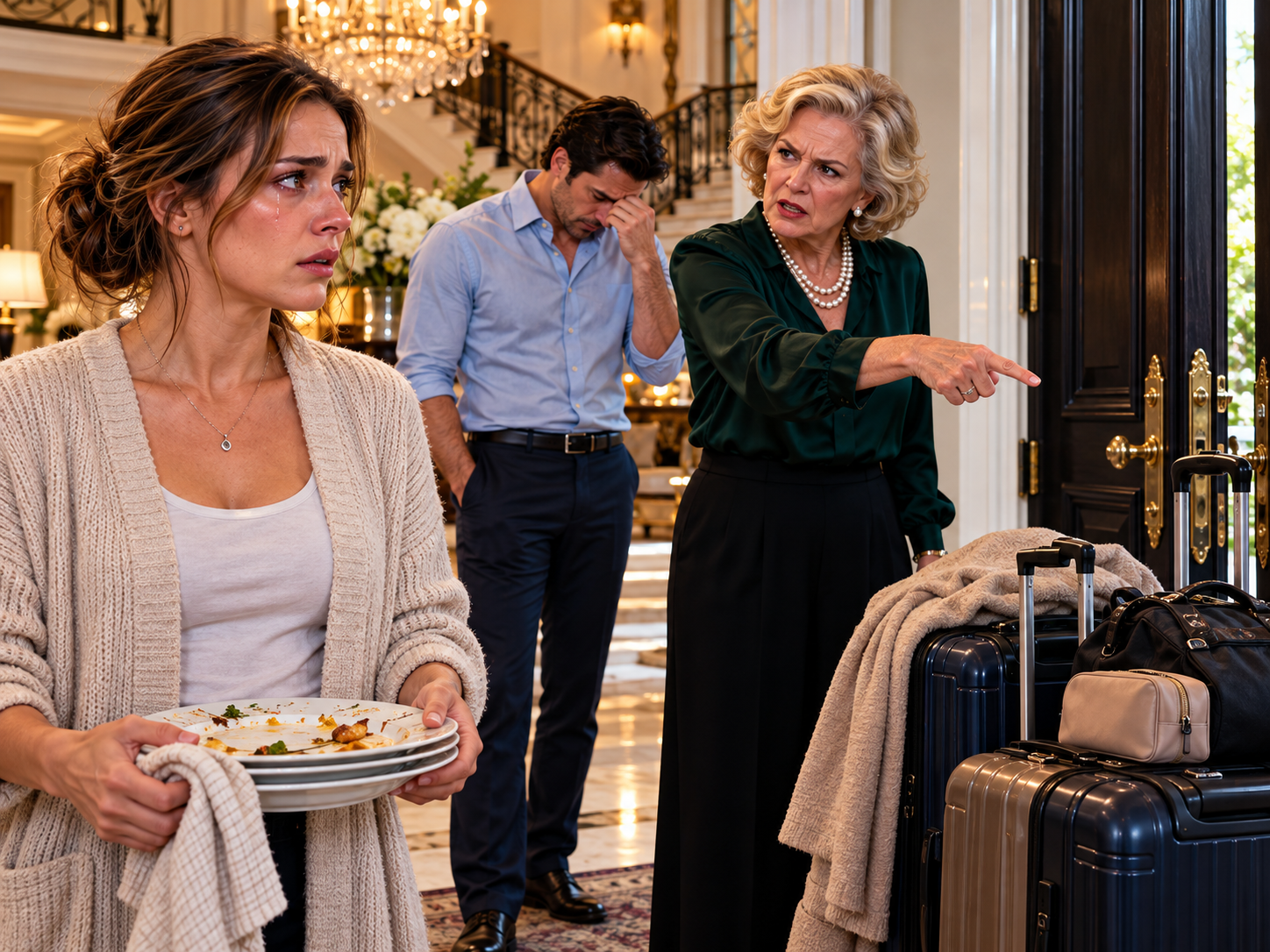
I could picture the dining room without trying. The long table, the polished silverware, the chairs Eleanor insisted had to remain in their proper positions. I remembered standing at the sideboard after dinner, gathering plates while everyone else continued talking. I remembered the evening she told me to leave, and Michael’s packed suitcases lined up beside the front door as if the decision had been settled long before I knew it was being made.
For a moment, I wanted to say yes simply because the invitation sounded different from the way Eleanor used to speak to me. She had left room for refusal. She had not told me that family came first or that I should put the past behind me. It was a small change, but I did not want to dismiss it just because it was small.
Then I noticed another thought hiding beneath my willingness to accept.
If I went, perhaps Eleanor would see that I was not trying to punish her. Perhaps Michael would feel relieved. Perhaps the relatives who had heard fragments of the story would understand that I was willing to move forward.
I had spent years trying to anticipate how everyone else might interpret my decisions. Even now, with my own keys on the table and no one waiting to judge how I behaved in the house, the old habit had returned almost automatically.
I put the phone down and finished my tea.
An invitation was not an obligation. Accepting it would not prove that I was generous, and declining it would not prove that I was bitter. The only question that mattered was whether I actually wanted to go.
The answer was not simple. Part of me missed the familiar parts of the mansion. I missed the garden in early summer, the way the afternoon light crossed the upstairs hallway, and the old kitchen where Jonathan used to sit with a newspaper while I prepared vegetables. I missed certain family rituals, too, even the imperfect ones. But I did not miss the constant awareness that I could be criticized for taking up too much space.
I decided to give myself a day before answering.
That evening, Michael called to ask whether I had received his mother’s invitation. Eleanor had told him she was thinking of having dinner and had asked whether he believed I might attend.
“I received it,” I said.
“She asked me not to put pressure on you.”
“Did she?”
“Yes. I told her the decision had to be yours.”
I listened for the familiar qualification that used to follow statements like that. He might have added that Eleanor was lonely, that she had been making an effort, or that I should consider how difficult everything had been for her. Instead, he waited.
“Do you want me to go?” I asked.
“I’d like to see you, but I don’t want you to go because you think it would make me feel better.”
“That’s a distinction you didn’t always make.”
“I know.”
He said it without trying to turn my observation into a fresh discussion of his guilt. That restraint made it easier to continue.
“I’m not sure I’m ready to have dinner there,” I told him. “I don’t know what I would feel when I walked into that dining room.”
“You don’t have to find out on Sunday.”
“I know. I’m trying to make sure I believe that.”
He was quiet for a moment. “I can understand that.”
We spoke about other things before ending the call. When I placed my phone down, I realized I had not spent the conversation reassuring him that I still cared about him. I had simply answered his questions honestly. The absence of that familiar duty felt almost as significant as anything he had said.
The following morning, I replied to Eleanor.
Thank you for inviting me. I appreciate that you left the decision to me. I’m not ready to have dinner at the house yet, so I won’t come on Sunday. I hope you have a pleasant evening.
I read the message once, then sent it before I could begin rewriting it to make the refusal more comfortable for her.
Her response came about twenty minutes later.
I understand. Thank you for telling me directly.
That was all. No accusation. No suggestion that I was making things harder than they needed to be. No reminder that the mansion had been a generous place for me to live.
I set my phone aside and returned to my work.
On Sunday, I went to a nearby market and bought fresh bread, tomatoes, and a small bunch of flowers. I had no grand plan for the day. I wanted to cook something I enjoyed and spend the afternoon reading. The simplicity of that choice felt like a quiet act of independence.
Late in the afternoon, Michael sent a message saying the dinner had gone ahead. He did not describe it as a success or tell me how much everyone had missed me. He simply said that Eleanor had asked him to thank me for replying, and that he had told the family I had made my own decision about attending.
I answered with a brief thank-you.
For the rest of the evening, I read on the couch, pausing occasionally to listen to the rain tapping against the window. I thought about how many times I had attended gatherings at the mansion because declining would have required an explanation I was too tired to give. I had mistaken my willingness to endure discomfort for proof of loyalty.
Now I could choose to stay away without turning the decision into a statement about the whole family.
A few days later, a relative who had been at Sunday dinner called me. She asked how I was doing and said she hoped things might become easier between everyone.
“I hope so, too,” I told her. “But I think it has to happen honestly.”
She agreed, though I could hear that she wanted a more definite answer. People often preferred a clean resolution: a misunderstanding, an apology, a family gathering, and then everyone sitting together again as though the conflict had been a brief interruption. It was easier to tell that story than to admit that relationships could change without returning to their old shape.
I did not blame her for wanting things to be simple. I had wanted the same thing for years.
But I could no longer make simplicity the price of my participation.
That night, I took the photographs from the shelf and looked through them one by one. There was Jonathan in the garden, smiling at something outside the frame. There was Michael beside me at a summer picnic, one arm around my shoulders. There was a holiday photograph of the whole family, Eleanor standing at the center with a composed smile.
I remembered the warmth of those days, but I also remembered the silences that had followed certain conversations. The photographs were not false. They were simply incomplete, as every photograph was.
I returned them to the shelf.
I could miss the mansion without wanting to live there again. I could appreciate Eleanor’s effort without pretending that one careful invitation had repaired years of hurt. I could love Michael without promising him a future I had not yet chosen.
The next morning, I woke with no unanswered message waiting for me and no decision hanging over my head. I made coffee, opened the curtains, and let the sunlight fall across the crooked bookcase.
I had declined an invitation. Nothing collapsed.
And for the first time, that ordinary fact felt like evidence of something I had spent years trying to learn: I could remain connected to people without surrendering my right to choose how close they came.
Click here to continue reading: PART 14: When Michael Asked What Would Have to Change for Us to Try Again, I Refused to Give Him a Checklist That Could Be Mistaken for a Promise
My Mother-in-Law Had Packed My Life Into Two Suitcases, but the Question My Husband Refused to Answer Was Only the Beginning
Part 13 of 20

