
By the end of the month, my apartment had begun to feel less like a place I was borrowing and more like a home I had made for myself. I bought a narrow bookcase from a secondhand shop and assembled it on the living-room floor. One of the shelves sat slightly crooked, no matter how carefully I tightened the screws, but I decided I liked it that way. The books fit. The photographs had a place. The blue-and-white dish rested near the window, where the afternoon light picked out the uneven glaze.
I had not expected independence to feel so ordinary. I had imagined it would arrive with some great rush of relief, a dramatic moment when I understood that I was finally free. Instead, it came in smaller pieces: buying the groceries I wanted without anticipating a comment, leaving a dish in the sink until morning, inviting a friend over without asking whether the visit would inconvenience someone else.
The quiet also gave me room to recognize how much of myself I had set aside while living in Eleanor’s house. I had become skilled at reading the temperature of a room. I could tell from the sound of her footsteps whether a question would be welcomed or treated as a challenge. I knew which subjects made Michael withdraw and which remarks would lead him to change the conversation. Those skills had helped me survive the arrangement, but they had also kept me in a state of constant preparation.
Now, when my phone rang, I did not automatically assume something had gone wrong.
Michael and I continued to speak occasionally. Sometimes we met for coffee; sometimes we exchanged messages about practical matters. He did not ask me to promise that I would return. More importantly, he stopped reporting every difficult conversation with Eleanor as though he needed me to decide whether he had handled it correctly.
One afternoon, he told me he had declined another invitation to explain the estate agreement to relatives who had not been involved in the review.
“She wanted me to make sure everyone understood that she hadn’t done anything wrong,” he said. “I told her Charles could explain the legal arrangement if anyone had questions. I also told her I wasn’t going to argue about whether you were entitled to feel hurt.”
“How did that go?”
“She was angry. Then she said I was making her sound like a terrible mother.”
“What did you tell her?”
“That I wasn’t trying to describe her entire life with one sentence. I was talking about what happened.”
I considered that. “That sounds reasonable.”
“I used to think that if I didn’t reassure her immediately, the whole conversation would get worse. Sometimes it does get worse. But I’m learning that I can let it get worse without changing my answer just to make it stop.”
I could hear the effort in his voice. He was not proud of himself in the way a person might be after winning an argument. He sounded unsettled, as though he was learning to stand on ground he had spent years avoiding.
“Your counselor is helping you see that?” I asked.
“Partly. Mostly, I’m realizing how often I’ve confused being a good son with never disappointing my mother. I thought I was keeping peace. I was actually handing the consequences to you.”
It was the clearest description he had given me of what he had done. I appreciated it, but I also understood that recognizing a pattern and changing it were separate tasks.
“I hope you keep working on it,” I said.
“I intend to.”
He did not ask whether I believed him. That was new, too.
A week later, Charles called with the final confirmation that the estate review’s required steps had been documented. The reserve adjustments would proceed through the formal process, and the records would remain available as required by the agreement. Margaret Ellis’s review had addressed the questions that had triggered the dispute. The residence safeguards remained in place, and Eleanor could not simply dismiss them because she disliked their implications.
Charles explained that I would receive a copy of the closing correspondence for my records.
“Does this mean I won’t have to keep revisiting everything?” I asked.
“Not unless a new issue arises that genuinely requires your participation,” he said. “The review is not an invitation for anyone to keep reopening the same dispute.”
I thanked him. After the call, I filed the correspondence in a drawer beside my lease and other important papers. I did not frame it or place it somewhere prominent. It was a record, not a trophy.
For the first time, the old estate agreement no longer felt like the center of my life. It had done what it needed to do. It had provided a process when family power had been used against me, and it had prevented the loudest person in the room from rewriting the arrangement by sheer force of confidence. But it could not decide whom I should love, where I should live, or what I should forgive.
Those choices belonged to me.
Later that week, Michael asked whether I would be comfortable meeting somewhere outside the neighborhood. He suggested a small art museum we had visited once during the first year of our marriage. I remembered the trip clearly. Jonathan had still been alive then, and Michael had spent most of the afternoon trying to identify which paintings his father would have liked. Eleanor had complained afterward that we had wasted a Saturday indoors when the weather was pleasant.
I agreed to go, with the understanding that we would each make our own way there.
The museum was quiet when we arrived. We moved slowly through the galleries, stopping whenever one of us found something worth looking at. There was no need to fill every silence. At one point, Michael stood in front of a landscape painting for several minutes, studying the tiny figures on a road that curved toward a distant village.
“Dad would have liked this,” he said.
“Because of the road?”
“Because you can’t tell where it ends. He used to say people liked to pretend they could see the whole journey from the starting point.”
I smiled. “He also used to say that people who claimed to know everything usually stopped listening.”
“That sounds like him, too.”
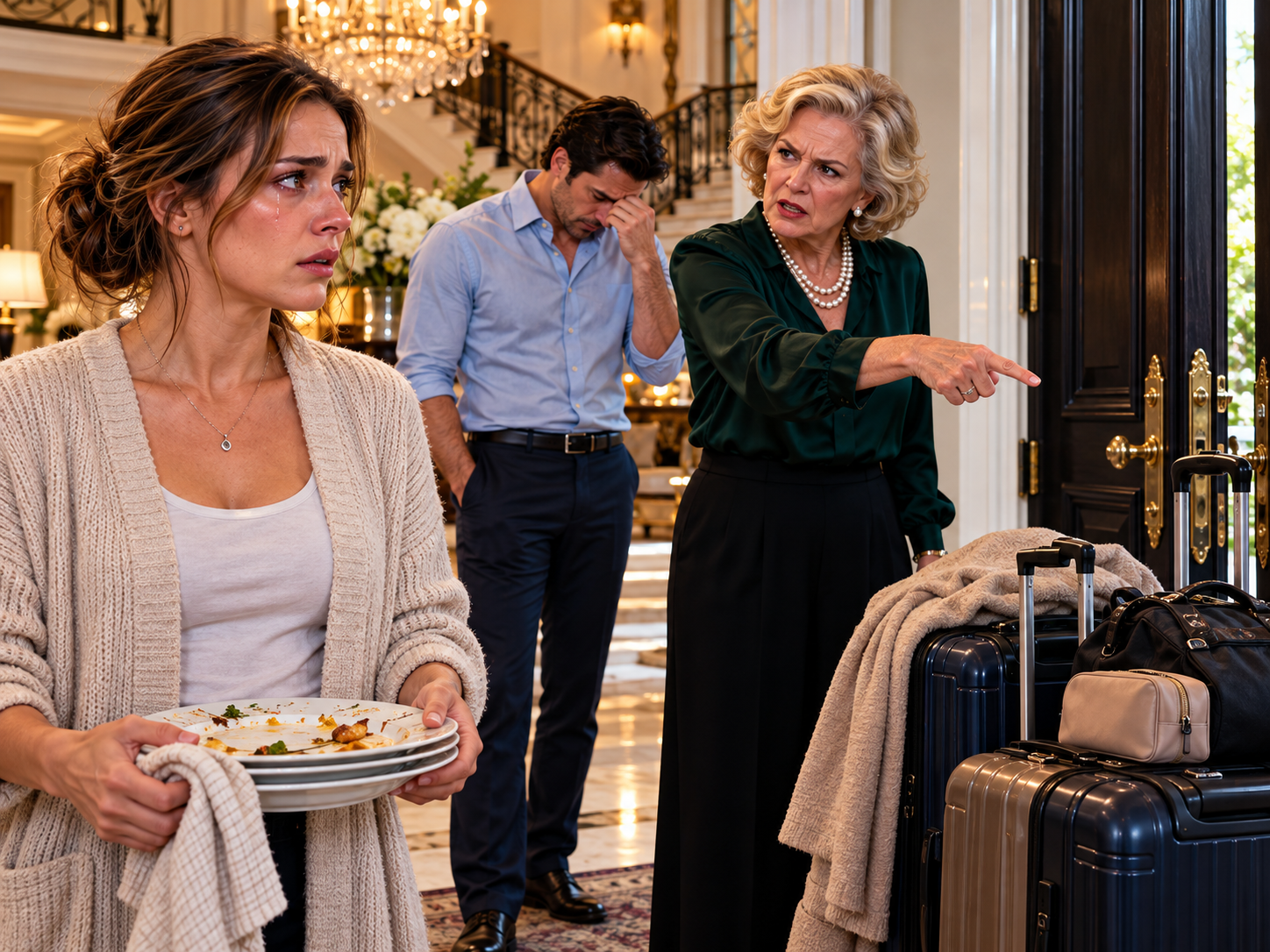
We continued through the gallery. I felt a pang of affection for the man I had married, for the memories we had made before fear and avoidance became so deeply woven into our daily lives. I also remembered the evening he placed my suitcases by the front door. Both memories were true. One did not cancel the other.
Outside, we bought coffee from a cart near the museum entrance. Michael asked how I had been feeling, and I told him I was sleeping better.
“I’m glad,” he said.
“I’m beginning to feel like I can make decisions without rehearsing every possible reaction first.”
He looked down at his cup. “I wish I’d helped you feel that way when we were living together.”
“So do I.”
He nodded and let the answer stand. He did not try to explain why he had failed or ask me to comfort him about the regret. I was grateful for that restraint.
Before we parted, he told me his counselor had asked him to think about what a healthy marriage would look like if it were not built around avoiding conflict.
“What did you come up with?” I asked.
“That both people have to be allowed to disagree without fearing they’ll lose their home, their family, or the person they love.” He paused. “And that I can’t call something peace just because nobody is arguing out loud.”
I looked at him for a long moment. “That’s a good place to start.”
“I know it’s only a start.”
We said goodbye, and I walked toward my car. The afternoon was bright, the air cool enough to make me pull my coat closer. I realized that I had enjoyed the museum visit without mentally measuring it against the question of whether I would ever move back in with him.
That mattered more than I could explain.
For the first time, I was not treating every pleasant moment as evidence for or against our marriage. I was allowing it to be what it was: a good afternoon with a person I still cared about, a person whose future choices would matter, but whose choices no longer determined the shape of my own life.
When I reached home, I placed my coat over the back of a chair and opened the window for a few minutes. The room smelled faintly of coffee and the oranges on the counter. I thought about the woman I had been in the mansion, always listening for the next sign of displeasure, and felt compassion for her instead of embarrassment.
She had tried very hard to belong.
She had simply mistaken endurance for the price of belonging.
Click here to continue reading: PART 12: Eleanor’s Final Letter Did Not Repair Our Family, but It Gave Me the One Thing I Had Stopped Expecting From Her: An Honest Acknowledgment of What Happened
My Mother-in-Law Had Packed My Life Into Two Suitcases, but the Question My Husband Refused to Answer Was Only the Beginning
Part 11 of 20

