The letter arrived without warning.
David's handwriting was on the envelope.
I almost opened it immediately.
Then I waited.
There was no urgency.
I made tea.
Sat at the table.
Then opened it.
Claire,
I don't know if this is necessary.
I suspect you'll tell me it isn't.
But I need to write it anyway.
I read slowly.
He wrote about the first night he asked for the divorce.
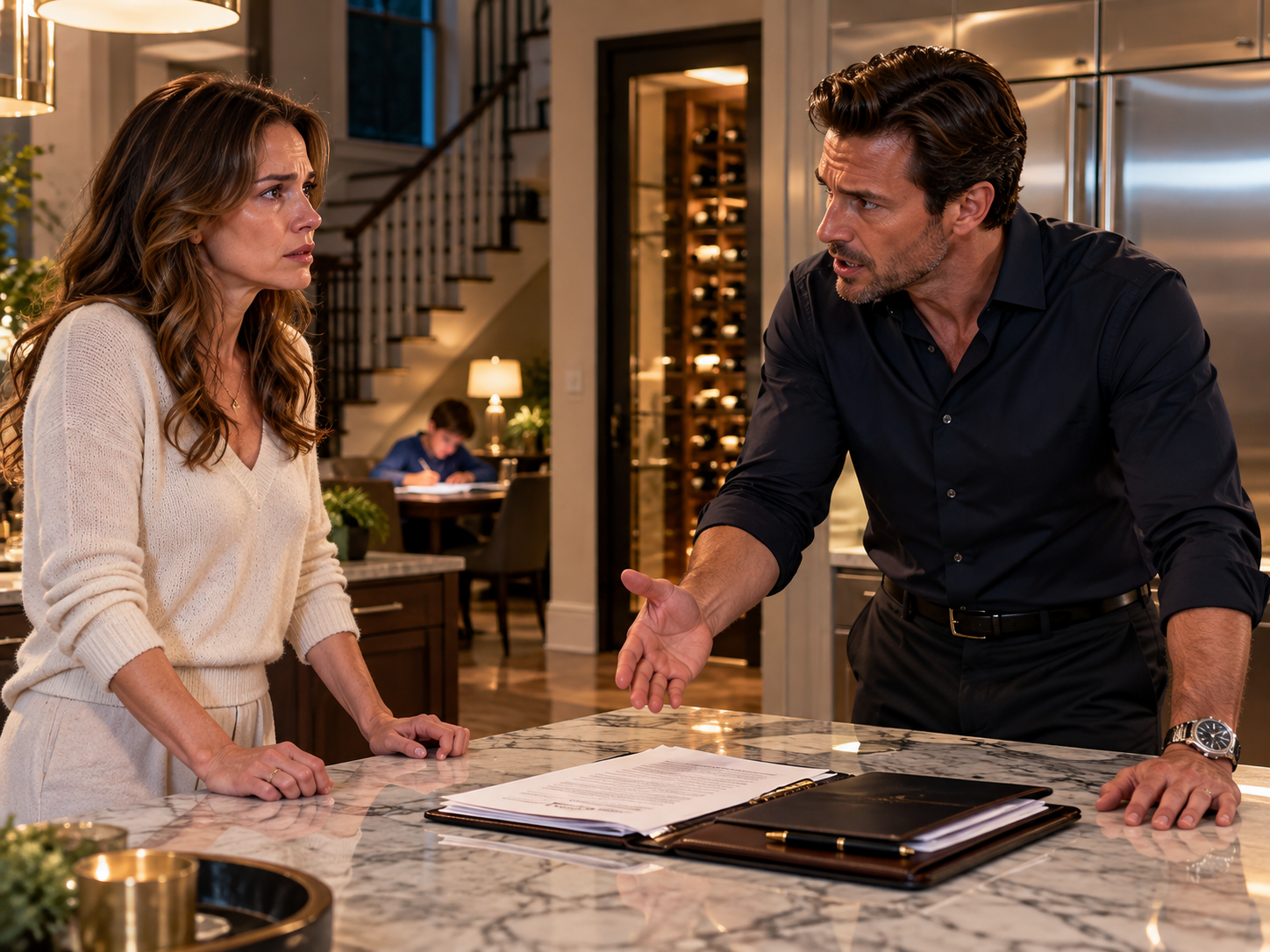
He remembered the kitchen.
The island.
The silence after he told me he wanted everything.
He remembered saying he wanted the boy.
He wrote that he had replayed those words many times.
Not because he had forgotten them.
Because he had finally understood how cruel they sounded.
He said he had been thinking about property as if the marriage were a transaction.
He had treated Sam as an obligation.
He had treated me as an obstacle.
He wrote that he was ashamed.
I stopped reading for a moment.
Then continued.
He said he had believed confidence meant never showing uncertainty.
He had believed being successful meant being able to take what he wanted.
He had believed money could compensate for the parts of his life that felt empty.
He admitted that the divorce had not created his unhappiness.
It had exposed it.
That sentence made me pause.
He continued.
“I used to think you had outsmarted me.”
I smiled faintly.
“Now I think you simply understood yourself better than I understood myself.”
I read the next paragraph twice.
He wrote about Sam.
He said becoming a father again after the divorce had been difficult.
He had to learn how to show up without expecting praise.
He had to learn that children remembered consistency more than expensive gifts.
He had to learn that saying “I love you” did not replace being present.
Then he wrote:
“I was angry that you took nothing from me, because I thought that meant you had lost. I understand now that you had already decided what mattered.”
I set the letter down.
For years, I had wondered whether David would ever understand.
Now I realized I no longer needed him to.
But it was still meaningful that he did.
I finished the letter.
At the end, he wrote that he did not expect forgiveness.
He did not ask me to reconsider the past.
He did not ask whether there was another chance.
He simply wanted me to know that he had finally learned the lesson.
I folded the paper.
Sam called that evening.
“Mom?”
“Yes?”
“Dad sent you something?”
“How did you know?”
“He told me.”
I smiled.
“What did he say?”
“He said you might throw it away.”
“I might.”
Sam laughed.
“What did you tell him?”
“That you wouldn't.”
“He was right.”
Sam paused.
“Are you okay?”
“Yes.”
“What did he write?”
“That he understands some things now.”
“Good.”
We talked about his work.
Then his plans.
Then his new apartment.
The letter became another piece of history.
Not something that changed my life.
Something that confirmed it had changed.
I kept it.
Not because I needed validation.
Because people deserve the chance to acknowledge what they did.
Even if the acknowledgment arrives late.
The next week, David and I met for coffee.
He looked nervous.
“You read it?”
“Yes.”
“And?”
“It was honest.”
He smiled.
“That's good.”
“I don't need you to feel guilty forever.”
“I know.”
“I don't want you miserable.”
“I know.”
“Then what do you want?”
He thought about it.
“I want to be someone Sam can be proud of.”
I nodded.
“That is worth wanting.”
He looked at me.
“And I want you to know I don't blame you anymore.”
“I never asked you to.”
“I know.”
He smiled.
“You're very difficult to manipulate.”
I laughed.
“That may be the nicest thing you've ever said.”
“It is.”
We sat quietly.
Then he asked, “Do you ever think about what would have happened if I had chosen differently?”
“Sometimes.”
“What do you imagine?”
“A different life.”
“Better?”
“Not necessarily.”
“Worse?”
“Not necessarily.”
He nodded.
“Just different.”
“Yes.”
That was the honest answer.
There was no alternate universe waiting for us.
Only the life we had lived.
I did not need to romanticize it.
I did not need to condemn it.
It happened.
We learned.
We continued.
The years moved forward.
Sam and his wife eventually bought a small house.
David helped with the move.
I helped with the kitchen.
When we stood in their new living room, I remembered the first house.
For a second, the memory felt sharp.
Then it softened.
Sam noticed.
“You okay?”
“Yes.”
He smiled.
“Mom, this house isn't yours.”
“I know.”
“You don't have to design everything.”
I laughed.
“I'm trying.”
David looked at the kitchen.
“Let her.”
Sam groaned.
“Don't encourage her.”
We laughed.
That was the moment I knew the old story had truly ended.
The house where David and I had lived had once represented our future.
Now our son had his own home.
A different future.
One we had not designed for him.
One he had chosen.
That was exactly how it should be.
Later that evening, I sat on their porch.
David joined me.
“You were right,” he said.
“About what?”
“Letting go.”
I looked at him.
“It took me a while.”
“It did.”
He laughed.
“I thought losing things meant losing myself.”
“And now?”
“Now I think losing the wrong things can make room for the right ones.”
I smiled.
“That's better.”
He nodded.
We watched Sam and his wife through the window.
They were arguing about something.
Then they laughed.
David smiled.
“I hope they never have to learn the way we did.”
“So do I.”
“But if they do?”
I looked at him.
“Then they'll make their own choices.”
He nodded.
That was all we could give them.
Not guarantees.
Not perfect examples.
Just enough honesty to help them recognize what mattered.
The letter remained in my desk drawer.
The settlement remained in the storage box.
The old photograph remained in an album.
None of them controlled me.
They simply documented where I had been.
And I had no reason to pretend I had never been there.
Click here to continue reading: PART 16: On the anniversary of the divorce, I returned to the old neighborhood expecting memories, but the house showed me how completely the meaning of that day had changed
David Asked for the House, the Cars, and Every Dollar We Owned, But the One Thing He Refused to Take Was the Detail That Made His Demand Dangerous
Part 15 of 28