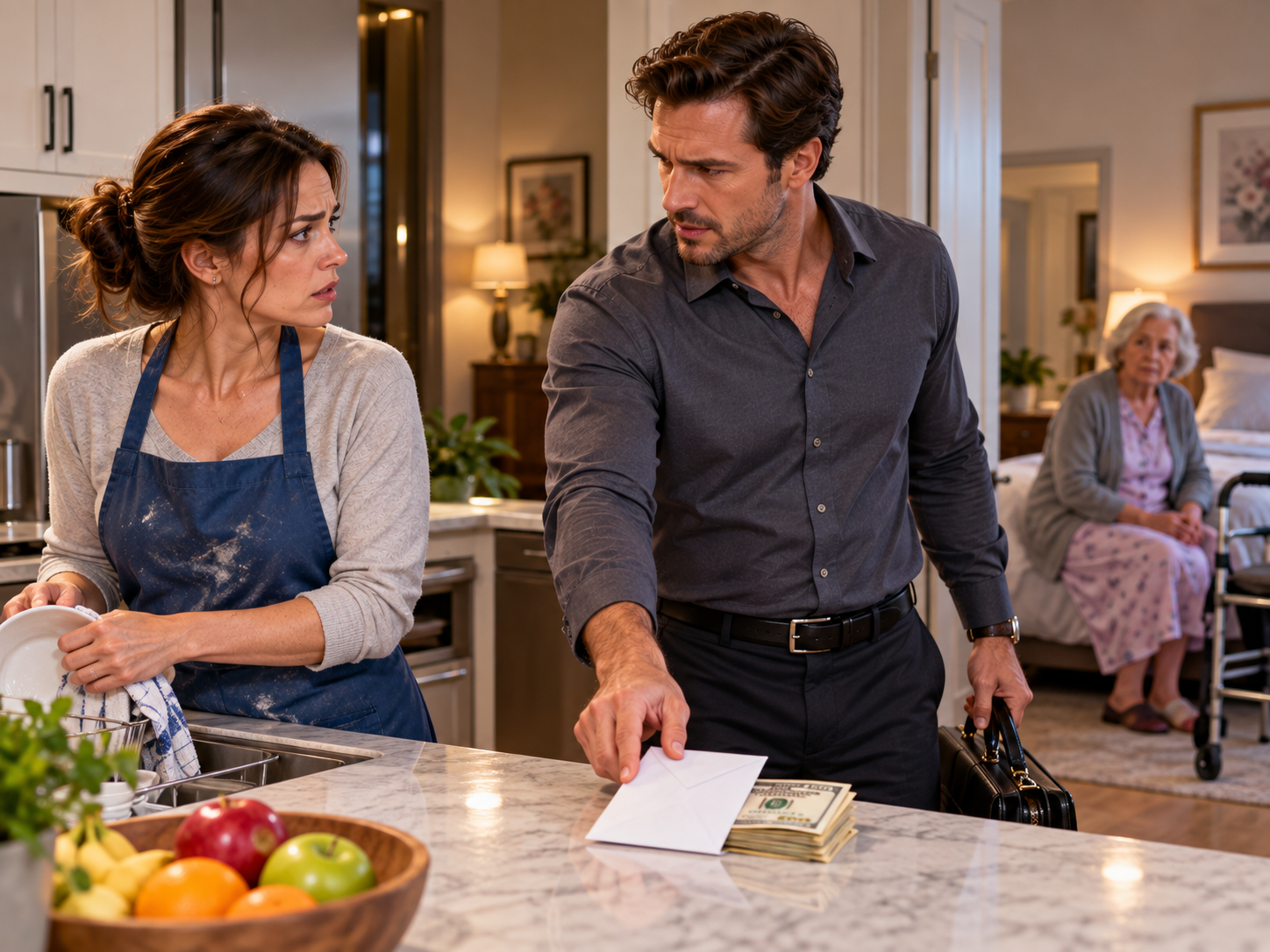
The final Monday came almost a year after the morning Julian had first left cash on the kitchen island.
Rain tapped against the windows.
It was the same soft rhythm Clara remembered from that first Monday.
For a moment, she stood in the kitchen and listened.
The house looked different.
Or perhaps she did.
The cabinets were the same.
The old clock still hung above the dining room.
The sink still dripped once every few minutes.
But the silence no longer felt threatening.
Beatrice was asleep upstairs.
Rosa had gone home after the morning shift.
Clara was alone in the kitchen.
She opened the cabinet beneath the sink.
The coffee tin was still there.
She took it out.
For months, she had kept it as a reminder.
Not of money.
Of proof.
She placed it on the counter and lifted the lid.
Empty.
The envelopes had long since been copied, documented, and placed with the legal records.
The cash itself had been returned through the appropriate process and, with Beatrice's agreement, money that could properly be retained was placed into her medical-care fund.
The tin contained nothing now.
Clara ran her fingers along the inside.
She remembered how frightened she had been when she first began putting envelopes there.
She had not known whether she was collecting evidence of a marriage ending.
She had only known that something was wrong.
The front door opened.
Beatrice's voice came from the hallway.
“Clara?”
Clara smiled.
“I'm here.”
She heard Beatrice's cane tapping against the floor.
A moment later, Beatrice entered the kitchen.
“You're staring at that tin again.”
“It is empty.”
“Finally.”
Clara laughed.
Beatrice looked at the tin.
“You kept it all this time.”
“I did.”
“Why?”
Clara thought about it.
“Because I needed to remember that I wasn't imagining what happened.”
Beatrice nodded.
“That is understandable.”
Clara closed the lid.
Then she put the tin back under the sink.
She did not throw it away.
Some things did not need to be erased simply because they were painful.
Outside, the rain became heavier.
Beatrice sat at the table.
“Tea?”
“Yes.”
Clara filled the kettle.
As she waited for the water to boil, she remembered the first time Julian had left the cash.
Back then, she had thought the money represented help.
Then she had believed it represented suspicion.
Later, it became evidence.
Now it meant almost nothing.
The amount itself had never been the point.
The point was that Julian had believed money could turn Clara's labor into something invisible.
He had believed a weekly envelope could make responsibility disappear.
He had believed that if he called her a wife, she would accept whatever burdens came with the title.
He had believed that if he called someone else a caregiver, he could separate the work from the woman who had actually been doing it.
He had been wrong.
The kettle clicked.
Clara poured the water.
Beatrice watched her.
“You know,” she said, “I never thanked you properly.”
Clara turned.
“For what?”
“For staying.”
Clara smiled.
“I stayed because I loved you.”
“I know.”
“And because I wanted you safe.”
“I know that too.”
Beatrice paused.
“But you should also know something.”
“What?”
“You did not save me by destroying yourself.”
Clara sat across from her.
“I don't think I knew the difference before.”
“You do now.”
Clara nodded.
That was perhaps the greatest thing that had changed.
She could care without disappearing.
She could love without surrendering every boundary.
She could help someone without allowing that help to become a reason they controlled her.
The doorbell rang.
Both women looked toward the hallway.
Clara stood.
It was not Julian.
It was Rosa, carrying a small paper bag.
“I forgot these yesterday,” Rosa said.
She handed Beatrice a container of homemade soup.
Beatrice smiled.
“You spoil me.”
“That is my job.”
Clara laughed.
Rosa looked at her.
“What?”
“Nothing.”
“You're smiling.”
“I am.”
Rosa shrugged.
“Good.”
After Rosa left, Beatrice opened the container.
The smell of chicken, herbs, and vegetables filled the kitchen.
It was ordinary.
Comforting.
Real.
Clara realized that this was what safety looked like.
Not a dramatic victory.
Not a locked door.
Not a secret folder.
Not a lawyer standing between them and a prepared deed.
Sometimes safety was simply eating soup without wondering who wanted something in return.
Later that afternoon, Margaret called.
She said the estate documents had been fully updated.
Beatrice's property was secure.
Her medical arrangements were documented.
Her care fund was established.
No one could quietly alter the plan without the safeguards Arthur had wanted.
Margaret also mentioned that Julian had completed the financial obligations arising from the divorce.
Clara listened.
“Is he all right?” Beatrice asked after the call ended.
Clara considered the question.
“I don't know.”
“And do you need to know?”
“No.”
Beatrice smiled.
“That is progress.”
Clara agreed.
There had been a time when every piece of Julian's life felt connected to hers.
His mood.
His plans.
His approval.
His anger.
His future.
Now his future belonged to him.
Hers belonged to her.
That separation was not cruel.
It was healthy.
In the evening, Clara opened an old box of photographs.
She found one from the year Arthur had died.
He had been sitting on the porch, looking annoyed because Clara had taken his picture without warning.
She remembered what he had said.
“You'll make me look old.”
“You are old.”
He had stared at her.
Then he laughed.
Clara smiled at the memory.
Beatrice saw the photograph.
“Your father-in-law liked you.”
“He did.”
“He trusted you.”
“I didn't understand how much until now.”
Beatrice looked at the picture.
“Arthur worried Julian would confuse inheritance with entitlement.”
Clara looked at her.
“Did he ever tell you that?”
“Not directly.”
Beatrice traced the edge of the photograph.
“He once told me that the most dangerous thing a person could inherit was the belief that they deserved everything.”
Clara sat quietly.
The sentence explained more than any legal document could.
Julian had not simply wanted a house.
He had believed the house was waiting for him.
He had not simply expected Clara to care for his mother.
He had believed her marriage vows made her labor available to him.
He had not simply accepted the caregiver money.
He had used it as a test of whether Clara would challenge him.
And when she did, he had been surprised.
The rain continued through the night.
On Tuesday, Clara returned to her apartment.
She placed the coffee tin in a cabinet.
Not beneath the sink.
Not hidden.
Just stored.
She opened the windows.
Fresh air moved through the room.
Her life was smaller than the one she had once imagined.
But it was hers.
She began working again on something she had postponed for years.
She enrolled in a course.
She started seeing friends she had gradually lost contact with.
She learned how to spend an afternoon without feeling guilty.
She learned that rest was not laziness.
She learned that saying no did not require an explanation.
And she learned that being loved should never mean being managed.
Months later, Beatrice's health stabilized.
She still had difficult days.
There were mornings when her leg hurt.
There were evenings when fatigue made her quiet.
But she remained in her own home.
She chose her meals.
She chose her caregivers.
She chose who had access to her affairs.
And whenever someone suggested that she was too old to make those decisions, she smiled.
“I am old enough to know what I want.”
Clara loved hearing her say it.
One afternoon, Beatrice asked Clara to help clean the kitchen.
Clara looked at her suspiciously.
“Are you paying me?”
Beatrice laughed.
“No.”
“Then I expect lunch.”
“Negotiator.”
“Absolutely.”
They worked together.
No apron.
No alias.
No envelope.
No hidden motive.
Just two women cleaning a kitchen.
When they finished, Beatrice leaned against the counter.
“Do you remember the first Monday?”
Clara nodded.
“I remember everything.”
“What did you think would happen?”
“I thought the money meant someone was finally helping.”
“And what did it mean?”
Clara looked around the kitchen.
“It meant I needed to start paying attention.”
Beatrice smiled.
“That was the beginning.”
“No,” Clara said softly.
She looked toward the window.
“The beginning was when I realized I deserved to be seen.”
Beatrice reached for her hand.
Neither woman spoke.
Outside, the afternoon light rested on the garden.
There was no dramatic ending.
No confrontation.
No final revenge.
Only a quiet house belonging to the woman who had fought to keep it, and a woman who had finally walked away from a marriage that required her to disappear.
Clara had once thought the most important thing she could recover was money.
Then she thought it was the house.
Later, she believed it was the truth.
In the end, it was herself.
On another Monday, months after everything was settled, Clara visited Beatrice again.
She walked into the kitchen without hesitation.
Beatrice called from the living room.
“Clara?”
Clara smiled.
“Yes?”
“Come sit with me.”
She went.
There was no faded blue apron hanging from her shoulders.
There was no false name.
There was no coffee envelope waiting on the island.
There was no secret beneath the mattress.
There was simply Clara.
And for the first time, that was enough.
Click here to continue reading: PART 9: “Months after the divorce, Clara thought the hardest part was behind her, until a letter from Arthur’s attorney revealed one final promise he had made”
My husband thought the cash on the kitchen counter was buying someone else’s labor, but I was already learning why he wanted his mother kept quiet
Part 8 of 20