Friday morning arrived quietly.
No storm.
No dramatic warning.
Just pale sunlight across the kitchen floor and the sound of Julian's car pulling into the driveway.
I had barely slept.
Beatrice had slept even less.
She sat in her bedroom wearing a cream cardigan and the pearl earrings Arthur had given her on their twentieth anniversary.
She looked fragile.
But her voice was steady.
“Are you ready?”
I adjusted the blue apron.
“As ready as I'll ever be.”
She smiled.
“Then let's see what my son thinks he knows.”
At nine o'clock, the notary arrived.
Valerie came with him.
Julian followed carrying a leather folder.
He looked pleased.
Too pleased.
I remained in the hallway as Hazel.
Julian glanced at me.
“Make sure Mom is comfortable.”
“I will.”
He opened the folder.
The deed was already prepared.
Beatrice looked at it.
“What's this?”
“The transfer.”
“I thought you said it was estate paperwork.”
“It is.”
“No.”
Julian frowned.
“Mom.”
She looked directly at him.
“You told me it was estate paperwork.”
“It is part of the estate.”
“You didn't tell me I was giving you the house.”
Valerie stepped in.
“Mom, you're not giving anything away. You're simplifying things.”
Beatrice's hands tightened around the arms of her chair.
“I own this house.”
Julian's expression hardened.
“And I'm your son.”
“That doesn't make you the owner.”
Silence.
I stood near the doorway.
Julian looked at me.
“Hazel, could you give us a minute?”
“No.”
He blinked.
“What?”
Beatrice spoke.
“She stays.”
Julian looked annoyed.
“This is family business.”
Beatrice smiled faintly.
“Then you should have treated me like family.”
The notary shifted uncomfortably.
Julian opened the folder.
“Mom, this is unnecessary.”
“No.”
“You need someone to manage this eventually.”
“I already have someone.”
“Who?”
“My attorney.”
Julian froze.
Valerie looked at him.
“What attorney?”
Beatrice answered.
“Margaret Ellis.”
The color drained from Julian's face.
He looked toward me.
For the first time, I saw recognition.
Not of Hazel.
Of something else.
Fear.
The front door opened.
Margaret entered with another attorney.
She carried a slim black folder.
“Good morning.”
Julian stood.
“What are you doing here?”
Margaret looked at Beatrice.
“She asked me to come.”
Julian's jaw tightened.
“Mom, you don't need this.”
“I do.”
Margaret placed the original deed on the table.
“The property belongs solely to Beatrice.”
Julian stared at the document.
“I know that.”
“Do you?”
Margaret opened another file.
“Because you seem to have prepared a transfer as though your mother were obligated to give it to you.”
Valerie stepped forward.
“This is ridiculous.”
Margaret didn't look at her.
“The proposed deed cannot proceed.”
Julian's voice became sharper.
“Why?”
“Because your mother has not received independent legal advice regarding the transfer.”
“She doesn't need it.”
“She does.”
Margaret turned toward the notary.
“And because I have reason to believe she has been pressured.”
The room went silent.
Julian looked at me.
“Who told you that?”
I said nothing.
Beatrice did.
“I did.”
Julian's face changed.
“Mom.”
“You wanted me to sign away my home.”
“For your own protection.”
“No.”
His voice rose.
“You can't manage this house forever.”
“I don't have to.”
“What does that mean?”
“It means the house was never yours.”
Valerie snapped, “You're confused.”
Beatrice turned toward her.
“I am not.”
Margaret placed Arthur's will on the table.
Then the amendment.
Julian stared at the documents.
“What is that?”
“Your father's estate plan.”
“I've seen his will.”
“Not this amendment.”
Julian reached for it.
Margaret stopped him.
“You can read it.”
He did.
His eyes moved rapidly across the page.
Then stopped.
The document specified that the house would remain under Beatrice's control for her lifetime.
After her death, it would be handled according to Arthur's instructions.
Julian was not the sole beneficiary.
Neither was Valerie.
The estate would be divided.
A significant portion would go to the medical charity Arthur had selected.
The remaining assets would be divided between the children.
The house itself could not simply be transferred to Julian.
Julian looked up.
“You hid this from me.”
Beatrice's expression was calm.
“Your father told me to.”
“Why?”
“Because he knew you.”
The sentence landed harder than shouting would have.
Julian stepped back.
Then his eyes fell on me.
“What does Hazel have to do with this?”
I looked at him.
“Nothing.”
He frowned.
Then I reached up.
I untied the scarf around my hair.
I removed the blue apron.
I placed it carefully over the back of a chair.
Julian stared.
His mouth opened.
No words came.
Valerie looked from me to him.
“Clara?”
“Yes.”
Julian's face went completely still.
“You?”
I nodded.
“You were Hazel?”
“For months.”
His eyes dropped to the apron.
Then to the coffee tin I had carried into the room.
I placed it on the table.
He recognized the envelopes.
“What is that?”
“Every payment you left for the caregiver.”
I opened the tin.
Envelope after envelope.
Dates written across the backs.
Julian picked one up.
“You kept all of this?”
“Yes.”
“Why?”
“Because you told Valerie the money was a trap.”
His face tightened.
I continued.
“You said if I spent it, you would call me irresponsible. If I did the work myself, you would save money. So I documented everything.”
I placed the notebook beside the envelopes.
Then the receipts.
Medication.
Medical supplies.
Food.
Gloves.
Bed pads.
Everything.
Valerie stared at the pile.
“This is insane.”
“No,” I said quietly.
“It is evidence.”
Julian looked at me.
“You deceived me.”
I met his eyes.
“You deceived me first.”
“You pretended to be a caregiver in my house.”
“I was caring for your mother in my home.”
“Our home.”
I shook my head.
“You stopped calling it ours a long time ago.”
The notary quietly gathered his papers.
“I believe this signing should not proceed.”
Margaret nodded.
“It will not.”
Julian looked at Beatrice.
“Mom, you can't do this.”
Beatrice's voice was soft.
“I didn't do anything to you.”
She looked at the house around them.
“I simply refused to give you something that was never yours.”
Valerie began crying.
Not because she was sorry.
Because the plan had collapsed.
Julian stood motionless.
I had expected anger.
Instead, he looked lost.
“You were going to evict us,” I said.
He swallowed.
“You heard that?”
“I heard everything.”
He closed his eyes.
I continued.
“You said the maid and your wife were both out of here once your mother signed.”
His face tightened.
“I didn't mean—”
“You did.”
He stopped.
For once, he had no explanation that could change what I had heard.
Beatrice reached for my hand.
I took it.
Margaret explained the next steps.
The transfer would not occur.
Beatrice would remain the legal owner.
Any future estate decisions would be handled through independent counsel.
The attempted transfer would be documented.
Julian and Valerie would have no authority to move their mother or dispose of her property without her consent and proper legal process.
The room slowly emptied.
The notary left first.
Valerie followed.
Julian remained.
He looked at me.
“Are you leaving me?”
I thought about the question.
Three years of marriage.
Three years of caring for his mother.
Years of being treated as though my work were an inconvenience.
“No.”
His eyes lifted.
I continued.
“I already left the version of this marriage where I was expected to disappear.”
He looked toward Beatrice.
Then back at me.
“Can we fix this?”
I didn't answer immediately.
There were no easy words.
No dramatic forgiveness.
No promise.
But there was a decision.
“I won't decide today.”
He nodded.
For once, he didn't demand an answer.
After he left, Beatrice and I sat quietly.
She looked exhausted.
But relieved.
“You saved me,” she whispered.
“No.”
She frowned.
“You saved yourself.”
“I couldn't have done it without you.”
“That is different.”
She smiled.
I looked at the green folder.
The documents.
The receipts.
The coffee tin.
All the pieces that had seemed disconnected now fit together.
The cash had exposed Julian's contempt.
The blue apron had allowed me to see how he treated someone he believed had no power.
The hidden will had exposed his plans for the house.
Arthur's documents had protected Beatrice.
And my records had protected me.
Nothing had been wasted.
Not even the humiliating parts.
Months later, Julian and I separated.
The marriage ended without another dramatic confrontation.
The divorce was finalized quietly.
Beatrice remained in her home.
She updated her estate documents with Margaret and established a clear medical and financial plan.
She also made one change that made me laugh.
She hired an actual part-time caregiver.
This time, everyone knew exactly who was being paid.
The money came from Beatrice's own account.
The schedule was written down.
The duties were clear.
And nobody pretended that caring for an elderly person was effortless.
Julian eventually apologized.
Not once.
Several times.
He admitted that he had treated caregiving as women's work, his mother's property as his future inheritance, and my labor as something he could demand because I was his wife.
I accepted the apology.
I did not return to the marriage.
There was too much damage.
But I no longer needed to hate him.
Beatrice stayed close to me.
We had long conversations on the porch.
Sometimes about Arthur.
Sometimes about Julian.
Sometimes about nothing.
She told me that Arthur had always liked me because I never tried to impress him.
“He said you made people feel safe.”
I smiled.
“I wish he were still here.”
“So do I.”
One afternoon, I opened the coffee tin.
The envelopes were still there.
I counted them.
Then I gave the entire amount to Beatrice's medical care fund.
She protested.
“You earned that.”
“No.”
“I owe you.”
“You don't.”
I closed the tin.
“The money was never the point.”
She looked at me.
“What was?”
I thought about the blue apron.
The green folder.
The rainy Monday.
The mattress.
The notary.
Julian's face when he realized Hazel was me.
“The truth.”
She smiled.
“Then you got it.”
Years later, when people asked why I had stayed so long, I never had one simple answer.
Because love had been real once.
Because I believed people could change.
Because I thought being useful was the same as being valued.
Because leaving felt impossible before I knew what staying was costing me.
But eventually, I understood something.
A marriage cannot survive on one person's sacrifice.
A family cannot be built on another person's silence.
And caregiving is not servitude simply because the person receiving care cannot repay it.
The house remained Beatrice's.
The will remained intact.
Julian lost the property he had already considered his.
Valerie lost the shortcut she had helped design.
And I lost the husband I had once hoped Julian would become.
But I gained something I had never expected.
The ability to see my own labor clearly.
The courage to document it.
The strength to say no.
And the freedom to stop performing a role for someone who had stopped treating me like a person.
On my final Monday in that house, I stood in the kitchen.
Rain tapped against the windows again.
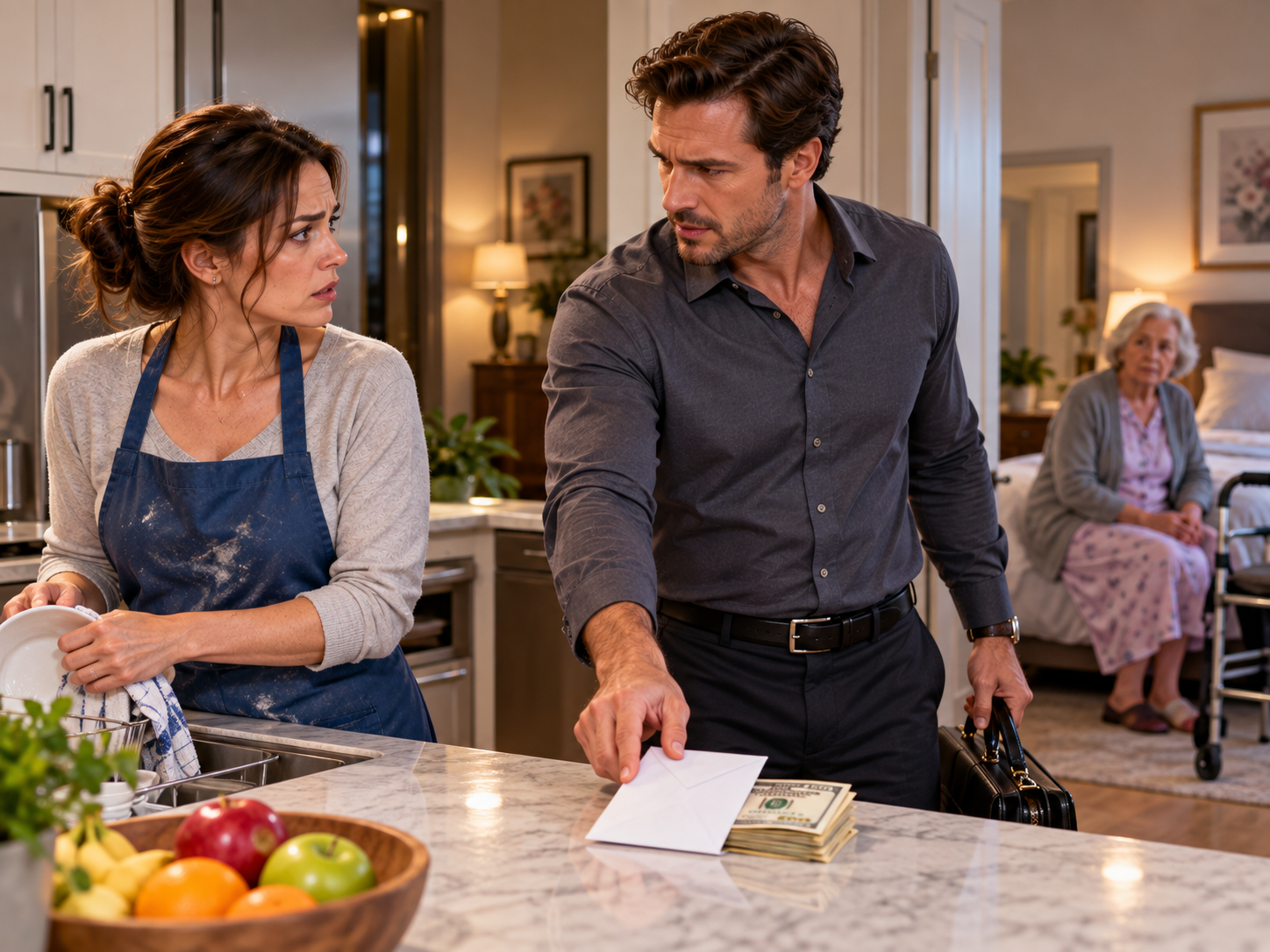
The same kind of morning when Julian had first placed the envelope on the island.
I opened the cabinet beneath the sink.
The coffee tin was empty.
I smiled.
Then I closed the cabinet.
Beatrice called from the bedroom.
“Clara?”
“I’m coming.”
I walked down the hallway.
This time, I didn't need an alias.
I didn't need an apron.
I didn't need to pretend to be invisible.
I was simply Clara.
And everyone in that house finally knew exactly who she was.
Click here to continue reading: PART 5: “After the deed was stopped, Julian tried to rebuild his version of the truth, but the documents, receipts, and one forgotten conversation made that impossible”
My husband thought the cash on the kitchen counter was buying someone else’s labor, but I was already learning why he wanted his mother kept quiet
Part 4 of 20