
The next afternoon, I changed clothes before Julian came home.
I pinned my hair high and tucked the loose strands beneath a plain scarf. I changed into a faded blue apron I had bought years earlier for painting furniture. I removed my wedding ring and placed it inside the pocket of my jeans.
Then I knocked softly on Beatrice's bedroom door.
“Hazel is here.”
Beatrice looked at me.
For a second, neither of us spoke.
Then she smiled.
“You look exhausted already.”
“I've been working here for years.”
“True.”
She reached for my hand.
“I'll play along.”
The arrangement should have felt ridiculous.
Instead, it gave me something I hadn't had in a long time.
Distance.
As Clara, I was Julian's wife.
The woman expected to manage his household.
The woman whose labor could be dismissed as part of marriage.
As Hazel, I was simply a caregiver.
My work had a name.
My hours had meaning.
My effort was visible.
I started keeping a written schedule.
Medication at eight.
Breakfast at eight-thirty.
Blood sugar at ten.
Rest after lunch.
Exercises for her left leg.
Bandage change.
Evening medication.
It was the same work I had always done.
But now I documented every hour.
Beatrice understood immediately.
“You're turning invisible work into evidence.”
“Yes.”
“Good.”
The first time Julian saw me, he almost walked straight past.
He came through the front door while I was carrying a basket of clean towels.
I lowered my head.
“Good afternoon.”
He barely looked at me.
“Who are you?”
“Hazel.”
He glanced toward Beatrice's room.
“Caregiver?”
“Yes.”
“Good.”
He took out his phone.
“Clara should have told me.”
I almost laughed.
Instead, I said, “She was busy.”
Julian nodded as if that explained everything.
He walked upstairs.
I waited until his footsteps disappeared.
Then Beatrice started laughing.
I covered my mouth.
“You should have seen your face.”
“You should have seen his.”
“He didn't recognize his own wife.”
“That may be the most honest thing he's ever done.”
From that day forward, Hazel existed in the house.
I wore the apron whenever Julian was home.
When he left, I became Clara again.
The distinction became strangely useful.
Julian spoke differently to Hazel.
He was polite.
Sometimes even grateful.
He asked whether his mother had eaten.
He asked whether her medication had been taken.
He asked whether she needed anything.
He never asked Clara those questions.
When he believed I was only his wife, the work was expected.
When he believed I was an employee, the same work became valuable.
That realization hurt more than I wanted to admit.
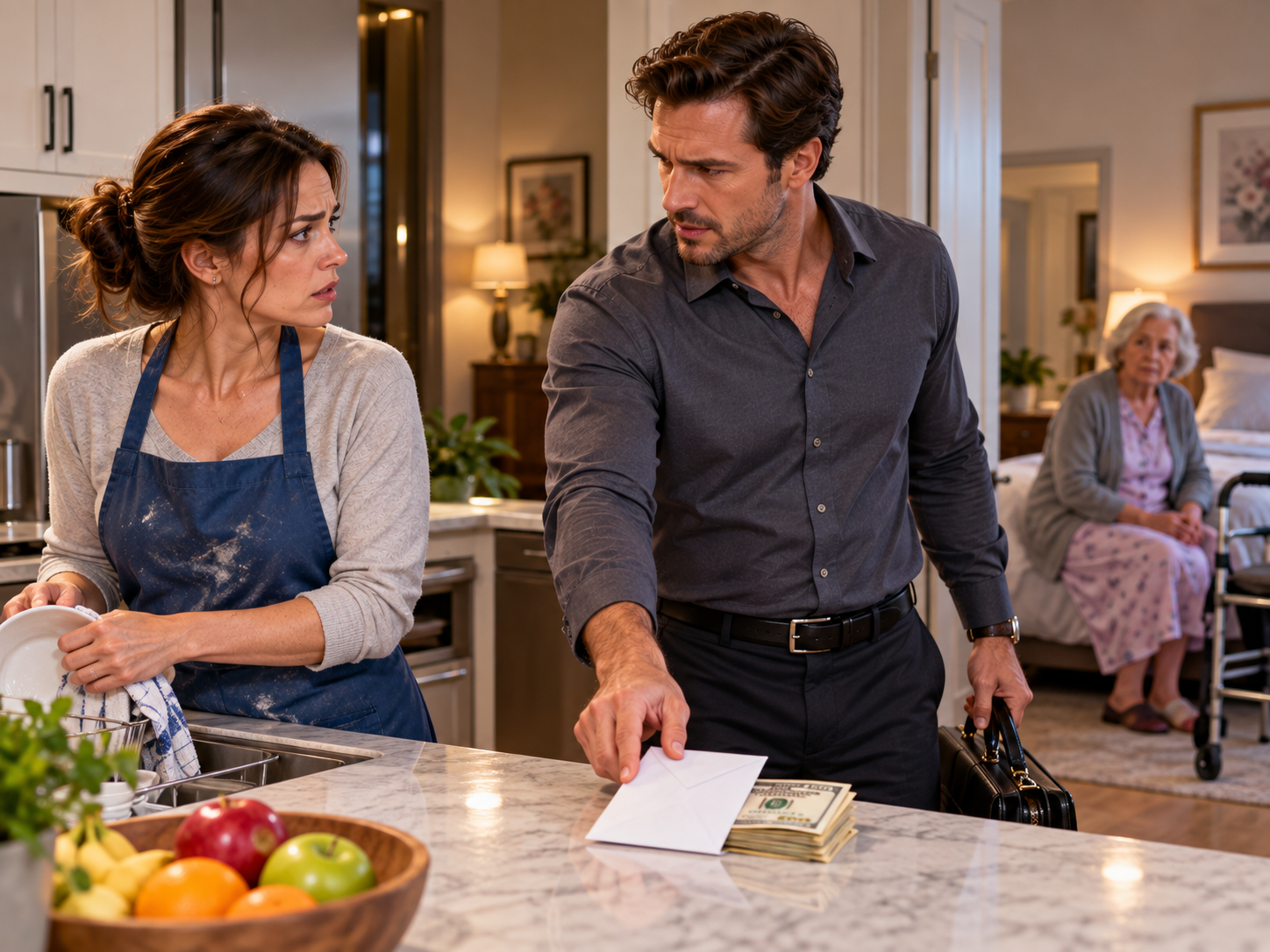
One evening, he handed Hazel an envelope.
“Weekly pay.”
I accepted it.
“Thank you.”
He smiled.
“Tell Clara the caregiver is doing a good job.”
I looked at him.
“I'll tell her.”
I put the envelope in the coffee tin later.
Another Monday.
Another payment.
Another record.
Meanwhile, Beatrice became more willing to talk.
One afternoon, while I helped her change clothes, she said, “Julian thinks the house is his.”
“I know.”
“He has always thought that.”
“Why?”
“Because his father let him believe whatever made him comfortable.”
I stopped.
“What do you mean?”
Beatrice looked toward the window.
“Arthur bought this house.”
“I know.”
“He paid for it before Julian finished college.”
“I thought Julian inherited it.”
“He inherited nothing.”
That surprised me.
“Then whose house is it?”
Beatrice's expression tightened.
“Mine.”
I sat down.
“What about Arthur's will?”
“He left everything to me.”
I stared at her.
“Everything?”
“Yes.”
“Then why does Julian keep talking about the house as though it's already his?”
“Because I let him.”
“Why?”
“Because I thought I had time to correct him.”
Her voice became faint.
“Now I don't.”
The room felt colder.
“What are Julian and Valerie planning?”
Beatrice looked at me.
“They want me to sign the house over.”
“Have they brought paperwork?”
“Not yet.”
“But they're trying.”
“Yes.”
She reached for the water beside her bed.
“They keep telling me it will make everything easier.”
“For whom?”
She smiled bitterly.
“Exactly.”
That evening, I watched Julian return home.
He kissed Beatrice's forehead.
“How are you, Mom?”
“Fine.”
“You should rest.”
“I am resting.”
He looked toward me.
“Hazel, make sure she doesn't overdo it.”
“Yes.”
Then he walked away.
Beatrice watched him leave.
“He's good at pretending.”
“So are you.”
She smiled.
“I learned from necessity.”
A few days later, Valerie arrived.
She brought flowers.
She brought pastries.
She brought a folder.
That was enough to make me suspicious.
I stayed in the kitchen while she visited Beatrice.
At first, her voice was sweet.
“Mom, this is just a standard document.”
“What document?”
“Nothing complicated.”
I stepped into the hallway.
Valerie looked up.
“Oh.”
She seemed annoyed to see me.
“Hazel, could you give us privacy?”
I smiled politely.
“Of course.”
I walked toward the kitchen.
Then I stopped just beyond the doorway.
I could hear them.
“Mom, you can't keep everything complicated forever.”
“I don't.”
“Julian needs certainty.”
“I need peace.”
“You'll have peace.”
“How?”
“By signing the house over to him.”
Silence.
Then Beatrice spoke.
“No.”
Valerie's voice sharpened.
“Why are you making this difficult?”
“Because it's my house.”
“You won't need it forever.”
The sentence hung in the air.
I heard Beatrice inhale.
Then Valerie said something quieter.
“You know a nursing facility costs money.”
I stepped away.
My hands were shaking.
They weren't trying to help Beatrice.
They were pressuring her.
I went into the kitchen and started washing dishes.
When Valerie left, she passed me without speaking.
The front door closed.
Beatrice called for me.
I returned.
“Are you all right?”
She nodded.
“Barely.”
“What are we going to do?”
She looked at me.
“We?”
“Yes.”
A tear slipped down her cheek.
“You're the only person I trust.”
I sat beside her.
“I won't let them force you to sign anything.”
“You may not have to.”
“What do you mean?”
She glanced toward the bedroom.
“Arthur prepared everything.”
“The will?”
She nodded.
“But where is it?”
“I don't know.”
My heart began beating faster.
“Didn't you say you had it?”
“I said Arthur made me promise to keep something hidden.”
“Where?”
She shook her head.
“I was frightened after he died.”
“Of Julian?”
“Of what Julian would do if he knew.”
I remembered her earlier warning.
There were things about the house I didn't know.
Now I understood why.
That night, Julian came home late.
He found me in the kitchen.
“Where's Hazel?”
I turned.
“She went home.”
He looked confused.
“Why?”
“She had an appointment.”
He shrugged.
Then he placed another envelope on the island.
“Make sure she comes back tomorrow.”
I picked it up.
“Of course.”
He poured himself a drink.
“Mom seemed upset today.”
“Valerie visited.”
“I know.”
He took a sip.
“She's helping.”
“With what?”
“Estate planning.”
My stomach tightened.
“Beatrice doesn't need to sign anything tonight.”
Julian looked at me.
“I didn't say tonight.”
“What does she need to sign?”
He smiled.
“Nothing you need to worry about.”
Then he walked upstairs.
I stood alone in the kitchen.
The coffee tin was beneath the sink.
The new envelope was in my hand.
I suddenly understood that the money wasn't the only thing Julian was trying to control.
He wanted the house.
And whatever was hidden inside it.
The next morning, Beatrice asked me to lock her bedroom door.
Then she pointed at the bed.
“Lift the mattress.”
I stared at her.
“Why?”
“Because Arthur trusted me to hide something.”
I gripped the edge of the mattress.
“Where?”
“Underneath.”
I lifted.
Beneath the mattress was a gallon-sized plastic bag.
Inside it was a green folder.
Beatrice reached toward it.
Her fingers trembled.
“Arthur made me promise never to tell Julian.”
I pulled the bag free.
The plastic crackled in the quiet room.
“What is it?”
Her eyes filled with fear.
“The truth about this house.”
Click here to continue reading: PART 3: The green folder contained more than a will, and as I read Arthur’s instructions, I realized Julian’s plan depended on a secret he had never discovered
My husband thought the cash on the kitchen counter was buying someone else’s labor, but I was already learning why he wanted his mother kept quiet
Part 2 of 20