Meera called the next morning.
“Mom?”
“Yes?”
“I've been thinking.”
“That sounds dangerous.”
She laughed.
“I want to ask you something.”
“Go ahead.”
“Do you still love Dad?”
I sat down.
“Yes.”
“Even after everything?”
“Yes.”
“Even after the eighteen years?”
I looked toward the bedroom.
“Yes.”
She was quiet.
“Do you love yourself?”
The question caught me again.
“I am learning.”
“That isn't an answer.”
“It is the most honest answer I have.”
She sighed.
“Mom, I don't want you to spend the rest of your life thinking you deserve whatever pain comes to you.”
I closed my eyes.
“I don't anymore.”
“Really?”
“I'm trying.”
“That counts.”
We spoke for another twenty minutes.
After the call, I found Arvind sitting at the dining table.
He had heard enough to understand.
“She worries about you.”
“She should.”
He nodded.
“I worry too.”
“About me?”
“Yes.”
I sat beside him.
“Why?”
“Because I taught you to believe your mistake was your identity.”
I looked at him.
“You did.”
“I know.”
“And I allowed it.”
He shook his head.
“That doesn't make it your fault.”
I looked at him.
For years, I had believed that because I had committed the first wrong, everything that came afterward belonged to me.
Now I understood that guilt could become another form of surrender.
One wrong decision did not give another person permanent ownership of your life.
Arvind seemed to understand that too.
The following week, he received a call from the specialist.
His latest results were encouraging.
The treatment was working.
He sat down after hanging up.
“Good news?”
I asked.
“Yes.”
He smiled.
I smiled too.
Then he said, “I should have been happy when I first heard this.”
“You are.”
“I am.”
“But?”
“I kept thinking about how different it could have been.”
I understood.
The disease had not been caused by his anger.
But his delay had mattered.
He had lost eighteen years of proper monitoring.
We could not know exactly what would have happened if he had followed the doctor's instructions.
That uncertainty would remain.
He looked at me.
“Do you ever think about what would have happened if you hadn't betrayed me?”
“All the time.”
“What do you imagine?”
“A different life.”
He nodded.
“Me too.”
“Would you have told me about your health?”
“Yes.”
“Would you have treated me differently?”
“I hope so.”
“Would you have been happier?”
He looked at the rain outside.
“I don't know.”
Neither did I.
There was no use inventing a version of the past that could never be tested.
We had the life we had.
The next Sunday, we went through old family photographs.
It was something we had avoided for years.
There were pictures from our wedding.
Me in a red sari.
Arvind looking impossibly young.
Our parents standing behind us.
Then Meera's birth.
Then Rohan's.
Then birthdays.
School uniforms.
Family trips.
The photographs revealed something neither of us had wanted to admit.
We had not been miserable every day.
There had been laughter.
There had been tenderness.
There had been genuine affection before the betrayal.
And even afterward, there had been moments when Arvind quietly cared for me without allowing himself to admit it.
I found one photograph from the year my mother died.
I was standing beside the funeral pyre, crying.
Arvind stood behind me.
His hand was near my shoulder.
He had not touched me.
But he had positioned himself close enough to catch me if I fell.
I stared at the photograph.
“I remember this.”
“So do I.”
“You were holding me without touching me.”
He looked at it.
“I wanted to.”
“Why didn't you?”
“Because I thought I would betray my anger.”
I looked at him.
“That sentence explains too much.”
He nodded.
We found another photograph.
I had been sick after surgery.
Arvind was carrying a bag of medicine.
His face was turned toward me.
Again, he wasn't touching me.
But he was watching.
I laughed softly.
“You were terrible at hiding that you cared.”
“I thought I was very good.”
“You weren't.”
He smiled.
For the first time, our old photographs didn't feel like evidence of failure.
They felt like evidence that our marriage had contained more than one emotion at a time.
Love.
Hurt.
Resentment.
Responsibility.
Longing.
Fear.
All of them could exist together.
That afternoon, Arvind asked me to go for a walk.
We walked slowly through the neighborhood.
At the corner tea stall, he stopped.
“Tea?”
I smiled.
“After eighteen years, you're finally asking me out?”
He laughed.
“It's just tea.”
“Still.”
We sat on two plastic chairs.
The tea arrived in small glasses.
Steam rose between us.
Arvind watched the street.
“I used to imagine you with Sameer.”
I looked at him.
“I know.”
“It made me furious.”
“I understand.”
“I wondered what he gave you that I didn't.”
I took a slow breath.
“Nothing important.”
He looked at me.
“I was lonely.”
“I know.”
“I wanted someone to notice me.”
“I should have.”
“Yes.”
The answer hurt him.
But he nodded.
“I should have.”
That was one of the hardest things we had learned.
My betrayal was mine.
But the loneliness that preceded it had belonged to the marriage.
Neither fact erased the other.
Arvind reached across the table.
His fingers touched mine.
A simple gesture.
The tea stall owner walked past without noticing.
No one cared.
That made the moment more meaningful.
We were no longer performing marriage for relatives.
We were learning how to live inside it.
When we returned home, Meera was waiting.
She looked at our joined hands.
Then smiled.
“I'll leave you two alone.”
Arvind laughed.
“Don't be dramatic.”
“You've given me enough drama for one lifetime.”
She hugged me.
Then she hugged her father.
That night, Arvind and I discussed whether we should tell our extended family.
We decided not to.
Not because we were ashamed.
Because the details belonged to us.
Relatives did not need to know.
Neighbors did not need a story.
The aunties who once called Arvind a saint did not need to revise their opinions.
Our marriage was not a public court case.
It was our life.
The next morning, Arvind received another hospital reminder.
He looked at the phone.
“Another blood test.”
“I'll come.”
He smiled.
“You don't have to ask anymore.”
“No.”
“You're coming because you want to.”
“Yes.”
He took my hand.
“I like that.”
I looked at him.
“What?”
“Being chosen.”
I understood.
For eighteen years, I had felt like punishment was the only reason he kept me.
Now he was learning that staying could be a choice.
And I was learning the same.
Click here to continue reading: PART 7: The first time Arvind reached for me without hesitation, I realized that rebuilding trust was not about forgetting the betrayal but learning how to live beyond it
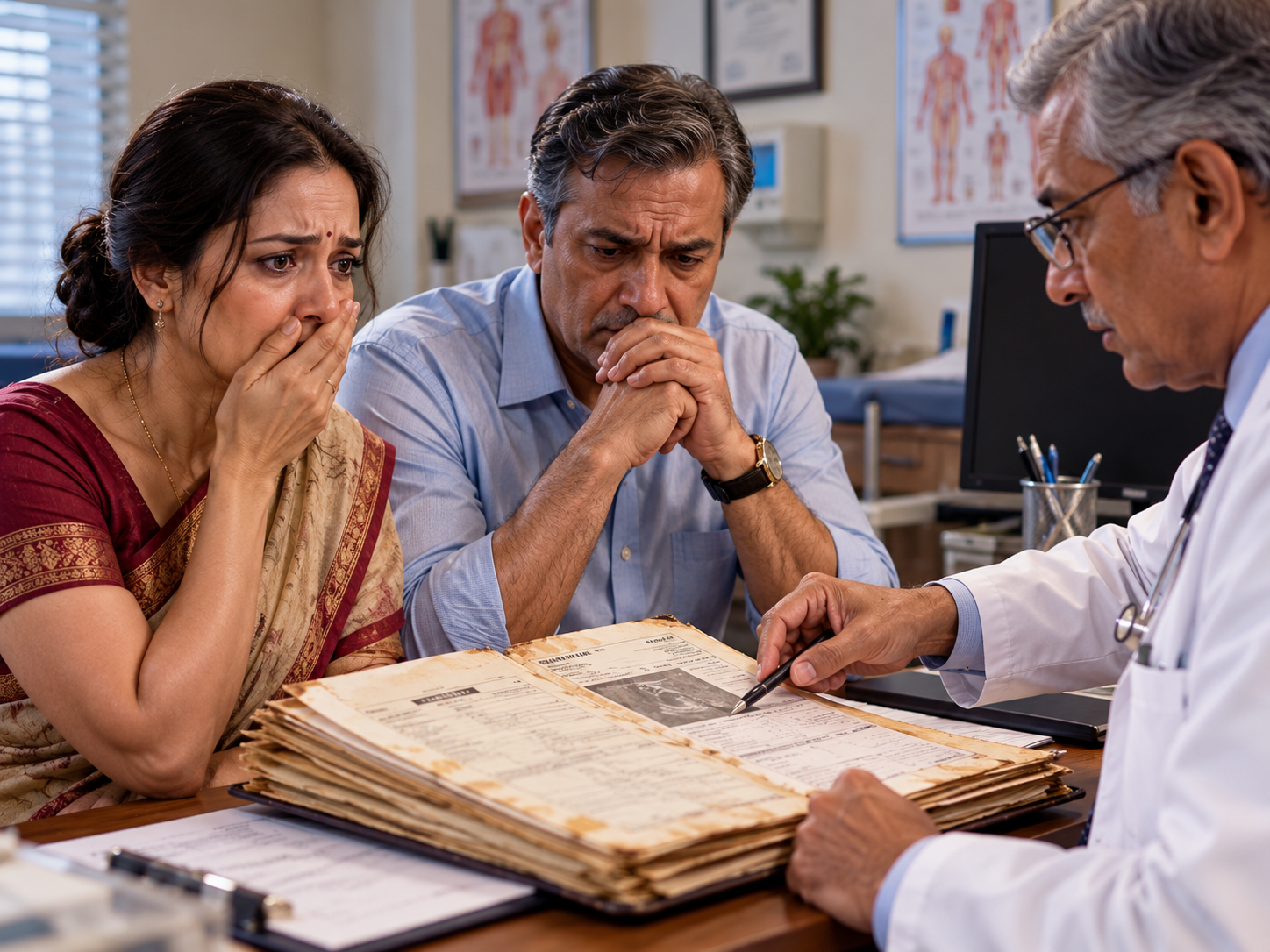
The old medical file on the doctor’s desk carried a date I recognized, and suddenly the eighteen years of silence in our bedroom felt different
Part 6 of 20