
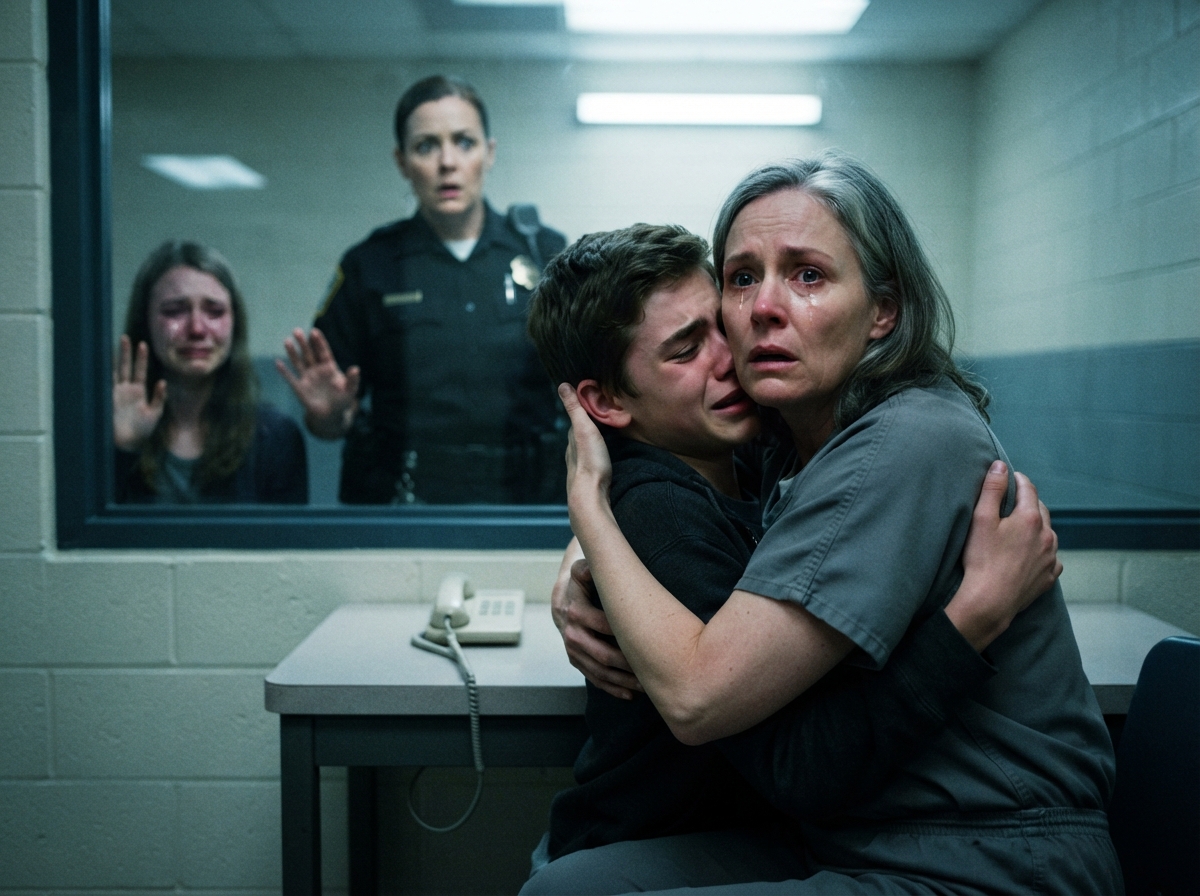
The move changed more than our address.
It changed the rhythm of our days.
Mom started waking later.
Matthew built a workbench in the garage.
I began visiting on weekends instead of driving over every evening.
The house slowly filled with ordinary clutter.
Shoes by the door.
Coffee cups.
Mail.
Tools.
Books.
Plants.
Nothing was hidden.
Nothing needed to be.
That mattered more than I expected.
The first Christmas in the new house was quiet.
Mom insisted on cooking Dad's favorite meal.
Matthew burned the potatoes.
Mom laughed.
“Your father would be proud.”
“He would blame the oven.”
“He blamed everything on the oven.”
We ate anyway.
After dinner, Mom brought out the old photograph.
She placed it beside the tree.
I watched her.
“Why do you still keep that one?”
“Because he looks happy.”
“He was.”
“For that moment.”
She nodded.
“That's enough.”
We had learned to separate moments.
Dad's death did not erase the years before it.
Mom's imprisonment did not erase the years after it.
A terrible event could occupy a place in a life without becoming the entire life.
That was something I had not understood at seventeen.
I understood it now.
Matthew became involved in a local community workshop.
He taught children how to repair bicycles.
One afternoon, a little boy asked him why he knew so much about old tools.
Matthew smiled.
“My dad taught me.”
The boy asked where his dad was.
Matthew paused.
“Gone.”
The boy looked sorry.
Matthew nodded.
“But he left me his tools.”
That was all.
He did not need to explain the murder.
The prison.
The trial.
The conspiracy.
Sometimes the simplest truth was enough.
Mom continued her work with wrongful-conviction organizations.
She became known for one particular sentence.
“Never stop asking what the evidence actually proves.”
People repeated it.
She always corrected them.
“That's not a slogan.”
“It's a warning.”
She had learned what happened when evidence became a story instead of a question.
Her work helped others review old cases.
Some were resolved.
Some were not.
She never promised outcomes.
She understood uncertainty too well.
One afternoon, she received a call from a woman whose husband had been convicted years earlier.
The woman wanted advice.
Mom listened for almost an hour.
When she hung up, she looked exhausted.
“Hard day?”
“Yes.”
“Did you help?”
“I don't know.”
She sat quietly.
“Sometimes helping means telling someone what they need to hear, even if it isn't what they want.”
“What did you tell her?”
“That she needs evidence.”
Mom looked at me.
“Hope is important.”
“But evidence changes things.”
I nodded.
That lesson had cost us too much to forget.
Years passed.
The legal consequences continued.
Martin's estate was investigated.
Financial victims received portions of recovered funds.
Several companies collapsed.
Others were restructured.
The name Hale became associated with scandal.
But Mom rarely mentioned it.
She had no interest in destroying reputations.
She wanted accountability.
There was a difference.
One anniversary, we returned to Dad's grave.
Matthew brought flowers.
Mom brought the letter.
I brought the old photograph.
We stood together.
Nobody spoke for a while.
Then Matthew said, “Do you think he would like the new house?”
Mom smiled.
“He'd complain about the kitchen.”
“Definitely.”
“He'd say the garage is too small.”
“Definitely.”
“And then he'd build something anyway.”
We laughed.
The cemetery no longer felt like a place where we were trapped in the past.
It felt like a place where we could visit someone we loved.
That difference took years.
On the drive home, Matthew asked me something.
“Do you still blame yourself?”
I looked at him.
“For what?”
“For not believing Mom.”
The question surprised me.
“Sometimes.”
He nodded.
“I used to blame myself too.”
“You were a child.”
“So were you.”
I smiled.
“Apparently Mom was right.”
“About what?”
“We were children.”
He laughed.
Then he became serious.
“You didn't betray her.”
“I thought I did.”
“You were scared.”
“So were you.”
“Exactly.”
We drove in silence.
That conversation stayed with me.
For years, I had thought forgiveness meant Mom forgiving me.
I finally realized I also had to forgive myself.
Not because I had done nothing wrong.
I had.
I had doubted her.
I had accepted a convenient story.
I had failed to ask questions.
But guilt had already taught me its lesson.
Carrying it forever would not help anyone.
The next morning, I opened the box containing Dad's letters.
I found the first one Mom had written from prison.
The paper had yellowed.
I read it again.
I didn't kill him, sweetheart.
For the first time, the sentence did not make me feel ashamed.
It made me grateful.
She had kept telling the truth even when almost nobody believed her.
I put the letter back.
Then I added something.
A note of my own.
Mom,
I believe you.
I folded it.
I placed it in the box.
Not because she needed proof.
Because I did.
A few weeks later, Mom found the note.
She read it.
Then she walked into my room.
“You wrote this?”
“Yes.”
She hugged me.
No speech.
No apology.
No explanation.
Just a hug.
Sometimes that was enough.
Our family never became untouched by the past.
Certain sounds still bothered Mom.
Certain dates still felt heavy.
Matthew still avoided dark hallways in unfamiliar buildings.
I still occasionally woke from dreams about the courtroom.
But the past stopped making our decisions.
That was freedom.
Not forgetting.
Choosing.
One spring, Mom planted a new rose beside the porch.
She called it Daniel.
Matthew objected.
“That sounds like something from a romance novel.”
Mom laughed.
“I like it.”
The rose grew slowly.
For the first year, it produced only leaves.
The second year, one flower appeared.
Mom photographed it.
She sent the picture to me.
Dad would have complained about the thorns.
I replied:
He would have kept it anyway.
She answered:
Exactly.
We had learned to speak about him without speaking only about death.
That was another victory.
The family photographs multiplied.
Matthew got married.
Mom became a grandmother.
I had children of my own.
The house became noisy.
There were toys in the hallway.
Small shoes beside the door.
Crayons on the table.
Laughter everywhere.
One afternoon, my daughter asked about the photograph of Dad.
“Who is that?”
“Your grandfather.”
“Where is he?”
I paused.
“He died before you were born.”
“Was he nice?”
I smiled.
“He was.”
“What did he do?”
I thought about the question.
He built things.
He repaired bicycles.
He made terrible pancakes.
He loved his family.
He was afraid of powerful people.
He tried to protect us.
He left evidence.
But I did not tell her about the murder.
Not then.
She was too young.
I wanted her first knowledge of him to be love.
Not blood.
Not prison.
Not court.
Love.
Later that evening, Mom watched my daughter sleeping.
“She looks like you.”
“I know.”
“She has your father's stubbornness.”
I laughed.
“Everyone says that.”
Mom smiled.
The house was quiet.
Then she said something I had not expected.
“I think your father would be happy.”
“With what?”
She looked around.
“The noise.”
I smiled.
“The mess.”
“The garden.”
“The children.”
“The fact that we are still here.”
I looked at her.
She touched my hand.
“That is what he wanted.”
For years, we had thought Dad's final wish was to expose the people who threatened him.
It wasn't.
That was only part of it.
He wanted us alive.
Together.
Free.
The evidence had been the means.
The family was the reason.
I finally understood that.
And once I did, the final piece of the story fell into place.
Dad had not won.
He had died.
Mom had not escaped unharmed.
She had lost six years.
Matthew had carried fear.
I had carried guilt.
There was no version of the story where everyone walked away untouched.
But we had survived.
More importantly, we had chosen what to do with the life that remained.
That was the ending Dad had wanted.
Not revenge.
Not a perfect victory.
A family that could still laugh in the kitchen.
A family that could still plant roses.
A family that could still tell stories.
A family that could remember without being destroyed by remembering.
The old evidence box stayed in a cabinet.
The memory box stayed on a shelf.
One contained everything that proved what had happened.
The other contained everything that proved we had lived beyond it.
I liked having both.
Because truth mattered.
So did life.
Click Here to continue read next: PART16: Years After the Night That Nearly Took My Mother From Us, We Finally Understood What Surviving Really Meant and Why Dad Left Us the Truth
The Night My Father Died Left One Detail Behind That Everyone Saw, Yet No One Thought Was Strange Enough to Question
Part 15 of 16

