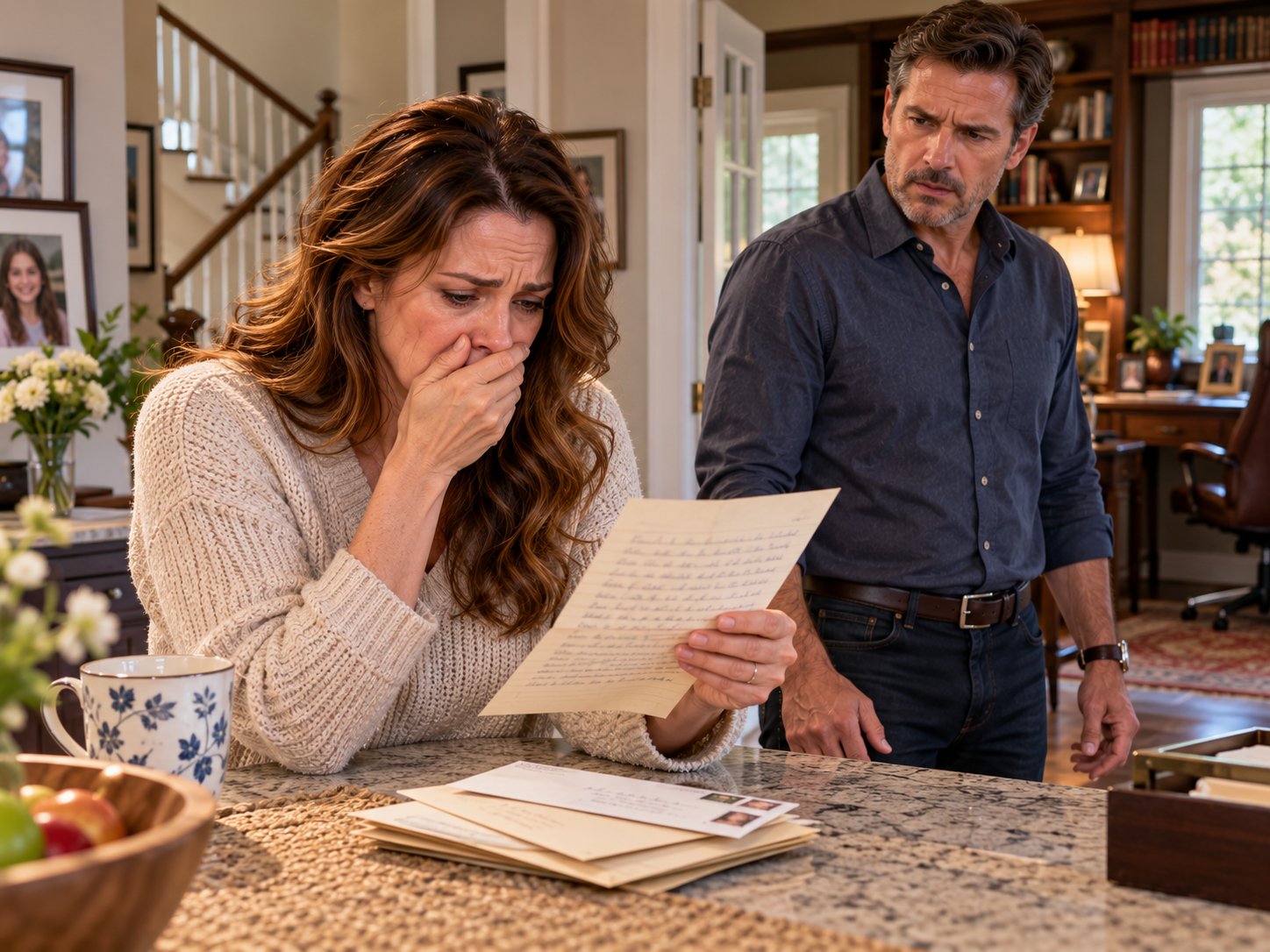
Tom stood in the hallway.
Neither of us spoke.
He knew.
I could see it in his face.
Not that I had called Claire.
He knew that I had learned something he could no longer explain away.
“Did you talk to her?” he asked.
“Yes.”
His shoulders dropped.
“What did she say?”
“That she never asked me to stay away.”
He closed his eyes.
“I know.”
“She never told you to tell me she needed space.”
“I know.”
“She wanted to come home.”
“I know.”
I felt anger rise again.
“Then say it.”
Tom looked at me.
“I lied.”
The words were quiet.
But they were finally words.
He admitted that he had convinced himself he was protecting both of us when Claire first left.
He had believed Mark was dangerous.
He had been afraid Mark would follow Claire to our house.
He had been afraid I would rush to find her and put myself in danger.
Those fears had been real.
But then the danger had changed.
Mark moved away.
Claire divorced him.
The calls stopped.
The years passed.
And Tom still did not tell me.
He admitted that by then, the truth had become harder to confess than the original lie.
“I kept thinking there would be a right moment,” he said.
“There wasn't.”
“No.”
“There never was.”
“I know.”
“And every year you waited made it worse.”
“Yes.”
I looked at him.
“What about the letters?”
He swallowed.
“I kept them because they were the only proof that she hadn't forgotten you.”
That answer broke my heart in a way I hadn't expected.
“You knew I thought she had forgotten me.”
“Yes.”
“And you let me believe it.”
“I was ashamed.”
“You were afraid of losing me.”
He nodded.
“You thought if I knew what you'd done, I'd leave.”
“I didn't know what you'd do.”
“I might have.”
“I know.”
The honesty came too late.
But it was still honesty.
I sat at the kitchen table.
Tom sat across from me.
For the first time, there was no argument to win.
Only damage to acknowledge.
“Did you contact Mark?”
His face changed.
“Yes.”
I stared at him.
“When?”
“After Claire left.”
“Why?”
“To make sure he wasn't coming here.”
“What did you say?”
“I told him Claire was not staying with us.”
“Was she?”
“No.”
“But you knew where she was.”
“Not exactly.”
“What did he say?”
“That if she came home, he would make trouble.”
“Did you believe him?”
“Yes.”
“And the messages Claire mentioned?”
Tom looked down.
“I don't remember exactly what I wrote.”
“Then find out.”
He brought me his old phone.
The messages were still there.
There were only a few.
They were not dramatic.
That made them worse.
Tom had asked Mark whether he had stopped contacting Claire.
Mark had replied that he wanted her to understand there were consequences for involving family.
Tom had answered that Claire needed time and that he would make sure she stayed away from the house.
I read the exchange twice.
Tom had not threatened Claire.
He had not helped Mark hurt her.
But he had communicated with the man she was afraid of without telling her or me.
He had taken control of information that belonged to all of us.
That was enough.
“You should have told me.”
“I know.”
“You should have told Claire.”
“I know.”
“You should have let us decide.”
“Yes.”
I placed the phone on the table.
“What do you think happens now?”
Tom looked at me.
“I don't know.”
For once, that answer was honest.
I called Claire.
She answered quickly.
I told her that Tom had admitted contacting Mark.
She was silent.
“Are you okay?”
“Yes.”
“I'm sorry.”
“Mom, don't apologize for his choices.”
I looked at Tom.
“I know.”
Claire said she wanted to meet.
Not at our house.
Not at hers.
Somewhere neutral.
We chose a small café halfway between our cities.
Three days later, I saw my daughter walk through the door.
She was thirty-eight.
I knew that.
But for one second, I saw the girl who had ridden a bicycle down our driveway with Tom running behind her.
She looked older.
Stronger.
Careful.
When our eyes met, neither of us moved.
Then she came toward me.
I stood.
We hugged.
It was awkward for half a second.
Then it wasn't.
She held me tightly.
I closed my eyes.
“I missed you,” I whispered.
“I missed you too.”
When we sat down, there was a long silence.
Neither of us knew how to fit nine years into a conversation.
Finally, Claire smiled through tears.
“You look different.”
“So do you.”
“Older?”
“Beautiful.”
She laughed.
That sound was so familiar that I nearly cried again.
We talked for hours.
She told me about the apartment where she had stayed after leaving Mark.
The friend who had protected her.
The divorce.
The job she found.
The life she built.
She told me about the nights she almost called.
I told her about the times I almost searched for her.
We both admitted that pride and shame had helped the silence survive.
But neither of us pretended the responsibility was equal.
Tom had created the original falsehood.
We had lived inside its consequences.
At one point, Claire reached into her bag.
She placed copies of the four messages on the table.
“I kept these because I was afraid I would someday doubt myself.”
I looked at them.
“I understand.”
She studied my face.
“Do you hate him?”
I thought carefully.
“No.”
“Why not?”
“Because I understand why he was afraid.”
Claire nodded.
“But?”
“But understanding doesn't erase what he chose.”
She looked relieved.
“I needed to hear that.”
We discussed whether she wanted contact with Tom.
She wasn't ready.
I respected that.
She asked whether I planned to stay married to him.
I didn't know.
That question could not be answered over coffee.
But I knew one thing.
I would no longer protect him from the consequences of telling the truth.
When I returned home, Tom was waiting.
He did not ask whether Claire had forgiven him.
He simply said, “How was she?”
“She is well.”
He nodded.
“Did she hate me?”
“She doesn't hate you.”
He looked relieved.
Then I added, “But she doesn't trust you.”
His face fell.
“I understand.”
“I don't know whether that can change.”
“I know.”
I sat across from him.
“I need you to understand something too.”
“What?”
“You don't get to decide what Claire hears from me anymore.”
He nodded.
“And you don't get to decide what I can handle.”
“I know.”
“And if she wants nothing to do with you, you have to accept that.”
He closed his eyes.
“Yes.”
We did not separate that day.
But our marriage changed.
There was no pretending the past could be repaired with one apology.
Tom began therapy.
He wrote Claire a letter.
She did not answer.
He accepted that.
I continued speaking with Claire.
At first, our calls were short.
Then longer.
She sent photographs.
I sent recipes.
We rebuilt something slowly.
Not the relationship we had lost.
A new one.
One built on direct questions.
No intermediaries.
No assumptions.
No secrets.
Months later, Claire visited the house.
She stood in the kitchen.
The green notebook was on the shelf.
I had kept it.
She picked it up.
“You still have this?”
“Yes.”
She opened it.
Her old handwriting filled the first pages.
She laughed.
“I forgot about this.”
“I couldn't throw it away.”
She looked at me.
“I'm glad.”
Tom was not home.
That was intentional.
Claire wasn't ready.
I respected that.
She walked through the garden.
She remembered the bicycle.
She remembered the school concerts.
She remembered the years before everything changed.
The past was still there.
But it no longer had to control the future.
Before leaving, she hugged me.
“I'll come back.”
I held her tightly.
“I'll be here.”
This time, neither of us misunderstood the words.
Years later, the three letters remained in my desk.
I did not destroy them.
I kept them beside Claire's green notebook.
Not because I wanted to remember Tom's betrayal.
Because I wanted to remember the day the silence ended.
Tom eventually accepted that rebuilding trust would be slow.
He never demanded forgiveness.
He never asked me to erase what happened.
Claire eventually chose to speak to him again.
It took time.
She never forgot what he had done.
Neither did I.
But people are more complicated than the worst decision they have made.
Tom had been wrong.
Deeply wrong.
Yet he also spent years trying, clumsily, to protect people he loved from a danger he did not know how to handle.
That did not excuse his choices.
It explained them.
And sometimes explanation was enough to understand the past without allowing it to dictate the future.
One evening, years after I found the letters, Claire called me.
“Mom?”
“Yes?”
“I found something.”
“What?”
“A photograph of Dad teaching me to ride my bike.”
I smiled.
“I remember that day.”
“He looks terrified.”
“He was.”
“I thought he was brave.”
“He wanted you to think he was.”
Claire laughed.
Then she said, “I'm glad I remember both versions.”
“Both?”
“The man who taught me to ride.”
She paused.
“And the man who made a terrible mistake.”
I looked toward the old green notebook on my desk.
“Yes,” I said.
“That sounds fair.”
“It is.”
After we hung up, I sat quietly.
For nine years, I had believed my daughter had chosen silence.
The truth was more painful and more complicated.
Fear had started it.
A lie had prolonged it.
Shame had buried it.
And three letters had finally broken through.
I looked at the envelopes one last time.
Claire's handwriting was still there.
Her name.
My name.
A connection that had survived nine years of silence because neither of us had ever truly stopped reaching for the other.
I placed the letters back in the drawer.
Not hidden.
Just kept.
Then I closed it.
The house was quiet.
For the first time in years, quiet no longer felt like rejection.
It felt like peace.
Click here to continue reading: PART 5: “Claire had returned, but the first fragile reunion exposed questions about Tom’s old choices that neither of us could leave unanswered”
I thought my daughter had chosen nine years of silence, until three unopened letters appeared beneath an old notebook in my husband’s desk
Part 4 of 20