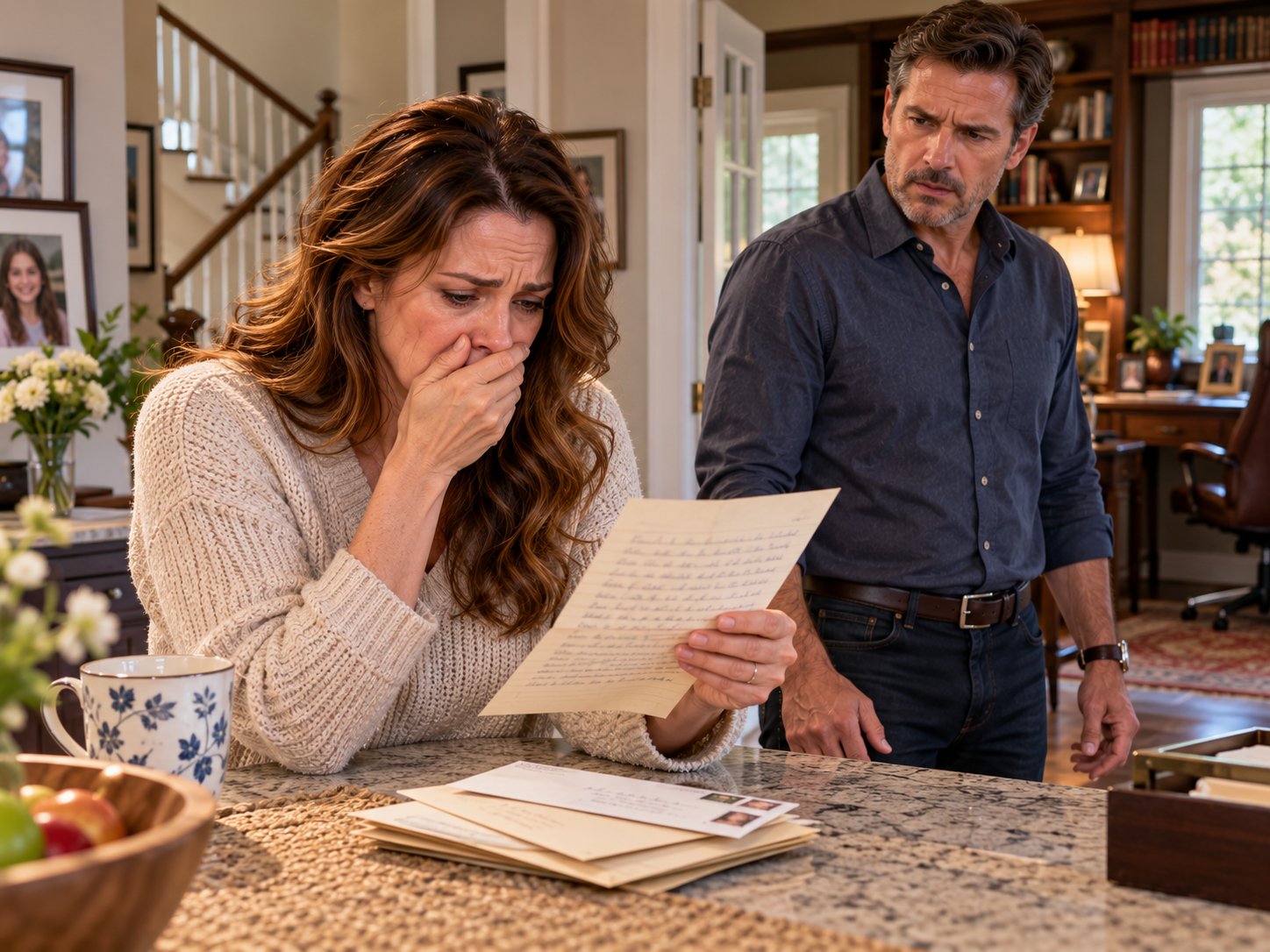
“Mom, if you’re reading this, please call me.”
The words were not spoken aloud.
They were written in blue ink on the first page of a letter I had no idea existed.
I stood at my kitchen counter with one hand pressed against the edge of the laminate and the other gripping the paper so tightly that it began to crease. Outside, rain tapped against the window above the sink. Behind me, somewhere down the hall, Tom was moving things around in his office.
For nine years, I had believed my daughter wanted nothing to do with me.
Now I was holding proof that she had tried to reach me.
My name was written across the envelope in Claire’s handwriting. I knew it immediately. She had always made her capital letters too large, even as a child. The C in Claire leaned forward as though it were impatient to get somewhere.
The envelope was yellowed at the edges.
Nine years old.
I looked at the date again.
Nine years.
My stomach turned.
The afternoon had started innocently enough. Tom had decided to replace his office chair, and the delivery company was coming the following morning. He wanted the bottom drawers of his old desk emptied before then.
“You're better at deciding what to keep,” he had said.
I had laughed.
“You mean you're better at making me do it.”
He had kissed the side of my head and disappeared into the office.
That was Tom. Practical. Quiet. The kind of man who could spend twenty minutes comparing screws at a hardware store and then forget why he'd gone there.
We had been married for twenty-seven years.
He had been in Claire’s life since she was five.
He taught her to ride a bicycle on the cracked pavement behind our first house. He ran beside her until his shoes were worn at the heels, refusing to let go of the seat until she shouted that he was cheating.
He attended her school concerts even when his employer made it difficult.
He knew which cereal she liked when she was twelve and which songs she hated when she was sixteen.
I had never thought of him as anything except her father.
Not biologically.
In every way that had mattered to us.
Until the night Claire left her husband.
That was where the silence began.
I had been recovering from knee surgery.
The pain medication made the days blur together. Sometimes I would wake from a nap unsure whether it was morning or evening. Walking from the bedroom to the kitchen required a cane, and stairs were an argument I usually lost.
Claire had called our house that night.
I had not been home.
Tom answered.
When I returned, he was standing in the kitchen with the phone still in his hand.
“What did Claire want?”
He had looked at me for a moment before saying, “She needs some space.”
I remember lowering myself carefully into a chair.
“Space from what?”
“Everything.”
“Is she all right?”
“She sounded upset.”
That answer had frightened me.
“What happened?”
Tom had sighed.
“She said she doesn't want us contacting her for a while.”
I had stared at him.
“Why?”
“She didn't explain.”
At the time, I accepted it because I was exhausted, medicated, and ashamed of how helpless I felt.
I told myself Claire was thirty-nine and married.
She could make her own decisions.
If she needed distance, perhaps I should respect it.
But there had always been a small voice inside me saying something wasn't right.
I silenced it.
For nine years.
Now, standing at my kitchen counter with her letter in my hands, that voice came back.
Louder.
I read the first paragraph again.
Claire wrote that things with Mark had become frightening.
She said she had left the house.
She was staying somewhere safe.
She did not want to tell me exactly where because she was afraid Mark might find out.
Then came the sentence that made my knees weaken.
“Mom, you once told me I could always come home, and I need to know whether you still mean that.”
I had told her that.
She had been seventeen.
She had failed an exam and believed her life was over.
I had held her on the kitchen floor and told her that no matter how badly things went, there would always be a place for her here.
She remembered.
I had not known she would need those words again.
I heard footsteps in the hallway.
I folded the letter quickly.
Tom appeared in the doorway.
He looked at the paper in my hand.
For one second, neither of us moved.
Then his face changed.
Not dramatically.
Just enough.
His shoulders stiffened.
His eyes went straight to the envelope.
“What are you doing with those?”
The question made my skin prickle.
“Those?”
He didn't answer.
I placed the letter on the counter.
“I found three envelopes in your desk.”
Tom looked toward the hallway.
“Ellen—”
“Why are there letters from Claire in your desk?”
He rubbed the back of his neck.
It was the gesture he used when he wanted time.
I had seen it for twenty-seven years.
This time, it frightened me.
“How many?” I asked.
“Three.”
“No. How many did she send?”
His silence answered differently.
I felt the room tilt.
“You knew about them.”
“I knew she wrote.”
“You knew.”
“Ellen, let me explain.”
“Why weren't they sent to me?”
He looked down.
“I didn't think you were ready.”
Something cold moved through my chest.
“Ready for what?”
He stepped toward the counter.
“Please don't jump to conclusions.”
I almost laughed.
“I'm holding three letters from my daughter that you kept in a locked drawer.”
“They weren't locked.”
“That isn't the point.”
“I know.”
“Then tell me what the point is.”
Tom looked exhausted.
For the first time in nine years, I saw fear in his face.
Not the fear of losing an argument.
Something older.
Something heavier.
“I was trying to keep you safe.”
I stared at him.
“From Claire?”
“No.”
“From Mark?”
His eyes flickered.
That was when I knew there was more.
I picked up the oldest envelope.
“What happened that night?”
Tom swallowed.
“Claire called after she left Mark.”
“I know.”
“She was terrified.”
“You told me she wanted distance.”
“I thought distance was safer.”
“That isn't what I asked.”
He sat down.
I remained standing.
He looked at his hands.
“Mark called here later.”
My fingers tightened around the letter.
“What did he say?”
“He said he knew she had called us.”
“And?”
“He asked whether she was here.”
“Was she?”
“No.”
“Then why were you afraid?”
Tom's jaw tightened.
“Because he said he knew where we lived.”
The room went silent.
Rain continued tapping the glass.
I lowered myself into the chair.
“You never told me.”
“You were recovering.”
“I could have handled it.”
“You could barely walk.”
“That was my decision.”
Tom looked at me.
“I know.”
“No, you don't.”
He looked away.
I opened the second envelope.
The letter was shorter.
Only a few paragraphs.
Claire wrote that Tom had told her I needed quiet and that she should not call again yet.
She said she did not understand because I had never asked her for space.
Then she wrote:
“I hope Mom is really okay. I’m trying to respect what you said.”
My vision blurred.
I read the sentence twice.
Then a third time.
“She thought I didn't want to hear from her.”
Tom closed his eyes.
“Yes.”
“You told her that.”
“I told her it wasn't safe to come home.”
“That is not the same thing.”
“I know.”
“Then why did she believe you?”
“Because she trusted me.”
The words landed harder than an accusation.
He had been her father.
He had taught her to ride a bicycle.
He had been the person she called when her car broke down.
She trusted him.
And he had used that trust to keep her away from me.
I stood.
“Where is the third letter?”
Tom looked toward the office.
“In the desk.”
“Get it.”
He didn't move.
“Tom.”
He rose slowly.
I followed him down the hallway.
His office smelled of old paper and furniture polish.
The desk stood against the wall, its bottom drawer still open.
The green notebook was lying there.
I recognized it.
Claire had used it as a teenager for grocery lists, phone numbers, homework reminders, and ridiculous little drawings she made when she was bored.
The stickers were still peeling from the cover.
Tom had kept it.
I had assumed I had kept it.
I picked it up.
Underneath was the third envelope.
This one was newer.
Only eight years old.
My name was written across the front.
My hands began to shake.
I opened it.
Claire wrote that she had tried calling again.
Tom had told her I was still recovering and needed peace.
She said she had found somewhere safe.
She said Mark had been contacting people she knew.
Then she wrote something that made me stop breathing for a moment.
“If Mom ever asks why I stopped calling, please don't tell her I chose this.”
I looked up.
Tom was standing beside the desk.
“Did you read them?”
“Yes.”
“All three?”
“Yes.”
“And you still didn't tell me?”
He had no answer.
I held the letter against my chest.
Nine years of silence suddenly had a different shape.
It was not a door Claire had closed.
It was a door someone else had been standing in front of.
I looked at my husband.
“Why?”
Tom's face crumpled slightly.
“I was afraid.”
“Of Mark?”
“At first.”
“And afterward?”
He looked down.
That pause told me there was another truth buried beneath the first.
I stepped closer.
“You said you were protecting me.”
“I was.”
“But after Mark stopped calling?”
Tom's mouth tightened.
“I thought it was better not to reopen everything.”
“You decided that for both of us.”
“Yes.”
“And then what?”
He didn't answer.
The room seemed to shrink around us.
I looked at the green notebook in my hand.
Then at the three letters.
Then at my husband.
For nine years, I had blamed my daughter for leaving.
Now I was beginning to understand that the silence had not belonged to her alone.
And whatever Tom had done after those first frightening months, he had been hiding it from me for years.
I folded the letters carefully.
“I want the truth.”
Tom looked at me.
“All of it.”
Click here to continue reading: PART 2: “Tom admitted he had feared Mark, but his explanation left one question unanswered: why had he kept Claire’s letters even after the danger was gone?”
I thought my daughter had chosen nine years of silence, until three unopened letters appeared beneath an old notebook in my husband’s desk
Part 1 of 20