The morning after the conversation with Detective Ramirez, I woke before sunrise. The house was quiet except for the refrigerator humming in the kitchen. For several minutes I stayed in bed, staring at the ceiling and thinking about everything we had uncovered. The tracker, the recording device, the handwritten rules, the locked bedroom door. None of it belonged in a child's life.
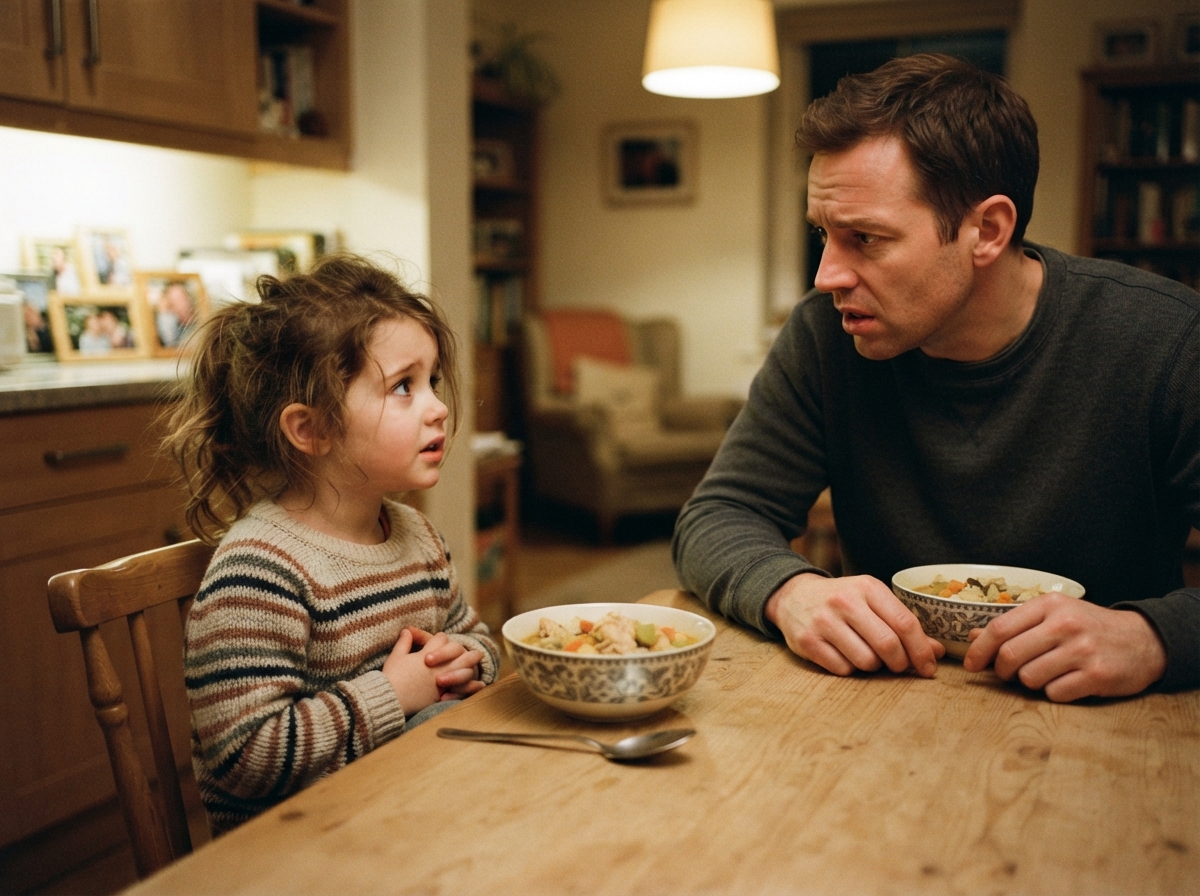
Downstairs, I found Ruby already sitting at the kitchen table.
She had one of her new coloring books open in front of her, but she wasn't drawing. She was arranging crackers in a neat row.
“Morning,” I said.
She looked up.
“Morning, Uncle.”
“You sleep okay?”
She nodded.
Then she glanced toward the counter.
“Are those for me?”
I followed her gaze.
A plate of toast sat beside the toaster.
“Yep.”
“All of them?”
“If you want them.”
She hesitated.
Then she took one.
She didn't reach for another.
I sat across from her.
“You can have more.”
“I know.”
But she didn't.
That was when I understood that knowing something intellectually and believing it were two different things.
Ruby had heard me tell her she could eat whenever she wanted. She had heard the therapist say she didn't need permission to be safe. She had watched me keep food in the kitchen where she could reach it. Yet some part of her still waited for a consequence.
I pushed the plate toward her.
“You can finish them.”
She looked at me.
“Are you sure?”
“Completely.”
She took another piece.
Then another.
By the time breakfast was over, she had eaten everything on the plate.
She looked almost surprised.
“Nothing happened,” she said.
I smiled.
“Nope.”
She touched her stomach.
“I thought maybe…”
She didn't finish.
I knew what she meant.
That was how the next few weeks went.
Ruby improved in ways that were easy to miss if you weren't watching closely. She began asking for things without first looking at an adult's face. She stopped hiding snacks every night. She laughed more loudly. She began leaving toys in the middle of the living room instead of putting everything away immediately.
But other habits stayed.
She still startled whenever someone raised their voice.
She hated closed doors.
She became nervous when she couldn't see me.
And she couldn't stand being told to wait.
One Saturday, I asked her to wait five minutes while I finished a phone call.
Her face changed instantly.
She dropped the crayon she was holding.
“Did I do something?”
“No.”
“Are you mad?”
“No.”
“Then why do I have to wait?”
I ended the call.
“Because I was finishing something. That's all.”
She stared at me.
“You're not going to punish me?”
The question hurt more than any accusation could have.
“No.”
She nodded slowly.
“Okay.”
I sat beside her.
“Ruby, sometimes adults make you wait because they're busy. It doesn't mean you're in trouble.”
She seemed to consider that.
“Okay.”
Then she picked up her crayon.
It took time.
A lot of time.
But she was learning.
Paula was learning too.
She had moved into a small apartment while the investigation continued. Sergio was no longer part of her daily life, but the damage he had left behind wasn't something she could simply walk away from.
She attended counseling.
She visited Ruby under supervision.
At first, Ruby wouldn't be alone with her mother.
I never forced it.
I believed Ruby deserved control over the pace of rebuilding that relationship.
One afternoon, Paula arrived carrying a paper bag.
“I brought something.”
Ruby looked inside.
There was a new coloring set.
“Thank you,” Ruby said.
Paula smiled.
“I remembered you like drawing.”
Ruby opened the box.
She looked at the colors one by one.
Then she stopped.
There was a dark purple crayon.
Her expression tightened.
Paula noticed.
“What is it?”
“Nothing.”
I watched Ruby put the purple crayon back.
She chose yellow instead.
Later, when Paula had left, Ruby told me why.
“Sergio used purple.”
“For what?”
“To write the rules.”
I didn't ask another question.
The details were becoming clearer one small piece at a time.
A color.
A chair.
A locked door.
A stuffed rabbit.
A bowl of food.
Things that looked harmless until you knew what they meant.
The detective called again the following Tuesday.
He told me the case had progressed and that prosecutors were reviewing the evidence.
“What about the recordings?” I asked.
“They're part of the case.”
“Did Ruby's statement match them?”
“Yes.”
I exhaled.
“That means she won't have to keep repeating everything?”
“We're trying to minimize that.”
I thanked him.
After hanging up, I sat at the kitchen table for a while.
The investigation was moving forward, but I couldn't stop thinking about how close everything had come to remaining hidden.
If Paula hadn't found the camera.
If she hadn't left.
If Ruby hadn't been dropped at my house.
If she hadn't asked that one question.
Would anyone have known?
I didn't like the answer.
That evening, Ruby and I made pancakes for dinner.
She insisted on helping.
She poured flour onto the counter.
Then she looked at the mess.
“Uh-oh.”
I laughed.
“That's okay.”
“But I made a mess.”
“That's what kitchens are for.”
She looked at me.
“Kitchens are for messes?”
“Sometimes.”
She smiled.
“Then I'm good at kitchens.”
“You're excellent.”
We cooked until the counter was covered in flour.
When we finished, Ruby sat at the table with syrup dripping down one side of her pancake.
She laughed.
I laughed too.
It was an ordinary moment.
Exactly the kind of ordinary moment I wanted her to have.
A few days later, Detective Ramirez came to my house.
He brought photographs and paperwork related to the investigation.
He also brought something else.
The stuffed rabbit.
The original one.
Ruby saw it from across the room and immediately went quiet.
Ramirez noticed.
“We don't have to bring this inside,” he said.
Ruby stared at it.
Then she approached.
“Is it mine?”
“It can be.”
She didn't touch it.
“What happened to the thing inside?”
“The device was removed.”
She looked at me.
“Is it safe now?”
“Yes.”
She reached out and touched one ear.
Then pulled her hand away.
“Can I keep it?”
I looked at Ramirez.
He nodded.
“It's no longer needed as evidence.”
Ruby picked it up.
She held it against her chest.
Then something unexpected happened.
She laughed.
It was a tiny laugh.
“This ear is still crooked.”
Ramirez smiled.
“Looks like it.”
Ruby squeezed the rabbit.
“He made it ugly.”
I looked at her.
She wasn't frightened anymore.
She was angry.
That difference mattered.
Fear had controlled her.
Anger meant she was beginning to understand that what had happened to her had been wrong.
That night, she put the rabbit on a shelf instead of sleeping with it.
“Why there?” I asked.
“So I can see it.”
“Okay.”
She climbed into bed.
Then she looked at me.
“Uncle?”
“Yeah?”
“When Sergio goes away, does that mean he can't come back?”
I sat on the edge of the bed.
“The court will decide what happens to him. But there are adults working to keep you safe.”
She thought about that.
“Can he find me?”
“We're taking steps to make sure he can't.”
She nodded.
Then she asked the question I hadn't expected.
“Did Mommy know everything?”
I took a breath.
“I think your mom knew some things were wrong.”
“Why didn't she stop it?”
There was no easy answer.
“She was afraid.”
Ruby looked confused.
“Adults can be afraid too?”
“Yes.”
“Even Mommies?”
“Even Mommies.”
She thought for a moment.
“Was she supposed to protect me anyway?”
I couldn't lie.
“Yes.”
Ruby looked down.
“I still love her.”
“You're allowed to.”
“Even if she didn't protect me?”
“Yes.”
She nodded.
“Okay.”
That conversation stayed with me.
Children shouldn't have to understand the difference between loving someone and trusting them.
But Ruby was being forced to learn it early.
The following week, Paula asked if she could take Ruby to the park.
I agreed to go with them.
We sat beneath a large oak tree while Ruby played on the swings.
Paula watched her daughter carefully.
“She looks different,” she said.
“How?”
“She doesn't look over her shoulder anymore.”
I looked at Ruby.
She was laughing.
“Sometimes she still does.”
Paula nodded.
“I know.”
She was silent for a moment.
“I wish I had listened.”
I didn't answer.
“You don't have to forgive me,” she said.
“I know.”
“I just want her to know I'm sorry.”
“She knows.”
Paula looked at me.
“Does she?”
“She does.”
That didn't mean everything was fixed.
It only meant the truth had finally entered the room.
That evening, after we returned home, Ruby found an envelope on the porch.
There was no stamp.
No address.
Just her name.
Ruby.
I picked it up.
The handwriting was unfamiliar.
I opened it carefully.
Inside was a single photograph.
Ruby's bedroom.
The picture had been taken from the hallway.
On the back, four words were written.
YOU DON'T KNOW EVERYTHING.
I stared at the photograph.
Ruby stood beside me.
“What's that?”
I immediately turned it over.
“Nothing.”
But she had already seen the expression on my face.
“Uncle?”
I looked toward the street.
No cars.
No people.
Just the fading light.
For the first time since Sergio's arrest, I wondered whether the danger we thought had ended had only changed shape.
Click Here to continue read next: PART6: The Photograph on the Porch Opened a New Question, and the Answer Forced Us to Reconsider Who Else Had Known What Happened
I Thought Three Quiet Days With My Niece Would Mean Cartoons, Simple Meals, and Bedtime Stories Until One Question Made Everything Feel Wrong
Part 5 of 16