Three days after the night Sergio was arrested, I drove Ruby to her first therapy appointment.
She sat quietly in the back seat with a new stuffed rabbit beside her.
This one was ordinary.
No hidden compartment.
No tracking device.
No rough black stitches.
Just a soft toy with floppy ears that Ruby had chosen herself from a store.
She had spent nearly twenty minutes comparing them before selecting it.
“Does this one have anything inside?”
The question had hurt.
“Yes,” I told her. “Stuffing.”
She pressed it against her chest.
“Only stuffing?”
“Only stuffing.”
She nodded.
The therapist's office was inside a small brick building surrounded by oak trees. The waiting room had puzzles, picture books, stuffed animals, and a low table covered with crayons. Ruby stood close to me while we waited.
When the therapist introduced herself, Ruby immediately looked at me.
“Do I have to tell her everything?”
“No.”
The therapist smiled gently.
“You don't have to tell me anything you aren't ready to tell me.”
Ruby studied her.
“Not even if I know it?”
“Not even then.”
Something about that answer seemed to comfort her.
She sat down.
I stayed nearby.
The session lasted forty minutes.
When Ruby came out, she looked tired but calmer.
“Was it okay?”
She nodded.
“Can we get pancakes?”
I laughed.
“Absolutely.”
That became our routine.
Therapy.
Pancakes.
Sometimes a walk.
Sometimes a trip to the library.
Sometimes nothing at all.
I learned that healing did not always look dramatic.
Sometimes it looked like a child choosing which syrup she wanted.
Sometimes it looked like sleeping through the night.
Sometimes it looked like leaving a snack on the table without hiding it for later.
Ruby still hid food occasionally.
The first time I found crackers tucked inside her pillowcase, I didn't scold her.
I sat beside her.
“You don't need to save these.”
She looked embarrassed.
“I know.”
“But you can if it helps you feel safe.”
She looked at me.
“Really?”
“Really.”
She kept the crackers.
A week later, they were gone.
She had eaten them.
That mattered.
Meanwhile, Detective Ramirez continued working the case.
He called me one afternoon.
“Robert, we found something.”
I was standing in the kitchen.
Ruby was drawing at the table.
“What?”
“The recording device.”
My stomach tightened.
“What about it?”
“Our technicians recovered the files.”
I sat down.
“Is it bad?”
There was a pause.
“It's important.”
He didn't use the word terrible.
He didn't need to.
He explained that the device had captured months of audio. Some recordings involved ordinary household conversations, but others appeared to document the punishments Ruby had described.
I asked whether I needed to hear them.
“No.”
The answer came quickly.
“Then I don't want to.”
“That may be for the best.”
I looked at Ruby.
She was coloring a butterfly purple.
“What happens now?”
“We're building the case.”
“Against Sergio?”
“Yes.”
I nodded.
Then Ramirez said something that changed the way I thought about Paula.
“We also need to understand what your sister knew.”
I closed my eyes.
“I know.”
“I'm not saying she caused this.”
“I understand.”
“But we need the truth.”
The truth.
That word followed me for days.
Paula came over for a supervised visit that weekend.
She sat across from me while Ruby colored.
For several minutes neither of us spoke.
Finally Paula said, “I knew something was wrong.”
I looked at her.
“How much?”
She stared at her hands.
“I knew Sergio was strict.”
“That isn't what I asked.”
She swallowed.
“I knew he locked her door.”
My jaw tightened.
“When did you find out?”
“Months ago.”
“And you stayed?”
She started crying.
“I was scared.”
“Of him?”
“Yes.”
“And Ruby?”
Her face collapsed.
“I thought I could fix it.”
I looked toward my niece.
She was humming quietly.
“How?”
“I thought if I kept him calm, things would get better.”
I didn't answer.
Paula wiped her eyes.
“He told me Ruby was difficult.”
“She was five.”
“I know.”
“He told you she needed discipline.”
“I know.”
“He told you withholding food was punishment.”
Paula covered her face.
“I know.”
The silence afterward was brutal.
I wanted to be angry.
I was angry.
But I also saw something I hadn't expected.
Paula looked broken.
Not because she had lost control of her life.
Because she had finally understood the price of being afraid.
She looked toward Ruby.
“I should have chosen her.”
I answered quietly.
“Yes.”
She nodded.
“I know.”
That afternoon, Ruby came over and handed her mother a drawing.
It showed three people standing beneath a bright yellow sun.
One was very small.
One had long hair.
One was tall.
Paula stared at it.
“Is this us?”
Ruby nodded.
“Who's the tall one?”
“Uncle Robert.”
Paula smiled through tears.
“And who's this?”
She pointed to herself.
“Mommy.”
“And you?”
Ruby tapped the smallest figure.
“Me.”
Paula looked at the picture for a long time.
Then she asked, “Can I keep it?”
Ruby nodded.
That was all.
No dramatic apology.
No instant forgiveness.
Just a picture passed from a child to her mother.
Sometimes that was all a family could manage in one afternoon.
A few days later, Detective Ramirez asked me to come to the station.
He showed me photographs of the evidence recovered from Paula's house.
The tracking device.
The recording unit.
The list.
Several photographs of Ruby's bedroom.
A chair positioned outside the door.
My hands went cold.
“Why would anyone do this?”
Ramirez looked at the evidence.
“Control.”
The word sat between us.
Not anger.
Not discipline.
Control.
He explained that the evidence suggested a pattern rather than isolated incidents.
The food restrictions.
The locked room.
The monitoring.
The recordings.
The tracking.
Each one had served the same purpose.
To make Ruby believe that someone else controlled every part of her life.
I thought about the first night.
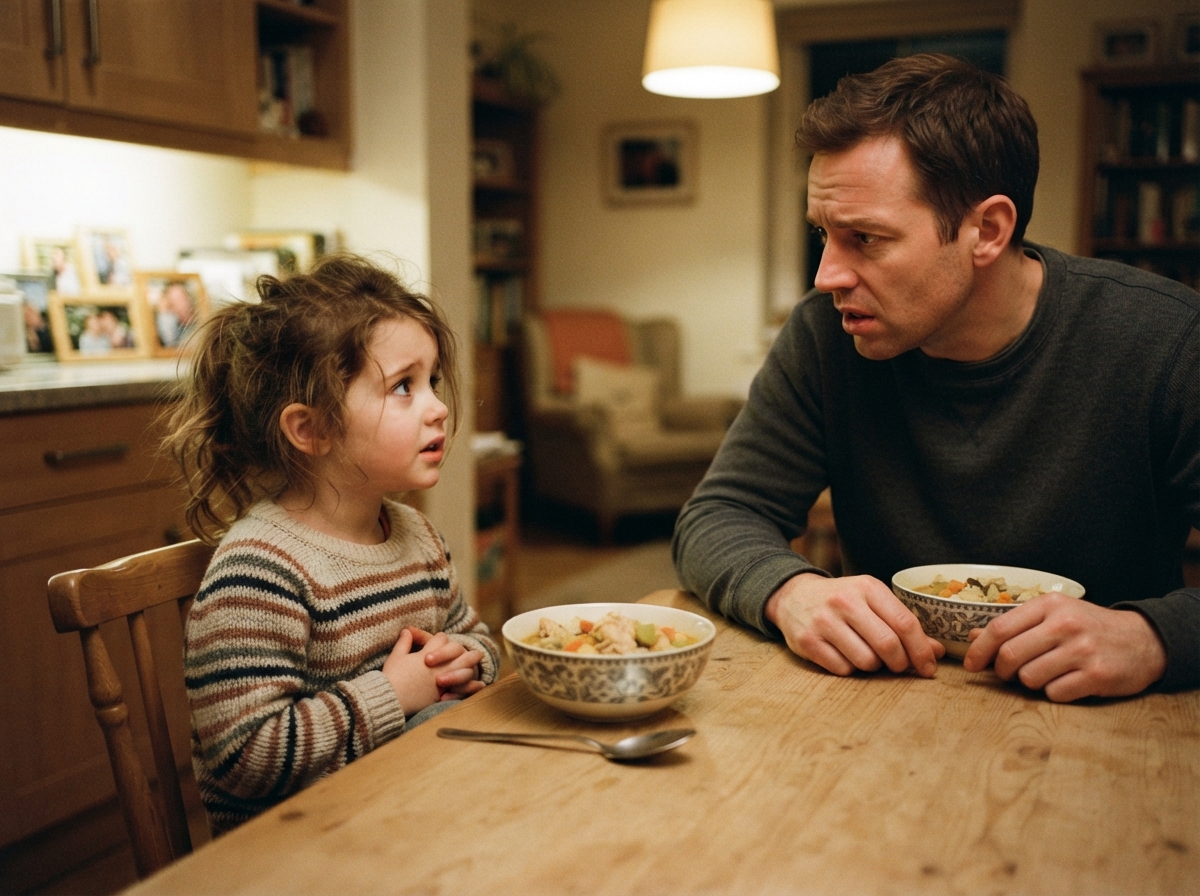
The bowl of stew.
Her hands beneath the table.
The question.
Am I allowed to eat today?
Now I understood why the question had carried so much fear.
She wasn't asking whether dinner was ready.
She was asking whether she was safe enough to take it.
When I returned home, Ruby was sitting at the kitchen table.
A bowl was in front of her.
She was eating chicken and vegetables.
Slowly.
Comfortably.
She looked up.
“Uncle?”
“Yeah?”
“I saved you some.”
I smiled.
“You did?”
She nodded.
I sat beside her.
“Thank you.”
She pushed the bowl toward me.
Then she said something that made my chest tighten.
“You don't have to ask.”
I looked at her.
“What?”
She pointed at the food.
“You can eat too.”
I laughed softly.
“That's right.”
She smiled.
For the first time, she was teaching me something.
That safety could become ordinary.
That food could simply be food.
That a kitchen could be a place where nobody was afraid.
That evening, Ruby asked for dessert.
She didn't ask whether she was allowed.
She simply said, “I want chocolate ice cream.”
I stood up.
“Coming right up.”
She smiled.
And while I scooped the ice cream, I realized the hardest part of the story wasn't what had already been uncovered.
It was what would happen next.
The evidence was real.
The recordings were real.
The tracker was real.
The list was real.
And now the people responsible would have to answer for them.
But Ruby still had to learn something much harder than identifying what had happened.
She had to learn that none of it had ever been her fault.
Click Here to continue read next: PART5: The Case Moved Forward, but Ruby’s Smallest Habits Revealed How Deeply Fear Had Shaped Her Life Long After Sergio Was Gone
I Thought Three Quiet Days With My Niece Would Mean Cartoons, Simple Meals, and Bedtime Stories Until One Question Made Everything Feel Wrong
Part 4 of 16