
The final review meeting was scheduled for a Wednesday morning, almost a year after Gérard's death. By then, the company had implemented the recommended controls, the estate had been administered according to the will, and the disputed acknowledgment remained the last unresolved piece of the financial questions that had surfaced after the transfer. I had learned to live with uncertainty, but I still wanted the review to reach a clear conclusion wherever the evidence allowed one. I asked Claire to attend and requested that the report distinguish carefully between established facts and matters that could not be resolved.
Madame Laurent arrived with the completed report and a separate document listing the remaining limitations. Daniel was present for the company, while Maître Perrin attended in his capacity as the estate's legal adviser. The atmosphere was serious but not hostile. Everyone understood that the meeting would not erase the personal damage caused by the dispute. Its purpose was to establish what the records could support and ensure that the company and estate were not left relying on assumptions.
Madame Laurent began with the disputed acknowledgment. The review had compared the available copy with verified examples of my signature, examined the emails surrounding its submission, and considered the audio recording from the villa. The evidence showed that Gérard had objected to using my name on a financial document without my knowledge and had asked for the underlying records to be verified. Mathieu had submitted the copy to the institution, but the available evidence did not establish who had created the signature or whether Mathieu knew it was invalid when he submitted it.
The report therefore concluded that the acknowledgment could not be relied upon as proof that I had knowingly accepted the financial obligation described in it. The bank had not established a basis for demanding repayment from me solely on the strength of that document. The report did not declare that Mathieu had forged my signature, nor did it claim that every related transaction had been improper. It recorded the limits of the evidence and recommended that the original document, if ever located, be examined before any further conclusion was drawn.
I listened without interrupting. The answer was narrower than the confession I had once imagined, but it was meaningful. I had spent months wondering whether I had unknowingly agreed to a debt that could threaten the security Gérard had left me. The review had established that no valid personal obligation could be demonstrated from the disputed acknowledgment. I would not be required to treat the document as a binding promise simply because my name appeared on it.
Claire asked whether the report identified any further action that should be taken by the estate. Madame Laurent said that the estate's administration had been completed according to the will, subject to the lawful liabilities already addressed. The disputed acknowledgment did not provide a basis to reopen the inheritance calculations or demand that I return the €120,000. The transfer had been authorized by Gérard, and the supporting correspondence showed that he intended it to remain separate from any unresolved financial undertaking.
I felt a deep breath leave my chest. The money had never been the true measure of my marriage, but I had feared that it might become a burden that outlasted the man who sent it. Now the review had separated the transfer from the disputed document. I could manage the money as part of my financial security without treating it as an unexplained debt waiting to be claimed.
Daniel then summarized the company's findings. Some historical transactions had been reconciled with supporting records, while others remained insufficiently documented. The review had not established that Mathieu had misappropriated company funds, and it had not identified a basis for treating every incomplete record as misconduct. The company had nevertheless adopted stronger controls because the earlier processes had allowed too much reliance on informal approvals and incomplete files. Those changes would remain in place.
The report also noted that the company should continue preserving the records connected to the disputed acknowledgment and respond to any further legitimate request for information. If new evidence emerged, it would be assessed through the appropriate process. The review was not a guarantee that no future question could arise; it was a careful account of what had been established and what remained uncertain. I appreciated that distinction more than I could explain.
When the meeting ended, Daniel walked with me to the lobby. He said the company could now focus more fully on its work, while retaining the improved procedures. I thanked him and told him that the changes had been worthwhile. The business had been built through Gérard's efforts, but it could not depend on his personal authority forever. It needed systems that would remain reliable even when the people who had created it were no longer there to explain their intentions.
Claire and I reviewed the final report later that afternoon. She explained that the conclusion protected me from the unsupported personal obligation, but it did not answer every question about how the signature had been created. If the original document appeared or new evidence emerged, the matter could be reconsidered. I told her I understood. I would preserve the report and the underlying records, but I would not spend the rest of my life searching for a certainty that the available evidence could not provide.
Mathieu contacted me that evening. He had received the report through the appropriate channels and wanted to know whether I was willing to meet. I agreed to a short conversation at the café where we had spoken before. I told Claire about the meeting, and we agreed that there was no reason to discuss the legal findings beyond what had already been documented.
Mathieu arrived looking older than he had a year earlier. He ordered coffee, then sat with his hands wrapped around the cup. For a while, we spoke about the company and the report. He acknowledged that the review had clarified the limits of what could be established, and he said he was relieved that the disputed acknowledgment could not be used to claim I had accepted the obligation. He did not claim that the report proved his innocence in every respect. He said he understood why the matter had needed to be examined.
I thanked him for saying that. I told him I was relieved too, but the process had been difficult because it had forced me to question decisions and relationships I had trusted for decades. I had not wanted him to be declared guilty of something the evidence did not establish. I had wanted to know whether I had accepted a financial obligation and whether my name had been used without my consent. The review had answered the first question and clarified the second as far as the evidence allowed.
He looked down at his coffee.
“I wish Father had told you everything while he was still alive,” he said.
“So do I.”
“He thought he was protecting everyone.”
“Perhaps he did. But protecting people by withholding information can leave them with the consequences.”
Mathieu nodded. For the first time, he did not defend his father's decision or suggest that I should have understood without being told. He said he had spent a long time believing that family members were supposed to trust one another without asking too many questions. He now understood that trust required people to be honest about what they knew and what they did not know.
I listened, remembering the years when I had treated patience as proof of love. I told him that I hoped he would carry that understanding into his future relationships. He said he intended to. Neither of us promised that our relationship would return to what it had been before the Vail trip, the will, and the financial review. We had changed too much for that to be realistic. But we were able to speak without threats or demands, and that was a beginning.
Before we parted, Mathieu asked whether I would ever forgive him for the way he had spoken to me after his father's death. He mentioned the call in which he described the transfer as a fair amount for twenty-five years of marriage. He said he had been frightened and angry, and he had tried to make the situation simple by treating the money as a final settlement.
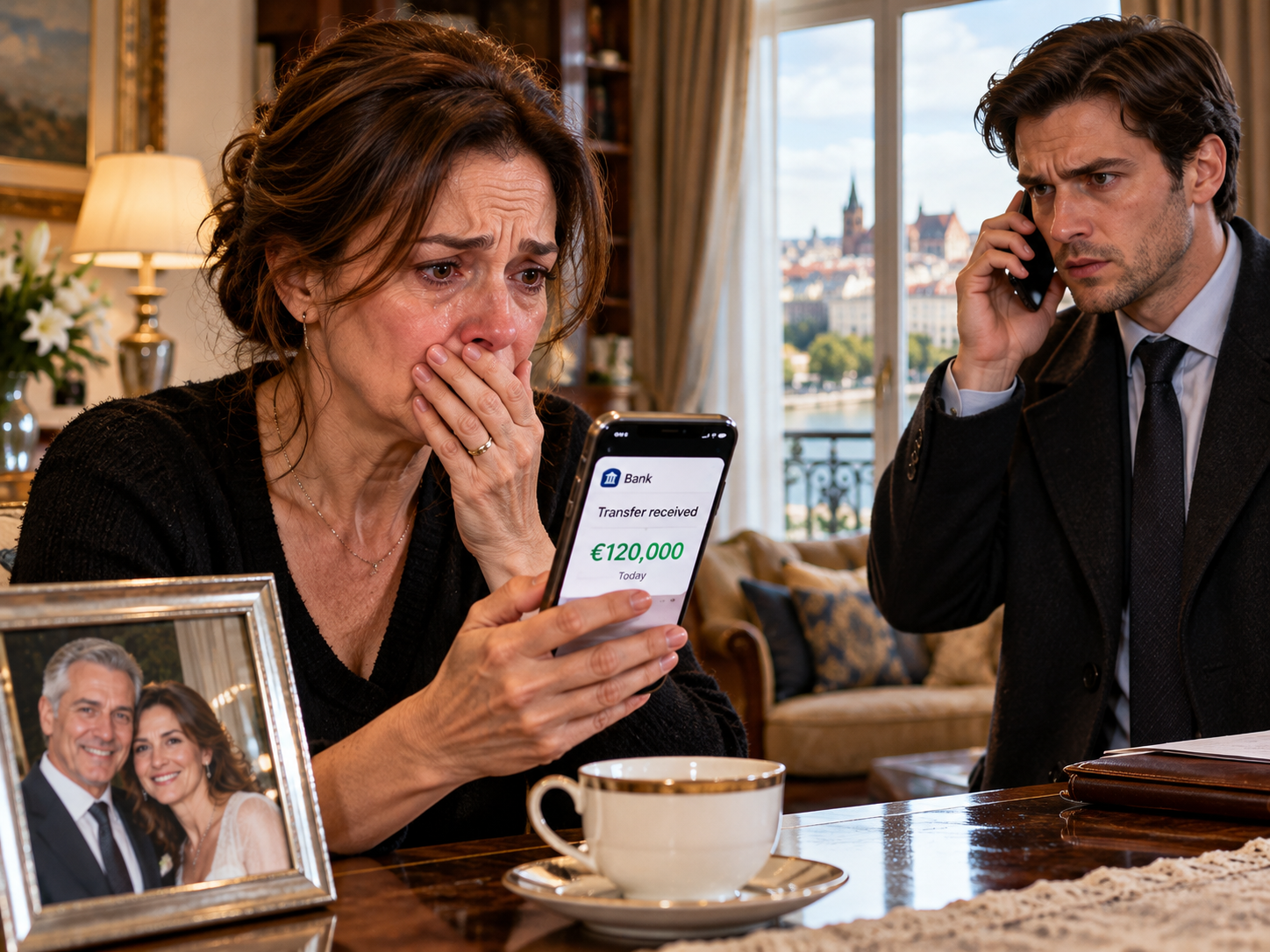
I remembered the coldness in his voice and the way I had stared at the notification, unable to believe that he had reduced my marriage to a figure.
“I can forgive the words,” I told him. “But forgiveness does not mean I will pretend they were harmless. It does not mean I will make financial decisions for you or give you the same access to my life that you once had.”
He nodded slowly. “I understand.”
I believed that he understood more than he had a year earlier, though I knew that understanding could deepen or fade depending on what he chose to do next. I did not need to guarantee the future of our relationship during that conversation. We said goodbye and went our separate ways.
Over the next few months, the company continued operating with its improved procedures. Daniel provided regular financial reports, and the board reviewed the business's performance without turning every meeting into a discussion of Gérard's final year. The unresolved historical records remained securely stored, but they no longer dominated the company's daily work. The regional expansion continued at a measured pace, and the business began preparing a new service offering based on customer demand rather than assumptions about growth.
I took an active interest in the company's direction without attempting to control every detail. I asked questions, reviewed the figures, and listened to the people responsible for each part of the operation. When I disagreed with a recommendation, I explained why. When I lacked the necessary expertise, I asked for professional advice. I was learning to be a responsible shareholder without becoming a substitute for every manager or adviser.
The properties also became easier to manage. I retained the Lyon apartment and decided to sell one of the other apartments after reviewing its costs and long-term prospects. The decision was practical, not emotional. The proceeds were placed into a diversified financial plan, and the remaining properties were managed according to their condition and performance. I postponed the decision about the villa until I could consider it without feeling that selling it would erase a piece of my marriage.
Jamie continued to build her career. She completed another stage of her training and began earning enough to support herself more comfortably. She still called me for advice occasionally, but she no longer treated my help as an automatic financial resource. When she asked whether I could review a job application, I did so. When she asked whether I would pay for an expensive course, I explained that she needed to evaluate its cost and benefit for herself. She accepted the answer without resentment.
Our relationship had become more balanced. We could talk about family memories without turning them into arguments about the inheritance. She could acknowledge that the Vail trip had been unfair to me without needing me to condemn every member of the family. I appreciated the progress, but I did not confuse it with a return to the old arrangement. We were building something new, and it was healthier precisely because it did not depend on me paying for closeness.
Brigitte remained more distant. She sent occasional messages about family occasions and sometimes asked whether I planned to attend. I answered honestly. If I wanted to go, I went. If I had other plans, I declined. We did not become close, but the conversations grew less hostile. She eventually stopped asking me to provide statements about Mathieu or to promise that the review would never be reopened. Perhaps she had accepted that I would not make declarations beyond the evidence. Perhaps she had simply grown tired of arguing. Either way, the pressure eased.
One afternoon, I received a letter from the former administrative assistant who had forwarded Gérard's handwritten notes. She thanked me for confirming that the documents had reached the proper people and said she was glad the records had been preserved. I replied with a brief note of thanks. Her small act of forwarding the envelope had helped clarify the chronology, even though it had not solved every question. It reminded me that responsible actions did not always produce dramatic outcomes. Sometimes they simply prevented important information from disappearing.
I visited the villa near Annecy again before deciding its future. The repairs had been completed, and the garden looked neat. I walked through the study, the dining room, and the terrace where we had once spent summer evenings. I remembered Gérard's laughter, Mathieu's childhood questions, and the quiet afternoons when I had read beside the window while the two of them discussed business. The memories were real, and they mattered. But the property no longer felt like a duty I had to preserve at any cost.
I decided to keep it for the time being and review the decision after another year. The costs were manageable, and I liked having a place where I could spend a few days away from the city. I arranged for the property manager to maintain it, set a clear budget, and made sure the necessary documents were stored securely. I was not keeping the villa to honor Gérard's every wish. I was keeping it because I wanted to see whether it could have a useful place in the life I was building.
On the drive back to Lyon, I thought about the final review. It had not revealed a villain whose every action could be condemned or a perfect explanation that made the family whole again. It had established that I had not knowingly accepted the disputed financial obligation, that the transfer had been intended as a separate provision for my security, and that the company needed stronger procedures. It had left some questions about the signature unresolved because the evidence did not support a definitive answer.
For a long time, I had believed that a story needed a complete explanation before its characters could move forward. Real life had taught me otherwise. Sometimes the most honest conclusion was that certain facts were known, certain possibilities remained unproven, and the future still had to be lived.
I had loved Gérard. I had cared for Mathieu. I had endured Brigitte's contempt and accepted responsibilities that were not always mine. None of those truths canceled the others. I could honor the years I had given without agreeing that they had purchased my silence. I could accept the inheritance without believing it was a payment for my marriage. And I could forgive what I was ready to forgive without pretending that trust had returned automatically.
The €120,000 remained in my account, a reminder of the morning when my husband's death had been followed by a transfer I could not understand. It no longer felt like a curse. It was a financial provision whose purpose had been clarified through records and professional review. The will had established my place in the estate, and the review had protected me from treating an unsupported document as a binding promise. Those outcomes mattered, but they were not the measure of my worth.
The greater change was that I had stopped waiting for the Delmas family to decide whether I belonged. I could continue speaking to Mathieu, Jamie, or Brigitte when it felt right. I could decline their requests without treating their disappointment as proof that I had failed. I could manage the estate responsibly and build a future that reflected my own needs.
One evening, I stood in the living room and looked at the photograph of Gérard above the fireplace. I did not feel the need to remove it, nor did I feel compelled to preserve it as the center of the room. It was a photograph of a man I had loved, and it could remain that. His final decisions had revealed care, fear, and mistakes. I could remember all three without allowing any of them to dictate what I did next.
I turned away from the photograph and opened the window. The evening air moved through the room, carrying the sounds of Lyon from the street below. I had spent months waiting for the last document to settle the past. Now I understood that the documents had done what they could. The rest belonged to me.
I would keep the truth where the records supported it, leave the unresolved questions where they belonged, and stop sacrificing my peace to make the family comfortable. Gérard's final gift had given me security. The inheritance had given me choices. The review had taught me to trust evidence rather than pressure.
What I did with those gifts was finally mine to decide.
Click here to continue reading: PART 13: I Returned to the Place Where Our Marriage Began, Hoping to Understand the Woman I Had Become After Twenty-Five Years Beside Gérard
My Husband Left Me €120,000, but His Son’s Call Made Me Fear What That Money Was Really Meant to Hide
Part 12 of 20


One Comment on “PART 12 – The Final Review Answered the Question Gérard Had Left Behind, but the Truth Required Me to Let Go of the Family I Had Tried to Save”