
Eleanor's message arrived on a Tuesday morning. She explained that she had been going through a few boxes of Jonathan's belongings and had found several items she thought I might want to see. She asked whether I would be willing to come to the mansion one afternoon to look through them.
I read the message twice. There was no demand, no reminder that the house belonged to her, and no suggestion that I owed her a visit. She had even added that she could send photographs instead if I preferred not to come.
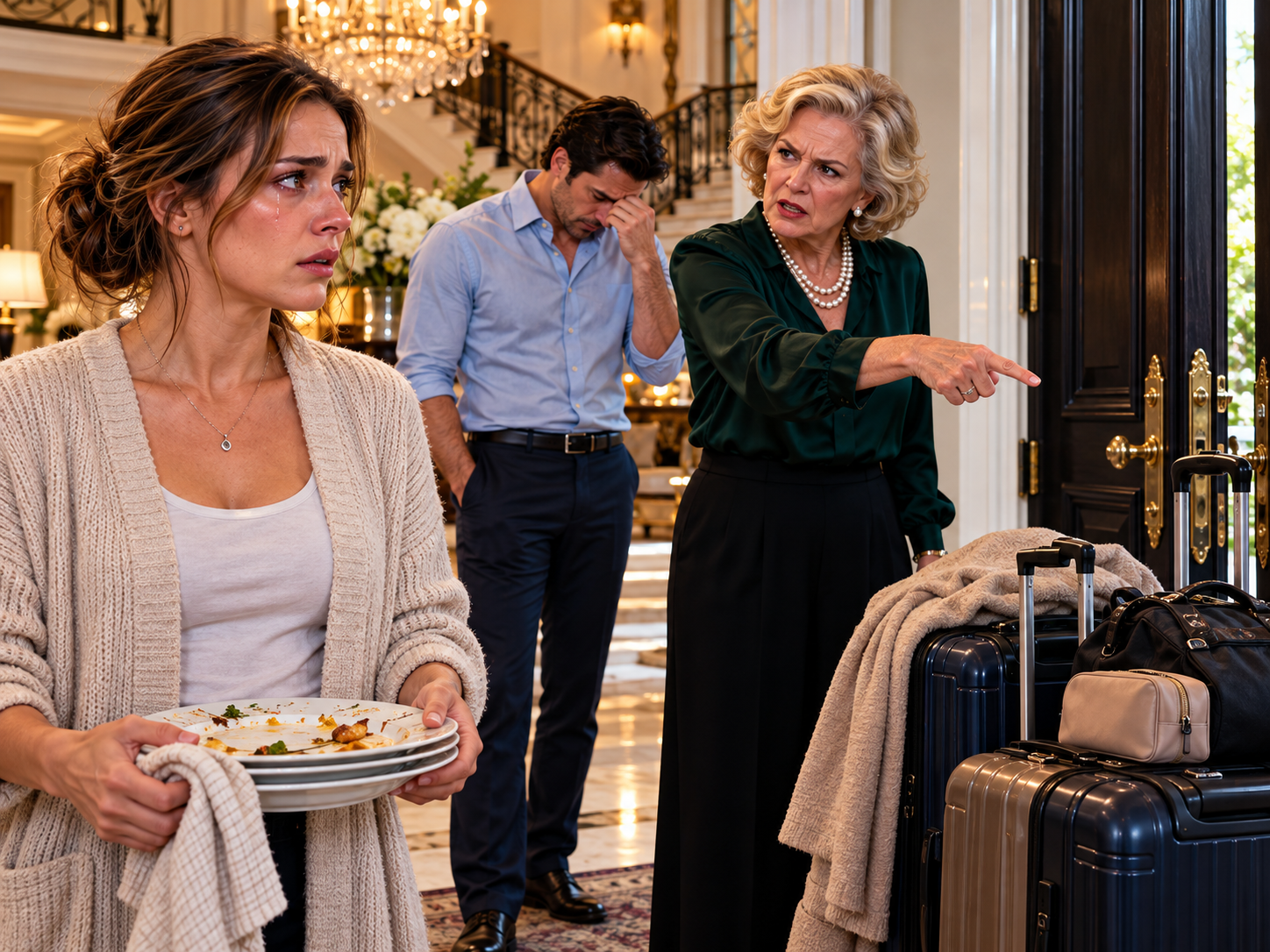
For a moment, I considered asking Michael to collect the items for me. That would have been easier. I could avoid walking through the front door, avoid seeing the dining room, and avoid the memories that still surfaced when I pictured the suitcases standing in a neat row beside the entrance.
But Jonathan had mattered to me in his own right. He had treated me with kindness without making me prove that I deserved it. I did not want the last years of his life, or the things he had left behind, to become inseparable from the conflict that followed his death.
I answered that I would come, provided we could agree on a time and keep the visit focused on his belongings. Eleanor replied that Thursday afternoon would suit her.
I told Michael about the arrangement. He asked whether I wanted him to be there.
“I don't think so,” I said. “I'd rather see what it feels like to go on my own.”
“All right.”
“If I need help carrying anything, I'll ask.”
“Of course.”
He did not remind me that Eleanor was trying, or tell me that the visit might be good for our relationship. He accepted the boundary without turning it into a discussion about what the visit meant.
On Thursday, I drove to the mansion shortly after two. The familiar street looked much as it always had. The front garden had been trimmed, and the stone path was clean. I parked near the entrance and sat in the car for a moment, looking at the house.
It was still an impressive building. The windows caught the afternoon light, and the front steps had been repaired where a corner had chipped. I could understand why Jonathan had wanted the property preserved. It held decades of family history, much of it good. But looking at it from the car, I no longer felt that its beauty gave it the right to define my life.
I got out, took a breath, and walked to the door.
Eleanor opened it before I knocked a second time.
“Thank you for coming,” she said.
“Thank you for letting me know about the boxes.”
She stepped aside. “They're in the sitting room. I thought it would be easier to look through them there.”
I entered and hung my coat on the hook near the door. For a brief second, I remembered the evening I had left, the packed suitcases and the cold certainty that no discussion would change the decision already made. The memory arrived sharply, but it did not swallow the present. I was here by choice, with my own car outside and my own apartment waiting for me afterward.
Eleanor led me to the sitting room. Two cardboard boxes sat on a low table beside a smaller wooden case. She had arranged several photographs and envelopes nearby.
“I haven't gone through everything,” she explained. “Some of it belongs with the estate records, and some of it is personal. I didn't want to decide what should happen to it without asking.”
“That seems sensible.”
We began with the photographs. There were pictures of Jonathan in the garden, standing beside a tree that had since grown much taller, and one of him holding a fishing rod beside a lake. I remembered him telling me about the trip. He had spent most of the morning untangling his line and only caught a small fish, which he described afterward as a generous contribution to the lake's population.
I laughed softly at the memory.
“He was pleased with that picture,” Eleanor said. “He thought it made him look more capable than he had been.”
“He told me the same thing.”
For the first time since I had entered the house, we shared a memory without either of us using it to make a point. The moment was small and almost comfortable.
We found an old notebook filled with Jonathan's handwritten lists, several receipts, and a folder containing papers that Charles would need to review before anyone decided whether they belonged with the estate records. I set those items aside carefully. Neither Eleanor nor I tried to interpret them or make assumptions about their legal importance.
Then I found a photograph of Jonathan and me at the kitchen table. He was pointing at something on a page while I leaned toward him, laughing. I remembered the afternoon. I had been trying to understand a recipe, and he had insisted that the instructions were unnecessarily complicated.
“You should take that one,” Eleanor said.
“Are you sure?”
“Yes. I have other photographs of him.”
I slipped it into the envelope I had brought. The gesture touched me more than I expected. Eleanor was not giving me the house or undoing the way she had treated me. She was simply recognizing that my memories of Jonathan were mine.
As we continued, we came across a small box of personal effects. Inside were a watch, a pair of reading glasses, and a fountain pen with a scratched black barrel. Eleanor picked up the pen and turned it over in her hand.
“He used this for years,” she said. “He wouldn't replace it, even when it started leaking.”
“He said it had earned the right to be unreliable.”
A reluctant smile crossed her face. “That sounds exactly like him.”
She set the pen down gently.
After a few minutes, Eleanor moved to the window and looked out toward the garden. I continued sorting through the papers, giving her time without feeling obliged to fill the silence.
“I was worried you might never want to come here again,” she said at last.
I placed a stack of photographs into the envelope. “I don't know whether I'll want to come back often. But I didn't want to avoid everything connected to Jonathan because of what happened between us.”
She nodded.
“I understand that now,” she said. “Or at least, I'm trying to.”
I looked at her. “What do you understand?”
“That I made it difficult for you to separate the house from your place in the family. I thought if I controlled the house, I could keep everything else from changing. I didn't consider that you might feel you had no secure place at all.”
I let her words settle before answering.
“That was how it felt.”
“I know.”
She did not immediately explain why she had behaved that way. She did not ask whether I could forgive her. I appreciated that she allowed the acknowledgment to stand on its own.
We finished sorting the boxes. I took the photograph, a few personal notes Jonathan had written to me, and a small envelope of pictures from the garden. The remaining items would be separated between family keepsakes and records that needed to be reviewed properly. I did not leave with anything that might complicate the estate process, and Eleanor did not suggest that I should.
When I stood to leave, she asked whether I would like to see the garden before going.
I hesitated, then agreed.
We walked through the back door and onto the patio. The garden was tidy, though a few branches had grown across the edge of the path. The old tree Jonathan had planted stood near the fence, its leaves moving gently in the breeze.
“He was proud of that tree,” Eleanor said.
“He told me it would outlive all of us if we stopped trying to make it grow faster.”
She gave a quiet laugh. “He was always saying things like that.”
We stood beside the tree for a minute. I felt affection for the place, for the memories held in it, and even for Eleanor's willingness to share them. But the affection no longer confused me into believing that I needed to live here.
When we returned to the entrance, Eleanor handed me my coat.
“Thank you for coming,” she said again.
“You're welcome.”
She seemed to want to say something else, but she did not force it. I opened the door, stepped outside, and walked to my car.
As I drove away, I glanced once at the mansion in the rearview mirror. I did not feel that I had reclaimed it, and I did not feel that I had abandoned it. I had simply visited a place that had once been part of my life, collected a few things that mattered, and left when I was ready.
At home, I placed the photograph of Jonathan and me on the shelf beside the others. I put his handwritten notes in a drawer where I could read them whenever I wanted. The fountain pen remained at the mansion, where it belonged among the family belongings.
I made dinner and sat by the window afterward, thinking about how the visit had gone. Eleanor had behaved respectfully. I was glad of that. But I did not turn the afternoon into a promise that our relationship would become close again.
A single good afternoon could be exactly that: a good afternoon.
It did not have to become evidence for a future I had not chosen.
Click here to continue reading: PART 19: The Last Estate Meeting Confirmed That Jonathan’s Wishes Had Been Respected, but It Was My Own Decision That Finally Freed Me From the Mansion
My Mother-in-Law Had Packed My Life Into Two Suitcases, but the Question My Husband Refused to Answer Was Only the Beginning
Part 18 of 20

