
The first time Michael and I met after the review was over, he arrived twelve minutes early and waited outside the café rather than taking a table without me. I noticed the difference before he said a word. In the past, he would have ordered for both of us, chosen the quietest corner, and explained afterward why he thought it was best. Now he stood near the window with his hands in his coat pockets, watching the pavement until he saw me.
“Would you rather sit inside or outside?” he asked.
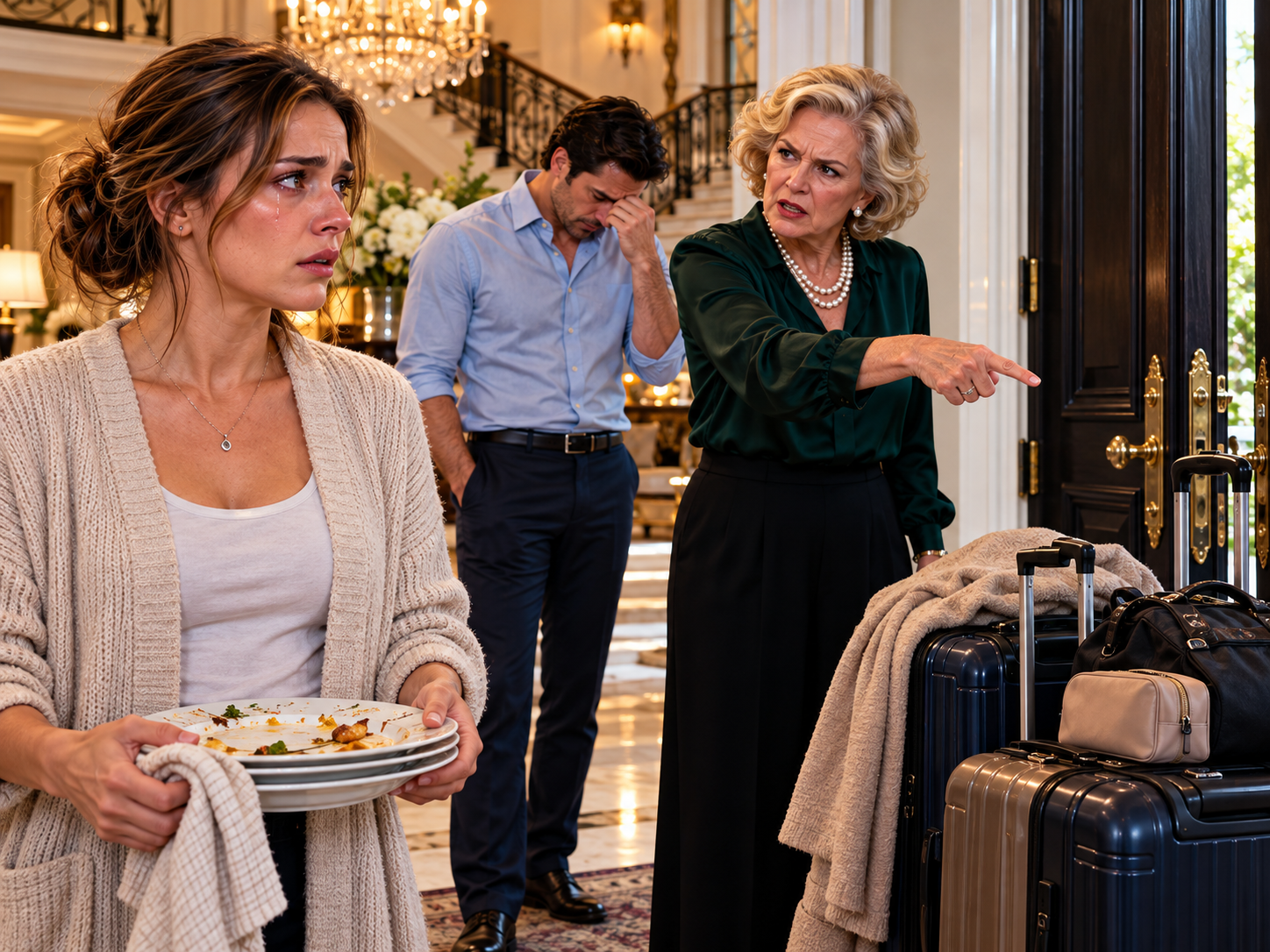
It was such an ordinary question that I nearly laughed. Five years earlier, I would have considered it a small kindness. After the night he had packed my suitcases, it felt like evidence of how much he had assumed he could decide on my behalf.
“Inside,” I said.
He held the door open, then let me choose the table. We ordered coffee and sat across from each other while people passed the windows carrying shopping bags and umbrellas. The sky threatened rain, and a cold draft slipped beneath the door every time someone entered.
Michael looked tired, but not in the way he had looked at the mansion. There, exhaustion had been an excuse to withdraw from any conversation that made him uncomfortable. Now he seemed to be making an effort to remain present, even when he did not know what to say.
“I’ve been thinking about the meeting with Margaret,” he began.
“So have I.”
“I keep going back to the questions she asked me. Whether I packed your things. Whether you asked me to. Whether I spoke to you before deciding.”
“You knew the answers before she asked.”
“I did.” He rubbed his thumb along the paper sleeve around his cup. “But I had never heard myself say them plainly. I kept describing what happened as a difficult situation with Mom. That made it sound like something that had happened to both of us. It wasn’t. I made a choice.”
I watched him carefully. He was not asking me to tell him he was a good person for recognizing it. That alone was different.
“You made a choice because it was easier for you,” I said.
“Yes.”
“And you expected me to absorb the consequences.”
“Yes.”
The honesty did not erase the anger I felt. It simply removed the familiar obstacle of having to argue with him about what had happened before we could discuss anything else.
He told me that he had attended three counseling sessions. His counselor had asked him to describe the first time he remembered being afraid of disagreeing with his mother. He had spoken about childhood dinners when Eleanor would become silent after someone challenged her, sometimes for days. Michael learned to apologize quickly, even when he did not believe he had done anything wrong. Eventually, he stopped distinguishing between keeping the peace and surrendering his judgment.
“I used to think I was avoiding conflict,” he said. “But I was deciding that your feelings were the easiest ones to sacrifice.”
I looked down at my coffee. The sentence was painful because it was accurate, not because it was eloquent.
“Understanding why you did something is not the same as repairing it,” I told him.
“I know.”
“Do you? Because every time you tell me something you learned in counseling, I worry you’ll expect me to treat it as proof that everything is different.”
He shook his head. “I don’t want you to do that. I need to change whether we get back together or not.”
That was the first statement from him that allowed my future to remain my own. I appreciated it without offering him reassurance.
We spoke for another half hour. He asked about my apartment and listened while I described the stubborn radiator and the shelf I had finally assembled without help. When he offered to bring over a toolbox, he added, “Only if you want me to.” I told him I had already borrowed one from a neighbor. He accepted the answer without insisting that he could do the job better.
Afterward, we walked together as far as the corner. He did not reach for my hand. We said goodbye, and I drove home alone.
For the first time, I did not spend the evening replaying every word, trying to decide whether the conversation meant we were moving toward reconciliation. It had been one conversation. It could be followed by better ones, or it could remain the only honest exchange we managed. I did not have to decide what it meant before going to bed.
Two days later, Michael called while I was preparing dinner.
“Mom wants to meet,” he said.
I turned down the stove. “About what?”
“She says she wants to talk about what happened.”
“Has she asked to speak to me?”
“She asked whether I could bring you over on Sunday.”
“Those are two different things.”
He went quiet. I could hear a television playing somewhere behind him.
“She said it would be easier if I brought you,” he admitted. “She thinks we should all sit down and put the whole thing behind us.”
“And what do you think?”
“I told her I would ask you. I didn’t say you would come.”
I leaned against the counter. “What did she say when you told her that?”
“She said I was making a simple conversation unnecessarily complicated.”
Of course she had. Eleanor had spent years treating my boundaries as inconveniences and my objections as evidence that I was difficult. Now, even after the formal review, she expected the family to return to the old arrangement with a conversation that required no acknowledgment of what had gone wrong.
“I’m not ready to visit her,” I said.
“I understand.”
“Do you? If I say no, I don’t want you going back and telling her I’m being stubborn. I don’t want you asking me again tomorrow because she’s upset. And I don’t want you promising her we’ll reconcile before we’ve even decided what that means.”
“I won’t.”
I paused, waiting for the qualification that had always followed his promises. It did not come.
“Then tell her I’m not ready,” I said.
He called his mother that evening. I learned what happened because he phoned me afterward, not because Eleanor sent a message through the family group chat.
“She was angry,” he said. “She told me you were letting the legal dispute poison the family.”
“And what did you say?”
“I told her the review was over, but that didn’t mean you had to pretend nothing happened. I said you had the right to decide whether you wanted to see her.”
I sat at my table, my dinner untouched. “How did she take that?”
“She asked me whether I was choosing you over her.”
The question was so familiar that I could almost hear Eleanor asking it in the kitchen, her voice low and controlled, as though the answer were a test of loyalty.
“What did you tell her?”
“I said this wasn’t supposed to be a choice between you. But if she needed me to agree that you had no right to be upset, I couldn’t do that.”
I closed my eyes. I had imagined Michael defending me for years. I had pictured grand declarations, raised voices, and dramatic confrontations in which he finally told his mother she could not treat me that way. What he had actually done was less theatrical: he had refused to repeat her version of events.
It was a beginning, not a victory.
“She told me I’d changed since you left,” he continued.
“Have you?”
“I hope so. But I don’t want to use that as an argument for why you should come back.”
I thanked him for telling me the truth and ended the call. Afterward, I stood by the sink for a long time, watching steam rise from the pot. The old instinct was still there: to comfort him, to reassure him that he had done the right thing, to make his difficult conversation easier by taking care of his feelings.
I let the instinct pass.
A week later, an envelope arrived from Eleanor. I recognized her handwriting before I picked it up. The letter inside was brief. She wrote that she regretted the way events had unfolded and that she hoped the family could move forward without continuing to revisit old disagreements. She mentioned the review, the financial accounting, and the need to respect the estate arrangements. She did not mention the suitcases or the message in the family group chat.
At the end, she invited me to lunch at the mansion.
I read the letter twice, then placed it beside Jonathan’s note. Eleanor had acknowledged the formal consequences. She had not yet acknowledged the personal harm.
I wrote back that I was not ready to visit, but that I appreciated her sending the letter. I did not accuse her of anything, and I did not pretend we were reconciled. The reply took less than five minutes to write.
For the rest of the week, nothing happened. No angry telephone call arrived. No relative contacted me to ask why I was punishing Eleanor. I began to suspect that Michael had finally stopped carrying messages between us, at least for the moment.
Then, on Friday afternoon, Charles called with a practical question about the estate file. He explained that the formal review had been completed, but that certain records needed to remain available in case questions arose about the reserve’s restoration. He wanted to confirm that I had kept copies of the documents relating to the residence agreement.
I told him I had.
“Good,” he said. “Keep them somewhere safe. The financial matter has been handled according to the findings, but clear records are important. They protect everyone from later confusion.”
After we finished, I asked whether Jonathan had left anything else that I should know about.
“Nothing that changes the outcome we discussed,” Charles replied. “The agreement did what it was intended to do. It established a process and made sure the obligations were taken seriously. It was never meant to settle every personal disagreement within the family.”
“I know.”
“Jonathan understood that legal protection has limits. He hoped the family would use it as a reason to behave better, not as a substitute for doing so.”
I thanked him and put the phone down.
That evening, I took Jonathan’s photograph from the bookcase and looked at it in the fading light. I no longer saw the image as a promise that someone would rescue me. Jonathan had made arrangements that helped me when I needed them, but he had not been able to live my life for me. He had left me a way to challenge an unfair decision. I still had to decide what to do with the freedom that followed.
Michael sent a message just before nine.
“Mom asked me to tell you that Sunday lunch is still open if you change your mind. I told her I wouldn’t pressure you. I’m sorry she keeps putting me in the middle.”
I typed a reply, then deleted it. I did not want to reward him for feeling uncomfortable, nor did I want to punish him for finally recognizing the pattern. After a moment, I sent a simple answer.
“Thank you for not pressuring me. I’ll decide for myself when I’m ready.”
He responded with a single acknowledgment.
I put my phone away and returned to my book. The decision about Sunday lunch remained unresolved, but it no longer felt like a decision I had to make to keep the family together. Eleanor could invite me. Michael could decide how to respond to her. I could decide whether I wanted to go.
That was the part of my life I was learning to protect.
Click here to continue reading: PART 6: A Family Gathering Went Ahead Without Me, and the Message Michael Sent Afterwards Revealed How Much of the Old Arrangement Still Remained
My Mother-in-Law Had Packed My Life Into Two Suitcases, but the Question My Husband Refused to Answer Was Only the Beginning
Part 5 of 20

