
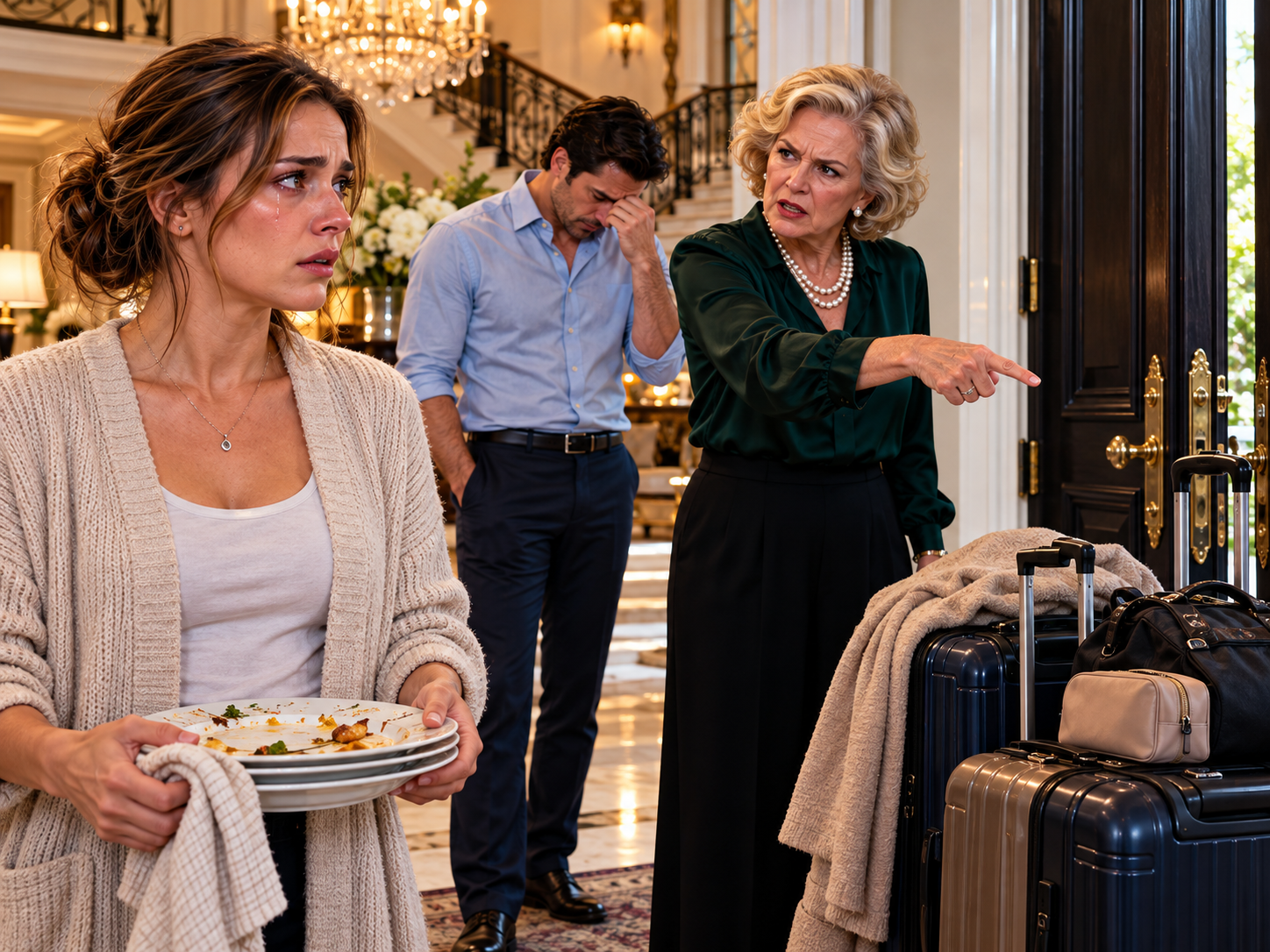
“Your bags are ready, Lisa. There’s no reason to make this uglier than it needs to be.”
Eleanor Richardson delivered the announcement as if she were reminding me that the dry cleaner would close at six. I stood beside the kitchen sink with three dinner plates balanced against my forearm. The dishwasher rumbled beneath the counter, and the last traces of roast chicken and rosemary hung in the warm air. At the dining table, my husband, Michael, stared into his coffee as though something important might appear at the bottom of the cup.
For a moment, I thought I had misunderstood her.
“Which bags?”
Eleanor tilted her chin toward the hallway. “Yours.”
I followed her gaze. Two suitcases stood upright beside the front door, their handles extended. My winter coat had been folded over one of them. The canvas overnight bag I kept beneath our bed sat on top, its zipper closed. Someone had even placed my small toiletry case beside the shoes lined against the wall.
Someone had gone into our bedroom, opened my drawers, chosen what I would need, and packed it without asking me.
I looked back at Michael. “Did you do this?”
His fingers tightened around the coffee cup. He was still wearing the pale blue shirt he had put on for dinner, though the collar had loosened and one sleeve was creased where he had pushed it to his elbow.
“Lisa, please,” he said.
“Please what? Tell me you didn’t pack my clothes? Tell me your mother didn’t decide where I’m supposed to sleep tonight?”
He rubbed his forehead. “Mom thinks we need some distance.”
“We?”
The word came out quieter than I intended. I had spent five years learning that a quiet question could sometimes expose more than a raised voice. Michael finally lifted his eyes, but only for a second.
“I don’t want to fight with you.”
“You’ve already made the decision. You packed my things before I even knew there was a decision to make.”
Eleanor picked up the silver serving spoon from the island and returned it to its tray. She was wearing a dark green blouse and the pearl earrings she reserved for evenings when she expected company. Her hair had been arranged in its usual smooth sweep. Nothing about her suggested that she had just ordered her daughter-in-law out of the house.
“This is my home, Lisa,” she said. “It has been in the Richardson family for generations. I’m entitled to decide what happens under my roof.”
I had heard some version of those words so many times that I could almost recite them with her.
When I first moved into the mansion after marrying Michael, Eleanor had explained that the arrangement was temporary. She said it would be practical to live together while Michael helped her manage the property and while we saved for a home of our own. I had agreed because the house was beautiful, because Michael assured me it would work, and because I believed that joining a family meant learning how to make room for one another.
The years that followed taught me how one person could occupy every room in a house while making another person feel as though she were taking up space.
I was allowed to cook in the kitchen, provided I put everything back where Eleanor wanted it. I could invite friends for coffee, but I was expected to ask permission first. The antique china was never to be used without her approval, even when I offered to prepare the family’s holiday dinners. If guests complimented a meal, Eleanor smiled and told them she had always been particular about the quality of food served in her home.
When a plumber praised the way I had organized the pantry, she rearranged the shelves the next morning.
She never had to say I was unwelcome. She found smaller ways to remind me.
Michael had watched all of it. Sometimes he would squeeze my hand beneath the table, promising to speak to his mother later. Sometimes he would tell me she was set in her ways, that arguing with her only made things worse, that we should be patient until we had enough money to move out.
But later rarely came. Patience became the arrangement, and I was always the one expected to provide it.
Now I understood that the two suitcases in the hallway were the final version of that arrangement. Eleanor had made her decision, and Michael had helped her carry it out before giving me the courtesy of knowing.
I set the plates down on the counter. Their edges struck the stone with a sharp clatter that made Michael flinch.
“How long have you known?” I asked him.
He looked at his mother before answering. That small movement hurt more than the packing.
“We talked about it this afternoon.”
“And you agreed?”
“I thought if you stayed somewhere else for a few days, things might calm down.”
“What things, Michael? Nothing happened today. We ate dinner. I cleared the table. Your mother decided she was finished having me here, and you packed my belongings.”
Eleanor’s mouth tightened. “You’re making yourself sound like a victim. I have been more than generous with you.”
“I’ve lived here for five years.”
“Without ever having to maintain a property of this size on your own.”
“I paid toward the household expenses. I handled appointments with contractors. I spent weeks arranging repairs after the upstairs bathroom flooded. I cooked for your guests, looked after the garden when you were away, and helped you prepare the house for the estate appraiser.”
“And you were able to do those things because you had a roof over your head.”
The answer came so smoothly that I knew she had rehearsed it, at least in her own mind.
Michael pushed his chair back slightly. “Can we please stop?”
I turned toward him. “I’m asking you one question. Do you want me to leave?”
He opened his mouth, then closed it.
Eleanor answered for him. “What Michael wants is peace. Something you seem determined to prevent.”
I had once imagined that marriage would mean having someone beside me when the rest of the world misunderstood me. I had not expected to find myself standing in his childhood kitchen, arguing for the right to be treated with basic consideration while he sat a few feet away and let his mother speak for him.
I took off my wedding ring, then stopped before setting it on the counter. The movement was instinctive, and the sight of the band in my palm startled me. I slipped it back onto my finger.
Not because I had forgiven him. Because I did not want to make a decision about my marriage in the same minute I had discovered what my husband was capable of.
I went to the hallway and lifted the smaller suitcase. It was heavier than it looked. The handle rattled against the frame, and one of its wheels caught on the edge of the runner. Michael stood up as though he might help me, but Eleanor said something under her breath, and he remained where he was.
I looked back once.
“Are you really going to watch me walk out without even telling me why?”
Michael’s gaze dropped to the floor.
There it was. No explanation, no apology, not even the courage to look directly at the woman he had promised to stand beside. His silence was so complete that I no longer needed him to speak.
I carried the suitcase outside. The evening air was cool, and the porch lights cast long yellow shapes across the driveway. My car sat near the stone fountain, where I had parked it after returning from the grocery store that afternoon. Through the front windows, I could see Eleanor moving around the kitchen. Michael had already disappeared from view.
I loaded the bags into the trunk, sat behind the steering wheel, and kept both hands in my lap. The mansion rose beyond the windshield, all lit windows and pale stone, an expensive, imposing structure that had gradually become a place where I measured every word before speaking.
I had tried to belong there. I had tried to make life easier for Michael, to earn Eleanor’s respect, to believe that if I were patient enough, she would eventually stop treating my presence as a favor she could withdraw.
The house had taken five years from me in a thousand small ways. That evening, it had tried to take the last of my dignity as well.
I started the engine, then switched it off again.
A voicemail notification appeared on my phone. I had seen it three days earlier and forgotten to return the call. The name on the screen was Charles Harrison, the attorney who had handled the Richardson family’s estate matters for decades.
I pressed play.
“Lisa, it’s Charles Harrison. I’m reviewing some older papers relating to Jonathan Richardson’s estate, and I’ve come across a provision I’d like to discuss with you directly. Nothing needs to be done immediately, but I would appreciate speaking with you before anyone makes changes to the current arrangements. Call me when you can.”
Jonathan, Michael’s father, had died two years before Michael and I married. I remembered him as a thoughtful man who had spoken softly but paid attention to everything. At family dinners, he had often asked me questions that were not merely polite. He remembered my answers, too.
He had been kinder to me than Eleanor ever was, although his health had declined before I had known him very long. In the months before his death, he sometimes seemed troubled by disagreements within the family. Once, after Eleanor corrected me in front of a group of guests, Jonathan had waited until we were alone in the garden and apologized for the way she spoke to me.
“You shouldn't have to earn the right to be treated decently,” he had said.
I had thanked him, then changed the subject. At the time, I thought he was offering sympathy, not warning me about something that might one day matter.
Now, sitting outside the house with my belongings packed into the trunk, I played the message again. Charles’s careful phrasing sounded different in the dark. A provision. Current arrangements. Before anyone makes changes.
I called him.
He answered after the second ring. “Lisa?”
“I’m sorry I didn’t return your message earlier. I need to ask you something. If someone has been living in a house under a family arrangement, can they simply be ordered out?”
He paused. “That depends on the arrangement, the property’s legal status, and the circumstances. Why are you asking?”
I told him what had happened. I described the suitcases, Michael’s silence, and Eleanor’s insistence that I had been nothing more than a guest. I did not cry. By the time I finished, the words had become strangely easy to say, as if the decision had already been made somewhere inside me and my mouth was only catching up.
Charles did not interrupt.
“Did Eleanor ask you to sign any documents tonight?” he asked when I finished.
“No. She just told me to leave.”
“Has anyone given you a written notice or asked you to sign something acknowledging that you have moved out voluntarily?”
“No.”
“Good. Please do not sign anything or agree to anything about your residence until we have reviewed the relevant papers. Can you come back to the house tomorrow morning at nine?”
I looked through the windshield at the illuminated front door. “You want me to return there?”
“I do. I’ll come with you. There are documents Jonathan arranged before he died that may be relevant to what you’ve described. I need to examine them in the proper context before I tell you what they mean.”
“Does Eleanor know about them?”
“I don’t know what she remembers or what she has been told. That is one reason I want to review the originals rather than speculate over the telephone.”
I felt the first clear sensation of the evening that was not humiliation or anger. It was uncertainty, but this time it did not feel like weakness. There was something I had not known, something Jonathan had arranged, and Charles believed it mattered enough to meet me at the house.
“I’ll be there at nine,” I said.
“Bring your marriage certificate if you have it readily available. And if Jonathan ever gave you a letter or document to keep, bring that too. Don’t search the house tonight. Just bring what you already have.”
I thanked him and ended the call.
I had no reason to believe that one old file could undo five years of family behavior. I did not know whether the papers would give me any rights at all. Charles had promised no victory, and I was not going to invent one for myself simply because I needed something to hold on to.
But Eleanor had assumed that sending me away was an uncomplicated act of authority. Michael had helped her do it. Neither of them had bothered to ask what Jonathan might have put in writing before he died.
I drove to a small hotel near the highway, checked in under my own name, and carried my overnight bag upstairs. The room smelled faintly of disinfectant and old carpet. A traffic signal blinked red through the curtains. I sat on the edge of the bed, still wearing the clothes I had cooked dinner in, and stared at the blank television screen.
At 10:17, my phone buzzed.
The Richardson family group chat had a new message from Eleanor.
“Lisa has decided to stay somewhere else for a while. We’re giving her the privacy she needs and hope everyone will respect that.”
The wording made my stomach tighten. She had taken a decision she had made for me and turned it into a choice I had supposedly made myself. A moment later, Michael reacted to the message with a thumbs-up.
I looked at the little symbol for a long time. It was such a small gesture, almost childish. Somehow, it managed to say everything he had refused to say in the kitchen.
I opened his private conversation. My first instinct was to ask how he could do this to me. My second was to demand that he tell the family what had really happened. Both messages would have given him another chance to hide behind an explanation.
Instead, I typed one sentence.
“I’ll return at nine tomorrow morning, and Charles Harrison will be coming with me.”
The message showed as read almost immediately.
For several seconds, the screen remained blank beneath it. Then the typing indicator appeared, vanished, and did not return.
I put the phone facedown on the bedside table.
For the first time in five years, I had stopped asking Michael to speak up for me. In the morning, I would find out whether Jonathan had left anything behind that could speak for itself.
Click here to continue reading: PART 2: The Family Attorney Arrived With an Old Brown Folder, and My Mother-in-Law Recognized the Signature Before He Explained What It Meant
My Mother-in-Law Had Packed My Life Into Two Suitcases, but the Question My Husband Refused to Answer Was Only the Beginning
Part 1 of 20

