
Spring arrived gradually, with longer afternoons and the first green shoots pushing through the garden beds. The bulbs Brianna and I had planted emerged in uneven clusters along the fence. Some flowers opened early, while others remained tightly closed for days. I kept checking them as though I could hurry their progress by watching.
When the first yellow blossoms appeared, I took a photograph and sent it to Brianna.
She replied almost immediately. Look at us. We planted something that survived.
I wrote back, Grandpa would be proud.
A moment later, she sent another message. I think he would be proud of you, too.
I read it twice before putting my phone down. I had become accustomed to receiving small kindnesses from Brianna, but I still found myself surprised by them. We were not suddenly inseparable. We did not share every thought or agree on every memory. Yet our conversations had begun to feel less like careful negotiations and more like the ordinary exchanges siblings might have had if our childhood had been different.
We met for lunch every few weeks. Sometimes we talked about Grandpa; sometimes we talked about work, money, or the ridiculous things people posted online. She had started asking questions about our childhood that she had once accepted other people’s answers to. I answered when I could, and when I could not, I told her so.
She learned not to push.
One afternoon, she asked whether I had considered inviting our parents to lunch with us.
“Not together,” I said.
“Okay.”
“And I don’t want you to arrange anything without asking me first.”
“I won’t.”
I studied her for a moment. “You don’t have to fix this.”
“I know.” She turned her glass slowly between her hands. “I think I used to believe that if I could get everyone in the same room, we could pretend we were a normal family. But we aren’t going to become normal just because we eat lunch together.”
“No.”
“I still want to know you, though.”
That was the part I trusted most: she was no longer asking me to make the family whole. She was asking whether we could build something honest between the two of us.
“I want that, too,” I said.
As the months passed, I began to notice changes in myself that had nothing to do with my parents. I slept more consistently. I stopped checking my phone whenever a car slowed near the house. I no longer felt compelled to explain every decision I made to an imaginary audience of people who might judge me for it. I could spend a Saturday doing nothing but reading, and I could spend the next one repainting a room without wondering whether Grandpa would approve.
I painted the upstairs hallway a soft, warm white.
The dark wood trim stayed, but the lighter walls made the space feel less crowded. I moved a small table beneath the staircase and placed a vase of flowers on it. The house still held Grandpa’s presence, but it also began to reflect the person living there now.
When Brianna saw the hallway, she stopped halfway up the stairs.
“You painted it.”
“I did.”
“I thought you were going to keep everything exactly as he left it.”
“So did I.”
She looked around, then smiled. “It looks good.”
“I was afraid you’d say it was depressing.”
“That was before I developed emotional intelligence.”
“Your growth is remarkable.”
She laughed and continued upstairs, stopping to admire the new arrangement of books in the guest room. We spent the afternoon making small changes: moving a chair closer to the window, hanging a picture that had been sitting in a box, and finding a better place for the extra blankets.
At one point, Brianna picked up the old glass bird from the Christmas decorations. It was missing a feather, and its painted eyes had faded.
“Do you still put this on the tree?” she asked.
“Every Christmas.”
“Even though it’s broken?”
“Especially because it’s broken.”
She held it carefully. “I think I remember this. Grandpa said it had flown through a storm.”
“He told us that because I dropped it.”
“Of course he did.”
“He said the missing feather made it more aerodynamic.”
Brianna laughed so hard she had to sit down. For a few minutes, we were simply two sisters sharing a ridiculous memory, and the years between us did not disappear so much as become less powerful. They were still there. They just did not occupy the entire room.
Later that month, my mother asked whether she could meet me for coffee again. I agreed, this time without spending days preparing myself. We met at the same café where we had spoken before, and the conversation was more comfortable, though still careful.
She asked about the coast. I told her about the guesthouse and the beach, and she listened without trying to turn the story into a discussion about why I had not invited her.
“I’m glad you went,” she said.
“Me too.”
She stirred her coffee. “I’ve been thinking about what you said during your visit. About needing to make decisions I might not like.”
I waited.
“I used to tell myself that I stayed away because I didn’t know how to face you. But that made it sound as though the situation had happened to me. I was the one who left. I was the one who kept choosing not to come back.”
I felt the familiar tension rise, then settle. This was not the first time she had acknowledged her choices, but it was the first time she had said it without immediately explaining what had made those choices difficult.
“I appreciate you saying that,” I told her.
“I know it doesn’t fix anything.”
“No, it doesn’t.”
She nodded. “I’m trying not to expect it to.”
We talked for another half hour. When we left, she asked whether I would be willing to meet again sometime. I said yes, as long as we continued to take things slowly. She agreed.
It was not forgiveness in a single, dramatic moment. It was not reconciliation complete. It was a conversation that ended without either of us pretending to be somewhere we were not.
My father remained more distant. We exchanged occasional calls and messages, usually about ordinary things. Once, he asked if I needed help repairing the loose hinge on the garden gate. I told him I had already fixed it.
“Good,” he said. “You’ve always been good at working things out.”
I almost laughed at the irony. He had not been there to teach me most of the things I knew how to do. Grandpa had shown me how to repair the gate, how to use a screwdriver, how to tell when a plant needed water, and how to keep going when a task seemed too difficult.
But I understood what my father was trying to say. He was reaching for a way to acknowledge me without asking for something in return.
“Grandpa taught me,” I replied.
“I know.”
There was a pause.
“I’m glad he was there for you,” he said.
It was a simple sentence. It was also the closest he had come to recognizing the life Grandpa had given me without treating it as a reflection of his own failure.
I did not rush to comfort him. I did not tell him that everything was fine. I simply said, “He was.”
And for once, that was enough.
As spring turned toward summer, I began to consider what I wanted the house to become. I did not decide to sell it, and I did not promise to stay forever. Instead, I made a list of repairs I wanted to complete over the next year and a separate list of things that could wait. I set aside money for the roof, planned to replace the cracked tile near the back door, and decided to turn one spare room into a small workspace.
The plans were practical. They were also mine.
One evening, I sat in the study with the window open. The air smelled of damp earth and freshly cut grass. Grandpa’s brass lamp illuminated the desk, and his photograph stood beside it. I had kept his letter in a drawer, where I could read it when I wanted to, but I no longer needed to open it every time I questioned whether I belonged in the house.
I knew what he had said.
I had never been a burden.
The words had taken a long time to believe, not because Grandpa had failed to make them clear, but because the people who should have loved me first had spent years behaving as though I were someone else’s responsibility. Their absence had become a voice inside me, one that asked whether I was asking too much whenever I wanted care, whether I was selfish whenever I set a boundary, and whether I had to earn the right to remain somewhere.
Grandpa had answered that voice long before I knew how to name it.
He had given me a home without making me pay for it with my future. He had protected me without demanding that I remain a child forever. He had left me the house because he trusted me to decide what to do with it.
That trust was the inheritance I was only beginning to understand.
The following weekend, Brianna came over for dinner. We cooked together in the kitchen, and she insisted on trying one of Grandpa’s old recipes for vegetable soup. She added too much pepper, forgot to cut the carrots evenly, and nearly burned the onions while telling me a story about a coworker.
“It’s going to taste fine,” she said when I pointed out the blackened edges.
“Your confidence is inspiring.”
“I’m choosing optimism.”
We ate at the kitchen table, laughing about the soup and remembering Grandpa’s habit of claiming that every meal tasted better the next day. After dinner, Brianna helped wash the dishes. She dried Grandpa’s blue mug and handed it to me without comment.
When she was ready to leave, she paused in the doorway.
“I’m glad you stayed here,” she said.
I looked at her.
“Not because I think you have to stay,” she added quickly. “I’m glad you had this place. I’m glad Grandpa gave you somewhere safe. And I’m glad you’re deciding what you want instead of letting Mom and Dad decide it for you.”
I felt a warmth rise behind my eyes.
“Thank you.”
She hugged me before she left. This time, neither of us stiffened.
After the door closed, I walked through the house slowly. I passed the newly painted hallway, the rearranged bookshelves, the guest room with its extra blankets, and the study with its familiar desk. In the kitchen, I put the blue mug away and turned off the light.
Outside, the garden was quiet. The repaired birdhouse hung beneath the apple tree, still crooked despite our efforts. The strawberries were beginning to spread through the bed, and the flowers along the fence had opened in uneven bursts of color.
I stood on the porch and looked at the house.
There had been a time when I thought the story of my life was the story of the people who had left me. Then I thought it was the story of the man who stayed. Both were true, but neither was the whole thing.
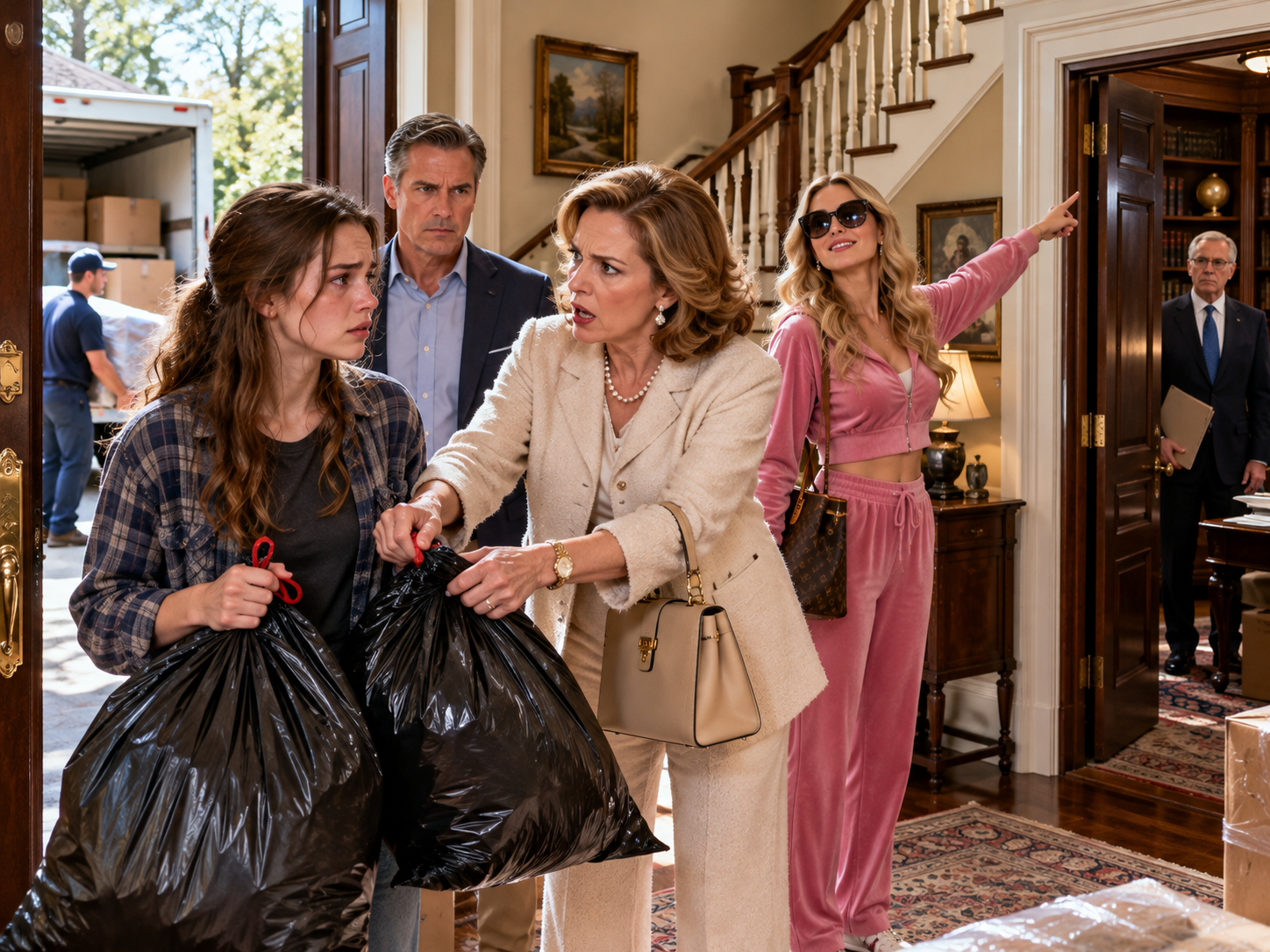
My parents had abandoned me. Grandpa had raised me. They had returned with a moving truck and tried to claim what they believed belonged to them. He had prepared for that possibility, protected my future, and left me the choice they had never offered me when I was a child.
But the life I built afterward belonged to me.
I could keep the house. I could change it. I could travel and return, invite Brianna inside, meet my mother for coffee, or tell my father I was not ready to talk. I could accept an apology without pretending it repaired the past. I could love Grandpa without turning grief into a permanent obligation.
And I could decide, one ordinary day at a time, what came next.
Before going inside, I glanced once more toward the study window. The lamp was off, and the room beyond the glass had grown dark. I no longer needed to imagine Grandpa standing there, ready to tell me what to do. I could remember his voice without waiting for another instruction.
I closed the front door behind me and turned the lock.
The house was quiet, but it did not feel empty.
It felt like home.
Click here to continue reading: PART 17: The Room That No Longer Needed to Stay Locked
The Morning My Family Came to Claim a House Before They Had Even Asked Who Owned It
Part 16 of 19

