
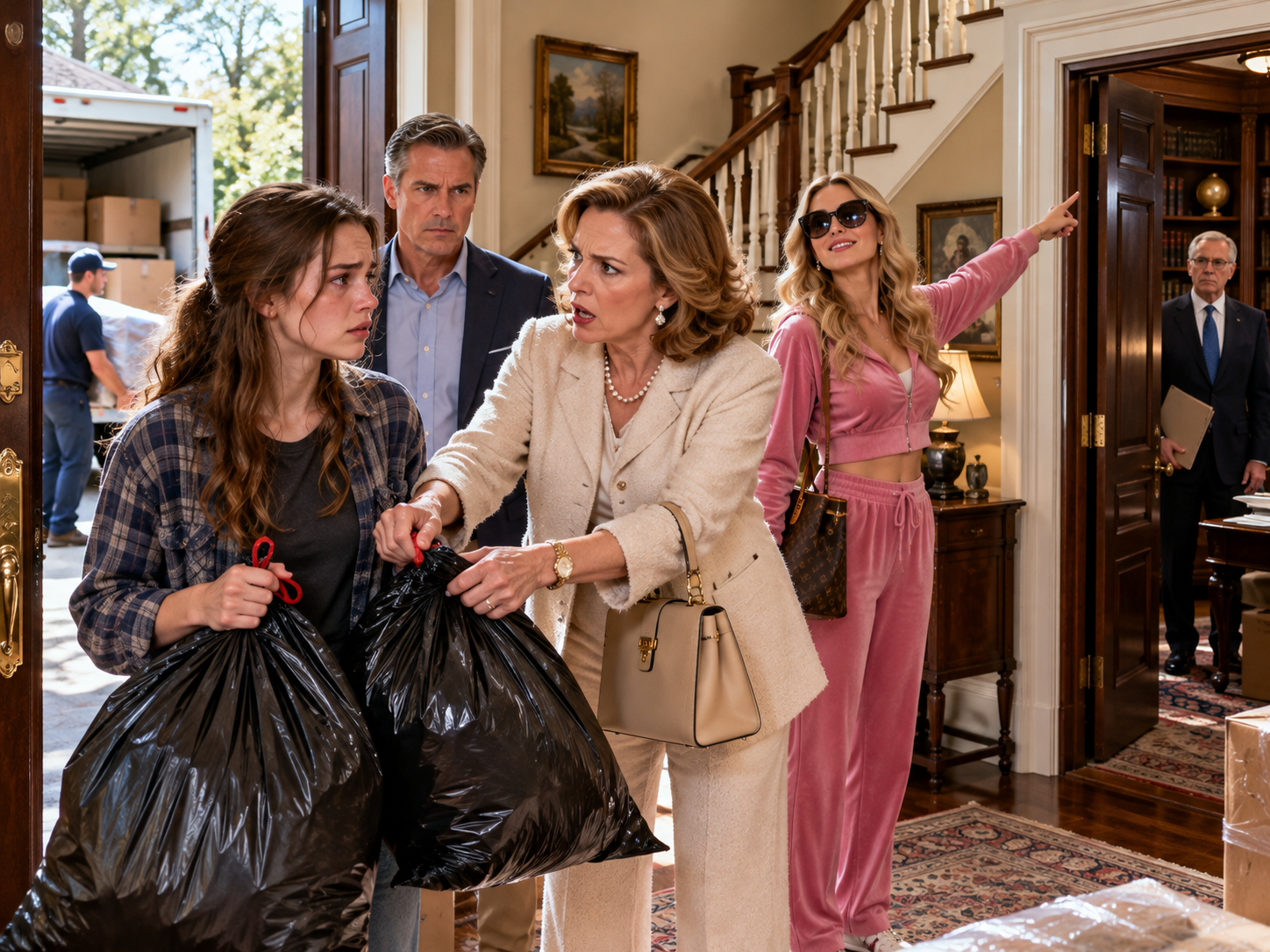
The first time I unlocked Grandpa’s study without feeling a knot tighten in my stomach, I was carrying a basket of clean laundry. I had gone upstairs to put away the towels and noticed that the door was open a few inches. Sunlight fell across the wooden floor, catching the dust that floated above the desk. For a moment, I stood there with the basket balanced against my hip, remembering the morning my parents had arrived with their moving truck and the two black garbage bags had landed at my feet. Back then, this room had seemed like the only place in the house where the truth might still be protected. Now, months after Grandpa’s funeral, it was simply a room I had not yet decided how to use.
I put the laundry away and returned to the doorway. The brass lamp stood beside his old notebook, and the books remained arranged in the order he had preferred. I had already sorted the legal papers with Eleanor’s help and placed the personal letters in a secure folder. The remaining shelves held novels, gardening manuals, old magazines, and a few books with cracked spines that Grandpa had read so many times the covers were almost smooth. I ran my fingers along one of them and wondered whether I had been keeping the room untouched because I wanted to honor him or because changing it felt like another kind of goodbye.
For months, I had treated every alteration as a question I needed to answer correctly. If I moved the desk, would I be disrespecting him? If I replaced the faded curtains, would I be pretending he had never lived there? If I turned the study into something useful, would I be giving away a part of him I could never recover? Those questions had sounded important when I was grieving. Now, I could see that they were often the same fear wearing different clothes: I was afraid that if I changed the house, I might lose the feeling that Grandpa was still close.
I carried the laundry basket downstairs, made a cup of tea, and sat at the kitchen table. Outside, the apple tree moved gently in the breeze. The birdhouse Brianna and I had repaired hung from one of its branches, still crooked, its little roof slightly lower on the left. A sparrow landed on it, peered inside, then flew away. I watched it until it disappeared behind the fence.
Then I returned to the study with a notebook and began making a plan.
I would keep Grandpa’s desk, the brass lamp, and the shelves along the far wall. I would preserve the books that mattered to me and donate the ones I knew I would never read. The room could become a workspace without ceasing to be his study. I could put a comfortable chair beside the window and bring in a plant. I could leave enough space for memories without asking the memories to determine every inch of the room.
The decision was surprisingly peaceful.
I called Brianna that afternoon and asked whether she could help me move a few things the following weekend. She agreed, then asked whether I wanted her to bring tools.
“Probably,” I said. “And no, you cannot claim the desk.”
“I was going to ask for the brass lamp.”
“You can claim the crooked birdhouse.”
“Fine. I’ll take it apart and make it worse.”
We laughed, and the conversation moved on to her work and a restaurant she wanted to try. When we hung up, I realized that I had not mentioned our parents once. It was the first time I could remember having a conversation with my sister in which the damage they had caused did not occupy the center.
On Saturday, Brianna arrived carrying a toolbox and a bag of pastries. She surveyed the study with exaggerated seriousness.
“Are we preserving history or committing a renovation?”
“Neither. We’re moving a chair.”
“Ah. A delicate historical operation.”
We started with the shelves. I chose several books to keep and placed the others in boxes for donation. Brianna dusted the lower shelves while I sorted through the upper ones. Every so often, we found something that prompted a story: a gardening book with a pressed leaf between its pages, a paperback Grandpa had bought for me when I was twelve, and an old dictionary with my childhood handwriting in the margins.
One page contained the word responsibility, underlined three times in blue pencil.
“I was probably doing homework,” I said.
Brianna leaned over my shoulder. “Or writing a dramatic declaration.”
“I was twelve. Everything was dramatic.”
“You still make dramatic declarations.”
“I do not.”
“You once told me that a restaurant had betrayed you because it changed its fries.”
“They were terrible fries.”
She laughed, and I felt the room loosen around us. For years, the study had been the place where I expected to find answers to questions about my parents, my childhood, and the legal future of the house. Now it was becoming a place where ordinary life could happen, where my sister could tease me, where I could work, and where Grandpa’s books could remain useful rather than untouched.
When we moved the desk a few inches toward the wall, a small envelope slipped from behind a drawer. It landed on the floor with a soft rustle.
My heart jumped before I could stop it.
Brianna froze. “What is it?”
“I don’t know.”
I picked up the envelope. It was unsealed, and my name was written across the front in Grandpa’s familiar handwriting. For a moment, the room seemed to shrink around me. I had already read his letter, heard his recorded statement, and discovered the notebooks that documented his efforts to keep my parents involved in my life. I had thought there were no more messages waiting for me.
I sat in the chair by the window before opening it.
Inside was a single sheet of paper, folded once. The note was short.
Emily, if you find this while moving things around, I hope it means you are making the house your own. There is no right way to remember someone. Keep what helps you live well. Let go of what only makes you afraid to change. You have always known how to make a home out of ordinary things. Trust yourself.
I read it once, then again. The words did not reveal a new secret or change anything I had learned. They were not a final instruction that required me to follow a particular path. They were a reassurance, offered in the plain language Grandpa had always used when he wanted me to stop worrying.
I handed the note to Brianna.
She read it quietly and returned it without speaking. Her eyes were bright, but she did not try to turn the moment into something larger than it was.
“He really did know you,” she said.
“He did.”
“And he wanted you to be happy here. Not trapped here.”
I nodded. “That’s what I’m beginning to understand.”
We placed the note inside the folder with his letter, not because it needed protection from the world but because I wanted to keep the two pieces together. Then we finished moving the desk and positioned the chair near the window. Brianna helped me hang a small shelf above it, and I placed three books there, along with the photograph of Grandpa beside the apple tree.
By late afternoon, the room had changed. The desk was no longer the first thing a person saw from the doorway. The chair caught the sunlight. The books I had chosen to keep were arranged within easy reach, and a small green plant sat on the windowsill. Grandpa’s things were still present, but they were no longer arranged as though the room might collapse if I disturbed them.
Brianna stepped back to inspect our work.
“It feels different,” she said.
“Good different?”
“Like someone lives here.”
I looked around the room. “Someone does.”
Before she left, Brianna asked whether she could borrow one of Grandpa’s gardening books. She wanted to learn how to grow herbs in pots on her balcony. I chose the book with the cracked spine and handed it to her.
“Bring it back whenever you’re done.”
She held it carefully. “I will.”
It was a small exchange, but I felt the significance of it. For months, I had been afraid that sharing anything from Grandpa’s life would somehow diminish what he had given me. Yet the book would not become less valuable because Brianna used it. The memories would not disappear because someone else learned something from them.
After she left, I sat at the desk and opened my laptop. I had been putting off a work project because I preferred to work at the kitchen table, where I could hear the house around me. That evening, I tried the study instead. The chair was comfortable, the lamp provided enough light, and the window offered a view of the garden. I worked for two hours without feeling that I had invaded a sacred place.
When I finally stopped, I turned off the lamp and stood in the doorway.
The room no longer needed to remain locked away from change. I could preserve the things that mattered without preserving every arrangement, every shadow, every silence. Grandpa had given me the house because he trusted me to live in it. He had not asked me to freeze my life at the moment he left it.
I closed the door gently, not because I was afraid of what lay inside, but because I was finished for the evening.
Downstairs, I washed my mug and placed it beside the sink. The house settled around me with familiar creaks. Outside, the sparrow returned to the crooked birdhouse and disappeared through the small round entrance.
For the first time, I understood that making room for the future did not require me to clear away the past.
Click here to continue reading: PART 18: What We Could Not Give Back
The Morning My Family Came to Claim a House Before They Had Even Asked Who Owned It
Part 17 of 20


One Comment on “PART 17 – The Room That No Longer Needed to Stay Locked”