The last chapter of Clara's story did not begin with a crisis.
It began with sunlight.
For once, there was no rain.
The kitchen windows were open, and warm air moved through the curtains.
Beatrice was older now.
Much older.
She still lived in the house.
She still insisted on making her own decisions.
She still complained when people tried to help too much.
Some things never changed.
Clara arrived with breakfast.
Beatrice looked at the bag.
“What did you bring?”
“Your favorite.”
“You should have brought something healthy.”
“You say that every time.”
“I mean it.”
“You'll eat it.”
Beatrice smiled.
“Probably.”
They sat together.
The care program was now established enough that it no longer depended on either of them.
That pleased Beatrice.
“It can continue without me.”
Clara nodded.
“That was the goal.”
“And without you.”
Clara looked at her.
“Excuse me?”
“You have your own life.”
“I know.”
“You should keep it.”
“I will.”
Beatrice smiled.
“Good.”
There was no sadness in the conversation.
Only honesty.
They both understood that time moved forward.
Clara no longer feared that understanding.
She had once believed security meant holding tightly to people and places.
Now she understood that real security included allowing things to continue without you.
The house had become larger than any individual.
That was its strength.
After breakfast, Clara walked into the kitchen.
She stood beside the island.
The surface was polished.
Empty.
Ordinary.
She placed her hand on it.
She remembered Julian's envelopes.
She remembered thinking that money might mean he had finally noticed the work she was doing.
She remembered the disappointment.
She remembered the first envelope she put into the coffee tin.
She remembered the moment she decided to become Hazel.
She remembered the faded blue apron.
She remembered Julian speaking about the “maid.”
She remembered the green folder.
She remembered Arthur's letter.
She remembered the divorce.
She remembered the first day she slept peacefully in her own apartment.
She remembered Beatrice telling her that forgiveness did not require reconciliation.
She remembered the first caregiver who asked whether wanting an afternoon off made her selfish.
She remembered the answer.
No.
It did not.
Clara smiled.
The woman who had once believed she had to earn her right to rest had learned to rest.
The woman who had once believed she had to keep everyone happy had learned to tolerate disappointment.
The woman who had once hidden behind another name had learned to speak under her own.
That was the real inheritance.
Not the house.
Not the money.
Not the documents.
Choice.
Beatrice entered the kitchen.
“You're thinking again.”
“I do that sometimes.”
“Dangerous.”
Clara laughed.
Beatrice looked at the island.
“Do you remember?”
“Yes.”
“I remember too.”
They stood together.
Neither needed to explain.
After a moment, Beatrice reached into a drawer.
She pulled out a small envelope.
Clara stared.
“Don't worry.”
“What is it?”
“Nothing like before.”
Beatrice handed it to her.
Inside was a handwritten note.
Beatrice had written it herself.
Clara read it.
It said that if anyone ever found the note after Beatrice was gone, they should know that the house had never belonged to the person who wanted it most.
It belonged to the people who respected what it was meant to protect.
At the bottom, Beatrice had written:
“Clara taught me that care can be chosen without becoming captivity.”
Clara's eyes filled.
“You wrote this?”
“Yes.”
“When?”
“Last week.”
“You could have told me.”
“Then it wouldn't have surprised you.”
Clara laughed through her tears.
“You're impossible.”
“I've been told.”
Clara folded the note.
“I'm keeping this.”
“I expected you would.”
They walked outside.
The garden was bright.
The tree Arthur had planted decades earlier was enormous now.
Its branches reached over the bench.
They sat beneath it.
Beatrice looked around.
“Do you think the house is safe?”
“Yes.”
“Really?”
“Yes.”
“Why?”
“Because no one person owns its future anymore.”
Beatrice smiled.
“That was the answer I wanted.”
They sat quietly.
A group of caregivers arrived for a meeting.
Voices drifted from the kitchen.
Someone laughed.
A child ran across the garden.
The house was alive.
Beatrice watched.
“I think Arthur would like this.”
“He would.”
“He would complain about the noise.”
“He absolutely would.”
They laughed.
The afternoon passed.
Clara helped prepare tea.
She answered questions.
She listened.
She did not take control.
She did not disappear.
She simply participated.
That evening, she returned to the kitchen.
The coffee tin was still on the shelf.
The apron was beside it.
She touched them both.
She thought about throwing them away.
Then she decided not to.
Not because she needed reminders of pain.
Because they reminded her of transformation.
The coffee tin represented the moment she began recording the truth.
The apron represented the courage she found while pretending to be someone else.
Neither belonged to Julian anymore.
They belonged to her story.
She turned off the kitchen light.
Beatrice called from the living room.
“Clara?”
“Yes?”
“Don't forget next Monday.”
“I won't.”
“You're bringing bread.”
“I know.”
“And tea.”
“Yes.”
“And don't be late.”
Clara smiled.
“I'll try.”
“No trying.”
“Then I'll be on time.”
Beatrice laughed.
Clara walked toward her.
Before leaving, she looked back at the kitchen.
Empty island.
Clean counters.
Warm light.
No envelopes.
No secrets.
No fear.
She closed the door behind her.
Outside, the evening air was cool.
She walked to her car.
For a moment, she stood beside it without moving.
She thought about the woman she had been.
She wished she could go back and tell her something.
Not that everything would work out.
Not that the marriage would end.
Not that the house would be protected.
Not that Arthur's documents would save the day.
She would tell her something simpler.
“You are allowed to notice.”
“You are allowed to ask.”
“You are allowed to say no.”
“You are allowed to leave.”
“You are allowed to be loved without disappearing.”
Clara smiled.
Then she got into the car.
She drove home.
Her life was not the life she had planned.
It was better in one important way.
It was hers.
The next Monday came.
And the Monday after that.
And another.
Life continued.
There were ordinary problems.
There were difficult days.
There were birthdays.
There were illnesses.
There were repairs.
There were celebrations.
There was laughter.
There were tears.
That was life.
Clara no longer needed a dramatic ending.
She had something better.
A continuing one.
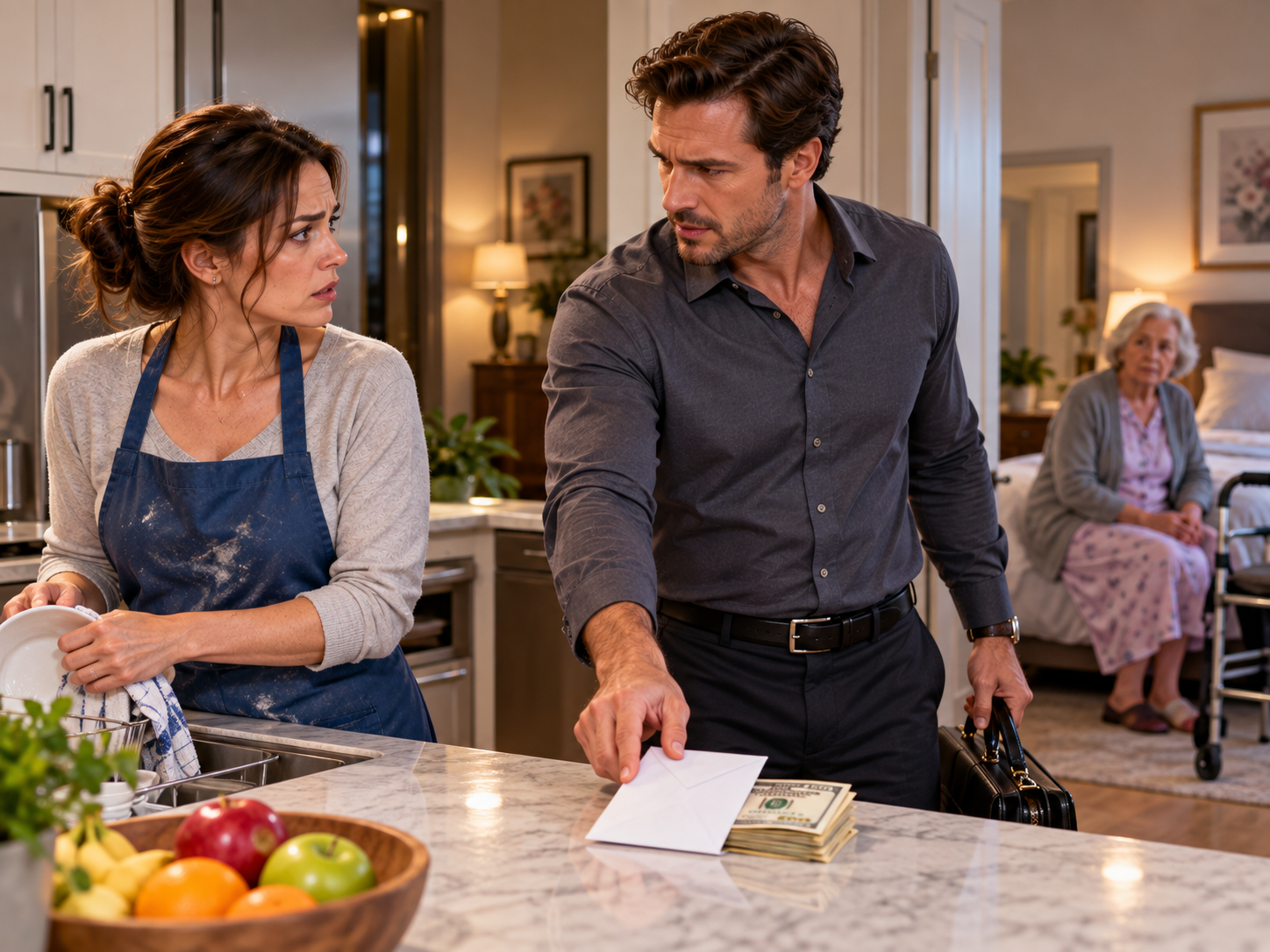
The story that began with money on a kitchen island had ended somewhere no one in that first room could have predicted.
The husband who believed he could control the house lost the marriage he had taken for granted.
The woman he called a maid became the person who documented the truth.
The mother he thought he could pressure remained the author of her own future.
The hidden will became known.
The secret became evidence.
The house became a place of care.
And the woman who once hid behind the name Hazel returned to her own name.
Clara.
Nothing more.
Nothing less.
Years later, people who visited the house would never know what had happened there unless someone told them.
They would see the garden.
The archive.
The care center.
The photographs.
They would see older people being treated with dignity.
They would see caregivers receiving support.
They would see a kitchen where people shared food.
They would not see the envelopes.
They would not see the fear.
They would not hear Julian's voice.
And that was exactly right.
The house did not need to preserve every wound.
It only needed to preserve the lesson.
Care is not ownership.
Love is not entitlement.
Family is not permission to control another person's life.
And help should make people stronger, not smaller.
On one final Monday, Clara stood again beside the kitchen island.
She looked at the empty surface.
She remembered the first envelope.
Then she looked toward the living room.
Beatrice called her name.
Clara answered immediately.
“I’m here.”
She walked toward her.
There was no apron.
No alias.
No hidden folder.
No coffee tin beneath the sink.
No secret waiting to be discovered.
Only a woman who had survived, learned, forgiven what she could, left what she needed to leave, and built something meaningful from the truth.
Clara sat beside Beatrice.
They drank tea.
They talked.
They laughed.
Outside, the garden moved gently in the afternoon wind.
And Clara finally understood what she had been trying to protect all those years.
It had never been the money.
It had never been the house.
It had never even been the marriage.
It was the right to remain herself.
That was the thing Julian had never understood.
That was the thing Arthur had quietly protected.
That was the thing Beatrice had finally taught her.
And that was the thing no one could ever take from her again.
The End
Read more original stories on Feel Every Story.
My husband thought the cash on the kitchen counter was buying someone else’s labor, but I was already learning why he wanted his mother kept quiet
Part 20 of 20