
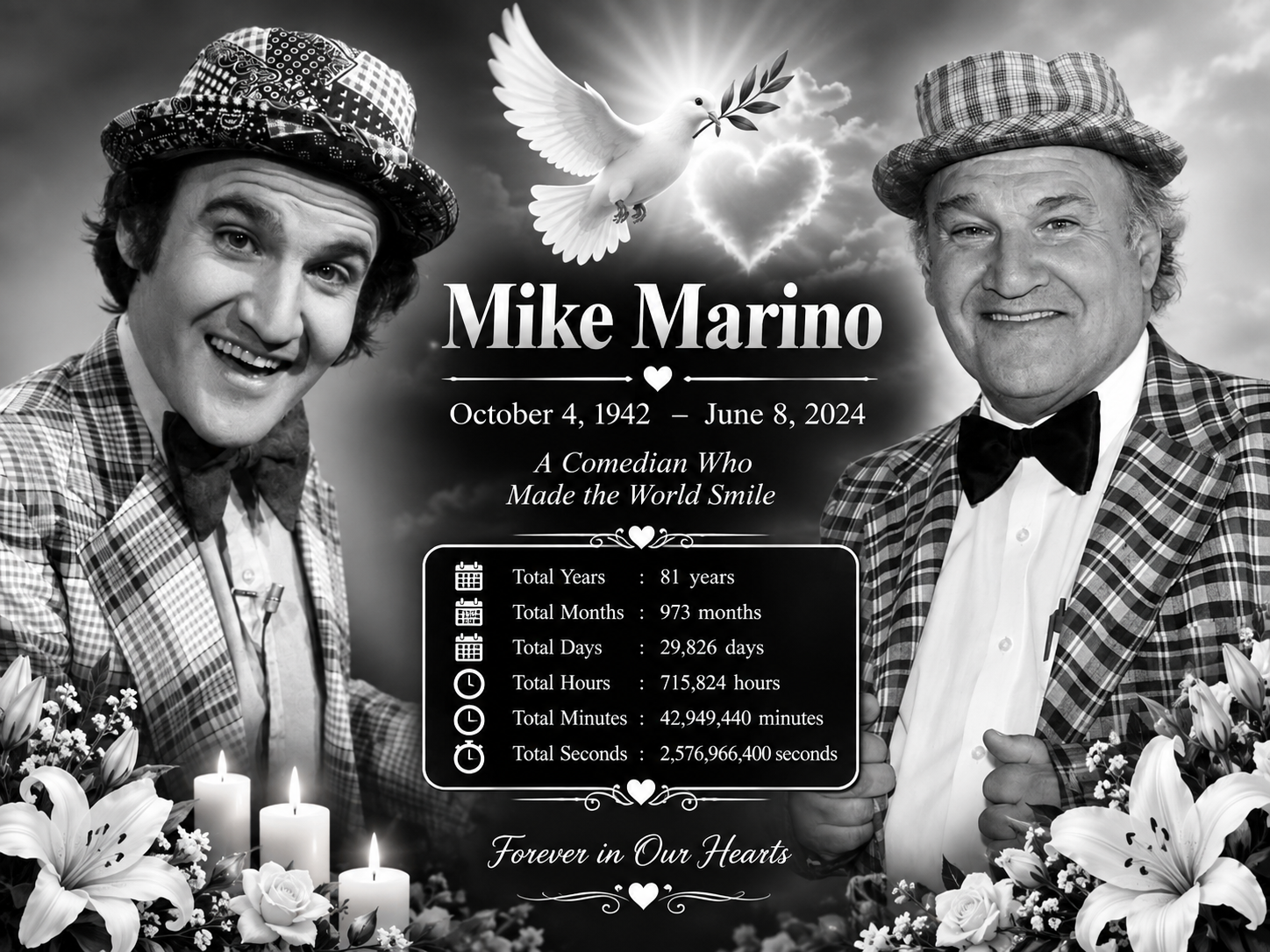
The final page of Mike Marino’s story does not require a scene that never happened. It does not require an invented final conversation, a private revelation, or a dramatic speech that no source recorded. His documented career already provides enough material to understand the journey.
The journey began in New Jersey.
It passed through school theater, music, acting training, commercials, television, comedy clubs, touring, characters, military stages, podcasts, digital projects, and hometown recognition.
It eventually reached a final medical chapter in 2026.
And then it stopped.
Marino was born in 1963 and died September 15, 2026, at age 63. His death came after a public battle with brain cancer, according to reporting based on posts from his official social-media accounts. Legacy separately reported the death and stated that a cause of death had not been announced.
Those facts provide the final boundary of the biography, but they do not provide its meaning by themselves.
To understand the career, it is necessary to return to the beginning.
Marino’s teenage years at Scotch Plains-Fanwood High School were already connected to performance. He participated in the Repertory Theatre, Drama Club, and Moonglowers, played drums in the marching band, and became a member of the Screen Actors Guild at sixteen.
The young performer then continued formal training. The Herbert Berghof Studio and American Academy of Dramatic Arts became part of his education, providing a foundation for the acting work that followed.
Commercials offered a major early professional opportunity. More than 200 national television commercials became part of his résumé, and he received a Best Actor Clio nomination.
Television followed with roles and appearances across several programs. “As the World Turns,” “One Life to Live,” “Becker,” “Nikki,” “Frasier,” and “Party of Five” were among his acting credits. He also appeared on “The Tonight Show with Jay Leno.”
But stand-up eventually became the most recognizable part of his professional identity.
The comedian who emerged from those years was unmistakably connected to New Jersey. His family experiences and Italian-American background became recurring material, and the phrase “New Jersey’s Bad Boy of Comedy” became closely associated with him.
The identity worked because it was rooted in a genuine part of his life. New Jersey was not merely a stage costume. It was the environment in which his childhood and early performance experiences had developed.
His characters added another layer. Cousin Mooney, Uncle Tommy, Cousin Michelle, and G.I. Giovanni allowed him to turn recognizable personalities into recurring comic figures.
The characters also demonstrated the continuing influence of acting on his comedy. Marino could move between his own voice and a character voice, changing the texture of a performance without abandoning the central themes of family and culture.
His touring career carried those themes into different cities and different rooms. He performed in comedy clubs, theaters, casinos, and event centers and appeared at Just for Laughs in Montreal for seven consecutive years.
That career required repetition without becoming static. A performer can tell a familiar story hundreds of times and still need to make each audience feel that the performance belongs to the present moment.
Marino also brought his work into military settings. Through the USO, he performed for service members, including in Bosnia and Afghanistan, and received the USO Bob Hope Comedy Award in 2015.
Those performances became one of the clearest examples of how far the original New Jersey performer had traveled.
The career had also become connected to television and digital media. His “Make America Italian Again” project continued the Italian-American themes that had long been part of his comedy.
His “Live From My Mother’s Basement” podcast brought his work back into the physical setting of his childhood. The basement of his family home became part of his later creative identity, and after his parents’ deaths, Marino purchased the house, according to his April 2026 interview.
Then came the return to school.
“Mike Marino: Back 2 School” brought him and Daniel Catullo to Scotch Plains-Fanwood High School. The production recreated elements of the school period and turned the auditorium into a comedy club. Marino described the project as personal and connected to the place that had shaped him.
The timing gave the project an additional significance that could not have been fully known when it was made. Marino was still working, still performing, and still creating. The project was not designed as a farewell.
But it became part of the final record.
The same is true of the 2024 Hall of Fame induction. Marino had already been recognized by the New Jersey Comedy Hall of Fame in 2008 and received the USO Bob Hope Comedy Award in 2015. Then his own high school inducted him in 2024.
The sequence shows how different communities remembered the same performer.
The comedy community recognized him.
The military entertainment community recognized him.
His hometown recognized him.
And his audiences continued to encounter him through performances and recordings.
The final year changed the rhythm.
After becoming ill while performing on a cruise ship, Marino was diagnosed with a brain tumor and underwent surgery. In April, he discussed working toward recovery through physical therapy and follow-up appointments.
Later reports described a more serious condition. News 12 reported that Marino was battling Stage 4 brain cancer after the surgery and had spoken publicly about the illness.
The progression was difficult, but the public record should remain grounded in what was actually reported.
There is no need to invent a final performance.
There is no need to invent a final conversation.
There is no need to claim that Marino knew exactly what the future held.
There is no need to turn his final illness into a fictional scene.
The facts are enough.
He continued working during a period of serious illness.
He had already completed a project that returned him to his old school.
He had created digital work that reflected his cultural identity.
He had left behind television appearances and comedy performances.
He had spent years touring.
He had performed for service members.
He had received professional and hometown honors.
He had built a career around family stories, New Jersey observations, Italian-American experiences, and characters.
Then, in September, the career became history.
Parade reported that Marino had been placed in hospice in the days before his death. On September 15, he died at age 63.
His death did not create the career. It simply marked its endpoint.
The career itself had already been built through thousands of choices and performances.
The young Marino chose performance.
The actor developed his craft.
The commercial performer learned the camera.
The television actor expanded his range.
The comedian found his public voice.
The character performer created recurring personalities.
The touring entertainer carried those personalities beyond New Jersey.
The USO performer brought comedy to service members overseas.
The podcaster brought his work back into his childhood home.
The hometown alumnus returned to his high school.
The entertainer facing illness continued to be connected to his work until the final months.
And then the live career ended.
What remains is not an abstract idea of Marino, but a record that can still be encountered.
His television appearances remain.
His comedy recordings remain.
His characters remain.
His special remains.
His interviews remain.
His podcast episodes remain.
His digital projects remain.
The memories of audiences remain.
The institutions that recognized him remain.
The school where he first performed remains.
The hometown he carried into his comedy remains.
And the stories drawn from his family and cultural background remain available through the work he recorded.
That is why the final page can end quietly.
There is no need to force a larger conclusion onto a life that already contains its own structure.
A boy from New Jersey found performance.
A teenager entered the professional acting world.
An actor became a comedian.
A comedian became known as New Jersey’s Bad Boy.
A performer created characters.
A touring entertainer traveled far from home.
A comedian performed for service members.
A television and commercial actor expanded his audience.
A digital creator found new ways to tell familiar stories.
A hometown son returned to the school where his performance life had begun.
A man facing serious illness continued to be remembered through the work he had already created.
And on September 15, 2026, Mike Marino died at 63.
The stage became still.
But the recordings did not.
The characters did not.
The stories did not.
The places he carried with him did not.
The career did not vanish simply because its creator could no longer add another performance.
It became an archive.
And whenever someone watches the comedian on a screen, hears one of the characters he created, revisits the school special, listens to an old interview, or discovers a performance that had been recorded years earlier, another small piece of that archive becomes present again.
Not a new Mike Marino.
Not a fictional final appearance.
Just the work that was already there.
And that is where the story ends: not with a manufactured goodbye, but with a performer’s own recorded voice continuing beyond the date when he could no longer speak into the microphone himself.
The End
Read more original stories on Feel Every Story.
The Laughs Had Always Been Easy to Hear, but Behind the Jersey Jokes Was a Performer Quietly Building a Career From the Ground Up
Part 16 of 16

