
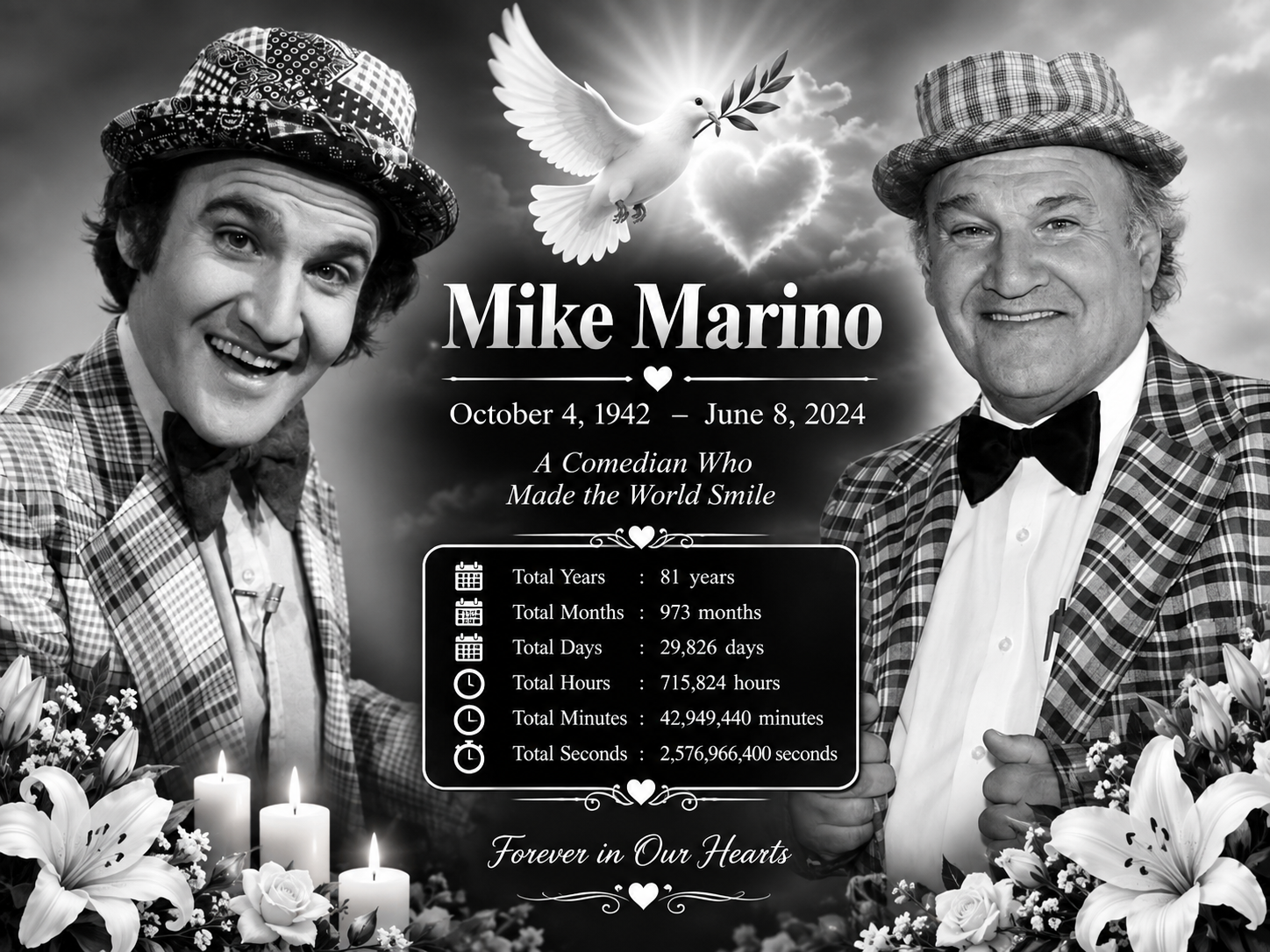
After a performer dies, memory rarely preserves only one version of the person. Instead, different audiences remember different moments. One person may remember a comedy club. Another remembers a television appearance. Someone else remembers a hometown event, a podcast, a character, or a military performance.
Mike Marino’s career was particularly suited to that kind of fragmented remembrance because he had worked across so many forms of entertainment. His public identity was not contained inside one program, one film, or one recurring role. It had been built through thousands of performances and many different kinds of appearances.
Some audiences knew him as “New Jersey’s Bad Boy of Comedy.” Others encountered him through television. Some knew his characters. Others knew “Make America Italian Again.” Still others may have discovered him through “Back 2 School,” “Live From My Mother’s Basement,” or a short online clip.
The result was a career that could be remembered from many directions without requiring a single definitive version of the performer.
His recurring characters provided one of the clearest examples. Cousin Mooney, Uncle Tommy, Cousin Michelle, and G.I. Giovanni were not simply names on a résumé. They were performance identities that Marino could return to repeatedly. Parade included them in its account of his death, describing them as beloved parts of the world he had created. ([Parade][2])
That phrase points toward something important about character comedy. A character becomes memorable when an audience can recognize it quickly. Voice, appearance, rhythm, attitude, and repeated behavior begin to work together. Over time, the character can become almost independent of the original joke.
Marino’s acting background helped make that possible. His formal studies at the Herbert Berghof Studio and American Academy of Dramatic Arts were followed by professional acting and commercial work. His résumé included more than 200 national television commercials and a Best Actor Clio nomination.
Commercials required a performer to create a clear impression in a limited amount of time. Television acting required another kind of control. Stand-up required still another. Marino moved among all three.
His television credits demonstrate that range. “As the World Turns” and “One Life to Live” placed him in daytime drama, while “Becker,” “Nikki,” “Frasier,” and “Party of Five” connected him to scripted television in other forms. His appearances on “The Tonight Show with Jay Leno” placed him in a late-night comedy environment.
These appearances remained part of the public record after his death. Legacy specifically noted his work on “The Tonight Show with Jay Leno” while remembering his career. ([Legacy.com][3])
The comedy career was broader still. Marino toured clubs, theaters, casinos, and event centers and appeared at Just for Laughs in Montreal for seven consecutive years, according to Parade. ([Parade][2])
A touring career creates another kind of archive because each venue contains a different audience. The same performer can deliver similar material to thousands of people across years, but every audience experiences the moment only once.
Recordings changed that relationship with time.
A filmed performance can be replayed. A television appearance can be rediscovered. A podcast episode can remain available. An online clip can circulate among viewers who were not alive or old enough to remember the original performance.
That became especially relevant to Marino because his work had already moved into digital formats. “Make America Italian Again” and “Live From My Mother’s Basement” showed that he was willing to use newer forms of distribution rather than remaining dependent on traditional comedy clubs and television.
The basement podcast was especially revealing because the setting connected the digital present with the physical past. The performer who had traveled across the country could sit in a house associated with his childhood and continue talking to an audience through modern media.
That combination of old and new was characteristic of the later career. The themes remained familiar while the formats changed.
The same thing happened with “Back 2 School.” The subject was rooted in Marino’s teenage years, but the project was designed as a modern television special and produced with Daniel Catullo. The school’s account described the planned transformation of the stage into a 1981 classroom and the auditorium into a comedy-club environment. ([SPF K12][4])
The project therefore turned memory into production. The past was not simply discussed. It became the setting.
That mattered because Marino had spent much of his career using memory as raw material. Family stories, New Jersey experiences, and Italian-American traditions repeatedly became comedy. In “Back 2 School,” the physical location itself became another piece of that material.
His hometown recognized that connection before his death. Marino was inducted into the Scotch Plains-Fanwood High School Hall of Fame in 2024. The recognition placed his later career beside the school activities that had begun it.
The New Jersey Comedy Hall of Fame had already recognized him in 2008. The USO Bob Hope Comedy Award followed in 2015. These honors came from very different contexts, but each became part of the permanent record.
The USO work is particularly distinct because it involved service members rather than conventional entertainment audiences. Marino performed in Bosnia and Afghanistan, bringing comedy to military communities far from the New Jersey environments that supplied much of his material.
His public life also included support for first responders and related charitable activities. These efforts added another dimension to the entertainer remembered primarily for making audiences laugh.
That complexity matters when considering what survives. The archive contains the jokes, but it also contains the career decisions that placed him in different settings.
The archive contains the characters, but it also contains the actor who created them.
It contains the New Jersey identity, but it also contains the performer who carried that identity around the world.
It contains the comedy, but it also contains the television work, commercial work, military performances, podcasts, and digital projects that made the career larger than stand-up alone.
The final months add another layer to that archive because they document Marino continuing to work while facing serious illness. After surgery for a brain tumor, he spoke publicly about physical therapy and follow-up care. Later, News 12 reported that he was battling Stage 4 brain cancer. ([News 12 – Default][5])
That public health journey should not be transformed into a dramatic fictional narrative. The documented facts are enough: he became ill, underwent surgery, worked through recovery, later publicly discussed advanced brain cancer, and died on September 15, 2026.
Parade reported that he had been placed in hospice care in the days before his death. ([Parade][2]) That detail marked the final transition from treatment and public updates toward the end of his life.
Legacy, meanwhile, reported the death date and age but stated that a cause of death had not been announced. ([Legacy.com][3]) The difference in wording between sources is important. News 12 reported brain cancer as the illness he had been battling, based on his official social-media posts, while Legacy did not list a formally announced cause.
After his death, those distinctions became part of telling the story accurately. A biography does not become more respectful by making uncertain details sound certain.
What can be stated firmly is that Marino died on September 15, 2026, at age 63. His career had lasted for decades and had included acting, stand-up, television, commercials, characters, touring, military performances, podcasts, and digital projects.
His final years also contained recognition from the place where the story began. The Hall of Fame induction and “Back 2 School” project placed his later career in direct conversation with his adolescence.
That connection may be one of the most enduring images of his professional life: not simply the comedian on a stage, but the professional entertainer returning to a school auditorium that had once introduced him to performance.
The significance of that image does not depend on inventing what he felt privately. The documented record already shows that he described the project as personal and as a full-circle moment. ([SPF K12][4])
The image therefore belongs to the public history of his career.
So do the television appearances.
So do the comedy characters.
So do the military performances.
So does the basement podcast.
So does the Italian-American identity that became part of his comedy.
So does the New Jersey voice that followed him for decades.
When audiences revisit those pieces now, they are not simply watching isolated performances. They are encountering fragments of a career that can no longer add another chapter.
The archive has become the place where the career continues.
Click Here to continue read next: PART12: The Lasting Record Reaches Back to a New Jersey Student and Forward Through Decades of Work, Leaving Marino’s Voice Preserved Long After His Final Performance
The Laughs Had Always Been Easy to Hear, but Behind the Jersey Jokes Was a Performer Quietly Building a Career From the Ground Up
Part 11 of 16

