
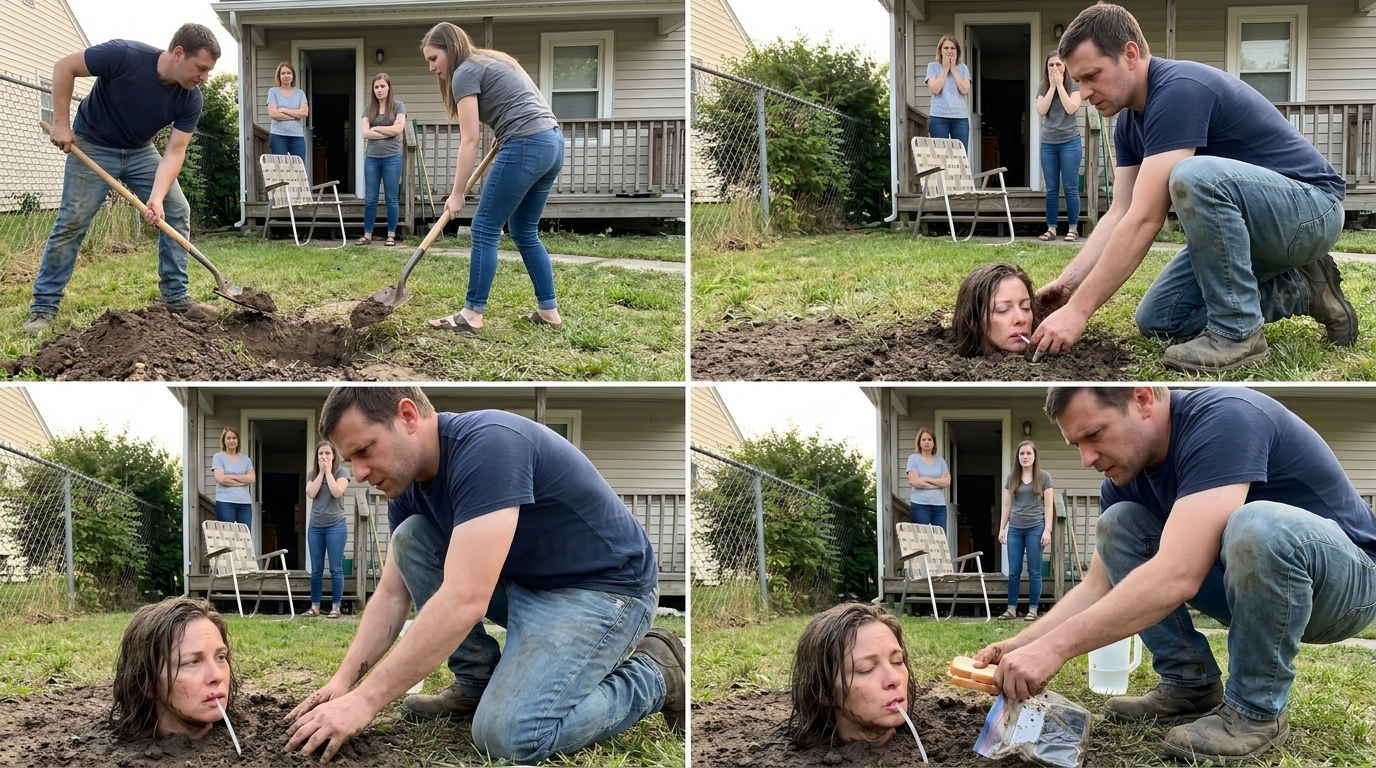
The dirt was cold enough to hurt her teeth.
She discovered that before sunrise, when the damp soil pressed beneath her jaw and the night’s chill still clung to the grass. By afternoon, the same ground would become hot against her shoulders, trapping heat around her neck until every breath felt used before it reached her lungs.
She could smell wet earth, crushed grass, and the sour water that had been poured over her head. Somewhere beyond the wooden fence, a vehicle passed and faded into the distance. A bird called from a tree. Ordinary sounds continued around her while she remained buried nearly to her neck in the backyard.
She kept her eyes lowered.
That was important.
Her husband wanted to see fear. His mother wanted an apology. His sister, Mara, seemed interested in the spectacle itself, as though watching someone suffer had become an unpleasant but acceptable way to spend an afternoon.
So she gave them none of what they wanted.
She breathed through the thin plastic tube hidden beside her mouth.
The tube was narrow and uncomfortable. Each breath had to be controlled. If she inhaled too sharply, the plastic flattened. If she waited too long, panic tightened her chest.
In.
Pause.
Out.
Listen.
Those four things became her entire world.
Her husband stood on the porch above her. She knew him by the rhythm of his footsteps. He moved slowly when he wanted to appear calm and heavily when he wanted everyone to know he was angry.
His mother rarely walked onto the grass. She remained close to the doorway, watching with the careful expression of someone who believed she was supervising a household matter rather than witnessing cruelty.
Mara dragged a lawn chair across the porch.
The metal legs scraped loudly.
She did not lift it.
She never seemed to notice how strange that detail was. A woman could be bothered by muddy grass touching the legs of her chair while another woman sat buried beside her.
The sound stopped.
Her husband spoke.
“Have you decided to behave?”
She did not answer.
He laughed under his breath.
That was exactly what he wanted: silence he could interpret as submission.
She let him have that misunderstanding.
Because beneath the loose earth near her right shoulder was a phone.
She had hidden it before they dragged her outside.
The phone was wrapped in a freezer bag. The screen was turned dark. The microphone remained uncovered enough to capture voices.
It was not a perfect plan.
It was barely a plan at all.
But it was something.
Her right wrist had been buried beneath the soil, yet the space around it was not completely packed. They had left a narrow pocket of movement. They probably assumed fear would make her helpless.
They were wrong.
She could move one finger.
That was enough.
Before they brought her outside, she had understood something frightening about her husband. His greatest weapon was not his temper. It was his ability to sound reasonable afterward.
He could make a threat sound like concern.
He could make an insult sound like advice.
He could make her reaction look more important than what had caused it.
When she confronted him, he said she was too emotional.
When she remembered something he denied saying, he told her pregnancy was affecting her memory.
When she tried to walk away from an argument, he blocked the doorway and accused her of creating drama.
His mother had begun repeating his explanations.
Mara had stopped questioning them.
Soon, even ordinary conversations felt dangerous because she never knew which sentence would later be turned against her.
The phone was her answer.
It could not pull her from the ground.
It could not give her water.
It could not protect her body.
But it could remember.
That mattered.
Her husband stepped closer to the railing.
“You know why you're here.”
She stared at a small patch of grass near her left shoulder.
He waited.
When she did not respond, his mother spoke from behind him.
“She needs to understand that actions have consequences.”
The woman said it with the certainty of someone discussing household rules.
The pregnant woman closed her eyes for one second.
Her baby had moved earlier.
Just once.
A small pressure beneath her ribs.
She had almost cried from relief.
Now she waited for another movement.
Nothing came.
Her stomach tightened.
She tried not to panic.
She remembered the kitchen from before they took her outside. The refrigerator had been humming. Her husband had been talking with his mother in the hallway. She had been holding the counter because her back hurt.
There had been an argument.
Not a loud one at first.
Then her husband said embarrassment was the only lesson she understood.
That was when she realized they had already decided what would happen.
This was not discipline.
It was punishment.
And they intended to make her accept it.
Her husband came down the steps.
The soles of his work boots sank slightly into the damp ground.
He stopped beside her.
“You're making this harder than it needs to be.”
She said nothing.
“You apologize, and this ends.”
Still nothing.
He crouched.
She could smell laundry detergent on his shirt.
That ordinary scent disturbed her more than the dirt.
He had washed his clothes.
He had eaten.
He had walked through the house.
He had continued living normally while she was trapped in the yard.
“You've always had a stubborn streak,” he murmured.
His voice was soft.
That was the voice other people believed.
She knew better.
He had learned how to make threats quiet enough to become deniable.
She shifted one buried finger.
The phone gave a faint vibration.
Recording.
Her husband did not notice.
He leaned closer.
“All you have to do is admit you were wrong.”
She looked at the ground.
He waited for tears.
None came.
His expression hardened.
“You think being quiet makes you strong?”
She still did not answer.
He stood.
His mother watched from the porch.
Mara shifted in her chair.
The three of them had different ways of participating, but none of them stepped forward to stop him.
That was the part she understood most clearly.
Cruelty did not always require three people to agree.
Sometimes one person acted while everyone else decided it was easier not to interfere.
By midday, the sun had warmed the soil.
Her lips were dry around the straw.
Her left foot had gone numb.
She had not eaten.
A plate with half a sandwich appeared on the porch railing. She could see it from the corner of her eye.
For a while, it remained there.
Then the wind pushed it onto the grass.
The plate landed several feet away.
Mara looked at it.
Then she looked at her.
She laughed.
Her mother-in-law told her not to encourage bad behavior.
Neither woman picked up the sandwich.
Ants reached it.
The pregnant woman watched them gather.
Hunger gnawed at her.
She reminded herself that pain was information.
Hunger was information.
Fear was information.
None of those things had to make her decisions for her.
She moved one finger again.
The phone recorded.
Her husband's voice.
His mother's voice.
Mara's laughter.
Every sound became part of a record they did not know existed.
The afternoon stretched.
They discussed groceries.
They talked about television.
They complained that the lawn might need cutting again.
Their conversation drifted over her as though she were furniture.
That was perhaps the cruelest part.
They were trying to make the unbearable seem ordinary.
Her husband mentioned that she would remain outside until she learned her lesson.
His mother agreed.
Mara asked whether they really intended to leave her there through the night.
Her husband said that depended on her attitude.
No one objected.
The baby moved again.
This time she felt it clearly.
Relief went through her so sharply that her eyes filled.
She kept her face still.
She could not afford to let them see what mattered most.
The clouds arrived late in the afternoon.
The temperature fell.
Her husband remained on the porch, looking down at his own phone.
His mother went inside.
Mara carried her cup toward the house.
For several minutes, the yard became quiet.
Traffic hummed beyond the fence.
An outdoor unit rattled softly beside the house.
Then the hidden phone vibrated.
Not the short pulse of a recording.
A longer vibration.
Her husband looked up.
Mara turned.
“What was that?”
Her husband did not answer.
His eyes moved across the yard.
The pregnant woman stopped breathing for a moment.
His gaze settled near her right shoulder.
He stepped down from the porch.
One step.
Then another.
The relaxed rhythm disappeared from his walk.
He approached the place where the phone was hidden.
She kept her mouth around the straw.
He crouched.
His palm pressed into the wet soil.
The pressure shifted dirt against her jaw.
“You didn't bring something out here, did you?”
His voice had changed.
The softness was gone.
His fingers began searching.
He scraped through the mud.
A stone moved.
Then a root.
Then his fingertips touched plastic.
He stopped.
Her heart hammered.
He looked directly at her.
She stared back without moving.
His hand closed around the freezer bag.
He began pulling.
The plastic emerged from the soil.
A corner of the phone appeared.
She pushed her buried finger toward the side button.
She missed.
He pulled harder.
The phone shifted.
She tried again.
Her fingertip found the button.
The screen illuminated through the cloudy plastic.
Her husband's face changed.
Mara stepped backward.
His mother appeared in the doorway.
And then a calm female voice came through the dirt.
“Sheriff’s dispatch. We have your location. Keep him talking.”
Click Here to continue read next: PART2: The Voice Beneath the Dirt Changes Everything When the Man Who Controlled the Story Finally Realizes He Is Being Recorded
The Backyard Became a Prison Before Anyone Outside the House Knew Something Was Wrong
Part 1 of 8

