
The courtroom was colder than she expected.
She sat with her hands folded tightly in her lap.
Across the room, her husband looked toward the table in front of him.
He did not look at her.
For months, she had imagined this moment.
She had imagined anger.
Perhaps an apology.
Perhaps some final explanation that would make the past easier to understand.
Instead, he looked ordinary.
That almost unsettled her more.
A person could cause enormous harm and still sit quietly beneath fluorescent lights.
The proceedings began.
The prosecution described the events in careful language.
There was no theatrical performance.
Dates.
Locations.
Recordings.
Medical evidence.
Statements.
The woman listened.
Her own life sounded unfamiliar when presented as a sequence of facts.
The prosecutor explained that the recordings were central because they captured conversations before, during, and after the incident.
The defense objected to portions.
The judge considered them.
The woman waited.
Eventually, the evidence was admitted.
She lowered her eyes.
One of the recordings played.
Her husband's voice filled the courtroom.
She knew the sound immediately.
The same controlled tone.
The same confidence.
But now there was no private room around it.
No doorway he could block.
No family member reinforcing his version.
His voice belonged to the record.
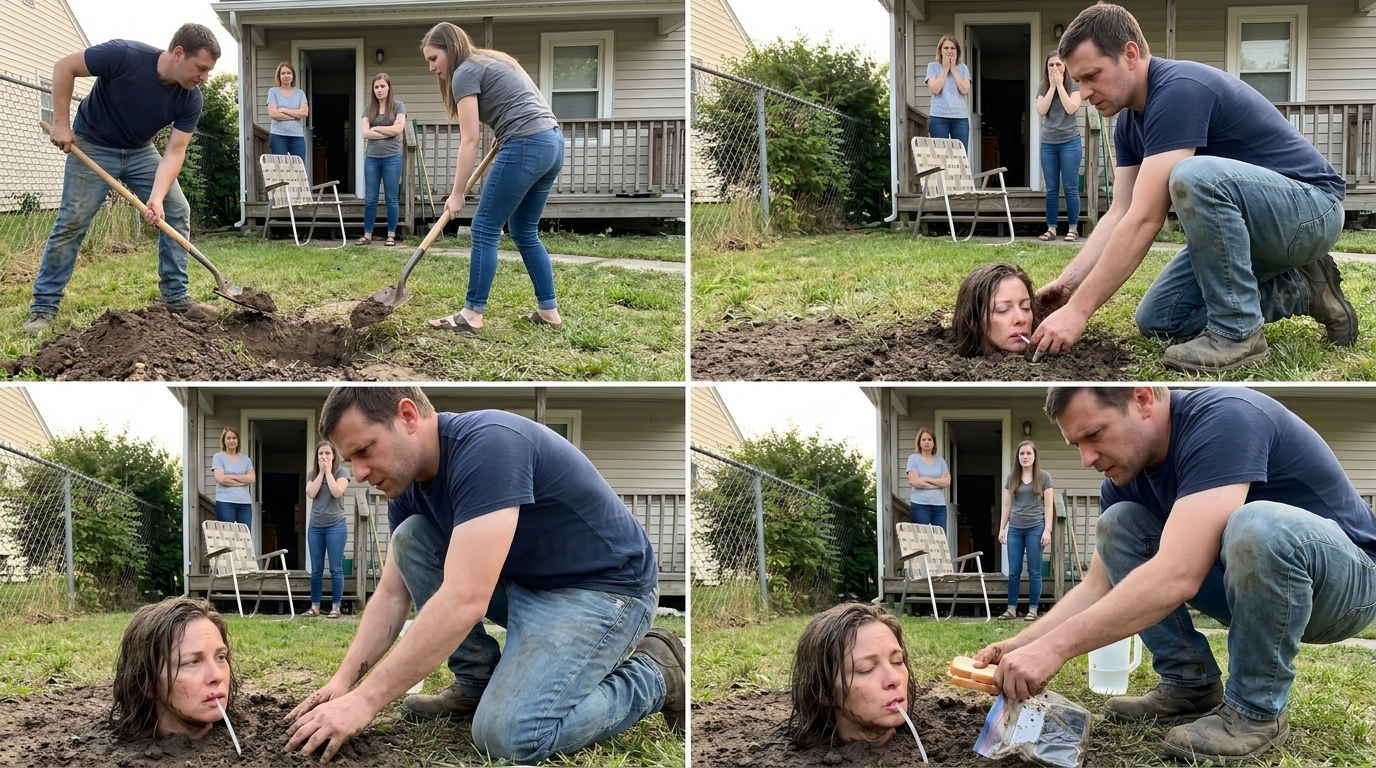
When the recording reached the discussion about the backyard, her fingers tightened.
The judge listened.
The lawyers listened.
Her husband listened.
His mother sat behind the defense table.
Mara sat separately.
Nobody spoke.
The recording ended.
The courtroom remained silent.
The prosecutor called the first witness.
Then another.
A medical professional explained the woman's condition after rescue.
The doctor described dehydration, physical strain, and the risks associated with prolonged confinement during pregnancy.
The defense questioned the doctor.
Could she have recovered?
Yes.
Could the baby's condition have remained stable?
Yes.
Did the examination prove every detail of the woman's account?
No single medical examination could prove every conversation.
The defense seemed pleased with that answer.
The woman felt a familiar doubt.
Then the doctor added something.
“But the physical findings were consistent with the history she gave us.”
The defense moved on.
The woman breathed again.
Her testimony came later.
She walked to the witness stand.
Her knees felt weak.
She sat.
The oath was administered.
The prosecutor began with simple questions.
Her name.
Her relationship to the accused.
Her pregnancy.
Her residence.
Then came the backyard.
She described the moment they took her outside.
She described the soil.
The straw.
The lack of food.
The way her body had been positioned.
She did not exaggerate.
She did not need to.
The details were enough.
She described how her husband spoke to her.
How his mother watched.
How Mara laughed.
How she kept the phone hidden.
The prosecutor asked why.
She answered honestly.
“Because I knew they could deny everything afterward.”
The courtroom remained quiet.
She explained how she had managed to activate the recording.
She explained the dispatcher.
She explained what happened when her husband discovered the phone.
The defense attorney stood.
His questions became sharper.
“Isn't it true that you had argued with your husband?”
“Yes.”
“Isn't it true that you were upset?”
“Yes.”
“Isn't it possible that your memory was affected by stress?”
“Stress can affect memory.”
The attorney paused.
“So your memory may not be perfect?”
“No one's memory is perfect.”
The woman looked directly at him.
“But I remember being buried.”
The attorney moved on.
He suggested that the incident had been intended as a scare tactic.
She answered.
“Being frightened was the point.”
He asked whether her husband had ever explicitly told her he wanted her dead.
“No.”
“Then you cannot say he intended serious harm.”
She thought carefully.
“I can say he knew I was pregnant. I can say he left me buried. I can say he knew I was without food and that I could not leave.”
The attorney said nothing.
The prosecutor later returned to those facts.
That exchange stayed with the woman.
She realized she had spent years believing she needed to prove what someone else intended.
Now she understood that she could describe what actually happened.
The court could determine the rest.
Her mother-in-law testified.
The older woman appeared nervous.
She said the family had been under stress.
She said the woman had become difficult.
She said the backyard idea had not been intended to cause harm.
The prosecutor played the recording.
The older woman's own voice suggested otherwise.
Her face changed.
She had no answer.
Mara testified after her.
She admitted she had been present.
She admitted laughing.
She admitted that she had known the woman was pregnant.
She admitted hearing discussions before the incident.
The defense tried to portray Mara as someone trying to reduce her own responsibility.
Mara accepted that possibility.
“I was afraid of him,” she said.
“Yet you still participated.”
“Yes.”
“Why?”
Mara swallowed.
“Because I chose the easier thing.”
The courtroom became very quiet.
The woman looked at her.
For the first time, she believed Mara understood what that sentence meant.
The prosecutor asked Mara whether she had ever believed the woman was dangerous.
“No.”
“Then why did you allow her to remain buried?”
Mara's eyes filled.
“I don't have a good answer.”
That was the first completely honest thing she had said.
The trial continued.
Evidence was presented from the backyard.
Photographs showed the disturbed soil.
The phone was introduced.
The freezer bag was examined.
The recording files were authenticated.
Every piece was small.
Together, they formed something difficult to escape.
The defense argued that the family had intended discipline rather than injury.
The prosecution answered that calling an act discipline did not change what was done.
The woman listened.
She did not know what verdict would come.
She had learned not to trust imagined endings.
Then closing arguments began.
Her husband's attorney described the household as troubled.
He spoke about arguments.
He spoke about stress.
He suggested that the situation had spiraled beyond what anyone expected.
The prosecutor focused on choice.
The husband chose the backyard.
His mother participated.
Mara remained.
They had opportunities to stop.
They did not.
The woman looked at her hands.
That was the truth she wanted remembered.
Not that everything had gone wrong accidentally.
They had opportunities.
They chose not to use them.
The judge later reviewed the evidence.
The woman waited.
The day felt impossibly long.
When the decision was finally delivered, she listened carefully.
The court found her husband responsible for the acts established by the evidence.
His mother's involvement was also addressed according to the evidence presented.
Mara's testimony and cooperation were considered in determining her own consequences.
The woman heard the legal language.
She did not cheer.
She did not smile.
She simply closed her eyes.
A long breath left her body.
Her husband finally looked at her.
Their eyes met.
For a moment, she saw the man she had once trusted.
Then she saw the man who had buried her.
The second image remained.
He looked away.
She did too.
Outside the courtroom, reporters waited.
She declined to speak.
She did not owe the public a statement.
She had already spoken where it mattered.
Her attorney walked beside her.
“You did well.”
She shook her head.
“I survived.”
He looked at her.
“That too.”
She stepped into the afternoon sunlight.
It felt warmer than the courtroom.
Her baby was waiting with a relative.
She took the child into her arms.
The weight was small.
Real.
She kissed the baby's forehead.
For the first time, the legal ending felt separate from her personal one.
The court had addressed what happened.
But she still had to learn how to live.
That work would take longer.
Click Here to continue read next: PART7: Freedom Does Not Erase the Past, but the Life She Builds Gives Every Old Fear a Smaller Place to Stand
The Backyard Became a Prison Before Anyone Outside the House Knew Something Was Wrong
Part 6 of 8

