
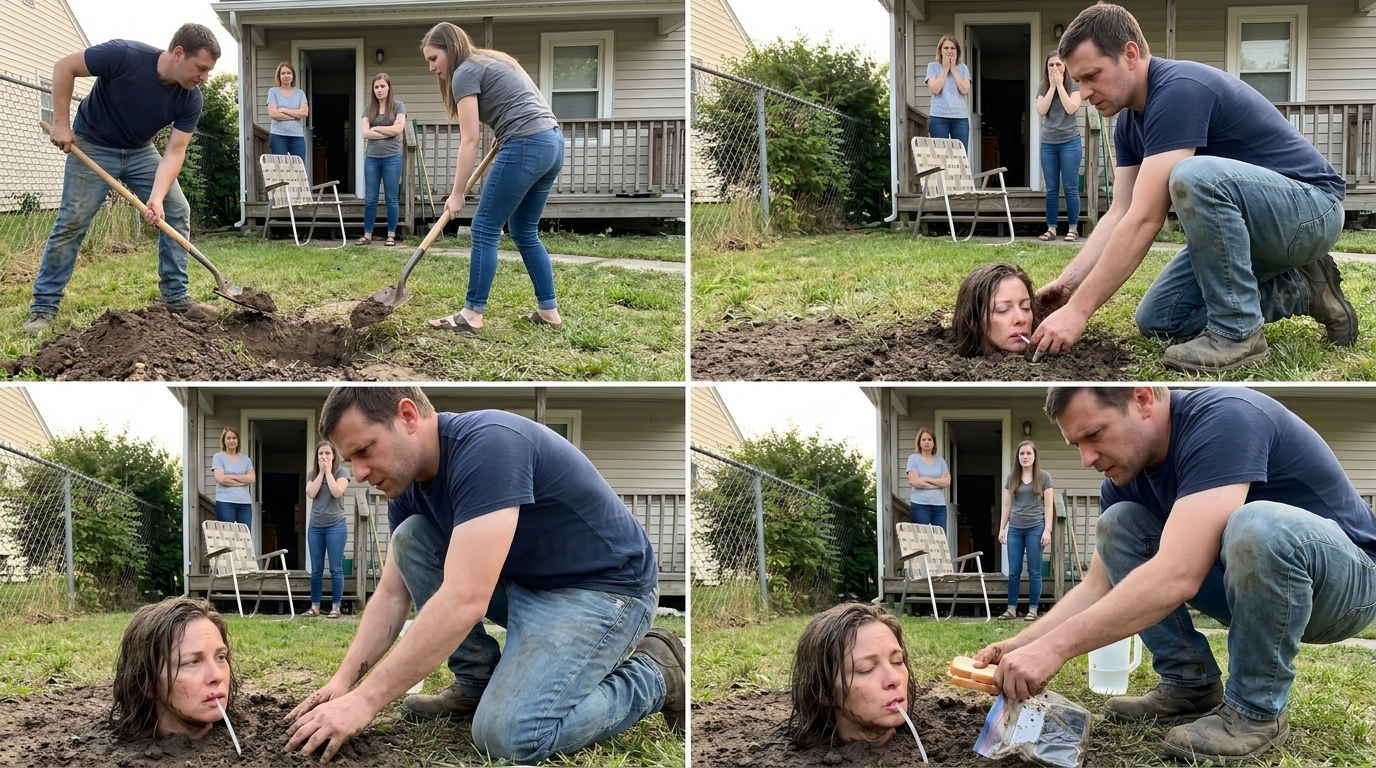
For one suspended second, nobody moved.
The phone glowed beneath the thin layer of mud.
Her husband stared at it.
Then he looked at her.
She had never seen such a quick change in his face.
First came disbelief.
Then calculation.
Then anger.
He knew.
The phone had not simply been found.
Someone was listening.
His hand tightened around the freezer bag.
“What did you do?”
She kept breathing through the straw.
The dispatcher's voice came again, quieter this time.
“Keep him talking.”
Her husband heard enough.
He knew someone was on the other end.
His mother stepped away from the doorway.
“What is happening?”
He did not answer her.
Mara remained near the porch steps, one hand gripping the railing.
The pregnant woman watched her husband study the phone.
He had spent months controlling conversations.
He had learned how to interrupt before she finished speaking.
He had learned how to explain her reactions before anyone could ask about them.
Now, for the first time, he was facing something he could not interrupt.
A recording did not forget.
A recording did not become frightened.
A recording did not change its story because someone spoke louder.
He yanked the phone upward.
The plastic tore.
The phone came free.
Mud fell across his wrist.
He stared at the screen.
The call was active.
The dispatcher was still listening.
He understood that too.
“You called them?”
His voice was low.
She said nothing.
His mother finally came down the steps.
“What did she call?”
He turned toward her.
“Go inside.”
She stopped.
“Why?”
“Just go inside.”
That frightened Mara more than anything else.
Until then, his mother had believed she understood what was happening.
Now she was seeing uncertainty on her son's face.
The woman buried in the ground noticed.
She had spent enough time studying them to know that fear traveled quickly.
Her husband's fear did not look like hers.
Her fear had been forced inward.
His spread outward.
His mother looked at the phone.
Then at the woman in the soil.
“What is that?”
He ignored the question.
Instead, he crouched again.
“You've been recording me?”
She looked at him.
He waited.
She gave him the first answer she had given all day.
Silence.
His jaw tightened.
He glanced toward the house.
Then toward the fence.
The yard suddenly seemed smaller.
The dispatcher spoke through the phone.
“Sir, keep your hands where we can see them.”
Her husband froze.
The words came from the tiny speaker.
Mara whispered, “They can hear us?”
He looked at her.
“Yes.”
His mother took another step backward.
Her expression had changed.
“What did you do?”
He snapped his head toward her.
“I didn't do anything.”
The pregnant woman almost laughed.
Not because anything was funny.
Because those words sounded so familiar.
I didn't do anything.
You misunderstood.
You're overreacting.
You're emotional.
You remember it wrong.
He had built an entire version of reality out of phrases like those.
Now the first crack had appeared.
The dispatcher asked for the woman's name.
She gave it.
Her voice was dry and weak, but steady enough.
The dispatcher asked whether she was injured.
She hesitated.
Her husband watched her.
That hesitation mattered.
She said she was pregnant.
She said she had been buried in the backyard.
She said she had been there since the previous day.
Her husband's mother covered her mouth.
Mara looked at the ground.
The story they had called a family matter had suddenly become something that could be heard outside the family.
Her husband began talking.
“She is confused.”
The dispatcher interrupted.
“Sir, do not speak over her.”
He stopped.
She watched him.
It was the first time she had ever heard a stranger tell him no.
The effect was immediate.
He looked smaller.
Not physically.
In certainty.
He no longer knew which words would work.
The dispatcher asked whether she had access to water.
Her husband answered.
“She has been given water.”
The woman remembered the pitcher.
She remembered him pouring it over her face.
The dispatcher asked whether she had been fed.
He hesitated.
That hesitation answered the question.
The dispatcher told him to step away from her.
He did not move.
The pregnant woman saw his hand tighten around the phone.
He was thinking.
She knew that expression.
He was looking for another version of events.
A version in which he had been helping.
A version in which she had asked for this.
A version in which he was the victim of an unreasonable accusation.
His mother tried to help him.
“She has been difficult since the pregnancy.”
The dispatcher asked whether she had personally witnessed the events.
The older woman fell silent.
Mara looked at her mother.
The woman looked away.
That was another crack.
The pregnant woman felt the soil against her shoulders.
Her body ached.
Her throat burned.
But for the first time since they buried her, she no longer felt completely alone.
She heard movement beyond the fence.
A vehicle slowed.
Her husband heard it too.
He turned his head.
Then another sound came.
A car door.
Her husband's face drained.
He stepped backward.
The dispatcher spoke.
“Remain where you are.”
He looked toward the road.
A distant voice called from outside the fence.
Her husband turned toward the gate.
Mara whispered his name.
He did not answer.
His mother began crying.
Not for the woman in the dirt.
Not yet.
She cried because the household story she had trusted was collapsing.
The woman buried in the yard watched all three of them.
Her husband had once told her nobody would believe her.
He had repeated it so often that she had almost believed him herself.
That was why she had hidden the phone.
Not because she expected rescue immediately.
Because she needed proof to exist somewhere outside her own memory.
Now the proof existed.
And someone had heard it.
Two uniformed officers entered the yard.
Her husband raised both hands.
The phone slipped from his fingers.
It landed in the mud beside her shoulder.
One officer moved toward him.
The other came directly to her.
“Ma'am, we're going to get you out.”
She tried to nod.
Her neck hurt too much.
The officer crouched beside her.
“Don't move your head. We're going to do this carefully.”
Her husband began speaking.
“She needs medical attention, obviously. I was only trying to calm her down.”
The officer looked at him.
“Step back.”
He stepped back.
The woman closed her eyes.
For several seconds, she listened to people moving around her.
Boots.
Gloves.
Tools.
Short instructions.
The ordinary language of rescue.
The first shovel entered the soil beside her shoulder.
She flinched.
The officer told her to keep breathing.
She did.
In.
Pause.
Out.
The same rhythm that had kept her alive.
The soil loosened.
Her right arm emerged.
Blood rushed into her fingers.
Pain shot through her hand.
She almost cried out.
The officer supported her wrist.
“Easy.”
Another section of dirt came away.
Her chest became freer.
She drew a deeper breath.
It hurt.
She welcomed the pain.
It was the pain of space returning.
The baby moved.
A stronger movement this time.
She pressed her lips together.
“I'm here,” she whispered.
She did not know whether she meant the baby or herself.
Perhaps both.
Behind her, her husband continued talking.
He explained.
He justified.
He insisted.
But now every explanation had to compete with the recordings.
The officers found the phone.
One placed it carefully into an evidence bag.
Her husband saw that.
His voice stopped.
That silence told her something.
He finally understood that he no longer controlled the story.
The officer helping her noticed her expression.
“You're safe now.”
She did not answer immediately.
Safe.
The word felt too large.
She had not felt safe in months.
Even before the backyard, she had learned to listen for his footsteps.
She had learned which doors he could block.
Which questions would make him angry.
Which memories he would deny.
Now people were digging her out while he stood several feet away, unable to reach her.
It was not the end of everything.
But it was the end of his control.
When they finally freed her shoulders, the officer placed a blanket around her.
The evening air touched her skin.
She shivered.
Her husband looked at her.
For the first time, he had nothing convincing to say.
The ambulance crew arrived.
One medic asked about the pregnancy.
She answered.
Another asked how long she had been buried.
She told them.
Her husband's mother tried to approach.
An officer stopped her.
Mara remained near the porch.
She looked at the lawn chair she had dragged into place.
Then at the patch of disturbed earth.
Then at the evidence bag.
Her face had lost all color.
The pregnant woman saw her.
Mara opened her mouth.
No words came.
The woman turned away.
She did not need an apology yet.
There were more important things.
Her body.
Her baby.
The recordings.
The truth.
As the paramedics lifted her onto the stretcher, she heard the dispatcher speaking to one of the officers.
“Make sure the audio files are preserved.”
She closed her eyes.
The sentence settled somewhere deep inside her.
Preserved.
That was exactly what she had needed.
Not revenge.
Not a perfect speech.
Not someone promising that everything would become easy.
She needed the truth preserved.
And now it was.
Click Here to continue read next: PART3: What the Recordings Reveal Forces the Family to Face the Difference Between a Private Lesson and a Crime
The Backyard Became a Prison Before Anyone Outside the House Knew Something Was Wrong
Part 2 of 8

