
The hospital lights were too bright.
After the darkness of the backyard, everything inside the emergency room seemed painfully sharp.
White walls.
Metal rails.
Blue gloves.
The quiet beep of a monitor.
She lay beneath a warm blanket while nurses examined her, asking questions in calm voices.
How long had she been outside?
Had she been given food?
Had she been struck?
Had she fallen?
Was she having pain?
Was the baby moving?
She answered as clearly as she could.
Sometimes her voice failed.
Sometimes she had to stop and swallow.
Nobody told her she was imagining things.
Nobody asked whether pregnancy had made her emotional.
That simple difference nearly broke her.
A nurse placed a hand near her shoulder.
“You don't have to rush.”
She nodded.
The baby's heartbeat was checked.
The sound filled the room.
Fast.
Steady.
Alive.
She stared at the ceiling.
Only then did she allow herself to cry.
The tears came quietly.
No dramatic sobbing.
Just a steady release that left her exhausted.
The doctor explained that they needed to monitor her closely because of the prolonged confinement and dehydration.
She listened.
She asked whether the baby was in danger.
The doctor answered honestly.
“There are concerns we need to watch, but right now we have a heartbeat, and that's encouraging.”
She closed her eyes.
A heartbeat.
She held onto those words.
Meanwhile, several rooms away, officers were examining the recordings.
The phone had captured more than her husband expected.
His explanations.
His threats.
His mother's comments.
Mara's laughter.
Their conversations about leaving her outside overnight.
The ordinary discussions that surrounded the punishment made the recordings even harder to dismiss.
Nothing sounded staged.
There was no performance.
No dramatic declaration.
Only people behaving as though what they were doing was normal.
That was what made the evidence powerful.
The husband tried to explain.
He said she had become difficult.
He said she had disobeyed him.
He said the burial was intended to frighten her into cooperating.
He said she was never in serious danger.
But the recordings told a different story.
A voice could be calm while describing something cruel.
A person could call punishment care.
A family could call cruelty discipline.
The words did not change the physical reality.
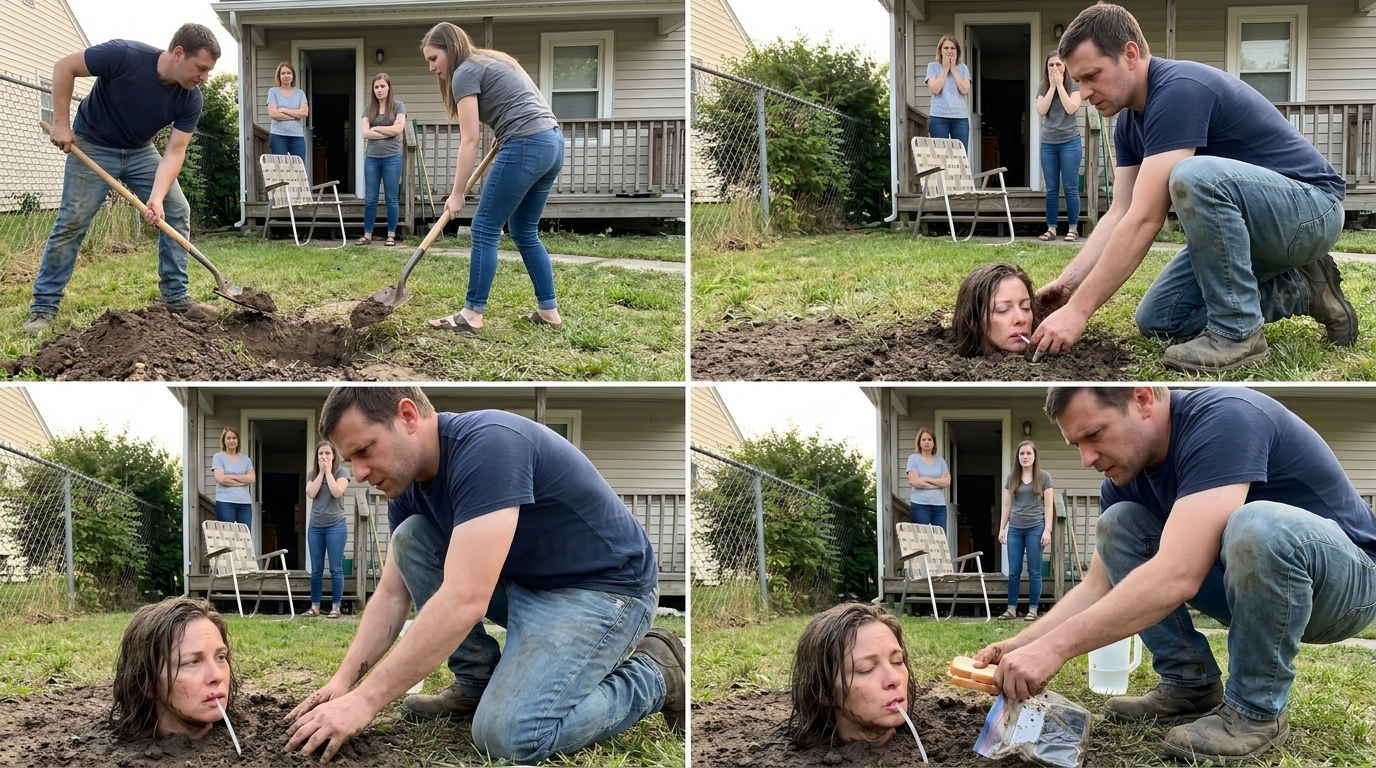
She had been buried while pregnant.
She had been left without adequate food.
She had been exposed to the weather.
She had been forced to breathe through a hidden tube.
And she had been expected to apologize.
The police asked her husband why he believed this was acceptable.
He had no good answer.
His mother tried to supply one.
“We thought we were helping the family.”
The officer looked at her.
“Helping whom?”
She had no response.
Mara eventually spoke.
“I didn't think it would go this far.”
The officer asked how far she thought it would go.
Mara stared at the table.
She did not know.
That answer was important too.
Cruelty often became easier when nobody decided where the boundary was.
One person began.
Another accepted it.
A third watched.
Soon the unacceptable became routine.
The pregnant woman heard later that Mara had admitted moving the lawn chair so it would not sit in the mud.
The detail stayed with her.
Not because it was the worst thing Mara had done.
Because it showed how ordinary the cruelty had become.
Mara had been worried about a chair.
The woman had been worried about whether her baby would move again.
Two realities had existed in the same backyard.
Only one had mattered to them.
That night, the doctor returned.
The baby's heartbeat remained steady.
The woman touched her stomach.
A small movement answered.
She smiled for the first time.
The smile disappeared quickly.
She still had questions.
What would happen next?
Where would she live?
Could she return home?
Would her husband be allowed near her?
What would happen to his mother?
What would happen to Mara?
The doctor could not answer those questions.
The police could answer some.
They told her that an investigation was underway.
They told her the phone had been secured.
They told her the recordings would be preserved.
She asked whether her husband could erase them.
The officer shook his head.
“Not now.”
Two words.
Not now.
She had lived too long inside a world where he could erase conversations simply by denying them.
Those words felt enormous.
Later, an officer asked her about the argument that had started everything.
She hesitated.
It was difficult to explain because the argument itself had never seemed like the beginning.
The beginning had been months of small things.
A comment.
A locked door.
A warning.
An accusation.
An apology demanded for something she had not done.
Each event seemed too small when considered alone.
Together, they had formed a pattern.
She told the officer about the way her husband spoke differently around strangers.
How he could become charming instantly.
How he could make her sound unstable without saying anything openly cruel.
How his family had gradually accepted his version.
The officer listened.
“Did you ever record him before?”
She nodded.
“Only after I realized nobody remembered the conversations the same way I did.”
She explained that the phone had not been intended as a weapon.
It had been a witness.
The officer wrote that down.
Witness.
She liked that word.
Her phone had become one.
The following morning, she learned that her husband had attempted to describe the backyard incident as a family intervention.
The phrase made her stomach turn.
An intervention suggested concern.
What happened in the yard had not come from concern.
It had come from control.
Her husband had wanted obedience.
His mother had wanted conformity.
Mara had wanted to remain on the safe side of the family.
None of them had wanted to confront what they were doing.
Until the phone spoke.
Then everything changed.
The husband was no longer confident.
His mother had become defensive.
Mara had begun asking whether she could speak privately with investigators.
The family that had presented itself as united was already separating under pressure.
The woman listened from her hospital bed.
She did not feel victorious.
She felt tired.
There was no joy in hearing about their fear.
There was only relief that she no longer had to carry the entire truth alone.
A nurse entered with water.
She drank slowly.
The first sip hurt her throat.
The second was easier.
She looked toward the window.
Morning had arrived.
Sunlight touched the glass.
For months, morning had meant listening for footsteps.
Now it meant something else.
A beginning she had not chosen.
A future she would have to build carefully.
Her husband had told her she would never be believed.
But belief was no longer the question.
There was evidence.
There were witnesses.
There was medical documentation.
There were recordings.
There was the phone beneath the soil.
And there was her own voice.
That afternoon, an investigator returned.
He carried a folder.
“We found something else on the phone.”
She looked at him.
“What?”
“One of the recordings starts before you were buried.”
Her stomach tightened.
The investigator placed the folder on the table but did not open it.
“It captures the conversation in the kitchen.”
She remembered that conversation.
The refrigerator.
The counter beneath her hand.
Her husband in the hallway.
His mother nearby.
The sentence about embarrassment.
She had thought that recording was useful because it showed the argument had existed.
The investigator told her there was more.
“There is a moment where your husband explains what he intends to do.”
She stared at him.
“What does he say?”
The investigator hesitated.
“He says he wants you to be frightened enough that you stop talking to anyone about what happens inside the house.”
Her breathing changed.
The truth had just moved backward.
The backyard had not been an isolated act.
It had been connected to something larger.
Her husband had known exactly why he wanted her silent.
The investigator continued.
“And there's another voice in the recording.”
She waited.
“Your mother-in-law.”
The room seemed suddenly smaller.
“What does she say?”
The investigator looked at the folder.
“She suggests the backyard.”
For several seconds, the woman could not speak.
The soil.
The chair.
The pitcher.
The laughter.
All of it had been part of a decision made before she was ever taken outside.
The investigator closed the folder.
“We'll talk about it when you're stronger.”
She nodded.
But she already understood the question that would now have to be answered.
Who had planned what happened?
And how long had they been planning to silence her?
Click Here to continue read next: PART4: A Forgotten Conversation Connects the Backyard Punishment to the Secret They Had Been Trying to Keep Buried
The Backyard Became a Prison Before Anyone Outside the House Knew Something Was Wrong
Part 3 of 8

