
The investigator returned two days later.
This time, he brought the recording.
She sat upright in the hospital bed.
Her hands rested over the blanket.
She was nervous.
Not because she doubted what she had heard.
Because she knew the voices.
The recording began with ordinary kitchen sounds.
A refrigerator humming.
A cupboard closing.
Water running briefly from the sink.
Then her own voice.
She sounded tired.
Younger somehow.
She heard herself asking why her husband had told his mother about the argument.
His answer came.
He sounded calm.
Almost bored.
He said there was no reason for her to make everything public.
Then his mother spoke.
She said family problems should stay inside the family.
The woman listening closed her eyes.
Those words had been repeated many times.
Family.
Private.
Respect.
Discipline.
Each one had been used to make silence sound like virtue.
The recording continued.
Her husband complained that she had begun telling people he frightened her.
His mother asked whether anyone believed her.
He laughed.
Then he said they would stop believing her if she kept making herself look unstable.
The woman opened her eyes.
She looked at the investigator.
“That was before they buried me.”
“Yes.”
The recording continued.
There was a pause.
Then his mother suggested that the woman needed something she would remember.
Her husband asked what she meant.
The older woman mentioned the backyard.
The room became silent.
The woman in the hospital stared at the phone.
The backyard had not been an impulse.
It had been discussed.
Considered.
Chosen.
Her husband had agreed.
The investigator stopped the recording.
She breathed slowly.
The baby moved beneath her hand.
She looked down.
For a moment, she could not separate the present from the memory of dirt against her face.
Then she reminded herself where she was.
Hospital.
Clean sheets.
A locked door.
People who knew what had happened.
She asked the investigator what would happen now.
He said the evidence would be reviewed with the rest of the case.
She asked whether her husband had been arrested.
He said the authorities were continuing the process.
She asked about his mother.
The answer was similar.
She nodded.
She had spent so long imagining that justice would arrive as one dramatic moment.
Instead, it came in pieces.
A report.
A recording.
A medical examination.
A statement.
A preserved file.
A witness.
Piece by piece, the story became impossible to deny.
Mara eventually requested to speak with her.
The woman did not want to see her.
Not yet.
But Mara left a message.
She said she had not understood how serious things were.
She said she regretted laughing.
She said she should have stopped them.
The woman listened once.
Then she turned the phone off.
An apology could not erase the dirt.
It could not return the days.
It could not change the moment she wondered whether her baby had stopped moving.
But she did not hate Mara.
Hatred required energy.
She had other uses for hers.
She needed to heal.
She needed to protect her child.
She needed to understand what came next.
Most of all, she needed to stop living as though every sound behind a door might be a warning.
The doctor eventually allowed her to leave the hospital under continued medical care.
She did not return to the house.
That decision felt strange.
The house had been hers too.
Her clothes were there.
Her photographs were there.
Her books.
Her belongings.
The small things she had arranged without thinking.
But the place no longer felt like home.
Home was supposed to be where the body relaxed.
She had learned to remain tense there.
So she left.
A relative helped her collect essential things while authorities handled the rest.
She stood outside the house once.
She could see the backyard from the driveway.
The disturbed earth had been covered.
The lawn chair was gone.
The patch of grass looked almost normal.
That was unsettling.
A place could hold terrible memories and still look ordinary.
She did not walk closer.
She did not need to.
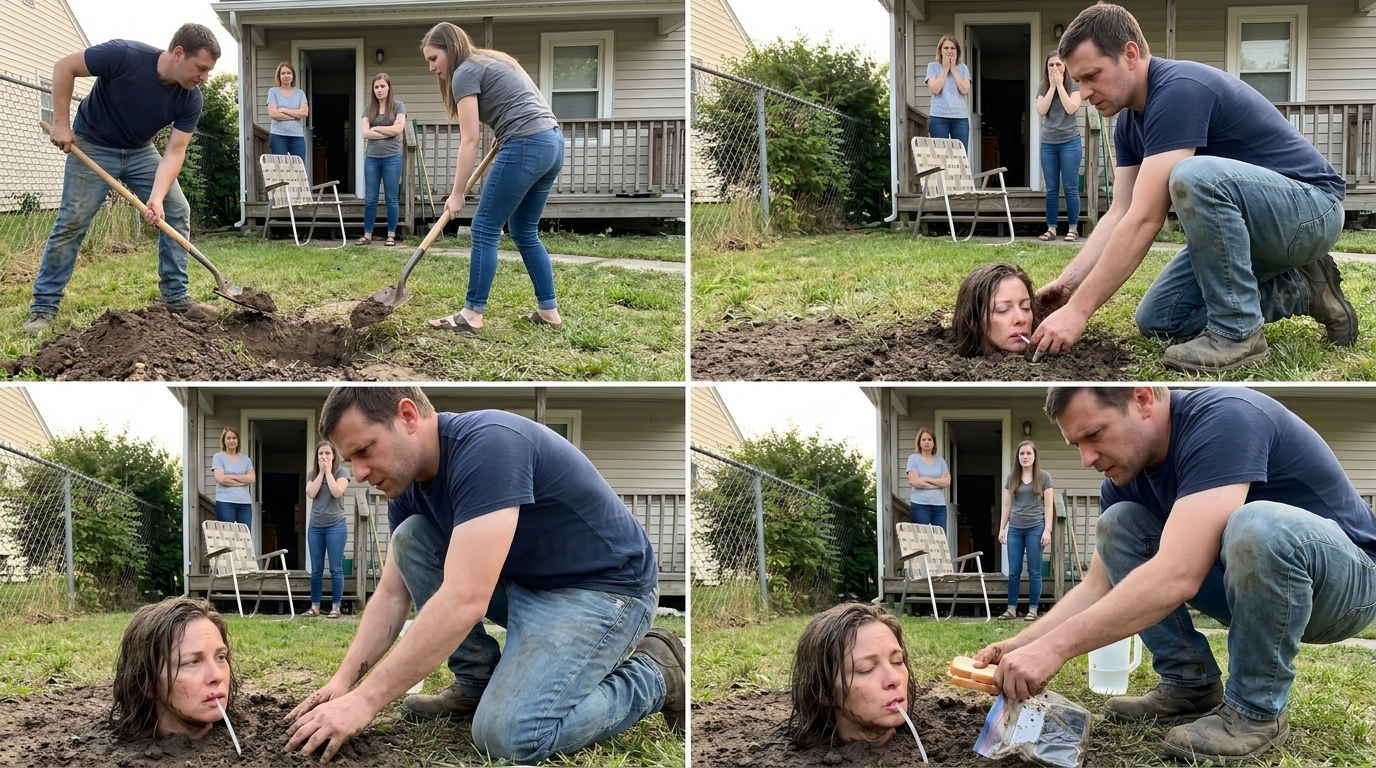
She knew exactly where she had been buried.
She knew where the phone had been hidden.
She knew where the pitcher had stood.
She knew where her husband's boots had pressed into the wet ground.
Those details would stay with her.
But they no longer controlled her.
Weeks passed.
The investigation continued.
The recordings were reviewed.
Her husband's statements were compared against the evidence.
His mother was questioned about her involvement.
Mara's account was examined too.
The family story weakened each time another fact was checked.
There was no single misunderstanding.
No isolated argument.
No accidental harm.
There was a pattern of control.
The recordings showed it.
Her testimony explained it.
The physical evidence supported it.
The medical records documented what her body had endured.
Eventually, she was asked to listen to one final recording.
She almost refused.
The investigator explained that it was important.
She agreed.
The file began.
Her husband's voice filled the room.
He was speaking to his mother.
He said the woman would eventually stop fighting.
His mother answered that fear worked better than arguing.
Then Mara's voice appeared.
She asked what would happen if the baby were hurt.
The recording went silent for several seconds.
Her husband answered.
“Then she'll learn to stop making trouble.”
The woman stopped the recording.
Nobody spoke.
She looked down at her hands.
For months, she had wondered whether she had been wrong to resist.
Whether she should have stayed quiet.
Whether speaking had made everything worse.
Now she understood something.
Her silence would never have satisfied them.
They had not wanted peace.
They had wanted control.
The distinction mattered.
She asked the investigator whether she could keep a copy of the recordings after the case.
He said the originals would remain evidence, but she would be able to access the material through the proper process.
She nodded.
The phone had once been a secret buried beneath the soil.
Now it was part of the truth.
Her baby was born later.
Healthy enough to make the doctors smile.
When she first held the child, she felt an emotion too complicated for a single word.
Relief was part of it.
Fear was part.
Love was larger than both.
She looked at the tiny face.
For a long time, she said nothing.
Then she whispered, “You were never the reason for what they did.”
She knew the child could not understand.
She needed to hear herself say it.
The legal consequences continued beyond that moment.
Her husband could no longer rewrite the backyard as a private lesson.
His mother's role could no longer disappear behind family loyalty.
Mara had to live with the fact that she had watched and laughed when she could have helped.
The woman did not decide their punishments.
That was no longer her responsibility.
Her responsibility was herself.
Her child.
Her future.
One evening, months after the rescue, she returned to the memory of the first morning.
She remembered the cold dirt.
The straw.
The numbness in her foot.
The silence inside her body.
She remembered thinking that if she survived, she would never again confuse quietness with safety.
She had learned something else too.
Proof did not have to be dramatic.
Sometimes it was a phone hidden beneath soil.
Sometimes it was a sentence recorded when nobody realized anyone was listening.
Sometimes it was a medical report.
Sometimes it was simply a person refusing to let someone else describe her reality for her.
She had not escaped because she was fearless.
She had been terrified.
She had survived because fear did not get to make every decision.
The backyard remained behind her.
The house remained behind her.
The voices remained in the recordings.
But they no longer defined the future.
Her child slept against her chest.
She placed one hand gently over the small back.
Outside the window, evening settled over the street.
There was no porch.
No lawn chair.
No pitcher.
No one standing above her demanding obedience.
Only quiet.
This time, quiet was not a trap.
It was peace.
And for the first time in a long time, she could breathe without listening for footsteps.
Click Here to continue read next: PART5: The Evidence That Once Protected Her Now Forces Her to Face the Consequences of Speaking the Truth in Public
The Backyard Became a Prison Before Anyone Outside the House Knew Something Was Wrong
Part 4 of 8

