The closer I came to my due date, the more ordinary details began to carry unexpected weight. I kept my hospital bag beside the bedroom door, checked the list of supplies my doctor had recommended, and made sure my phone stayed charged. My mother learned which appointments I preferred to attend alone and which ones I wanted her to accompany me to. We spoke often about the baby, and gradually the anticipation began to take up more space than the fear.
Mateo asked whether he could attend one of the prenatal appointments. I discussed it with my doctor and agreed, provided he respected the medical team's instructions and did not turn the visit into a conversation about our marriage. He arrived on time and sat quietly beside me while the doctor explained the next stages of care. When we heard our son's heartbeat, Mateo's face changed. He pressed his lips together and stared at the monitor, his eyes shining.
Afterward, he walked with me to the car. “I can't believe he's almost here,” he said.
“Neither can I.”
He asked whether I had chosen a name. I told him I was still considering a few possibilities and would share the final choice when I was ready. He accepted that answer, although I noticed the disappointment in his face. In the past, I would have hurried to reassure him that he would have an equal say in every detail. Now I wanted to see whether he could tolerate not being included in every decision without treating it as rejection.
“I know I've missed a lot,” he said as we reached the car.
“You have.”
“I want to do better.”
“Then keep doing the things that are difficult when no one is watching.”
He nodded. We said goodbye without an embrace. It was not the reunion he had hoped for, but it was an honest one.
Over the next several weeks, Mateo continued counseling and made a practical effort to prepare for the baby's arrival. He asked what supplies were needed and offered to contribute to expenses. We discussed arrangements through clear messages rather than long emotional calls. When he disagreed with something, he expressed his view without demanding that I change mine. These changes mattered, but I was careful not to confuse a better pattern with a completed transformation.
Carmela, by contrast, remained inconsistent. Through relatives, she sometimes sent messages wishing me well. At other times, she complained that I was keeping her from her grandson and that my mother had taken advantage of the crisis to separate Mateo from his family. I did not respond to those accusations. My lawyer advised me to preserve any communications that crossed a boundary and to keep contact limited to what was appropriate and safe.
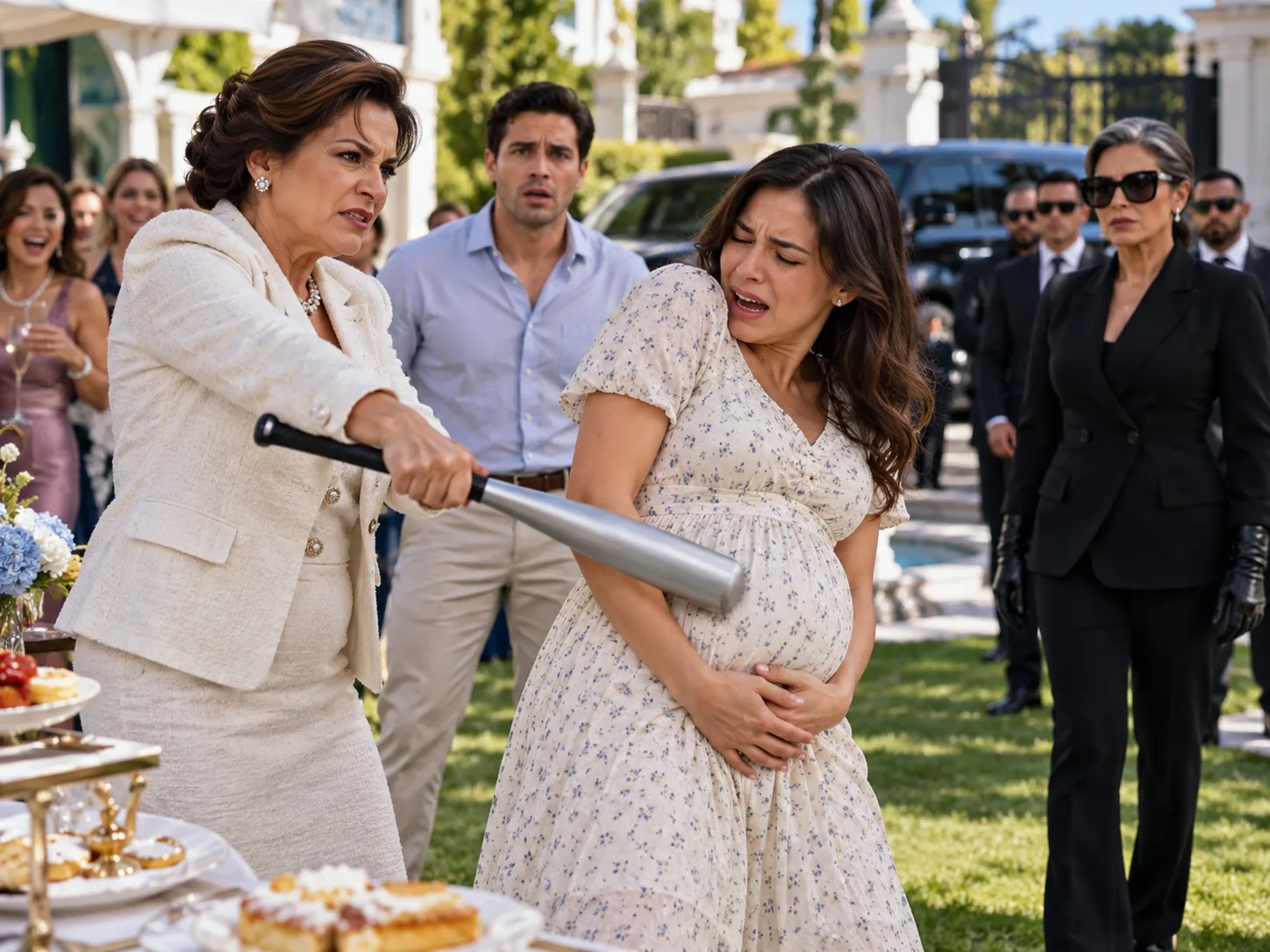
One afternoon, Arturo called me. He sounded older than he had at the lunch in El Pedregal, his voice subdued and tired. He apologized for standing by the grill while his wife attacked me. He said he had frozen, then convinced himself that someone else would intervene. By the time he understood what was happening, I was already on the ground.
“I should have moved,” he said.
“Yes,” I replied.
“I've spent a long time telling myself that I didn't know what she would do.”
“You knew what she was capable of doing to me with her words. You just didn't think it would become physical.”
He was quiet for several seconds. Then he admitted that he had watched Carmela humiliate people for years and had learned to avoid becoming her target. His silence had been a form of self-protection, but he could finally see what it had cost others.
I thanked him for acknowledging it. I did not tell him that everything was forgiven. He had offered an honest apology, and I accepted that it was his to offer. What happened next would depend on whether he continued to tell the truth when the rest of the family preferred a more comfortable version.
A week later, Mateo asked whether I would consider a meeting with him and a counselor to discuss co-parenting. He made clear that it did not have to involve reconciliation. I agreed to explore the option with my lawyer's guidance, because our son would connect us for years regardless of what happened to the marriage. I wanted any future arrangements to be based on the child's needs, not on Carmela's expectations or Mateo's fear of disappointing her.
During the meeting, the counselor asked Mateo what he believed his responsibilities would be as a father. He spoke about providing for our son, being present, and ensuring that he grew up in a stable home. The counselor then asked how he would respond if his mother insulted me in front of the child.
Mateo shifted in his chair. “I would tell her to stop.”
“What if she refused?”
“I would take my son out of the situation.”
“And what if she accused you of choosing your wife over your mother?”
He looked at me, then turned back toward the counselor.
“I would have to choose my child's safety.”
I felt something loosen inside my chest, but I did not let myself turn the answer into a guarantee. The words were right. The test would come when Carmela was angry, when relatives were watching, and when he could no longer avoid paying a price for disagreeing with her.
The counselor encouraged us to create clear expectations for communication, medical information, and contact after the birth. We agreed that decisions about our son would be made between his parents, with medical guidance when needed. We also agreed that extended family visits would be arranged in advance and that nobody would be entitled to access simply because of their relationship to the child.
Mateo did not object when the counselor emphasized that the same rules applied to both families. My mother would not be allowed to override parental decisions merely because she had supported me, and Carmela would not be allowed to ignore boundaries because she was a grandmother. I appreciated that distinction. I did not want to replace one person's control with another's. I wanted a life in which boundaries protected everyone rather than serving as weapons.
After the meeting, Mateo walked me to the entrance. He asked whether I thought we were making progress.
“I think we're learning how to talk about what needs to change,” I said. “That isn't the same as knowing whether we can repair the marriage.”
“I know.”
He seemed disappointed, but he did not argue. Before leaving, he asked me to tell him if the doctors gave me any important updates about the baby. I agreed. It was a reasonable request, and I wanted him to be informed as the birth approached.
At home, my mother helped me finish preparing the nursery. We washed the small clothes, arranged diapers and blankets, and checked that everything I needed was within easy reach. On one shelf, I placed a photograph of myself as a child, sitting on my mother's lap. I had almost forgotten how carefree I looked in it. Seeing the picture reminded me that I had once known what it felt like to be loved without having to earn it by staying quiet.
The legal matter remained unresolved. My lawyer told me that the authorities were continuing their review and that I should not interpret the absence of an immediate decision as proof that nothing would happen. I understood. I had chosen to report the assault because it was the truth, not because I could control the outcome. I continued to cooperate when asked and concentrated on the decisions I could make in my own life.
Carmela sent another message through Mateo. She wanted to know whether she could visit the baby after his birth. The question arrived before we had even settled on the exact arrangements for the hospital. I felt the old pressure return, the expectation that I would begin accommodating her wishes simply because the next family milestone was approaching.
I showed the message to my lawyer and discussed an appropriate response. We agreed that any contact would be considered only when I was medically ready and when clear conditions could be established. I did not need to decide the entire future of Carmela's relationship with her grandson before he was born.
Mateo called that evening. “Mom wants to know whether she'll be allowed at the hospital.”
“I haven't made that decision.”
“She says she deserves to be there.”
“Being his grandmother doesn't give her a right to be present at my medical care.”
“I know. I told her that.”
I sat down on the edge of the bed. “What did she say?”
“She accused me of letting your mother control everything.”
“And what did you say?”
“That the decision belongs to us as parents, and that you're the one giving birth. Your comfort and the medical team's advice come first.”
I closed my eyes. It was the first time he had described his mother's anger without asking me to resolve it for him. I felt a cautious, unfamiliar respect for the choice he had made.
“Thank you for telling her that,” I said.
“I should have been doing it for years.”
“Yes,” I replied. “You should have.”
Neither of us tried to turn the moment into a promise. We talked briefly about the hospital arrangements, then ended the call. I sat in the quiet room afterward, feeling both relieved and sad. I had wanted this version of Mateo for so long. I could recognize the effort without pretending that it erased what had come before.
A few days later, I woke before dawn with a dull ache in my lower back. At first, I assumed it was ordinary discomfort. I followed the instructions my doctor had given me, paid attention to the timing and pattern of the sensations, and contacted the medical team when I was unsure. They advised me on what to watch for and when to come in. My mother helped me prepare, moving calmly through the house while I tried to keep my thoughts from racing.
The ache eased, but the experience made the approaching birth feel real in a way that shopping lists and folded blankets never had. I sat beside the cot and rested my hand on the rail. My son would soon be here. He would need me to be present, to learn, to ask for help, and to make decisions even when I was frightened.
I thought of the woman I had been in the garden, bent over and pleading with her unborn child to move. I wished I could reach back through time and tell her that she did not have to earn protection by being patient. I wished I could tell her that asking for help was not a failure, and that leaving a dangerous situation did not mean she had failed at marriage.
But I could not change that afternoon. I could only carry its lesson into the future.
The following morning, Mateo sent a message asking whether I felt better. I told him the discomfort had eased and that I was following medical advice. He replied that he was glad and asked me to let him know if the situation changed. There was no request for reassurance, no mention of his mother, no attempt to use my answer as an opening to discuss reconciliation.
I placed the phone on the table and looked around the nursery. Everything was ready enough. The cot stood near the window, the blanket my mother had knitted lay folded at the foot, and the little clothes were arranged by size. I was still frightened. I was also ready to meet the child I had spent months protecting.
For the first time, I did not imagine his birth as a moment that would reunite the family or force Carmela to become kinder. His arrival was not a cure for the adults around him. It was the beginning of his own life, and I wanted him to enter it surrounded by people who understood that love required action.
Mateo might yet become one of those people. I hoped he would.
But my son would never be asked to wait for someone else's courage before he was allowed to feel safe.
Click here to continue reading: PART 8: When Her Son Finally Arrived, Elena Chose a Future Built on Truth Rather Than the Family’s Demand That Everyone Forget
One Blow in the Garden Exposed the Cruelty I Had Spent Two Years Pretending Was Ordinary Family Trouble
Part 7 of 28