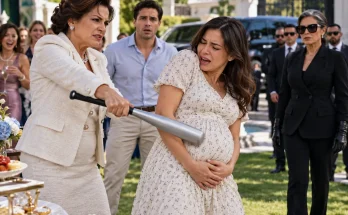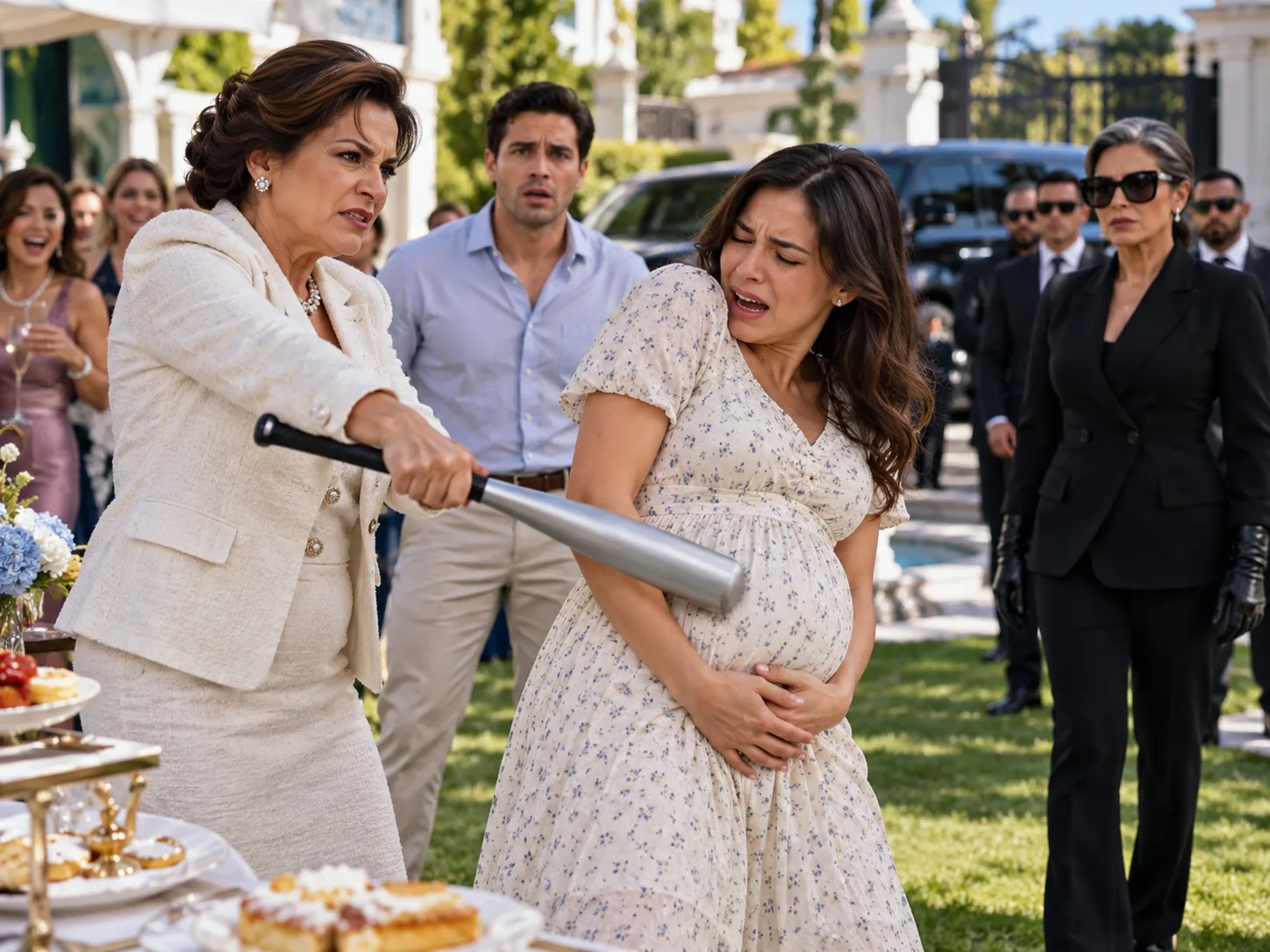
The first thing I heard after the bat struck me was laughter. Not from everyone, and not for long, but enough to make the sound impossible to forget. I was bent forward on the grass beside the swimming pool, my hands locked around my six-month-pregnant belly, struggling to draw a full breath while pain spread through my side. Above me, the afternoon sun glittered on the water. Somewhere near the outdoor grill, a piece of meat hissed over the flames. My husband, Mateo, stood a few steps away, staring at me as though the scene had unfolded too quickly for him to understand.
His mother, Carmela Villalobos, held the aluminum baseball bat loosely in one hand. She looked less frightened than annoyed. When I cried out and tried to straighten, she gave a short, disbelieving laugh, as if my pain were an embarrassing performance staged to ruin her Sunday lunch. The bat slipped from her fingers and landed on the grass with a dull clatter.
“Honestly, Elena. It barely touched you.”
I couldn't answer. My attention had narrowed to one desperate question: Was my son moving? I pressed my palms against the curve of my stomach, waiting for the familiar flutter that had become the most reassuring part of my days. I had learned his little patterns—the quiet stretches after breakfast, the occasional kick when I lay on my left side, the sudden activity whenever I drank something cold. Now there was only my own uneven breathing.
Mateo finally rushed toward me. “Lena, let me see.”
I recoiled when he reached for my arms. The movement hurt, but I barely noticed it. I looked at him and saw the instant his expression changed. He had expected me to take his hand, to accept his concern, to let him turn this into another family disagreement that could be softened with apologies later. Instead, I looked at him with a clarity I had never allowed myself before.
“You watched her,” I whispered.
His mouth opened. “I didn't think she would actually—”
“Don't.”
One word was all I could manage, yet it stopped him more effectively than shouting would have. I had heard every version of his defense before. His mother had a sharp tongue. His mother had been raised differently. His mother didn't understand how her comments sounded. If I could only ignore her, things would settle down. But a baseball bat had no interest in generational differences, and the child beneath my hands could not be protected by another promise that things would improve.
I forced myself to stand with the help of a nearby garden chair. The ground seemed to tilt under my feet. Around the patio, relatives shifted awkwardly. Arturo, Carmela's husband, stood beside the grill with a pair of tongs hanging motionless from his hand. Her sister Mercedes lowered her glass. Two younger cousins, who had laughed when Carmela first took the bat, stared at the grass as if the blades might offer them somewhere to hide.
“I need a hospital,” I said.
Carmela rolled her eyes. “Here we go. One little incident, and suddenly we're all supposed to panic.”
Mateo turned toward her. “Mom, stop.”
She stared at him in disbelief. “Excuse me?”
For once, he didn't immediately apologize to her. He glanced at me, then at the bat, then back at his mother. I might have felt relief if the delay hadn't already told me so much. He had found his courage only after the blow landed.
“Someone get the car,” I said.
Arturo put down the tongs and hurried toward the house. One of the cousins followed him. Mateo stepped closer again, holding out his hands, but I moved away. I didn't trust him to carry me, and I didn't trust myself to lean on the man who had spent two years asking me to endure what he refused to confront.
Carmela crossed her arms. “You make everything about yourself, Elena. This family has welcomed you into a beautiful home, and you repay us by acting like a victim.”
I looked at her. Her hair was perfectly arranged, her pale linen dress spotless except for a small splash of water near the hem. She had spent the afternoon criticizing my maternity dress, telling relatives that the color made me look tired and that women with better taste knew how to dress for their husband's family. Only minutes earlier, she had been explaining to her sister how some women knew precisely when to become pregnant to secure a wealthy husband.
I had heard those remarks so often that I could almost predict their rhythm. What I had never imagined was how easily she could turn her contempt into physical violence while the people around her watched.
For two years, Carmela had treated me as an unwelcome stain on the Villalobos name. She mocked the neighborhood she believed I came from, questioned the cost of my clothes, and once told the housekeeper to count the silver after I left a room. When I protested, she called me sensitive. When I kept quiet, she considered it proof that she had won. At family dinners, she could humiliate me with a smile and then complain that I had made the atmosphere uncomfortable by not smiling back.
Mateo always found me afterward. In the privacy of our bedroom, he would pull me against his chest and promise that he understood. He said he loved me. He said his mother had always been difficult. He said that once we had our own child, she might soften and finally accept me.
I wanted those words to be true so badly that I mistook his tenderness in private for protection in public. I convinced myself that he was trapped between two people he loved, rather than a man who had learned that silence cost him less than standing beside his wife.
When I became pregnant, Carmela's treatment grew harsher. She began referring to the baby as Mateo's little heir, as though I were merely the container entrusted with producing the next Villalobos. If I disagreed with her, she accused me of trying to separate her son from his family. If Mateo defended me in private, she made certain he paid for it later with hours of accusations about disloyalty and disrespect.
So I adapted. I chose my words carefully. I left gatherings early when I could. I learned which subjects would provoke her and swallowed my replies when she raised them. Each compromise seemed small enough to justify, until the sum of them became the life I was living.
That Sunday lunch in El Pedregal was supposed to be another afternoon I survived quietly. The mansion's wide lawns were trimmed to perfect lines, and the patio tables had been arranged beneath cream-colored umbrellas. Carmela had been drinking mimosas since noon. By midafternoon, her cheeks were flushed, and her comments had become louder as more relatives gathered around the pool.
I had touched my purse once, considering an excuse to leave. Six months of pregnancy had made me tired, uncomfortable, and less willing to pretend that everything was fine. Still, I stayed. I wanted Mateo to enjoy the afternoon without another argument. I wanted to believe that if I endured one more lunch, one more insult, one more pointed laugh, the day might end peacefully.
That was the bargain I had made with myself: if I could keep everyone comfortable, perhaps they would stop making me pay for being there.
The bat had belonged to one of the younger cousins, who had brought it along with a ball. Carmela took it from him as if she were about to join a harmless game. She swung it lightly through the air, smiling at the relatives who watched. Then her eyes moved to my stomach.
My body reacted before my mind could explain why. I stepped back and placed both hands over my belly.
“Don't,” I told her.
Mateo looked up from his drink. “Mom.”
Carmela's smile widened. “What? I'm not going to hurt the precious heir.”
She advanced a step, moving the bat as though she were testing its weight. I backed away again. The pool was behind me, the patio furniture to my right, and the open lawn offered little shelter. I could have run toward the house, but I had no reason to believe she would follow through with what she was threatening. Not really. Not in front of everyone. Not with her own son standing there.
Then she said something about testing my maternal instincts, and her expression changed. The joke had become a challenge. She wanted me to flinch. She wanted the family to see that she could frighten me whenever she chose.
“Carmela, put it down,” Mateo said.
He had finally risen, but he was still several feet away. His voice carried a warning without conviction, the kind he used when he wanted to appear reasonable without risking a real confrontation.
Carmela raised the bat.
I tried to turn my body away, shielding my stomach with my arms. The metal struck my side with a hollow, sickening sound.
Pain flashed through my abdomen. My knees buckled, and I folded around my son, both arms wrapped tightly over him as I struggled not to fall. For a terrible moment, I could hear nothing except the rushing of blood in my ears. Then the voices returned: a gasp, a chair scraping, someone saying my name, and Carmela insisting that I was exaggerating.
Mateo dropped beside me. I pushed him away when he reached for my shoulder.
“Don't defend her,” I said, though he hadn't spoken yet.
His face had gone pale. He looked as if he wanted to argue that this had been an accident, that he hadn't known she would swing, that none of us could have predicted what happened. I knew every sentence before he said it because I had spent two years helping him find those sentences.
Instead, I gripped the edge of the chair and fought to remain upright.
“I need medical help. Now.”
This time, nobody laughed.
Click here to continue reading: PART 2: The Woman Carmela Had Dismissed for Years Was the Only Person Elena Finally Trusted to Hear the Truth
One Blow in the Garden Exposed the Cruelty I Had Spent Two Years Pretending Was Ordinary Family Trouble
Part 1 of 28