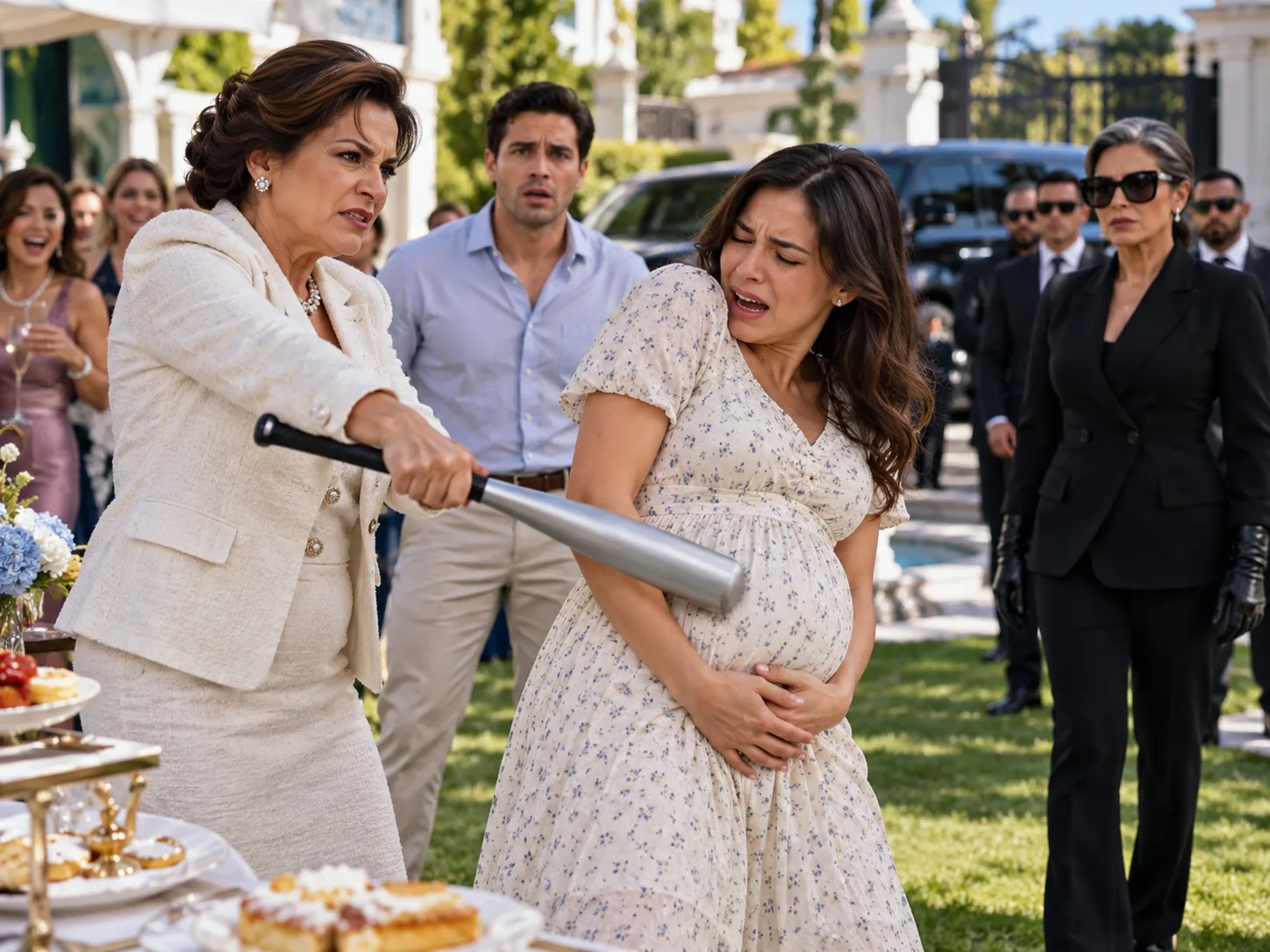
I reached for my phone with trembling fingers. The screen blurred as I tried to unlock it, and a fresh wave of pain made me clutch my stomach again. Mateo knelt beside me, speaking too quickly, asking whether I could breathe, whether I could stand, whether I could hear him. His panic sounded almost convincing. If I hadn't seen him standing there while his mother lifted the bat, I might have believed that he had only just discovered how dangerous she could be.
“Call an ambulance,” I said.
“I'll take you myself.”
“No. Call an ambulance.”
He hesitated, then pulled out his phone. Across the lawn, Arturo was already shouting for someone to bring a car around, while Mercedes hurried to the house to find towels and water. Carmela remained where she was, arms folded, watching the family scramble around me as though the entire affair were an inconvenience she had been forced to manage.
“I told you I barely touched her,” she muttered.
Arturo turned on her. “Carmela, enough.”
She stared at him, offended by the interruption. “Don't you start. She has been looking for an excuse to make us all look terrible since the day she married Mateo.”
I wanted to tell her that no excuse was necessary. The evidence lay in the grass beside her shoes. But speaking required more effort than I had, and I could not afford to spend any of it on her. I closed my eyes and concentrated on breathing slowly while keeping both hands over my abdomen.
Mateo tried to take my hand. This time, I let him touch my fingers, not because I forgave him, but because I needed something steady while the pain rose and receded. He kept repeating that everything would be all right. I stared at the gold wedding band on his hand and wondered how many times I had mistaken the comfort he offered me for the courage he lacked.
The ambulance arrived within minutes, though the wait felt much longer. The paramedics asked what had happened, and Mateo began to answer. I interrupted him.
“His mother struck me with a baseball bat. I'm six months pregnant.”
One of the paramedics looked directly at me. “Did the bat hit your abdomen?”
“My side. Near my stomach.”
“Any bleeding? Have you felt the baby move?”
“No bleeding. I haven't felt him move since it happened.”
The paramedic's expression remained professional, but the questions became more urgent. They helped me onto a stretcher, secured the straps, and checked my vital signs. When Mateo moved to climb into the ambulance, I turned my head away.
“Please,” he said. “Let me come with you.”
I wanted my husband beside me. That was the terrible part. Even after everything, some part of me still wanted him to be the man I had believed I married. But I couldn't bear the thought of lying in a hospital bed while he explained his mother's behavior to me, turning the worst moment of my life into another misunderstanding I was expected to forgive.
“Follow us,” I told him. “But don't tell me what she meant.”
The doors closed before he could answer.
At the hospital, the staff moved quickly. A nurse asked for my medical history, the date of my last prenatal appointment, and whether I had experienced contractions before. Another checked the bruising along my side. A doctor explained that they needed to assess both me and the baby, including his heartbeat and signs of injury that might not be immediately visible.
When they placed the monitoring equipment against my abdomen, I held my breath. The room seemed to shrink around the steady movements of the nurse's hands. I watched her face, searching for any hint of concern she might be trying to hide.
Then a rapid, familiar rhythm filled the room.
My son's heartbeat.
I began to cry before I realized the tears had started. The sound was strong, quick, and astonishingly ordinary. I gripped the edge of the bed and turned my face toward the ceiling, afraid that if I looked at anyone, the relief would break me apart.
The doctor did not promise that everything was fine. He explained that a blow during pregnancy could cause complications even when the first examination appeared reassuring, and that they needed to monitor me and perform further checks. I listened carefully, asking questions whenever I could manage them. For the first time that afternoon, my fear had somewhere useful to go.
Mateo arrived while the nurse was adjusting the monitor. He stopped just inside the room, his hair disheveled and his shirt collar crooked. He looked at the equipment around my bed and covered his mouth with one hand.
“Is he okay?”
“The doctors are checking,” I said.
He approached slowly. “Lena, I swear to you, I never thought she would do that.”
I watched him for several seconds. “You saw her pick up the bat. You saw me step away. You heard me tell her to stop.”
“I thought she was trying to scare you.”
“And you thought that was acceptable?”
He looked down. His silence answered before he could find another explanation.
“I was going to stop her.”
“But you didn't.”
“Everything happened so fast.”
The words landed harder than I expected. He was still trying to measure the incident by the time it took to happen, as if a few seconds could erase the years that had led to it. His mother had not suddenly become cruel that afternoon. She had spent two years testing how far she could go, and Mateo had taught her that he would always wait until the damage was done before asking her to stop.
A nurse entered to check the monitor, and I turned toward her, grateful for the interruption. She asked Mateo to step aside while she adjusted the equipment. He obeyed, moving to the far wall. He looked so helpless there that, for an instant, I felt the old instinct to comfort him.
I didn't act on it.
After the next examination, the doctor told me that my son's heartbeat remained reassuring, but observation was necessary. I would stay for monitoring, and the staff would continue checking for signs of contractions, bleeding, or other complications. I thanked him, then asked the nurse to document what I had reported about the assault.
Mateo lifted his head. “Why do you need that?”
“Because it happened.”
“Lena, this is my family. We can deal with this privately.”
I stared at him. “Your mother hit me with a metal bat while I was carrying your child.”
“She was drinking. She lost her temper. I know it was wrong.”
“You're already explaining it.”
He stepped closer. “I'm trying to keep this from becoming something that destroys everyone.”
I felt a coldness settle over me. He was afraid of consequences, not only for his mother but for the family name, the mansion, the comfortable arrangement that had allowed him to remain everyone's good son. I was the one lying in a hospital bed, and still he was thinking about what might happen to them if I told the truth.
“Everyone had a chance to stop this before it happened,” I said. “You all waited until I was on the ground.”
He sat down without replying.
Later, when the room was quiet and the staff had dimmed the lights, I opened my phone. There were missed calls from relatives, messages asking whether I was all right, and one from Mercedes telling me not to make any decisions while I was upset. Nobody had asked what Carmela had done in words that did not soften it. Nobody had offered to make a statement about what they had witnessed.
Then I saw the message I had sent my mother that morning.
Sunday lunch at the Villalobos house. I wish things were different between us.
I had written it before leaving home, after staring at our conversation for nearly twenty minutes. My mother and I had barely spoken for eleven months. Our last argument had ended with me telling her that she could not decide whom I married, and her telling me that love did not make a man brave. I had accused her of judging Mateo without giving him a chance. She had accused me of confusing endurance with loyalty.
Neither of us had called the other since.
I had hoped that message would be a small opening, nothing more. I hadn't wanted to ask for help. In truth, I had been ashamed to let her know how much of her warning had come true. I had told myself I was an adult, that I had chosen my husband, and that I could handle his family without being rescued.
My mother replied fourteen minutes after I sent it.
So do I.
Four words. No lecture, no demand, no attempt to win the argument. I had read them in the car outside the mansion and felt an ache that had nothing to do with pregnancy. Then I had put the phone away and walked inside to endure another lunch.
Now I opened her message again.
Mateo watched me from the chair. “Who are you texting?”
“My mother.”
His shoulders tightened. “What are you going to tell her?”
“The truth.”
“Lena, please. Let me talk to Mom first. I'll make sure she understands what she's done.”
I looked at him. “You have had two years to make her understand.”
He rubbed both hands over his face. “I know. I know I should have been stronger.”
It was the closest he had come to admitting what I had wanted him to admit for years. But the admission came after the blow, after the ambulance, after our son's heartbeat had become the only sound that mattered. I could no longer accept a confession as a substitute for action.
I typed a message to my mother, then stopped before sending it. What could I say that would capture the afternoon without turning it into a plea? How could I explain that the woman she had warned me about had struck me while my husband stood nearby? How could I admit that I had stayed quiet for so long that I had begun to doubt my own right to be angry?
My fingers shook. I deleted the message and tried again.
Mom, Carmela attacked me. She hit my pregnant belly with a bat. I'm in the hospital. The baby is being monitored.
I stared at the words, then pressed send.
The reply did not come immediately. I watched the screen, feeling foolish for expecting anything after nearly a year of silence. Mateo had lowered his head, his elbows resting on his knees. The room smelled faintly of disinfectant and warm plastic. Beyond the curtain, a cart rattled along the corridor.
Then my phone rang.
My mother's name appeared across the screen.
I answered, but for a moment neither of us spoke. I could hear traffic behind her and the controlled rhythm of her breathing. When she finally said my name, the sound of it brought back the little girl I had been before money, pride, marriage, and resentment had made every conversation a contest.
“Tell me exactly what happened,” she said.
I did.
I told her about the lunch, the insults, the bat, and Mateo standing close enough to intervene. I told her about the ambulance and the doctors monitoring the baby. I tried to keep my voice steady, but when I reached the moment the metal struck my side, the words broke apart.
My mother did not interrupt. She did not tell me that she had warned me. She did not ask why I had waited so long to call. She listened until I had nothing left to say.
Then her voice changed—not louder, not frantic, but so precise that I sat up straighter in the bed.
“Are you safe right now?”
“I'm at the hospital.”
“Is Mateo there?”
“Yes.”
“Can he hear this conversation?”
I glanced toward him. He was watching me, his expression wary.
“He's in the room.”
“All right,” my mother said. “You stay where the doctors can care for you. Do not let anyone pressure you into changing your account of what happened. I'll handle getting to you.”
I swallowed. “Mom, you don't have to—”
“Yes, Elena. I do.”
The call ended before I could find another objection. I held the phone against my chest, unsure whether I felt relief or fear. My mother had always been decisive. It was one of the qualities I admired most in her and resented most when it was directed at me.
Mateo stood. “What did she say?”
“She is coming.”
He looked toward the door, then back at me. “Lena, we need to think carefully about this. My mother will be humiliated. If your mother arrives here and starts making threats—”
“My mother hasn't threatened anyone.”
“You know what I mean.”
I did. He meant that the balance of power might change. He meant that the woman he had spent years watching dismiss me was about to meet someone she could not dismiss so easily. And he meant that he was frightened—not by the fact that his mother had hurt me, but by what might happen when I stopped handling her cruelty alone.
I turned my face toward the window. Outside, the evening light had begun to fade over the hospital parking lot. My son was still being monitored. I had no guarantee that the coming hours would be easy, and I was terrified of what the doctors might find. But one thing had become clear: I would not spend another minute protecting Carmela from the consequences of her own actions.
My mother was on her way.
And for the first time since I had married Mateo, I was no longer the only person in my corner.
Click here to continue reading: PART 3: When the Iron Gates Began to Open, Carmela Discovered That the Woman She Had Mocked Was Not Coming to Beg
One Blow in the Garden Exposed the Cruelty I Had Spent Two Years Pretending Was Ordinary Family Trouble
Part 2 of 28

One Comment on “PART 2 – The Woman Carmela Had Dismissed for Years Was the Only Person Elena Finally Trusted to Hear the Truth”