
There was no final dramatic moment.
I used to think there should be.
Every story I had imagined about betrayal ended with a confrontation, a confession, or a revelation.
Real life had given me none of those.
Instead, it gave me a Tuesday morning.
I woke before the alarm.
The room was still dark.
I lay there for a moment listening to the quiet.
Then I remembered.
The affair.
The marriage.
The grocery store.
The man who hadn't recognized me.
The shaking.
The divorce.
The years afterward.
All of it came back in a single chain of memory.
And nothing happened.
My breathing stayed steady.
My heart didn't race.
I didn't feel the need to get up and walk around.
I simply remembered.
Then I turned over and went back to sleep.
That was when I knew something had changed permanently.
The memory had not disappeared.
It had lost its emergency status.
Later that morning, I made coffee.
The woman I was seeing sat at the table reading.
She looked up.
“You seem peaceful.”
“I am.”
“Did you sleep well?”
“Eventually.”
She smiled.
We ate breakfast.
The day began.
No announcement.
No milestone.
Just another day.
At work, I received an email that required an immediate response.
I dealt with it.
A colleague made a joke.
I laughed.
Someone asked about the weekend.
I answered.
The ordinary machinery of life continued.
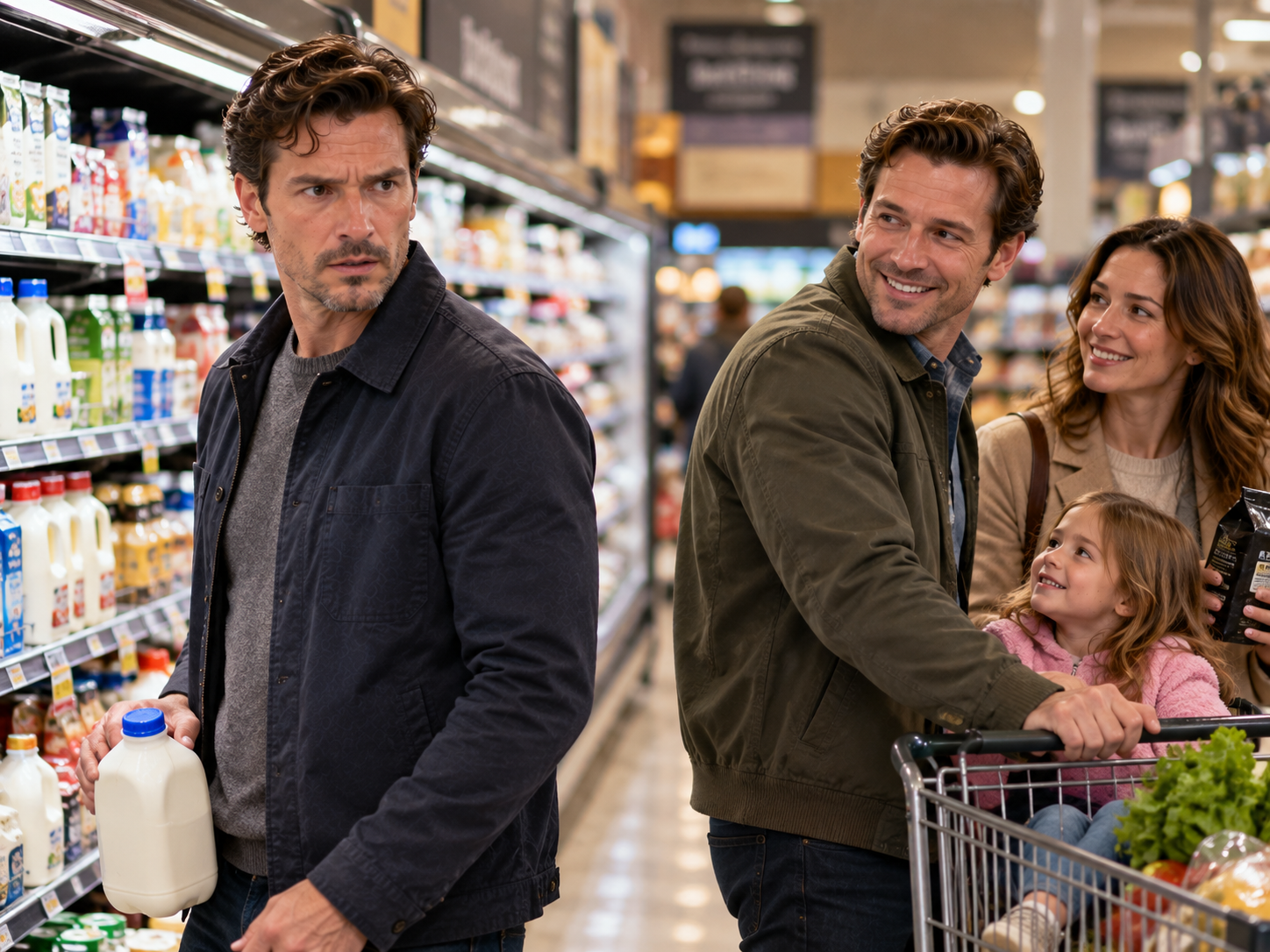
That afternoon, I passed a grocery store.
I almost laughed.
The first store had become such a symbol in my mind.
For a long time, I had imagined that place as the location where my healing failed.
Now it was simply a store.
I stopped to buy milk.
Inside, a child was crying because his mother wouldn't buy candy.
A man was comparing prices.
Someone had left a cart in the wrong place.
The cashier looked tired.
Nothing was sacred.
Nothing was dangerous.
I paid.
Outside, I stood beside my car.
I remembered the first time.
My knees had weakened.
I had cried.
I had believed the past had returned to claim me.
Now I understood that the past had never left.
It had simply become quieter.
I got into the car.
Before starting the engine, I thought about my former wife.
I hoped she was well.
I meant it.
I didn't need to see her.
I didn't need to hear from her.
I didn't need proof.
I had once believed that forgiving someone meant remaining emotionally available to them.
It didn't.
Forgiveness could exist at a distance.
So could love.
So could gratitude.
So could history.
I started the car.
That evening, I opened the reading-room door.
The old box sat on the cabinet.
I picked it up.
For a moment, I considered putting it away somewhere permanent.
Then I didn't.
I opened it.
The wedding album was there.
The old notebook.
The photograph from the lake.
The handwritten page from the worst period after the affair.
I looked at each one.
Nothing demanded anything from me.
The objects were silent.
That was the difference.
I had once treated them as if they contained answers.
They didn't.
They contained evidence of things that had happened.
The answers had always been in what I did afterward.
I closed the box.
Then I opened the notebook.
The pages were crowded with thoughts from years earlier.
Some were angry.
Some were frightened.
Some were written in the middle of the night.
Some were almost impossible to read because my handwriting had been so rushed.
I reached the final page.
I had written:
“Let the story be finished without needing it to be erased.”
Underneath it, I added one final sentence.
“I don't need to carry it every day to prove it mattered.”
I closed the notebook.
That was the end.
Not because the past was erased.
Because I no longer needed to rehearse it.
The woman I was seeing came into the room.
“You finished?”
“Yes.”
“How does that feel?”
I thought about it.
“Quiet.”
She smiled.
“Good.”
We stood together for a moment.
Then she asked whether I wanted dinner.
“Yes.”
“What do you want?”
“Anything.”
“That isn't helpful.”
I laughed.
“Pasta.”
“Better.”
We went into the kitchen.
While she cooked, I opened the window.
The evening air was warm.
Somewhere outside, a motorbike passed.
A neighbor laughed.
Someone called to a child.
Life.
Ordinary, imperfect, unfinished life.
I thought about how much I had once wanted certainty.
I wanted to know whether my wife truly regretted the affair.
Whether the other man had ever cared.
Whether I had been enough.
Whether I had stayed too long.
Whether leaving had been right.
Whether I would ever heal.
I had wanted every question answered.
Now I understood that some questions didn't deserve lifelong attention.
Was I enough?
That question had never belonged to another man.
Was she sorry?
She had shown me enough.
Did the other man remember me?
No.
And that no longer mattered.
Was staying a mistake?
Not entirely.
Was leaving a failure?
No.
Had the marriage been real?
Yes.
Had it become impossible to continue?
Yes.
Could I forgive her?
Yes.
Could I remain married to her?
No.
Could both answers be true?
Yes.
That was the final simplicity.
Not one answer.
Several truths living together.
After dinner, we sat by the window.
She leaned against me.
“You're quiet.”
“I'm thinking about how different everything is.”
“Good different?”
I smiled.
“Yes.”
I didn't tell her that I had once believed peace would feel like excitement.
It didn't.
Peace felt like not checking the door.
Not checking the phone.
Not checking the past.
It felt like trusting the morning to arrive without demanding that it repair yesterday.
It felt like being able to remember my former wife with compassion without confusing compassion for reconciliation.
It felt like remembering the other man without anger.
It felt like knowing that some people would always be connected to certain chapters of my life, even if they never appeared in the next ones.
It felt like accepting that I had been hurt without making hurt my identity.
Later that night, I received a message.
My former wife.
“Hope you're doing well.”
I looked at the words.
There had been a time when I would have searched them for hidden meaning.
Now I didn't.
I replied:
“I am. I hope you are too.”
A few minutes later:
“I am.”
I smiled.
Then I put the phone away.
No more messages.
No waiting.
No interpretation.
I went to bed.
The next morning, sunlight came through the curtains.
I woke slowly.
For a moment, I didn't think about anything.
Then I remembered the affair.
I remembered the grocery store.
I remembered the man who had smiled politely because he had no idea who I was.
And I remembered the man sitting in his car four years earlier, shaking and crying, convinced he would never be free of that pain.
I wished I could tell him something.
Not that everything would work out.
Not that the marriage would survive.
Not that the future would be painless.
Only that he would eventually understand.
He had not been weak for staying.
He had not been foolish for hoping.
He had not failed because forgiveness did not restore the marriage.
And he had not failed because seeing one familiar face could still hurt years later.
He was human.
That was enough.
I got out of bed.
Made coffee.
Opened the window.
The city was already awake.
I watched people begin their mornings.
Someone hurried toward a bus.
Someone walked a dog.
A shop opened its doors.
A delivery truck stopped at the corner.
Nothing about the world suggested that my past was important.
And that was strangely comforting.
My life no longer needed the world to acknowledge what had happened.
I knew.
My former wife knew.
That was enough.
The man from the grocery store didn't need to know.
He never had.
I had spent years believing recognition would heal humiliation.
It wouldn't have.
Only time, honesty, responsibility, boundaries, forgiveness, and the decision to continue had done that.
Not perfectly.
Not completely.
But enough.
I took my coffee to the reading room.
The old box remained on the cabinet.
I didn't open it.
I didn't need to.
The story was still there.
So was I.
But I no longer lived inside it.
That was the ending.
Not forgetting her.
Not forgetting the affair.
Not pretending the marriage hadn't mattered.
Not pretending the pain had never returned.
Just becoming someone whose future was larger than what had happened in the past.
I sat by the window.
Opened my book.
And began reading.
Outside, the city moved forward.
So did I.
The End
Read more original stories on Feel Every Story.
I Thought Four Years Had Been Enough to Bury Her Affair, Until a Familiar Stranger Smiled at Me in a Grocery Store
Part 28 of 28

