The invitation arrived almost exactly one year after my parents’ anniversary dinner.
Bellamy House.
Same restaurant.
Same month.
This time, Camille had booked the room.
I stared at the email for several minutes before opening it.
SUBJECT: Hannah’s Thirteenth Birthday Dinner.
The message was simple.
We’re keeping it small. Hannah asked for dinner here because she says this is where our family finally got interesting.
I laughed.
Then I read the rest.
Reservation is in my name. Deposit paid. Everyone covers their own drinks after dinner. No surprise upgrades. No one allowed to give speeches longer than two minutes. Aunt Ruth has been specifically warned.
At the bottom was one final line.
You are invited as my sister. Nothing else required.
I read that sentence twice.
Nothing else required.
A year earlier, entering Bellamy House had meant responsibility.
Menus.
Payments.
Guest lists.
Problems.
This time I arrived carrying only a birthday card for Hannah.
Daniel was still the manager.
He recognized me as soon as I stepped inside.
“Miss Doyle.”
“Hello, Daniel.”
He smiled.
“I heard you wouldn’t be hosting tonight.”
“No.”
“That must be relaxing.”
“You have no idea.”
He gestured toward the dining room.
“Your family is already inside.”
The room looked different.
Smaller tables.
Fewer flowers.
No champagne tower.
No expensive seafood station.
It was not less beautiful.
Just less theatrical.
Hannah spotted me first.
“Aunt Liv!”
She ran over and hugged me.
“You came.”
“Of course.”
She grabbed my hand.
“You’re sitting beside me.”
The seating chart confirmed it.
My name was handwritten beside hers.
Not because I paid.
Not because someone needed help.
Because she wanted me there.
Camille approached.
She looked nervous.
“Everything okay?”
“So far.”
“You’re not allowed to inspect the bill.”
“I wasn’t planning to.”
“Good.”
She smiled.
“I paid the deposit myself.”
“Congratulations.”
“Don’t sound surprised.”
“I’m deeply impressed.”
She punched my shoulder.
Mom joined us.
She wore a blue dress I remembered from years earlier.
“You look beautiful,” I said.
“So do you.”
She glanced toward my hands.
“You didn’t bring anything besides the card?”
I raised an eyebrow.
She caught herself.
Then laughed.
“I almost asked whether you brought the cake.”
“I noticed.”
“Camille brought the cake.”
“I know.”
Mom sighed dramatically.
“This growth business is exhausting.”
“So I’ve heard.”
Dad arrived carrying drinks.
He handed one to me.
“Gin and tonic.”
I looked at him.
“You remembered.”
“I wrote it in my phone.”
“Still counts.”
He tapped his temple.
“Technology.”
Dinner began.
Hannah opened gifts.
Ruth gave her a book about family history and announced that every teenager should understand how embarrassing previous generations were.
Camille gave her concert tickets.
Mom and Dad gave her a camera.
I gave her a leather-bound journal.
She ran her thumb across the cover.
“For writing what?”
“Whatever people forget.”
Her expression changed.
She understood.
“Like Great-Grandma?”
“Maybe.”
Hannah hugged me again.
When dinner arrived, servers placed platters along the center of the table.
Roasted vegetables.
Potatoes.
Salmon.
I almost laughed.
The menu closely resembled the one from the anniversary.
Mom noticed too.
Our eyes met.
For a second, the old scene returned.
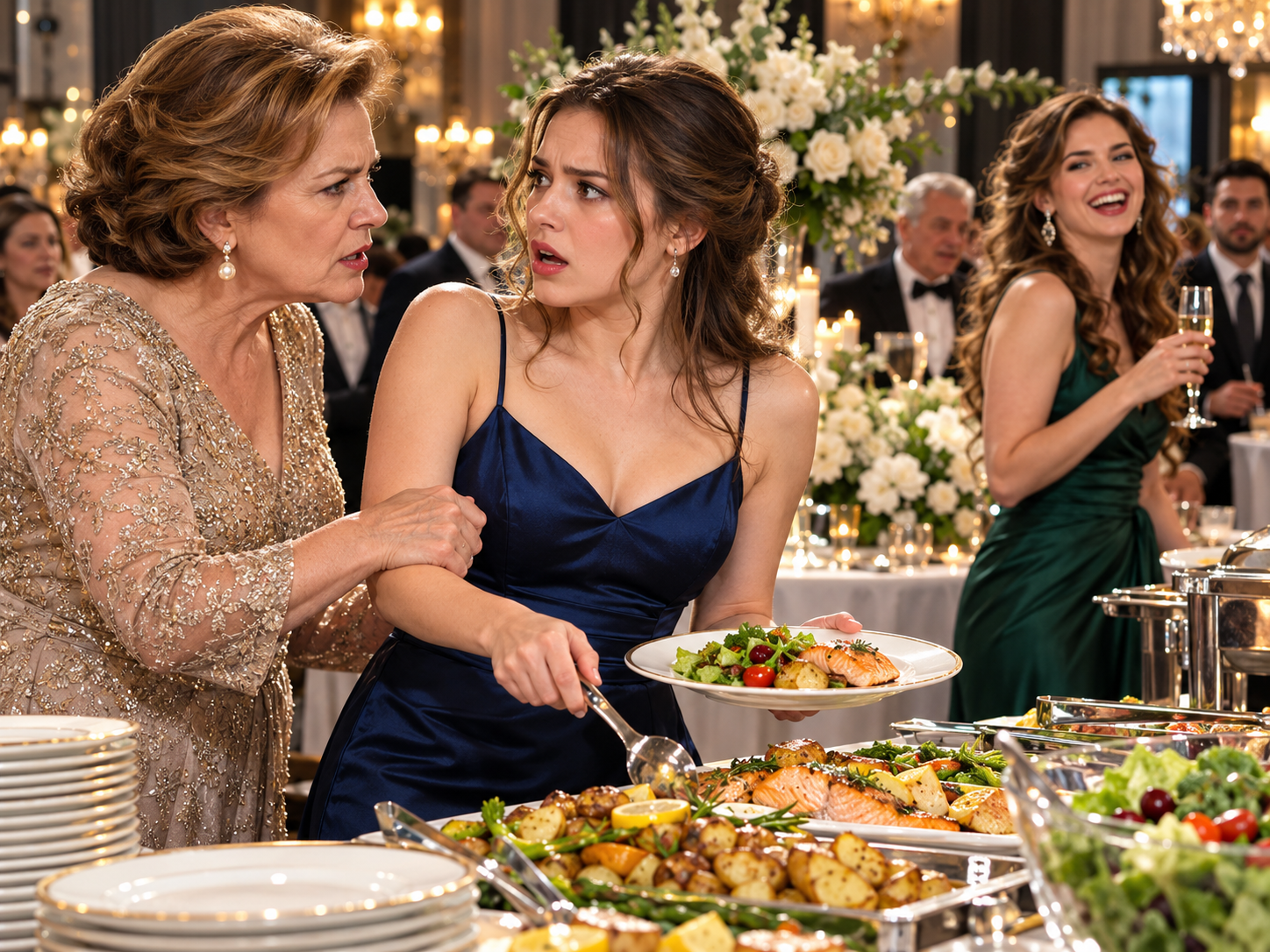
Her hand on my wrist.
Don’t fill your plate.
Then Mom reached for the serving spoon.
My body tightened automatically.
She paused.
Not because she planned to stop me.
Because she remembered.
She handed me the spoon.
“Your turn.”
I served myself.
Enough.
No more.
No less.
Nobody watched.
That might have been the best part.
Real change eventually becomes ordinary.
Halfway through dinner, Daniel approached Camille.
“Ms. Doyle, may I speak with you?”
She stood.
My old reflex activated instantly.
Problem.
Fix.
I almost rose.
Then stopped.
Camille followed Daniel into the hallway.
Dad continued eating.
Mom continued talking to Ruth.
Nobody looked at me.
Ten minutes later Camille returned.
“Everything okay?” I asked.
“They charged us for an extra table by mistake.”
“And?”
“I fixed it.”
She took another bite of potato.
That was all.
A year earlier, she would have handed the issue to me.
I would have solved it.
Then resented her.
Now she simply handled the problem attached to her name.
After dinner, Hannah stood for her birthday speech.
“I only get two minutes because Mom made a rule.”
Ruth checked her watch.
“Use them wisely.”
Hannah rolled her eyes.
Everyone laughed.
She thanked us for coming.
Then she looked toward me.
“Aunt Liv gave me this journal.”
She held it up.
“I’m supposed to write down what people forget.”
My chest tightened.
“So I already wrote something.”
She opened the first page.
“Families can change, but only if everybody does some of the changing.”
The room went quiet.
Hannah shrugged.
“That’s it.”
Ruth nodded.
“Better than most politicians.”
Camille pointed at her.
“No political speeches.”
“Fine.”
Hannah sat down.
I looked around the table.
Dad was laughing.
Mom was cutting cake.
Camille was distributing plates.
Ruth was correcting somebody’s grammar.
One year earlier, I had believed walking out of Bellamy House might end my relationship with all of them.
Instead, it ended the version of those relationships that depended on my silence.
That distinction had taken months to understand.
Boundaries had not destroyed the family.
They had destroyed an arrangement.
The family had been forced to decide whether anything real remained underneath.
Something did.
Not enough to erase the past.
Enough to build differently.
When dessert ended, Daniel placed the bill beside Camille.
She opened it.
Mom did not push it toward me.
Dad did not ask whether I could cover anything.
Camille checked the charges carefully.
Then she paid.
I watched without pretending not to.
She caught me looking.
“What?”
“Nothing.”
“You’re proud of me.”
“Don’t ruin it.”
She smiled.
“I knew it.”
Outside, the December air was sharp and cold.
Snow had not yet begun, but the sky carried the metallic smell that meant it might.
Hannah went home with Mom and Dad.
Ruth left with a cousin.
Camille and I remained near the entrance.
For a minute, neither of us spoke.
Then she looked back through the restaurant window.
“Do you think about last year?”
“Sometimes.”
“I do.”
She shoved her hands into her coat pockets.
“I hated you for leaving.”
“I know.”
“I thought you wanted to embarrass me.”
“I didn’t.”
“I know that now.”
She looked at me.
“You really just wanted to stop.”
“Yes.”
Camille nodded.
“I’m glad you did.”
The words were quiet.
I believed them.
“If you hadn’t,” she continued, “I probably would have gotten worse.”
“Maybe.”
“No. Definitely.”
She looked toward the parking lot.
“I was becoming someone I wouldn’t have wanted Hannah to learn from.”
That mattered more than apology.
She had seen herself clearly.
We hugged.
Not perfectly.
Not dramatically.
Just sisters.
At home later that night, I opened Grandma’s box again.
Her letters had become familiar.
Some pages were beginning to soften at the folds.
I reread the sentence that had changed me most.
Love should survive your no.
It had.
Not effortlessly.
Not immediately.
But it had.
Then I reread the second sentence I had once found difficult.
If your family ever learns to let you put the weight down, do not punish them by refusing to notice.
I understood that better now.
There had been a period after the anniversary when every mistake felt like proof that nobody had changed.
Mom pushing a restaurant bill toward me.
Dad calling about his truck.
Camille almost asking for money.
I had been tempted to treat those moments as failure.
But people are rarely transformed in one clean movement.
They stumble toward different behavior.
The important question is not whether old habits appear.
It is whether they remain unquestioned.
My family had begun questioning them.
So had I.
That was why I had been able to help Dad after his fall without feeling used.
Why I could choose a cabin without booking the entire trip.
Why I could accept Mom paying for brunch without rushing to reimburse her.
Why I could sit beside Camille while she handled a restaurant error herself.
Helping was no longer the price of my place in the family.
It was something I could give freely.
The next morning, Hannah texted me a photograph.
Her journal lay open on her desk.
The second entry read:
Aunt Liv says quiet people still need people to notice them.
I smiled.
Then another message arrived.
Also Grandma says you left your scarf at the restaurant.
I checked the hook beside my door.
Empty.
Old Olivia would have driven across town immediately.
Instead I typed:
Can she bring it Sunday?
Hannah replied.
She says yes.
A moment later:
She also says she is proud of herself for not bringing it tonight.
I laughed.
Tell her I’m proud too.
Sunday dinner became a loose family tradition.
Not every week.
Nobody wanted that.
Usually twice a month.
The host rotated.
Hosting meant providing the main dish.
Everyone else brought something.
No one person carried everything.
One Sunday, Dad cooked chili so spicy Ruth accused him of attempted murder.
Another week, Camille forgot dessert.
Nobody died.
Mom hosted Easter and asked me to bring bread.
Just bread.
I brought bread.
She did not ask what else I had prepared.
Nothing else.
The world continued turning.
A year after Hannah’s birthday dinner, Dad sold his old shop.
He asked whether I could review the sale documents.
This time, I said no.
Not because I was angry.
Because I was not a lawyer.
He hired one.
The transaction went perfectly.
Dad later told me, “Apparently professionals exist.”
“Revolutionary.”
Mom joined a gardening club.
Camille started therapy.
I began traveling more.
Not because I was escaping my family.
Because I finally understood that my life could expand without anyone interpreting my absence as betrayal.
I went to Portugal.
I hiked part of the coast.
One evening, I sat alone at a small restaurant overlooking the Atlantic.
The waiter brought grilled fish, bread, olives, and potatoes.
The portions were generous.
For a fraction of a second, I heard my mother’s old voice.
Don’t fill your plate.
The memory arrived without power.
I served myself.
I ate until I was full.
Then I ordered dessert.
Chocolate.
Raspberry.
Of course.
I sent a photograph to the family group chat.
Dad replied with three thumbs-up emojis.
Mom wrote:
Looks delicious. Eat everything.
Camille responded:
Who are you and what have you done with our mother?
Hannah added:
CHARACTER DEVELOPMENT.
I laughed so hard the couple at the next table looked over.
I lifted my glass toward the ocean.
For years, I had believed independence meant never needing anyone.
Then I believed boundaries meant never giving more than my exact share.
Both ideas had been reactions to the same fear.
Real freedom turned out to be quieter.
It meant knowing I could give without disappearing.
Receive without owing.
Leave without abandoning.
Stay without surrendering.
Say no without expecting love to vanish.
And say yes because I genuinely wanted to.
Grandma had been right.
A family does not survive because nobody wounds anyone.
It survives when people stop pretending wounds are normal.
When apology becomes behavior.
When responsibility is redistributed.
When love no longer requires one person to remain smaller so everyone else can stay comfortable.
The dinner that changed us began with my mother telling me not to fill my plate.
Years later, that sentence became almost unbelievable.
Not because she had never said it.
Because we had become different enough that she never would again.
And perhaps that was the ending Grandma had hoped for all along.
Not revenge.
Not repayment.
Not a perfect family.
A table where everyone carried something.
A table where nobody carried everything.
A table where there was enough room for me whether my hands were full or empty.
Click Here to continue read next: PART9: The First Time My Family Needed Me After I Finally Built a Life of My Own, I Had to Decide What Helping Really Meant
I Arrived at My Parents’ Anniversary Dinner and Discovered My Sister Had Somehow Become the Host of the Celebration I Paid For
Part 8 of 16