Two days later, I stood in my mother's living room while she helped me arrange the documents the hospital had given me. My bruising had begun to fade at the edges, but my body still reminded me of the assault whenever I moved too quickly. I was learning not to mistake an ordinary moment for proof that the danger had passed. I followed my doctor's instructions, kept my appointments, and paid attention to every change in how I felt.
My mother had arranged for a lawyer experienced in family matters and assault cases to speak with me. She wanted me to understand my options before deciding how to proceed. I gave the lawyer my account of the incident, identified the relatives who had witnessed it, and explained what had happened afterward. I did not ask my mother to make the story disappear. I wanted the facts recorded accurately, even if the truth made the people I had married into uncomfortable.
The lawyer explained that I could make a formal report and that the witnesses' accounts might be important. She also advised me to preserve messages from Mateo and his family, especially anything that showed attempts to pressure me into changing my account or returning to the mansion before I felt safe. I agreed. The messages were already on my phone, but I had previously read them only to understand what Mateo wanted from me. Now I read them as a record of what he had said and what he had avoided saying.
Carmela's apology arrived that evening in a long message. She began by saying she had been drinking and had allowed her temper to get the better of her. She wrote that she had never intended to cause harm to her grandson. Then she explained that I had embarrassed her in front of the family by refusing to accept her jokes, and that the afternoon had gotten out of control.
Near the end, she wrote, I hope you can understand that I am not a monster.
I read the message twice. There was no sentence acknowledging that I had warned her to stop. No recognition that she had followed me with a bat after seeing me protect my stomach. Her apology asked me to consider how she wanted to be seen, while leaving me to carry the memory of what she had done.
I forwarded the message to the lawyer and did not reply.
Mateo called the following morning. He sounded exhausted, and I could hear traffic in the background.
“Have you read Mom's message?” he asked.
“Yes.”
“She really is sorry.”
“Then she can accept that I need time and that I may never feel comfortable around her again.”
“She says you won't even give her a chance.”
“She had a chance before she lifted the bat. She had another when I asked her to stop.”
“Lena, I know what she did was wrong.”
“Then stop asking me to make it easier for her.”
He went quiet. I heard a door close on his end of the call.
“I don't want to lose you,” he said.
I closed my eyes. There had been a time when those words would have been enough to soften me. I would have told him that he wasn't losing me, that we could work through this, that I understood how difficult his relationship with his mother was. I would have reassured him before he had to take responsibility for anything.
Now I understood that his fear of losing me had never been the same as his willingness to stand beside me.
“Then you should have protected me when I needed you,” I said.
“I can't change that afternoon.”
“No. But you can stop asking me to pretend it was smaller than it was.”
He began to cry quietly. I listened, my hand resting on my belly, and felt grief for the man I had hoped he would become. I still loved him. That truth had not vanished with the bruises. But love no longer persuaded me that returning to the mansion was safe or that I should keep sacrificing my peace to preserve his family's image.
When the call ended, I sat for a long time without moving. My mother came into the room and placed a glass of water on the table beside me. She didn't ask what Mateo had said. She knew I would tell her if I wanted to.
“I don't know what will happen to us,” I admitted.
“You don't have to know today.”
“What if I regret leaving?”
“Then you'll make your next decision with the information you have then. You don't owe anyone a promise to remain unhappy.”
I looked at her. “I used to think you wanted me to leave him.”
“I wanted you to have a choice that wasn't controlled by fear.”
Her answer stayed with me.
A few days later, the formal process began. I gave my statement and provided the messages I had preserved. The lawyer explained what might happen next and reminded me that the investigation and any legal decisions belonged to the relevant authorities. My mother's position in business did not change the facts of the assault, and I did not want it to. I wanted the people who had witnessed the incident to tell the truth about what they had seen.
Some relatives contacted me privately. One cousin admitted that he had laughed at first because he thought Carmela was pretending to threaten me. He said he stopped laughing when the bat struck my side. He offered to confirm what he had witnessed if asked. Mercedes sent a message saying she wished she had intervened sooner, though she still described the afternoon as a terrible family argument.
I answered neither of them immediately. Their words mattered, but they could not return me to the moment before the blow or give me back the confidence I had lost while trying to fit into the Villalobos family. If they wanted to help, they could do so by telling the truth without softening it.
Meanwhile, my mother began making arrangements for my safety and comfort. She asked whether I wanted to stay in her home until the baby arrived and whether I needed help collecting personal belongings from the mansion. We discussed the practical details with the lawyer rather than turning the situation into a dramatic confrontation. I would not go back alone, and I would not allow anyone to use the retrieval of my belongings as an excuse to force a meeting with Carmela.
Mateo agreed to cooperate with the arrangements, although he continued to ask whether I might reconsider the marriage. He said his mother had been staying mostly in her rooms and that Arturo had told her to stop contacting me. He said he had finally made it clear that he would not ask me to return while she remained in the house.
For a moment, I wondered whether he had changed. Then I asked why he had needed so many days, so many conversations, and the possibility of losing me before he could say what he should have said in the garden.
He didn't have an answer that could satisfy me.
“I was afraid,” he said eventually.
“I know.”
“I didn't want to go against her.”
“I know that, too.”
He waited for me to tell him that fear was understandable, that we could start again, that the past did not have to determine our future. I had offered him those words so many times that he seemed to expect them even now.
Instead, I told him I needed space. If he wanted to become a different kind of husband and father, he would have to do that without treating my return as the reward for his first few acts of courage. Our son deserved better than a father who only became protective when the consequences of his silence reached his own life.
The day we arranged to collect my belongings, I did not go to the mansion. My mother and the lawyer coordinated the visit, and I remained at home, following my medical advice and resting. Mateo made certain that my personal items were packed and ready. He sent a list of what he had gathered and asked whether there was anything else I wanted.
I replied with a short list and thanked him for arranging it.
It was the first practical conversation we had managed without either of us trying to turn it into a discussion about reconciliation. That small improvement did not erase what had happened, but it gave me a glimpse of what a boundary could accomplish. I could speak to him when necessary without surrendering the decision I had made to protect myself.
My mother never demanded that I use her wealth or influence against the Villalobos family. She did not need to prove that she could outspend Carmela, embarrass her publicly, or strip away the status she had spent years cultivating. Her support was quieter and more useful. She helped me obtain advice, accompanied me to appointments when I wanted her there, and made sure I was not left to handle difficult conversations alone.
For years, I had hidden the truth about my mother's success because I wanted Mateo's family to judge me on my own merits. I had also hidden the truth about how they treated me because I was ashamed to admit that I had stayed. Both decisions had come from the same hope: if I could manage everything privately, perhaps I could make the marriage work without forcing anyone to confront what was wrong.
I finally understood that privacy was not worth the price of silence.
A week later, my mother asked whether I was ready to tell her more about the argument that had separated us. We sat together at the kitchen table after dinner. The room smelled of ginger tea, and the evening rain tapped against the windows. I told her that I had felt judged when she questioned Mateo's ability to stand up to his mother. I had wanted her to trust my decision, and I had interpreted her concern as an attempt to control my life.
She listened without interrupting.
When I finished, she said, “I should have found a way to stay close to you without making you feel you had to choose between us.”
I reached for her hand. “I should have called when I realized things were getting worse.”
We did not solve eleven months of hurt in a single conversation. There were other things to discuss, old misunderstandings that would need patience and honesty. But we were speaking again, not because one of us had won the argument, but because neither of us wanted pride to decide what happened next.
As the weeks passed, I continued my prenatal care and followed the medical team's guidance. There were days when I felt stronger and days when the memory of the bat returned without warning. A sharp noise could make me tense. The sight of a metal object lying on the ground sometimes pulled me back to the lawn, to the laughter, to Mateo standing several steps away.
When that happened, I reminded myself where I was. I looked around the room, took a slow breath, and rested my hand over my son. My mother never told me to forget the incident or to stop thinking about it. She let me speak when I needed to and respected the moments when I wanted quiet.
Mateo continued to contact me. Some messages were about appointments and practical matters. Others asked whether I missed him or whether I could imagine returning home. I answered the first kind when a reply was necessary. I left the second unanswered until I felt ready to address them.
Eventually, I told him that I was not prepared to resume our marriage. I would not make a permanent decision simply because the family wanted the crisis to end, and I would not promise to return to the mansion. If we were ever to rebuild trust, it would require sustained action, accountability, and a home in which my safety did not depend on Carmela's mood.
Mateo said he understood. I hoped he meant it. But I no longer needed to decide whether his words were sincere before deciding what was right for me.
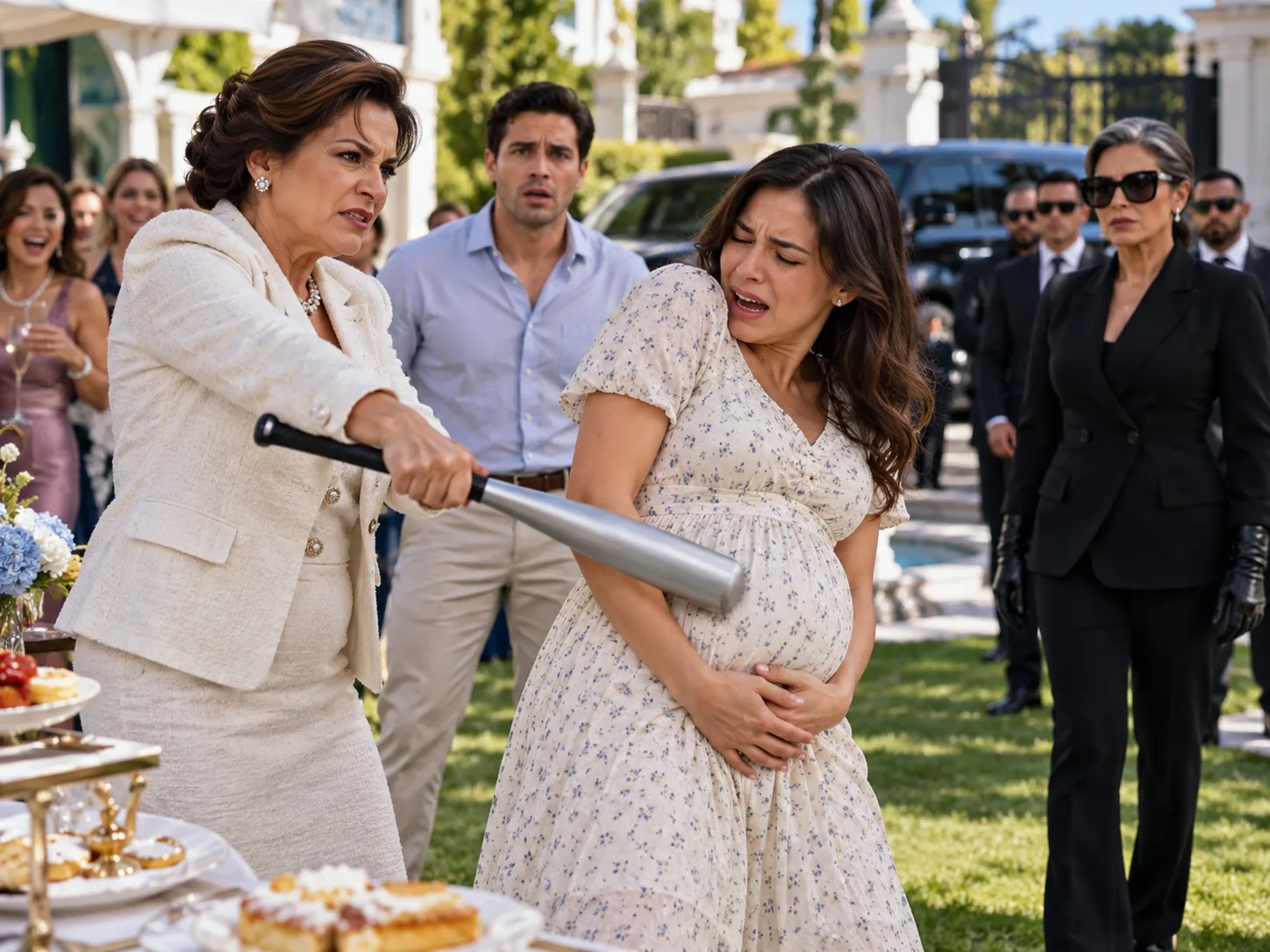
The legal process continued according to its own timetable. I was told to preserve relevant communications and respond to requests for information. I did so. I did not make public accusations beyond what I could personally attest to, and I did not ask anyone to exaggerate what had happened. The truth was serious enough without embellishment: Carmela had raised a bat and struck a pregnant woman who had told her to stop, and the people present had failed to prevent it.
I could not control whether every witness would speak honestly. I could control whether I continued telling the truth.
Months later, when I thought back to the afternoon in El Pedregal, I remembered the details differently depending on the day. Sometimes I remembered the blue pool and the smell of grilled meat. Sometimes I remembered the sudden silence after the laughter stopped. But I always remembered Carmela's certainty that my mother would never dare enter the mansion.
That certainty had been the foundation of her cruelty. She believed I had no one to turn to, that my pride would keep me silent, and that the family's wealth and reputation would protect her from consequences. She had mistaken my reluctance to involve my mother for weakness. She had mistaken my patience for permission.
My mother had not arrived to claim the mansion or humiliate Carmela in front of the relatives. She had arrived because I was her daughter and I had asked for help. The fact that Carmela had underestimated her was incidental. What mattered was that I no longer had to stand alone in a place where people treated my safety as less important than their comfort.
I still did not know what kind of relationship Mateo and I would have in the future. He was the father of my unborn son, and that connection would remain regardless of what happened to our marriage. I hoped he would learn to separate love from obedience and responsibility from appearances. I hoped he would one day understand that refusing to challenge cruelty is not the same as keeping the peace.
But those hopes belonged to him to fulfill, not to me to manage.
One quiet evening, I stood beside my mother's window and watched the rain ease over the garden. My son moved beneath my hand, a small, unmistakable shift that made me smile before I could stop myself. I had been frightened for him every day since the assault, and that fear had not disappeared. Still, I was beginning to imagine his arrival without picturing the mansion, Carmela's judgment, or Mateo's hesitation.
I imagined a room where he could cry without being called difficult, where a boundary would not be treated as an insult, and where love would not require anyone to accept humiliation in exchange for belonging.
I did not know exactly how I would build that life. I only knew that I would no longer sacrifice it to keep another person's pride intact.
The Villalobos mansion still stood behind its iron gates, its lawns trimmed and its windows shining in the sun. Carmela still had her house, her name, and the family that had once laughed along with her. But the gates could no longer decide who had the right to speak, and the mansion could no longer convince me that being welcomed inside was worth being hurt.
The day Carmela raised the bat, she thought she was reminding me of my place.
Instead, she showed me what my place could never be.
It would not be beneath her, pleading to be treated with dignity. It would not be beside a husband who waited until the damage was done before choosing his words. And it would not be inside a beautiful house where everyone knew the truth but preferred the comfort of pretending otherwise.
My place would be wherever I could protect my son, speak honestly, and live without asking permission to feel safe.
For the first time in two years, I no longer needed the Villalobos family to agree with me before I could believe that I deserved those things.
Click here to continue reading: PART 5: Mateo Finally Tried to Choose His Wife, but Elena Had Learned That Courage Arriving After the Damage Could Not Undo It
One Blow in the Garden Exposed the Cruelty I Had Spent Two Years Pretending Was Ordinary Family Trouble
Part 4 of 28