
The invitation arrived in a message from Emily on a Wednesday evening.
She wanted to know whether I could join her and the twins at the town's autumn festival that Saturday. The boys were old enough to enjoy the children's activities, and she thought they might like the small petting area near the park.
I smiled when I read the message.
I had watched the twins grow from tiny infants into energetic toddlers who seemed determined to investigate everything within reach.
I replied that I'd be happy to meet them.
The festival was held in the town square, where temporary stalls lined the sidewalks and families gathered beneath strings of small lights. The air smelled of roasted nuts, fresh bread, and damp leaves.
I arrived shortly after ten.
Emily was waiting near the fountain with the twins in a stroller.
One wore a blue jacket.
The other wore green.
I was grateful for the distinction because they were becoming more difficult to tell apart.
"Rachel!" Emily called.
I waved and walked toward them.
The boys recognized me, or at least seemed pleased by the familiar face.
One reached toward my hand.
The other immediately tried to climb out of the stroller.
Emily laughed.
"That's our morning so far."
We spent the first hour moving between the children's activities.
The twins watched a small group of goats with intense interest. One laughed whenever an animal moved closer to the fence. The other preferred observing from the safety of Emily's arms.
I helped carry the diaper bag while she managed the stroller.
It was an ordinary outing.
We bought warm drinks, watched children decorate paper pumpkins, and stopped to listen to a local musician playing near the square.
For a while, I forgot about work entirely.
Then a woman approached us near the craft stalls.
She looked familiar, though I couldn't immediately place her.
"Rachel?" she asked.
I turned.
"Yes?"
She smiled.
"I recognize you from the grocery store. You're the cashier involved with that community fund, aren't you?"
I nodded cautiously.
"I help with the program."
She looked toward Emily and the twins.
"Oh, are these the babies from that story?"
The question caught me off guard.
Emily's expression changed.
She looked down at the stroller, then back at the woman.
I felt a sudden discomfort.
The store had never identified Emily publicly, and I hadn't shared her name during employee training.
Yet people in a small town talked.
Someone might have remembered seeing her at the register that Friday. Someone else might have heard a fragment of the story and connected it with later visits.
The woman seemed friendly rather than malicious.
But her curiosity had crossed a boundary.
"I'm sorry," I said calmly. "We don't discuss customers' personal circumstances."
The woman blinked.
"Oh, I didn't mean anything by it."
"I understand."
She looked embarrassed.
"I just thought it was a lovely story."
I smiled politely.
"Thank you for supporting the program."
After a moment, she wished us a good day and walked away.
Emily remained quiet.
I looked at her.
"Are you okay?"
She nodded, but her expression was guarded.
"Can we sit down for a minute?"
"Of course."
We found a bench near the edge of the square.
The twins were occupied with small toys, and the noise of the festival seemed distant beneath the trees.
Emily adjusted the stroller brakes and sat beside me.
"I know she didn't mean to be rude," she said.
"I don't think she did."
"But I hated that."
I nodded.
"I'm sorry."
She looked at me.
"You didn't do anything."
"I still wish it hadn't happened."
Emily watched the children for a moment.
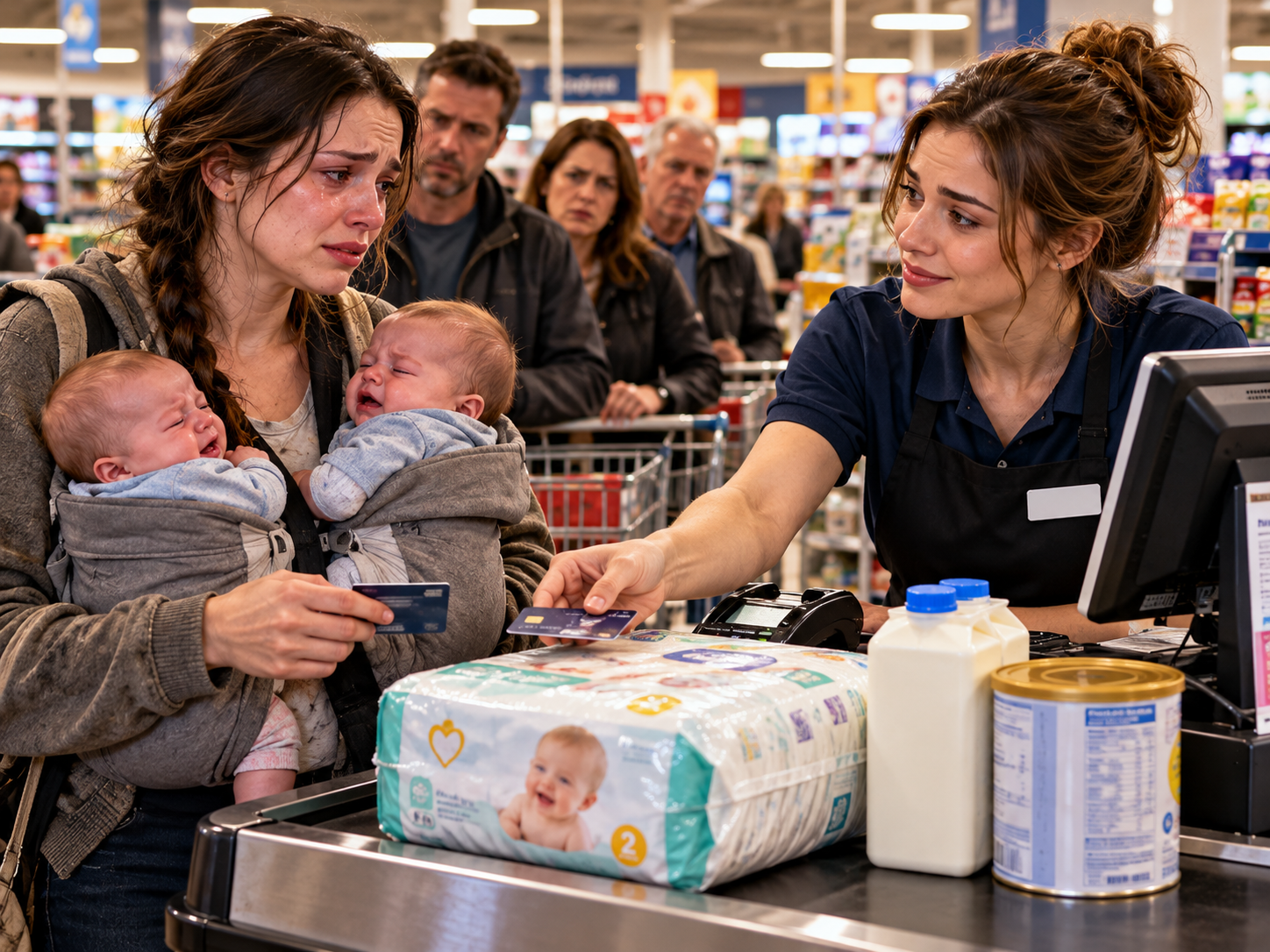
"I've worked hard to stop thinking of myself as the woman who couldn't buy diapers."
Her voice was quiet.
I waited.
"That day was awful. I'm grateful for what you did, and I'm glad the fund exists. But sometimes I feel like people would rather remember me at my worst than see who I am now."
The words struck me.
I had never thought of Emily only through that moment.
At least, I hadn't intended to.
She was my friend.
She was raising two energetic children, working, managing her household, and building a more stable life.
Yet I understood how easily a powerful story could become the only thing people remembered about someone.
"I don't see you that way," I said.
She smiled faintly.
"I know you don't."
She looked toward the twins.
"But I don't want them growing up hearing that their mother was the woman who couldn't afford their diapers."
I felt my throat tighten.
"They won't hear it from me."
"I know."
She reached for my hand briefly.
"I just needed to say it."
I squeezed her fingers.
"I'm glad you did."
We sat quietly for several minutes.
Then Emily took a breath and stood.
"Come on. The boys still need to see the pumpkins."
I laughed softly.
"They do."
We returned to the festival.
The rest of the morning was pleasant, though I remained thoughtful.
I watched Emily help one twin choose a small pumpkin while the other tried to carry one nearly as large as his head.
She laughed, took photographs, and spoke with other parents.
Nobody mentioned the grocery store.
Nobody asked about the envelope.
She was simply a mother enjoying an autumn morning with her children.
That was how it should have been.
After the festival, I drove home and thought about the encounter.
The woman who approached us hadn't intended to embarrass Emily.
She had probably heard a version of the story and wanted to express admiration.
But admiration could become intrusive when it treated someone's private hardship as public property.
I had been careful during training sessions and program meetings.
Still, the experience reminded me that privacy wasn't something we could protect once and then forget.
It required attention.
The following Monday, I spoke with Mike.
I explained that someone at the festival had tried to identify the customer connected with the fund's beginning.
I didn't give him details about Emily's reaction beyond what was necessary.
Mike frowned.
"We've never released her name."
"I know."
"Did the person say where she heard the story?"
"No."
He considered that.
"In a town this small, people connect things."
"That's what worries me."
We reviewed the information shared during employee orientation and the association's matching-donation campaign.
Nothing identified Emily.
But the original story had been discussed informally by employees who remembered the transaction.
I suggested reminding staff that customer privacy applied to conversations outside work as well as inside the store.
Mike agreed.
At the next staff meeting, he reviewed the policy.
He didn't mention Emily or the festival.
He simply explained that employees should not discuss identifiable customer transactions with friends, relatives, or other shoppers.
The reminder was straightforward.
Most employees nodded and moved on.
But I hoped it would prevent another uncomfortable encounter.
That evening, I called Emily.
I told her Mike had reviewed the privacy expectations with staff.
She sounded relieved.
"Thank you."
"I wanted you to know."
She hesitated.
"Rachel, I don't want you to feel like the story has to disappear."
I sat down.
"What do you mean?"
"The fund is important. People should know it exists. I just don't want my hardest day to become the only thing people know about me."
I understood.
"We can talk about the program without identifying you."
"Exactly."
She paused.
"And I still want you to keep the letters and photographs."
I smiled.
"I wouldn't throw them away."
"I know. I just wanted to say that."
We talked for a while longer about the festival.
The twins had apparently refused to let go of their pumpkins when they got home.
Emily had placed them on a low shelf, where the boys could admire them without trying to carry them through the apartment.
I laughed at the image.
When the call ended, I felt grateful for her honesty.
Our friendship had reached a point where we could discuss uncomfortable things without worrying that the conversation would damage what we had.
That mattered more than I could have explained.
A few weeks later, Emily invited me to dinner.
It was a simple meal at her apartment, with the twins seated in high chairs and determined to spread food across every available surface.
I helped wipe the table afterward while Emily washed dishes.
We talked about work, the boys' latest attempts to climb furniture, and a book she'd been reading in short stretches after they fell asleep.
The evening was ordinary.
I liked it that way.
Before I left, Emily showed me a photograph she'd taken at the autumn festival.
The twins stood beside their pumpkins, both smiling.
She asked whether I'd like a copy.
"Of course."
She handed me the picture.
"No dramatic story attached," she said with a small smile.
I laughed.
"Just two boys and their pumpkins."
"Exactly."
At home, I placed the photograph beside the others.
The collection now showed the twins at different stages of their lives.
Tiny infants wrapped in blankets.
Babies sitting upright.
Toddlers standing beside furniture.
And now two little boys proudly displaying pumpkins.
I looked at the pictures for a long time.
The original envelope had contained a photograph and a letter that changed how I understood a moment at the register.
But the newer photographs told a broader story.
They showed growth, ordinary happiness, and a life continuing beyond one difficult evening.
I closed the drawer gently.
Emily had trusted me with part of her story.
That didn't mean I owned it.
It meant I had a responsibility to respect the parts she chose to share and the parts she wanted to keep private.
I turned off the light and went to bed.
Click here to continue reading: PART 16: When Rachel Was Asked to Explain the Grocery Fund’s Success, She Finally Found Words for What the Original Eight Dollars Had Really Changed
The Young Mother Had Already Been Refused Twice When I Made a Decision That Could Have Cost Me My Job
Part 15 of 20

