
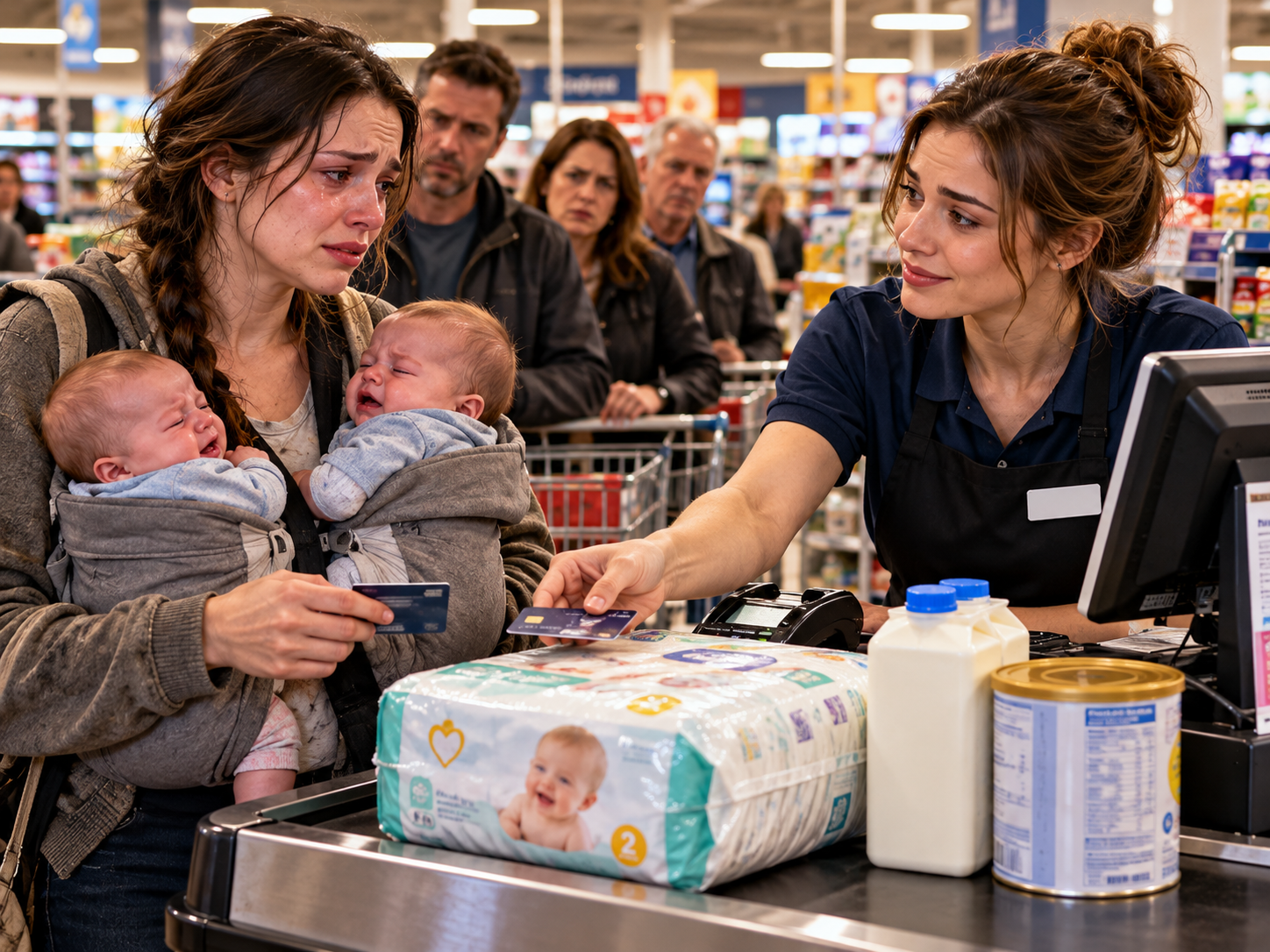
“Could you take the diapers off?”
The young woman's voice was so quiet that I almost missed it beneath the crying baby and the impatient movement of the customers waiting behind her. Her bank card was still between her fingers. She stared at the payment terminal as though the word DECLINED might disappear if she waited long enough. I had already watched her try twice. Both attempts had failed. Now she was asking me to remove the one item that seemed most urgently needed.
I glanced at the package of diapers resting beside the carton of milk. The woman had brought only three things to my register: milk, baby formula, and diapers. There were no snacks, no unnecessary purchases, nothing that suggested she had come into the store for anything beyond the immediate needs of her household. She stood beneath the bright fluorescent lights with two infants secured against her chest. One was sleeping, his small mouth slightly open. The other had been crying since she entered my line, his face reddening with each exhausted breath.
My name is Rachel, and I've worked at the same small-town grocery store for almost six years. I know which customers come in before church on Sundays, which elderly couples prefer their groceries packed in paper bags, and which parents stop after work with tired children who have no patience left for shopping. In a town our size, unfamiliar faces tend to stand out. I had never seen this woman before. She looked young, perhaps in her twenties, although exhaustion made it difficult to judge. Her dark hair was pulled into a practical braid, and there were faint shadows beneath her eyes.
It was Friday evening, the busiest part of my shift. People were stopping for groceries on their way home, and the line behind the woman had grown while she searched for another way to pay. I could hear shopping carts knocking against one another. Someone sighed loudly. A man near the back muttered that there should be another register open. I kept my attention on the woman because I could see that she had heard every complaint. Her shoulders were drawing inward, and she was trying to soothe the crying infant while holding her card and purse with one hand.
“I'm sorry,” she said again, looking directly at me this time. “I thought there was enough on it.”
“You don't need to apologize,” I told her.
She shook her head, embarrassed. “I checked before I came.”
I believed her. There was something about the way she said it, not as an excuse but as an explanation she desperately wanted me to understand. She had planned this purchase. She had counted on the money being available. Whatever had gone wrong, it had happened at the worst possible moment, in front of strangers who were growing increasingly impatient.
I looked at the total remaining on my screen and checked the amount she was short. Eight dollars and forty-two cents. I stared at those numbers for a second. It was less than the cost of the lunch I'd bought during my previous shift, but for the woman standing in front of me, it was the difference between taking the diapers home and leaving them behind. I knew nothing about her circumstances. I didn't know whether she had family nearby, whether she was employed, or whether this was a temporary emergency. All I knew was that she had two babies and couldn't complete the purchase.
One of the customers behind her shifted his basket onto the conveyor belt before she had finished. “Can we get moving?” he asked. His voice wasn't especially loud, but it carried. The woman flinched. She adjusted the carrier, trying to settle the crying baby, and reached toward the diapers. I put my hand gently on the package before she could lift it. “Give me just a moment,” I said. She looked frightened, as though she expected another problem. I opened my wallet beneath the counter and took out my own bank card.
Our store had rules about handling transactions, and I knew I needed to be careful. I wasn't changing prices, canceling charges improperly, or giving merchandise away. I was paying the difference myself, the same way another customer might help someone at the register. Still, I understood that Mike, our manager, might want an explanation if he noticed the transaction. I had been saving every spare dollar that month, and I couldn't pretend eight dollars meant nothing to me. But I could afford to lose that amount. The young woman looked as though she couldn't.
“I'll cover the rest,” I said.
She stared at me. “What?”
“The amount you're missing. I've got it.”
Her eyes widened, and she immediately shook her head. “No, please. I can't ask you to do that.”
“You didn't ask.”
“But I don't know you.”
I smiled a little. “I'm Rachel.”
The introduction seemed to confuse her more than reassure her. For a moment, she stood perfectly still while the baby against her chest continued crying. Then she looked down at my card and back at my face. “I don't know when I could give it back,” she said. Her voice had begun to tremble. I could see how much it cost her to admit that. She wasn't bargaining or trying to persuade me. She was telling me the truth as plainly as she could.
“You don't have to repay me,” I said. “Let's get you and those little ones home.”
I completed the remaining payment and handed her the receipt. She looked at it as though it were something she didn't quite understand. Then tears filled her eyes. She turned her face slightly away from the customers behind her, embarrassed by her own reaction. I began packing her groceries, putting the formula and diapers into one bag and the milk into another. I kept my movements ordinary because I didn't want to make the moment more difficult for her. She was already carrying two babies and the weight of being watched by a line of strangers.
“Thank you,” she whispered.
“You're welcome.”
“No, I mean…” She stopped, swallowing hard. “You don't know what kind of day I've had.”
I didn't ask. The register wasn't a place where she should have to explain her circumstances to earn kindness. I simply passed the bags across the counter and asked whether she could manage them with the carrier. She nodded, although it took her a moment to arrange the handles around her wrist. The sleeping baby stirred, then settled again. The other continued crying, his tiny hands opening and closing against the fabric of the carrier.
She looked back at me before leaving. “I won't forget this.”
I told her to take care of herself, and she walked toward the doors. The automatic panels opened, admitting a gust of warm evening air. I watched her disappear into the parking lot before turning to the next customer. The man who had complained avoided my eyes while I scanned his groceries. I didn't say anything about his impatience. There was no point. The young woman was gone, and the line needed to move.
For the next several hours, I worked as usual. I scanned groceries, counted change, answered questions about sale prices, and helped an elderly customer carry a heavy bag to her cart. The store gradually emptied as evening approached. The bright noise of the rush gave way to the steady hum of the refrigerators and the occasional squeak of a cart wheel. Every so often, I thought about the woman with the twins. I wondered whether she had managed to get them home before the crying baby became too upset. I hoped she had someone who could help her that night.
My coworker Denise came over during a quiet moment and asked why I'd paid for part of a customer's groceries. She had been working at the neighboring register and had seen enough to understand what happened. I told her the woman was short by a few dollars and needed diapers. Denise leaned against the counter and shook her head. “You have a good heart, Rachel, but you know Mike watches everything.” I shrugged. “It was my money.” She looked toward the manager's office. “I know. I'm just saying he might ask questions.”
Denise wasn't being unkind. She'd worked at the store longer than I had and understood how quickly an innocent decision could become a discussion about policy. Mike wasn't a cruel manager, but he took the rules seriously. He had to. Our store operated on narrow margins, and every unexplained transaction eventually reached his desk. I considered telling him what had happened before he heard it from someone else, but the evening grew busy again. By the time I finished closing my register, he was occupied with a delivery issue in the stockroom.
I counted my drawer, completed the paperwork, and clocked out shortly after nine. The parking lot was nearly empty, its asphalt still holding the warmth of the day. I walked to my car with aching feet and the familiar fatigue that followed a long shift. The eight dollars and forty-two cents had already left my account. I wasn't thinking about getting it back. I was thinking about dinner, a shower, and the possibility of sleeping late before returning to work the next morning.
At home, I made a sandwich and sat at the kitchen table. The house was quiet except for the refrigerator motor and the ticking clock above the doorway. I thought again about the young mother's expression when her card was declined. There had been something especially painful about the way she tried to apologize to everyone around her. I knew that feeling. Years earlier, before I found steady work at the grocery store, I'd stood at a checkout counter calculating which items I could afford to keep. I remembered how humiliating it felt to make those decisions while people waited behind me.
I didn't consider myself generous in any remarkable way. I lived carefully, paid my bills, and occasionally helped someone when I could. I had made plenty of mistakes and had days when I was impatient or distracted. The decision at the register hadn't come from a desire to prove anything. I simply couldn't watch a mother remove diapers from her purchase over an amount I could cover. If the situation had been reversed, I would have hoped someone might do the same for me.
Before bed, I checked my phone. There were two messages from Denise about the next week's schedule and a reminder from the bank about an upcoming payment. Nothing unusual. I set the phone on the nightstand and turned off the light. I assumed the woman with the twins was somewhere in town, settling her babies and trying to get some rest. I had no reason to believe our paths would cross again.
The next morning, I arrived at the store ten minutes before my shift. The air was cool, and the parking lot was already filling with weekend shoppers. I entered through the employee door, hung my jacket in the break room, and tied my apron around my waist. The familiar smell of fresh bread drifted from the bakery. I was thinking about whether the morning would be busy when Denise appeared in the doorway.
She wasn't smiling.
“Rachel,” she said, “Mike wants you in his office.”
I stopped adjusting my apron. “Now?”
“Right now. He told me to cover your register.”
I looked at her face. “Did he say why?”
Denise hesitated. “No. But he seemed serious.”
My stomach tightened. I immediately thought of the transaction from the previous evening. Had a customer complained? Had the payment caused some problem in the system? I knew I hadn't taken money from the register or changed the total improperly, but that didn't prevent my mind from moving through every possible consequence. I had worked at the store for nearly six years. The job wasn't glamorous, but it paid my bills and gave my days a reliable structure. I couldn't afford to lose it over a misunderstanding.
I walked down the narrow hallway toward Mike's office, hearing the sounds of the store fade behind me. The door was partly open. Mike sat at his desk with a folder beside him and an envelope resting near his keyboard. He looked up when I knocked. His expression was difficult to read. “Come in, Rachel,” he said. “Close the door.”
I stepped inside and did as he asked. Mike gestured toward the chair opposite his desk, but I remained standing. He studied me for a moment, then asked whether I'd paid for part of a customer's groceries the previous evening. I nodded, my mouth suddenly dry. “A woman with twins,” I said. “She was short on the total, so I used my card for the difference. I didn't change anything in the register.”
Mike listened without interrupting. Then he picked up the envelope.
“She came back after your shift ended,” he said. “She wanted me to make sure you got this.”
I stared at the envelope in his hand.
Whatever I had expected when Denise called me into the office, it wasn't this.
Click here to continue reading: PART 2: The Envelope Waiting on Mike’s Desk Contained More Than Rachel Expected, but the Young Mother’s Message Raised an Even Harder Question
The Young Mother Had Already Been Refused Twice When I Made a Decision That Could Have Cost Me My Job
Part 1 of 20

