
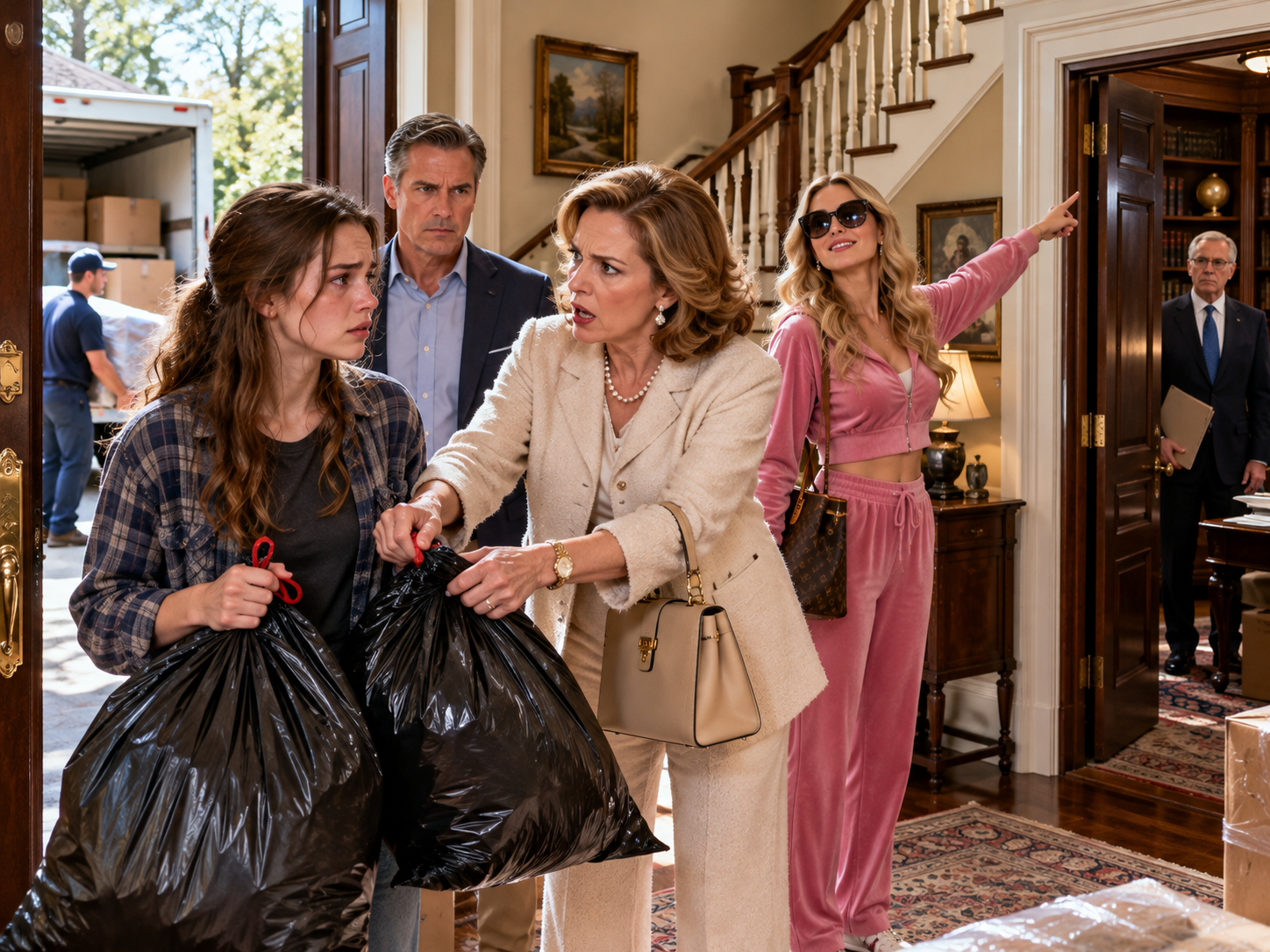
The request came three weeks after Christmas. My mother left a voicemail asking whether we could meet for coffee. She said she wanted to talk without Dad or Brianna present and that she was not calling about the house. Her voice sounded quieter than I remembered, but the familiar caution remained beneath her words. She did not apologize in the message. She only said that there were things she should have explained years ago and that she hoped I would hear her out.
I listened to the voicemail twice before deleting it from the screen. I did not delete the message itself; I saved it in a folder on my phone, then set the device down. The request stirred feelings I had not expected to return so quickly. I had spent years wishing my mother would call, and now that she had, I felt neither relief nor excitement. I felt wary, as if I were being asked to enter a room where I could not see who else was waiting.
I called Brianna that evening and told her about the message. She was quiet for a moment before saying that Mom had mentioned wanting to speak with me. Brianna did not try to persuade me to agree. She said our mother had been upset since the estate dispute ended, but she did not know whether that meant she was ready to take responsibility. I thanked her for being honest. I did not want another person telling me what my mother intended as though intention could be known without asking.
The next day, I called Eleanor. She reminded me that the estate matter was separate from any personal conversation I might choose to have. The legal process had concluded, and my mother had no authority over the house. If I met her, I could choose a public place, set a time limit, and leave if the conversation became uncomfortable. Eleanor did not advise me whether to go. She simply helped me think through the practical boundaries that would allow me to make the choice for myself.
I decided to meet my mother at a café near the center of town. I told her I could stay for forty-five minutes and that I wanted the conversation to be about our relationship, not the inheritance. She replied that she understood and thanked me for agreeing. Her response was so polite that it almost sounded rehearsed. I wondered whether she had practiced the message with Dad or whether she had spent the weeks since Christmas trying to decide how to approach me. I could not know, and I reminded myself not to invent an answer before the meeting.
On the morning we were supposed to meet, I woke earlier than usual. I made coffee, watered the plant on the kitchen windowsill, and checked the time more often than necessary. I considered canceling. I could tell myself that I owed my mother nothing and remain at home with my books and work. That would be a valid choice. But I also knew that part of my hesitation came from fear: fear of hearing another explanation that made my childhood sound like a misunderstanding, fear of becoming the five-year-old who waited for promises to be kept.
I went anyway. The café was busy when I arrived, with the smell of toasted bread and ground coffee filling the air. My mother sat near the window, both hands wrapped around a cup she had not touched. She wore a dark blue coat and had pulled her hair back more loosely than usual. For a moment, she looked older than I remembered. Then she saw me and stood too quickly, nearly knocking the chair behind her.
She asked whether she could hug me. I hesitated, then allowed a brief embrace. Her arms felt familiar in a way that surprised me, but the feeling passed quickly. We sat down, and she asked what I wanted to drink. I ordered tea and waited. I had decided before arriving that I would not fill every silence for her. If she wanted to explain herself, she would have to begin.
Mom looked at the cup in front of her. She said she had thought about calling me many times over the years. She had written letters she never sent and saved photographs she had not known whether I wanted. She said the longer she waited, the more ashamed she became, and the harder it felt to return. She spoke of financial pressure, disagreements with Dad, and the difficulty of raising Brianna while trying to establish a stable life.
I listened, but I did not nod to encourage her. I had heard versions of those explanations before, and I could understand that adults sometimes became trapped in their own choices. What I needed to know was whether she understood the effect of those choices on me. I asked her why she had never sent a birthday card, even when I was old enough to write my own address.
She closed her eyes briefly. She said she had no good answer. At first, she had told herself she would call when things improved. Later, she became afraid that I would reject her or ask questions she could not answer. Eventually, she began to believe that Grandpa had become the center of my life and that I would not want her back. She admitted that the story had been easier to accept than the possibility that I was waiting for her.
“That still made it your choice,” I said.
She nodded. “Yes. It did.”
The acknowledgment was small, but it was different from the explanations that had filled our earlier conversations. She did not immediately add that she had been doing her best or that Dad had agreed with her. She sat quietly and let the statement remain between us. I watched her hands tighten around the cup, and I felt a complicated mixture of anger and sadness. I had wanted those words when I was a child. Hearing them now did not give me back the years, but it confirmed that I had not imagined the abandonment.
I asked whether she had ever planned to return for me. She said that at first she had, but after the guardianship arrangement became formal, she and Dad decided I was settled with Grandpa. They told themselves that changing the arrangement would disrupt my life. They also knew that returning would require them to explain why they had stayed away for so long. Over time, they began treating the decision as permanent without ever discussing it honestly with me.
“Did you ever ask Grandpa whether I wanted to see you?” I asked.
She shook her head. “I was afraid of what he would say.”
That answer hurt more than I expected. My mother had not been kept from me by a locked door or a secret address. She had been afraid of the conversation, and she had allowed that fear to become a wall between us. I looked out the window at people passing on the sidewalk. The world continued moving around the café, indifferent to the years we had lost.
She then asked whether I had believed Grandpa's recording when he said that he had tried to contact them. I told her I had read the letters and seen the records. She did not dispute their authenticity. Instead, she said she had been ashamed of the correspondence and wished she had handled things differently. I asked why she had returned with the moving truck rather than calling me first. Her face tightened, and for the first time in the conversation, she looked defensive.
She said Dad had believed the house would eventually come to them, and they had assumed that I would be able to find another place to live. They thought it would be easier to move their belongings in while the estate was still being settled. I reminded her that Grandpa had been buried the day before. She looked down and said they had not considered how cruel the timing would feel. I told her the problem had not been the timing alone. They had arrived expecting to take my home and had treated me like an inconvenience.
Mom started to say that she had not meant to call me a burden. Then she stopped herself. “I said it,” she admitted. “I knew it would hurt you, and I said it anyway. I am sorry.”
I waited for the familiar qualification, the explanation that would make the apology easier for her to offer. It did not come immediately. She wiped her eyes and said she had been angry that Grandpa had left the house to me, and she had taken that anger out on the person he had protected. She knew that was unfair. I did not tell her it was all right, because it was not. But I thanked her for acknowledging what she had done.
The conversation moved into more difficult territory. Mom asked whether I hated her. I told her I did not spend my days hating her, but that I had stopped expecting her to become the mother I needed. That was a different kind of loss. As a child, I had believed that if I waited long enough, she would return and explain everything. As an adult, I had learned that waiting could become a way of abandoning myself. I could not build my future around the possibility that she might someday change.
She said she understood, though I doubted she fully did. She asked whether there might be a way for us to have a relationship now. I told her I was willing to consider further conversations, but I would not promise closeness or pretend the past was resolved. I needed her to respect my boundaries, stop discussing the house as though it belonged to the family, and accept that I would not always answer her calls. She nodded slowly and said she would try.
When the forty-five minutes were nearly over, Mom asked whether I wanted to keep the photographs she had saved. She said she had a box of pictures from when I was small, including several from before I moved to Grandpa's house. I was surprised that she still had them. I told her I would like to see them, but I did not want to take the box home that day. We agreed that she could send a few scans first, allowing me to decide whether I wanted the originals.
Before we parted, she reached for my hand across the table. I let her touch it briefly, then withdrew. I was not punishing her. I simply did not feel ready for a gesture that implied more closeness than we had earned. She seemed to understand. We said goodbye outside the café, and I watched her walk toward her car before heading in the opposite direction.
I spent the afternoon walking through a nearby park. The winter trees stood bare against the pale sky, and damp leaves clung to the path. I thought about the conversation, not searching for a single verdict but trying to understand what had changed. My mother had acknowledged the abandonment, apologized for the garbage bags and the cruel words, and admitted that shame had kept her away. Those were meaningful statements. They did not undo her actions, and they did not prove that she would behave differently in the future.
At home, I made tea and sat in the study with Grandpa's letter. I did not need to reread it, but I wanted to see his handwriting. I thought about his advice not to let hatred consume me. He had never said I should reconcile with my parents. He had wanted me to make my own choices without allowing their behavior to dictate the rest of my life. That remained the most useful thing he had given me.
Two days later, Mom sent three photographs. One showed me as a baby in a yellow blanket. Another showed Brianna sitting beside me on a living-room rug, both of us looking toward someone outside the frame. The third was a picture of Grandpa holding me in the garden, his face turned toward the camera while I clutched a toy rabbit. I saved the photographs in a folder and thanked Mom for sending them. I did not ask for the entire box yet.
The images reminded me that my story had begun before the abandonment, but they did not make the years afterward less real. I could acknowledge that my mother had once held me as a baby and still recognize that she had failed to be present when I needed her. I could accept an apology without granting immediate trust. I could leave the door open a little without inviting someone to walk through it whenever they pleased.
That evening, I looked at the calendar and realized that my mother and I had spoken for nearly an hour, even though I had planned to stay for forty-five minutes. I had not left because I was overwhelmed or because she had demanded more than I could give. I had left because the conversation had reached a natural stopping point. That distinction mattered. For the first time, I had chosen when to enter and when to leave a conversation with my mother, and neither decision had been made for me.
Click here to continue reading: PART 11: When My Father Finally Called, I Refused to Let Him Turn an Apology Into Another Demand for Obedience
The Morning My Family Came to Claim a House Before They Had Even Asked Who Owned It
Part 10 of 15

