
Grandpa's letter began without ceremony. He wrote that if I was reading it, he hoped the house had finally become quiet. He imagined I would be sitting in his study, perhaps in the old chair with the loose armrest he had promised to repair and never quite managed to fix. The detail made me smile through tears. His handwriting was uneven, but every line carried the patient rhythm of the man who had taught me to read, to cook, and to believe that a promise should mean something.
He told me he was sorry for leaving me to face my parents without him. He had wanted to spare me the confrontation, but he knew that his presence had been the only thing preventing it for years. He explained that he had not told me every detail of his conversations with them because I had been a child who needed stability more than explanations about adult failures. As I grew older, he had struggled to decide when to speak. He feared that telling me everything might make me feel responsible for a choice I had never been allowed to make.
Grandpa wrote that my parents' decision to leave me had been theirs alone. They had faced difficulties, but difficulties did not erase responsibility. He had offered temporary help when they first brought me to his house. When they failed to return, he asked them repeatedly to decide whether they intended to resume caring for me. They avoided the question until legal arrangements became unavoidable. Even then, he had hoped they might visit, call, or send a letter. He had kept that hope longer than he now believed was reasonable.
He also explained why he had preserved the correspondence. It was not because he wanted to humiliate my parents after his death. He had seen how easily people could reshape the past when those most affected were too young to remember the details. He wanted the records available if anyone later claimed that I had chosen to leave my family or that he had kept me from them. The truth, he wrote, should not depend on which adult spoke with the greatest confidence.
I read those lines several times. For years, I had wondered whether some small action of mine had made my parents decide not to return. Perhaps I had cried too much, asked too many questions, or preferred Grandpa's house in a way that hurt them. I knew, as an adult, that those thoughts were unreasonable. Yet childhood beliefs do not always disappear simply because a person learns better facts. Grandpa's letter did not erase the pain, but it gave me a clear place to put the responsibility.
He wrote about the house next. He said he had left it to me because it had been my home, not because he expected me to spend the rest of my life inside it. He knew I might someday want to move, travel, or build a different life. If that happened, he wanted me to make the decision freely. The house was meant to give me choices, not restrict them. He had arranged the estate with professional advice because he wanted those choices protected from people who might confuse their expectations with legal rights.
There was a final paragraph about forgiveness. Grandpa said he could not tell me whether my parents deserved it, and he would not ask me to offer it for his sake. He hoped I would not carry hatred because hatred could become exhausting, but he understood that trust could not be restored by a few words spoken after years of absence. If my parents wanted to know me, they would have to begin with honesty and accept whatever boundaries I set. I was not required to make their guilt easier to bear.
The letter ended with a memory from my sixth birthday. Grandpa described the crooked cake we had baked together and the way I had insisted on placing every candle myself. I had been afraid the cake would fall apart, but he told me that it only needed to taste good. He wrote that I had laughed when the frosting slid down one side and that he wished I could remember how happy I had looked. “You have always belonged here,” he wrote. “Not because I gave you a house, but because I chose you, and you chose to make a life with me.”
I folded the letter carefully and placed it on the desk. For several minutes, I sat without moving. The room smelled of old paper, furniture polish, and the faint trace of tobacco that lingered in Grandpa's coats. His reading glasses rested beside the lamp. The notebook he had used for grocery lists lay open to a page containing reminders about medication and a note to buy birdseed. Those ordinary objects hurt more than the legal documents because they made his absence immediate. He would never sit in this chair again, never ask whether I had eaten, never call me into the garden to show me the first tomatoes of the season.
Eleanor returned quietly and found me wiping my face with the sleeve of Grandpa's shirt. She did not ask what the letter said. Instead, she told me the movers had left and my parents were preparing to go. Dad had asked for copies of the estate documents and said he intended to consult an attorney. Eleanor had explained the process and reminded him that he could not occupy the house or remove property while the estate was being administered. She also advised me not to engage in further arguments about ownership without legal guidance.
I asked whether Grandpa had truly arranged everything as carefully as she described. Eleanor nodded. She said he had begun reviewing his estate plan several years earlier, long before his final illness. He had wanted to ensure that the house and his savings would support me, and he had been especially concerned that my parents might attempt to claim control after his death. He had not acted impulsively or in anger. He had considered the possibilities, asked questions, and made deliberate choices.
Eleanor explained that the will still needed to pass through the appropriate estate process and that there would be administrative steps before the property could be transferred fully into my name. The documents were strong, she said, but she would not promise that nobody could challenge them. My parents had the right to seek advice, just as I had the right to defend Grandpa's wishes. She wanted me to understand the difference between having a clear legal position and assuming the matter required no further attention.
I appreciated her honesty. After the confrontation, part of me wanted a simple declaration that everything was finished. Eleanor would not offer false certainty, but she gave me something more useful: a plan. We would secure the house, document its contents, maintain the necessary records, and respond through proper channels if my parents contested the estate. She had already arranged for the relevant papers to be filed and would keep me informed. I did not have to manage the process alone.
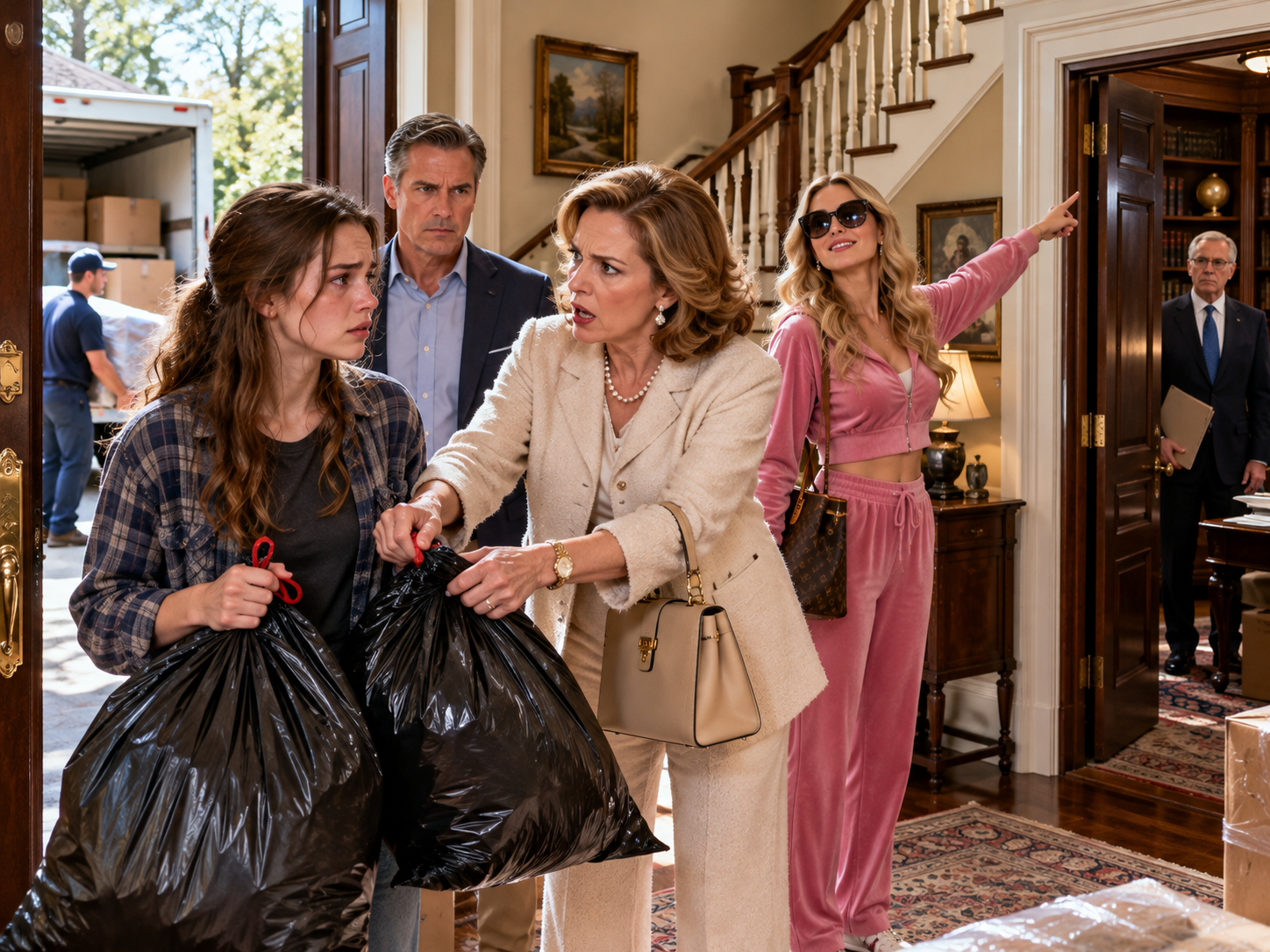
When I stepped into the foyer, my mother was standing beside the front door. Dad had gone outside, and Brianna waited near the staircase. The garbage bags lay where they had fallen, crumpled against the wall. Mom looked at them, then at me. Her eyes were red, but her expression remained guarded. She said she had not known Grandpa intended to leave the house to me. I believed that much. Everything about their arrival suggested they had expected a different outcome.
She asked whether we could talk privately. I glanced toward Eleanor, who remained within sight but gave us space. Mom began by saying that raising two children had been difficult and that she and Dad had made decisions they believed were necessary at the time. She said they had intended to return for me but that life had become complicated. I listened, waiting for her to acknowledge the years of silence. Instead, she spoke about money, work, and the pressure of trying to keep the family together.
“You could have called,” I said. “You could have sent a birthday card. Grandpa never stopped you from knowing where I was.” Mom looked away. She said she had been ashamed and that the longer she waited, the harder it became to explain. I understood that shame might make a person avoid a painful conversation. I did not understand how it could justify seventeen years of absence. I told her that her discomfort had never been more important than a child's need to know she had not been forgotten.
Mom began to cry again. She said she did not expect me to understand everything immediately. I answered that I had spent most of my life trying to understand. What I needed now was not another explanation designed to make her choices sound unavoidable. I needed her to recognize what those choices had done. She looked toward the study, where Eleanor had returned to organize the documents, and asked whether I would consider giving them time to find another place to stay.
I told her they had arrived with a moving truck without asking whether they were welcome. They had ordered me to pack my belongings the morning after Grandpa's funeral. They had treated his furniture as something to be discarded and his home as a prize to be claimed. I could not pretend those actions had not happened simply because the legal documents had disappointed them. They needed to leave. If they wanted to speak to me again, they could contact me respectfully and accept that I might not answer.
Dad came inside when he heard the last part. He accused me of turning my back on family and said Grandpa would have been ashamed to see us arguing over property. I looked at him for a long moment. “Grandpa spent seventeen years making sure I had a home,” I said. “You came here to take it away before asking how he died. Don't tell me what he would have wanted.” Dad's jaw tightened, but he did not reply. He picked up his keys and told Mom they were leaving.
Brianna remained behind after our parents stepped onto the porch. She stood beside the hall table, holding the photograph she had taken from Grandpa's bedroom. She asked whether she could put it back. I nodded. She placed it carefully against the wall, then looked at me. Without the sunglasses and the confident tone she had used earlier, she seemed uncertain about where to put her hands. She said she had believed I stayed with Grandpa because I liked his house better than living with them.
I told her I had been five. I had loved her, and I had expected to see her again after the weekend. She swallowed hard and said she remembered waving goodbye, but she had been told later that I did not want to return. I could see that she was trying to reconsider years of memories built around a false explanation. I did not know whether we could become sisters in any meaningful sense. Too much time had passed, and her behavior that morning had been cruel. But I also knew she had been a child when our parents separated us.
Brianna apologized for claiming the bedroom and insulting the house. The apology was awkward, almost whispered, but it was the first thing anyone in my family had said that acknowledged a specific wrong. I thanked her for saying it. She asked whether we might talk again someday, without Mom and Dad. I told her I was not ready to promise anything, but I would think about it. She accepted that answer and went outside. A few minutes later, their car pulled away from the curb.
The house became quiet. Eleanor stayed long enough to help me check the doors and make a list of anything the movers had disturbed. Nothing important appeared to be missing. Grandpa's dresser remained upstairs, the dining room drawers were intact, and the photograph Brianna had handled was back in its place. Eleanor advised me to keep the records of the visit and to call if my parents returned unexpectedly. She gave me a copy of the estate contact information and reminded me that I could ask questions whenever I needed to.
After she left, I stood alone in the foyer. The black funeral wreath still hung beside the front door. The lilies in the dining room were beginning to wilt, and a faint draft moved through the hallway. I picked up the garbage bags and carried them into the kitchen. For a moment, I considered throwing them away immediately. Instead, I folded them and placed them beneath the sink, where they became ordinary household objects rather than instructions about where I belonged.
The weeks that followed were not entirely peaceful. My parents consulted an attorney and questioned the estate arrangements, but Eleanor responded with the will, the guardianship records, and the documentation Grandpa had carefully preserved. Their objections did not establish that he lacked capacity or that I had influenced him improperly. After reviewing the evidence, their challenge went no further. The estate process continued, and the house was eventually transferred according to Grandpa's wishes. My parents did not return with another truck.
Brianna contacted me once during that period. She wrote that she had been thinking about what she heard in the study and wanted to apologize again. I answered briefly. We exchanged a few messages over the following months, mostly about childhood memories and the years we had spent apart. I did not rush to call her my sister in the way I had once imagined a sister would be. Trust, I had learned, was built through repeated choices. I was willing to see whether she could make different ones.
I kept living in the house. I repaired the loose armrest on Grandpa's study chair, cleaned the garden beds before winter, and placed his reading glasses in a small wooden box beside the desk. I did not change everything at once. Some rooms remained exactly as he had left them for months, while others gradually began to reflect my own tastes. I painted the kitchen a warmer color and replaced the old curtains. Each change felt less like removing him and more like accepting the freedom he had wanted me to have.
One afternoon, I found the notebook containing the recipe for his crooked birthday cake. The measurements were written in his careful handwriting, with a note in the margin reminding him not to add too much milk. I baked the cake that evening, and the frosting slid slightly down one side, just as it had when I was six. I sat at the kitchen table with a slice and remembered his laughter. The grief was still there, but it no longer felt like something I had to carry alone. The house held enough memories to make room for both sadness and gratitude.
I thought often about the morning my parents arrived. The moving truck, the garbage bags, Brianna's announcement, and Mom's certainty that the house belonged to her had all revealed something important. But the moment that stayed with me most was not their humiliation when Eleanor appeared. It was the sound of Grandpa's voice telling me I had never been a burden. I had spent seventeen years learning that truth through his actions. Hearing him say it after his death allowed me to believe it without reservation.
I never received the childhood I might have had if my parents had returned. Grandpa could not give me that, and neither could the house. What he gave me was a life in which I was loved consistently, protected carefully, and taught to recognize the difference between family by blood and family by choice. His final arrangements were not revenge. They were the last expression of the responsibility he had accepted when a five-year-old girl arrived at his door with a pink suitcase.
On the first anniversary of his death, I opened the study windows and let the autumn air move through the room. I placed his letter beside the photograph of us in the garden and sat in the chair he had used for so many years. Outside, the leaves were beginning to fall, and the house creaked softly as the wind moved along the roof. I could still imagine him calling from the kitchen, asking whether I wanted another cup of tea. The memory hurt, but it also made me smile.
That morning, I understood why Grandpa had told me not to fight my parents at the door. He had wanted the truth to stand on its own. He had known that their actions would reveal what words might conceal, and he had prepared the evidence so I would not have to defend my place in the house through anger or pleading. When the study door opened, it was not merely an attorney who stepped into the hallway. It was the protection Grandpa had spent years arranging for me.
I closed the study door gently and walked into the kitchen. The old house was quiet, and for the first time, I did not hear that quiet as loneliness. I heard the life Grandpa had helped me build, the one my parents had tried to take before they understood it was mine. I made coffee, opened the back door to the garden, and stepped into the cool morning air. I had been left behind once, but I was no longer waiting for anyone to come back and choose me. Grandpa had already done that, and now I could choose the life I wanted for myself.
Click here to continue reading: PART 5: The Letter Grandpa Left Behind Revealed a Promise He Had Kept Even When His Own Daughter Turned Away
The Morning My Family Came to Claim a House Before They Had Even Asked Who Owned It
Part 4 of 20

