
By early summer, Laura had stopped measuring her progress by the number of days she could go without thinking about Mark. That measure had always made the past the center of the test. If she remembered him, she worried that she had failed to move forward; if she did not remember him, she sometimes wondered whether she was avoiding something important. Eventually, she understood that memory was not a verdict. A thought could arrive, be acknowledged, and leave without requiring a response.
The realization came to her on an ordinary afternoon when she was watering the plant beside the kitchen window. A small leaf had turned yellow, and she examined the stem before trimming it away. She had forgotten to check the soil for several days, but the plant was healthy enough to recover. She adjusted its position so it would receive more light and made a note to water it the next morning. Nothing about the small mistake required panic. It only required attention.
At work, Laura's responsibilities continued to grow. The authorization checklist was now being used by several teams, and she had been asked to help evaluate the results. The early figures suggested that employees were identifying missing explanations and inconsistent records more consistently than before. Some cases took longer to resolve, but fewer were being returned because of incomplete documentation. Laura prepared a short report outlining what had improved and what still needed adjustment.
She made sure the report acknowledged the limits of the pilot. The data covered a specific period and a limited number of departments; it could not establish that every future problem would be prevented. She wanted the managers to understand both the value of the process and the need to keep evaluating it. Her experience had taught her how dangerous certainty could be when it arrived before the evidence.
During the presentation, a senior manager asked why Laura had placed so much emphasis on the explanation given before a signature. She answered that consent was more meaningful when a person had received clear information, had an opportunity to ask questions, and had not been misled about the purpose of the document. The process did not guarantee that nobody would ever be deceived, she said, but it created a record that could help distinguish a genuine misunderstanding from a deliberate attempt to conceal information.
The manager thanked her for the explanation. Another colleague asked for a copy of the checklist to adapt for a different type of application. Laura agreed, with the condition that they review the changes together before using it. She left the meeting with a list of practical next steps and a sense that her work was moving in a useful direction. There was satisfaction in helping people do their jobs better without needing to tell them why the subject mattered so personally to her.
That evening, she met Elaine for dinner. They sat near an open window while warm air moved through the restaurant, carrying the sound of traffic and conversation from the street. Elaine had been planning a summer visit to a coastal town and wanted Laura's opinion about the dates. Laura checked her calendar and suggested a weekend when neither of them had work obligations.
They discussed where to stay, how far they wanted to walk, and whether it would be worth renting bicycles. Elaine wanted to fill every day with activities, while Laura preferred leaving at least one afternoon open. They compromised on a loose plan with room for changes. The conversation reminded Laura that planning could be an invitation rather than a defense against uncertainty.
On the drive home, she passed the turnoff toward the highway connected to Mark's supposed accident. For an instant, she saw the old funeral flowers in her mind, white lilies arranged around a photograph of a man she believed she would never see again. She remembered the sympathy cards, the quiet voices, and the unbearable feeling that the future had closed before she could understand what had happened.
But the memory did not pull her back into that day. She kept driving, arrived home, and carried her bag inside. The road had been part of her life long before the tragedy, and it would remain part of the world after it. She no longer needed to avoid every place that touched the past. She could decide where to go based on where she wanted to be.
A week later, Margaret called. Her family had arranged a small gathering to remember Peter on the anniversary of his death. They planned to share his postcards, display the photograph beside the car, and invite a few people who had known him. Margaret wanted to let Laura know because the investigation had connected their lives, even though Laura had never met Peter.
Laura thanked her for the invitation and asked whether the family would be comfortable with her attending. Margaret said she would be welcome, but there was no obligation. Laura considered it. She wanted to acknowledge Peter and his family, yet she did not want to turn their gathering into another stage of the case or intrude on a private remembrance.
After a little thought, she decided to attend for a short time. She would go as herself, not as an investigator or a witness, and she would leave if the family preferred more privacy. She told Margaret her decision, and Margaret responded warmly. They agreed that there would be no need for Laura to speak unless she wished to.
The gathering took place in a community room decorated with simple flowers and framed photographs. Laura arrived carrying a small bouquet and found Margaret greeting people near the door. The two women embraced briefly. Margaret introduced Laura to several relatives, explaining that Laura had helped bring the truth about Peter's death into the open. Laura accepted their thanks without pretending she had done more than she had.
On a table near the windows lay the postcards Margaret had described. Some showed landscapes, while others contained only a few lines written in a hurry. One card mentioned a diner where the coffee tasted burnt but the pie was excellent. Another complained about a long delay caused by a broken-down truck. The details made people laugh, and their laughter was affectionate rather than bitter.
Laura stood back and listened as Peter's relatives shared stories. They remembered his stubbornness, his habit of sending postcards instead of calling, and his tendency to promise he would visit when work slowed down. One niece said she had grown up imagining him as a distant figure because she had known him mostly through photographs. Now, after reading his messages, she felt she had discovered a more ordinary, approachable person.
The words stayed with Laura. Peter had been more than the unidentified victim in a report, more than the name used to support Mark's false story. He had belonged to a family that remembered his habits and waited for his calls. The truth could not return him, but it had allowed his name and history to be placed where they belonged.
When Margaret asked whether Laura wanted to say anything, Laura looked at the photographs before answering. “I didn't know Peter,” she said. “I can't tell you what his life was like beyond what I've learned from the records and from all of you. But I'm glad his name is being remembered as his own. I'm sorry the truth took so long to reach you.”
She stopped there. She did not turn her words into a speech about courage or healing. Margaret reached for her hand and thanked her. They stood together quietly for a moment before another relative came to show Margaret a postcard with a humorous note about a hotel room that had been much smaller than advertised.
Laura stayed for another half hour, then said goodbye. On the drive home, she felt sadness for Peter and his family, but also relief that the gathering had centered on his life rather than on Mark's deception. She had not needed to explain her own experience or search for a connection between their losses. It was enough to witness a family remembering someone they loved.
At home, she placed the bouquet she had brought but not left with the family into a jar on the kitchen table. She changed her clothes, made a light dinner, and sat by the window while the evening faded. The day had been emotionally difficult, yet she did not feel compelled to review every conversation for mistakes. She had attended, listened, and left respectfully. That was enough.
The next morning, she received a short message from Margaret thanking her again. Laura replied that she was glad she had come and wished the family peace. She then put her phone away and prepared for work. The gathering would remain with her, but it would not become another investigation she needed to conduct. Peter's family had their memories, and Laura had her own responsibilities.
Later that week, her attorney sent a final confirmation that the office had no outstanding request for additional statements from her. The note was brief and administrative. Laura saved it with the other records, then closed the folder. She understood that a new development could theoretically arise in any complicated case, but she no longer treated every possibility as an approaching event. She had followed the process, told the truth, and preserved the evidence she had been asked to keep.
That evening, she invited Elaine over to help plan their coastal trip. They spread a map across the kitchen table, compared two possible routes, and argued about whether a particular seaside café was worth a detour. Elaine wanted to book everything immediately. Laura preferred reserving the room and deciding the rest as they went. Eventually they agreed on the basics and left the details open.
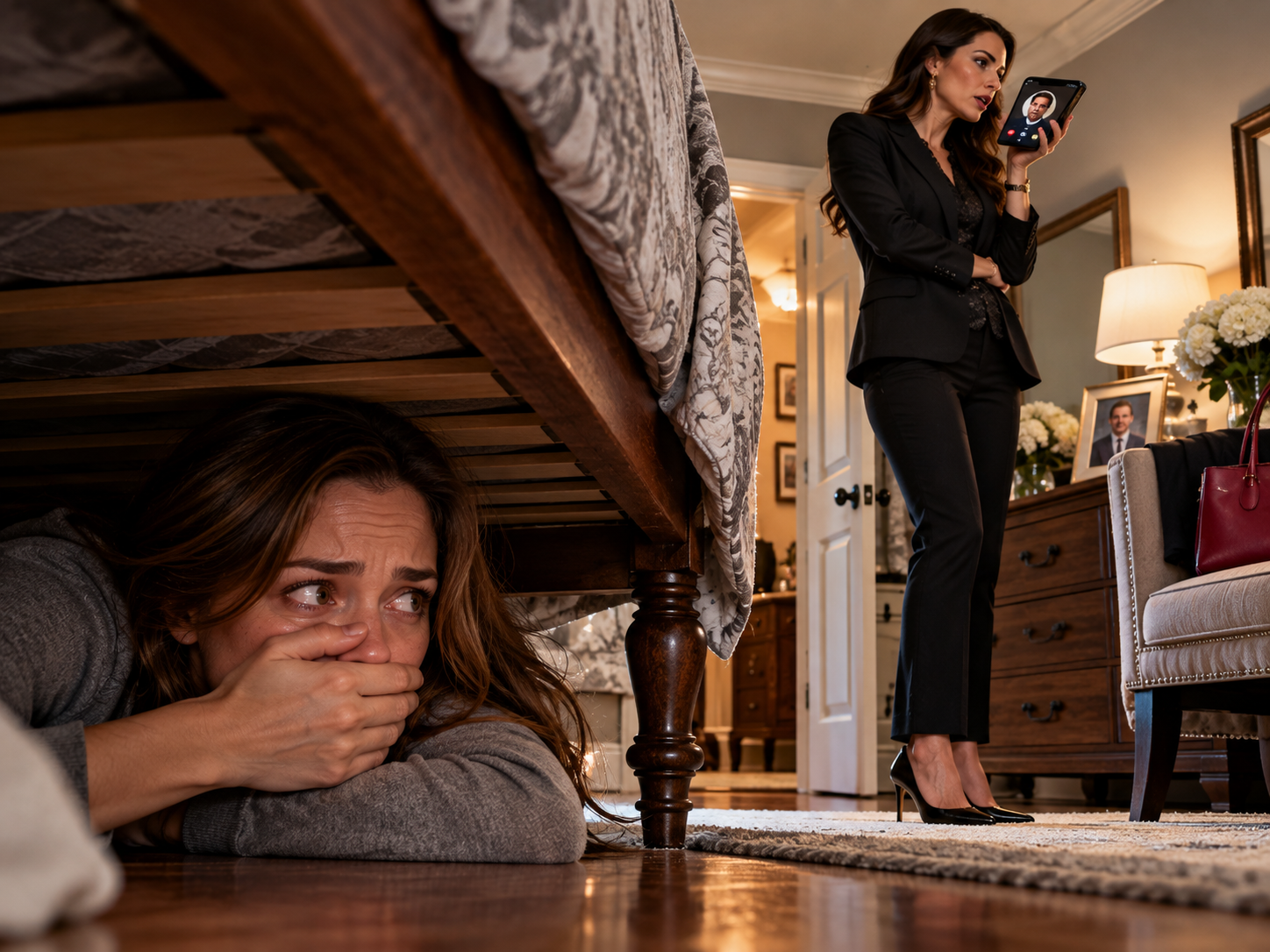
After Elaine left, Laura stayed at the table with the map folded beside her. She thought about the woman who had hidden beneath her bed, unable to imagine a future beyond the next few minutes. That woman had been afraid because the person she trusted most had secretly dismantled the life they shared. She had not known whom to believe or how far the deception reached. She had acted anyway: she listened, recorded what she could, sought help, and refused to surrender the document that mattered.
Laura felt tenderness for that version of herself. She no longer judged her for missing the warning signs or for believing a husband who had spent years building a shared life with her. Trust was not foolish merely because someone had abused it. The responsibility for deception belonged to the person who chose to deceive. Laura could learn from what happened without rewriting her past as though she should have known everything from the beginning.
Before bed, she checked the front door and turned off the downstairs lights. The hallway was dim, and the floor gave a soft creak beneath her foot. She paused, then continued upstairs. The sound was only a sound. It did not need to be explained, recorded, or reported. It could exist without becoming a threat.
In her bedroom, the landscape painting hung above the desk, its gray-green colors muted in the lamplight. The room had become familiar in a way it had not been when she first repainted it. She had chosen the color, arranged the furniture, and decided what would remain. The room did not erase the memory of what had happened there. It held the life she had made afterward.
Laura sat on the edge of the bed and looked around. She was not suddenly free of every painful memory, and she did not expect to be. Some days would bring an unexpected ache. Certain roads, songs, or ordinary objects might remind her of the marriage she had believed in. But those moments no longer meant she was trapped in the past. They were parts of a life that had changed, not commands to return to the beginning.
She switched off the lamp and lay down. In the quiet, she could hear the familiar sounds of the house: the distant hum of the refrigerator, the settling of wood, the soft movement of branches outside. She did not hold her breath. She did not wait for a key to turn or a voice to come from a speaker. She closed her eyes because she was tired and wanted to sleep.
The next morning would bring another day, and she would meet it with the tools she had earned: patience, judgment, the willingness to ask for help, and the understanding that no person could control every outcome. She had lost the future she once imagined with Mark, but that loss had not erased her capacity to make choices, build relationships, or feel joy without apology.
She had once believed that the truth would arrive as a final answer, complete enough to restore the life she had known. It had not. The truth had revealed the deception and exposed the harm, but it could not return Peter to his family or give Laura back the years she had spent believing a lie. What it had given her was something less dramatic and more useful: the freedom to stop organizing her future around Mark's secrets.
When she woke, the room was filled with early light. Laura rose, opened the curtains, and looked toward the day ahead. There was coffee to make, work to do, and a trip to look forward to. The house was hers, the choices were hers, and the future no longer belonged to a man whose voice she had once mistaken for a ghost.
She walked downstairs, took the blue mug from the cupboard, and filled it with coffee. Then she opened the front door to let in the fresh morning air. Nothing stood waiting on the other side. There was no hidden visitor, no new clue, no voice calling her back to the life she had lost. There was only the street, the morning, and the day she had chosen to begin.
Laura stepped outside and closed the door behind her. For the first time, she did not feel that she was leaving the past unguarded. She was simply going out to live.
The End
Read more original stories on Feel Every Story.
The Woman Who Entered My House Without Knocking Knew My Husband’s Habits Better Than Anyone Should
Part 20 of 20

