
In February, a cold rain settled over Cherry Hill and turned the sidewalks dark. Laura left the office shortly after five, carrying a folder she intended to review at home. She had spent the afternoon helping her team resolve a disagreement over an application that contained conflicting information. The answer had not been obvious, but the analysts had worked through the evidence without rushing to blame the customer or excuse the company. When they finished, Laura felt the quiet satisfaction of a problem examined carefully and handled fairly.
On the drive home, she passed a familiar stretch of road and found herself thinking about the highway where Mark's supposed accident had occurred. For a few seconds, the old questions returned with their familiar insistence. How had he planned it? How much had he understood about Peter's life? Had he ever considered the family who would be left waiting for someone who was never coming home? Laura tightened her grip on the steering wheel, then loosened it deliberately.
She had once believed that the answers to those questions were necessary for her to recover. If she could reconstruct every decision Mark had made, perhaps she could identify the exact moment their marriage had become a lie. If she could discover what he had felt, perhaps the years they had shared would finally make sense. But every new fact had led to another gap, and the gaps had begun to consume more of her life than the facts themselves.
At home, she placed the folder on her desk and changed into comfortable clothes. Rain tapped against the kitchen window while she made tea in the blue mug. She opened her work notes, reviewed two pages, and marked a question to raise with her team the next morning. Then she put the papers away. There was no reason to turn the evening into another workday merely because the house was quiet.
Her phone rang while she was eating. The caller was her attorney, who wanted to confirm that Laura had received the previous notice and understood that no further action was currently required from her. She confirmed both points. The attorney explained that the legal process had reached a stage where the remaining work was largely procedural. If a significant development occurred, Laura would be informed through the proper channel.
“Is there anything else I should be doing?” Laura asked.
“Not at this time,” the attorney replied. “Keep your records, and let us know if you receive any direct contact connected to the case. Otherwise, you can carry on with your life.”
The words were simple, but Laura remained on the call for a moment after the practical details had been covered. For years, she had waited for permission to stop looking over her shoulder. She had wanted someone official to say that she had done enough, that she was not overlooking a danger, that she could put the file away without becoming careless. Now, hearing that she could carry on, she realized that she had already begun doing so.
After the call, she put the phone down and returned to her tea. She did not open the old folders stored in the desk drawer. She did not reread Mark's letter or the copies of the documents that had exposed his scheme. Those records remained available if she needed them. Tonight, she wanted to read the novel she had bought at the end of the year and abandoned after the first chapter.
The book took a little effort to enter. She had become accustomed to reading reports, legal correspondence, and messages that might contain some crucial new detail. Fiction asked her to follow people whose problems did not threaten her own life. She found herself impatient with the first few pages, then gradually interested in the characters. By the time she looked at the clock, she had read nearly a hundred pages.
The following afternoon, she received a message from Margaret. It was not about the case. Margaret had found a photograph of Peter standing beside a battered car, one arm raised against the sunlight. The picture had been taken years before his death, and the family was trying to identify the location. Margaret asked whether Laura recognized it from any of the records she had seen.
Laura studied the photograph. The background showed a low building, a fuel sign, and a row of trees. It looked like dozens of roadside stops she had passed in New Jersey and Pennsylvania. She did not recognize the place, and she told Margaret so. She also suggested checking the date printed on the back and comparing it with Peter's postcards, if the family still had them.
Margaret thanked her. She explained that they were not trying to solve another mystery at any cost. They simply wanted to organize the photographs and preserve the stories attached to them. Some details might be recovered, and others might remain unknown. Her message ended with a small joke about how Peter had apparently taken more pictures of his car than of the people who loved him.
Laura smiled at the screen. She replied that the photograph looked as though the car had been given equal billing in his family history. Margaret sent back a laughing response, and the conversation ended naturally. Laura put the phone away without feeling that she had failed to help. Not every question was hers to answer.
At work the next week, a colleague asked Laura to review the checklist she had created for disputed authorizations. The company was considering making it part of the standard training material for several departments. Laura examined the draft carefully. She removed a sentence that sounded too absolute, clarified the distinction between a missing record and evidence of misconduct, and added a reminder that employees should document the explanation given to customers before obtaining signatures.
Her manager thanked her for the revisions. “You have a good instinct for where a process can go wrong,” she said.
Laura considered the compliment. It would have been easy to explain that the instinct had come from personal pain, but she chose a simpler answer. “I have learned that small assumptions can become expensive if nobody checks them,” she said.
The checklist moved forward, and Laura's work continued. She was careful not to treat every file as a hidden crime waiting to be discovered. Most customers were simply trying to manage their money, their families, or their futures. A good review process protected them without turning routine mistakes into accusations. Laura wanted the system to be more careful, not more frightened.
One evening, while clearing space in a cabinet, she found the envelope containing the first copies of the records she had collected after Mrs. Gable warned her about the screams. The pages were worn at the corners, and her handwritten notes were cramped and uneven. She remembered how desperately she had tried to build a complete explanation from every detail: the washed mug, the key, Vanessa's handbag, the voice from the speaker.
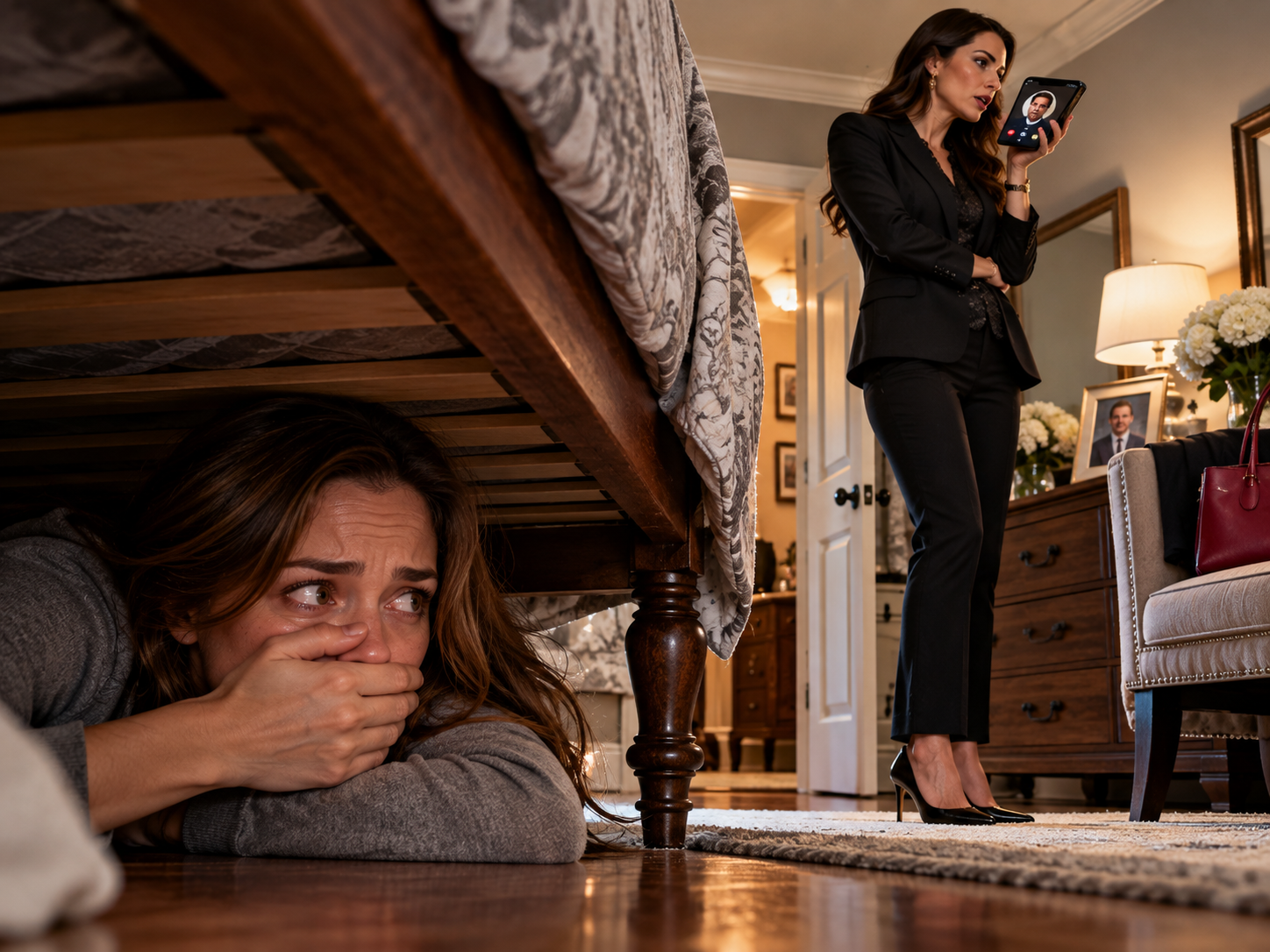
She sat at the table and read only the first page. It was enough to remind her how frightened she had been. She could still see herself crouching beneath the bed, afraid that even breathing would reveal her presence. The woman in those notes seemed distant now, but Laura felt no embarrassment toward her. That woman had acted with the information she had, and she had kept going despite being terrified.
Laura placed the papers back in the envelope and moved it into a labeled file box with the other legal records. She did not destroy anything. She simply stopped keeping the documents within arm's reach. There was a difference between preserving evidence and living beside it as though another emergency might begin at any moment.
A few days later, Mrs. Gable knocked on Laura's front door with a small container of homemade soup. The older woman had made too much, she explained, and thought Laura might appreciate some on a cold evening. Laura invited her inside for tea. They sat in the living room and talked about the weather, a neighborhood road repair, and a tree that had lost one of its larger branches during the last storm.
Eventually, Mrs. Gable asked whether the investigation had truly ended. Laura explained that the main facts had been established, the insurance review was closed, and she was not expecting further involvement unless something changed. Mrs. Gable looked relieved. She said she had worried that bringing the screams to Laura's attention might have caused more trouble than it solved.
“You did the right thing by telling me,” Laura said. “You noticed something unusual and didn't ignore it. What happened afterward wasn't your fault.”
Mrs. Gable lowered her eyes toward her teacup. She had spent weeks wondering whether she should have called the police sooner, or whether she had misheard the voices, or whether she had interfered in something private. Laura told her that nobody could have known the full truth from a few sounds through a wall. Speaking up had given Laura a chance to investigate, and that had mattered.
When Mrs. Gable left, Laura carried the empty cups into the kitchen. The visit had stirred the old memories, but they did not overwhelm her. She felt grateful for the neighbor's concern and for the fact that they could sit together now without pretending nothing had happened. Their relationship did not need to become profound. A neighbor had noticed something wrong, and a woman had listened. Sometimes that was enough.
That night, Laura returned to her novel. The rain had stopped, and a faint line of moonlight rested on the floor near the window. She read until her eyes grew tired, then marked her place and switched off the lamp. The house was quiet, but quiet no longer meant that she was waiting for a secret to reveal itself.
She thought briefly of Mark, not with longing and not with the desperate anger that had once filled her chest, but with the sober knowledge that she would never understand every part of him. His choices belonged to him. The consequences had affected her, Peter, Peter's family, and others whose lives intersected with the scheme. Laura could acknowledge that harm without dedicating the rest of her life to imagining what Mark might have thought.
She rolled onto her side and let the thought pass. There were still unanswered questions in the world, including some that touched her own past. She had learned that an unanswered question did not always represent unfinished work. Sometimes it was simply a boundary around what could be known.
The following morning, the rain clouds had cleared. Laura opened the curtains, watered the plant by the kitchen window, and began another ordinary day. She had work to do, people to meet, and a book waiting beside her bed. For the first time in a long while, she did not feel the need to check whether those ordinary things were safe from the past. She was ready to live them.
Click here to continue reading: PART 19: What Remained When the Story Was Over
The Woman Who Entered My House Without Knocking Knew My Husband’s Habits Better Than Anyone Should
Part 18 of 20

