
The police found the storage unit shortly after noon. Detective Harris called me from the facility, where officers had discovered several boxes of financial records, a laptop, and a locked metal case containing passports issued under different names. None of the passports belonged to me, but one carried Mark's photograph. The name beneath it was unfamiliar, and the date of issue fell within the month before his supposed death.
The discovery confirmed that someone had prepared for Mark's disappearance. It did not establish who had died on the highway or whether Mark had planned the accident from the beginning. Detective Harris told me that forensic specialists would examine the contents and that I should remain at home while the investigation continued. I agreed, though staying still felt almost impossible.
That afternoon, the archive released a copy of the original authorization to the police. Detective Harris brought it to my house in a sealed envelope. She did not open it until we were seated at the kitchen table, with another officer nearby. The document contained my signature, Mark's signature, and the signature of a third person identified as an independent witness.
The authorization was not the simple financial permission Mark had described when he asked me to sign it. It granted access to an investment account, allowed the transfer of funds under specified conditions, and named a secondary beneficiary who would receive control if I became incapacitated or died. The beneficiary was Vanessa Reed.
I read the page twice, searching for some sentence that would make it less disturbing. I found none. My signature was genuine, but the paragraph above it had been concealed when Mark presented the paperwork to me. A handwritten note attached to the back referred to a separate account holding a large sum of money and instructed the administrator to release it after the insured person's death had been verified.
“Did you know about this account?” Detective Harris asked.
“No. Mark told me the documents were routine.”
“Did you receive any money from it?”
“I received the life insurance payment after his death. Nothing else.”
She turned the page toward me. The account records showed that a substantial amount had been moved into the investment account shortly before the accident. After Mark's reported death, the money had been transferred through several companies before disappearing into an account registered under a different name.
The transfer had not been authorized by me. Someone had used the paperwork to make it appear that I had consented.
“Why would he give Vanessa control?” I asked.
Detective Harris folded her hands. “We believe he intended to use her as an intermediary. If the account was questioned, the documents would make it appear that she had acted under your authorization.”
“So he could blame her.”
“Possibly. We're still investigating the full arrangement.”
The officer beside her placed another photograph on the table. It showed a man standing outside the storage facility, carrying one of the boxes recovered that morning. His face was partially visible beneath a cap, but I recognized the posture immediately.
Mark.
I could no longer tell myself that the voice had been a recording or that Vanessa had created an elaborate deception using a stranger. My husband had survived the accident, and he had continued to use the financial arrangements he had made before it.
The next question was where he had gone.
Detective Harris explained that investigators had found a series of messages on the recovered laptop. Most had been deleted, but some could be reconstructed. One referred to a meeting at a roadside motel. Another discussed the movement of money through the dissolved holding company. The most recent message had been sent the night before Vanessa entered my house.
It contained a short instruction: Find the original authorization before Laura does.
I looked at the detective. “He knew I was looking.”
“We believe someone informed him that you had requested the claim file.”
“Who?”
“We don't know yet.”
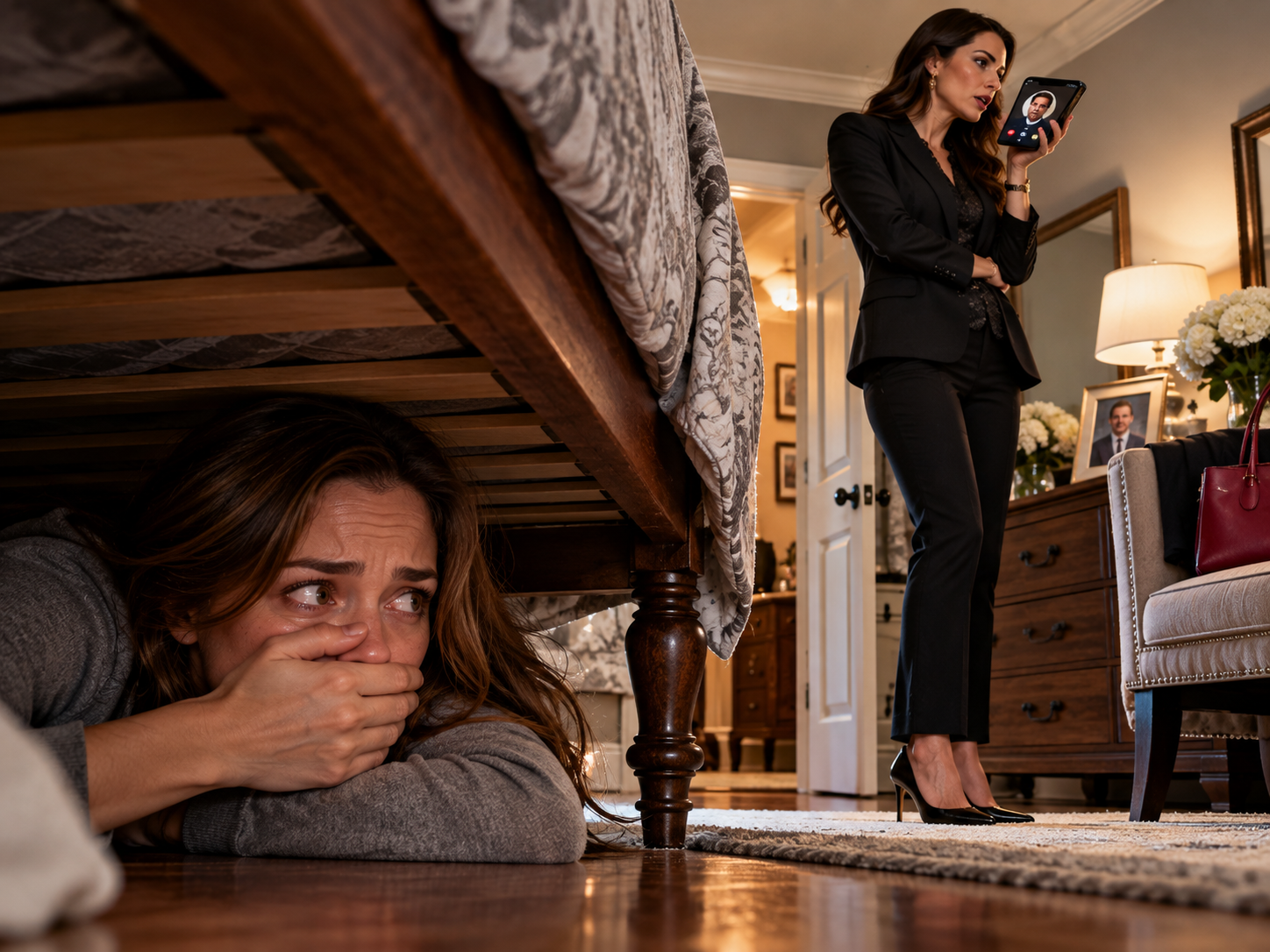
I thought of the insurance representative who had told me about the amended beneficiary information. I thought of the photograph pushed beneath my door and the woman who had watched me from beneath my own bed. The truth was no longer a single secret. It was a network of people who had each known a portion of it, and some of them had used that knowledge to protect themselves.
The police arranged for me to stay with Elaine while they examined my house for evidence of unauthorized access. I packed a small bag, locked the door, and left the blue mug on the drying rack. I could not bring myself to throw it away. It had belonged to the man I remembered, even if the man I remembered had been only part of the truth.
At Elaine's house, I barely slept. She sat beside me in the living room while I told her what the police had discovered. She did not interrupt or tell me that everything would be fine. She simply listened, occasionally placing a cup of tea beside my hand when she noticed I had forgotten it was there.
Near midnight, my phone rang from an unknown number.
I almost ignored it. Then the caller spoke.
“Laura.”
The voice was unmistakable.
For two years, I had imagined what I would say if I could somehow speak to Mark again. I had rehearsed questions during sleepless nights, in the car, and at the kitchen sink. I had imagined anger, tears, and the relief of hearing him apologize. Now that he was speaking, all I could manage was a single word.
“Why?”
He breathed into the receiver. “I can explain.”
“You're supposed to be dead.”
“I know.”
“I buried you.”
“I know what you went through.”
“No, you don't.” My voice rose before I could control it. “You don't know what I went through because you weren't there. You let me believe you were dead. You let me stand beside a coffin and listen to people tell me how sorry they were. You let me wake up every morning and remember that you would never come home.”
He said nothing.
“Was any of it real?” I asked. “Our marriage? The life we built? Did you ever love me, or was I just another signature you needed?”
“Laura, I did love you.”
The answer came too quickly.
“Then why did you do it?”
“Because I made mistakes, and I couldn't see another way out.”
“You had a way out. You could have told the truth.”
“I couldn't.”
“You chose not to.”
He exhaled sharply. “The money was supposed to protect us. I made investments that went wrong. I borrowed against accounts I shouldn't have touched. By the time I understood how bad it was, people were threatening to expose everything. I thought if I disappeared, I could settle the debts and come back when it was safe.”
“And the man who died on the highway?”
“I didn't kill him.”
I closed my eyes. “Who was he?”
“A man who worked with someone I knew. He was supposed to help me leave. The accident happened, and he died. I panicked.”
“Did you arrange for people to believe he was you?”
Mark did not answer immediately.
“Did you?”
“Yes.”
The word was so quiet that I almost missed it.
I gripped the phone. “You let them bury another person in your place.”
“I thought it was the only way to keep you from being dragged into what I'd done.”
“You used my grief to hide.”
“I was trying to protect you.”
“You were protecting yourself.”
He began speaking faster, explaining that the debts had grown, that he had feared criminal charges, and that he had believed he could repair the damage before anyone discovered what he had done. He said Vanessa had helped him manage the accounts and that the insurance policy was supposed to provide a financial cushion while he disappeared. He insisted he had never intended for me to lose my home or my savings.
Every explanation contained another admission. He had concealed money, falsified records, manipulated the insurance claim, and allowed an innocent person to be buried under his name. He had not merely abandoned me. He had used my trust as an instrument in his plan.
“What do you want from me now?” I asked.
“The authorization. I need the original document.”
“The police have it.”
His silence told me more than any confession could have.
“You knew I was looking for it,” I said.
“Laura, listen to me. If they use that document, they'll connect you to the transfers. Your signature is on it. You could be charged.”
“Then I'll show them what you did.”
“You don't understand how this works.”
“I understand that you lied to me.”
“I can fix this. We can meet somewhere, talk properly, and figure out what to do.”
I almost laughed at the familiar word we. He had used it at Christmas dinners, in conversations about money, and whenever he wanted to make his plans sound like shared decisions. Even now, after two years of pretending to be dead, he was trying to draw me back into a partnership I had never knowingly agreed to.
“No,” I said.
“Laura—”
“You don't get to decide what happens to me anymore.”
I ended the call and immediately contacted Detective Harris. She instructed me not to answer another call from Mark and asked whether he had mentioned a meeting place. He had not, but the police were already tracking activity associated with the recovered laptop and the phone number he had used.
The next morning, Mark sent a message through an intermediary asking me to meet him at the motel in Mount Laurel. He promised to explain everything and return the money that had been taken from the investment account. Detective Harris advised me not to respond, but she also explained that the police could arrange a controlled meeting if Mark made direct contact and the legal requirements were met.
I did not want to see him. The thought of standing in front of him after everything he had done made my stomach tighten. But I also understood that he might disappear again if he believed the investigation was closing in.
After consulting with the police, I agreed to cooperate with their plan. I would not meet him alone, and I would not carry any documents or make any promises. Officers would be nearby, and the conversation would be recorded.
The motel looked smaller than it had during my first visit. The sign flickered above the office, and the parking lot smelled of wet asphalt. I sat in a room at the far end of the building, my hands resting on my knees. A small recording device had been placed where it could capture the conversation. Detective Harris remained close enough to intervene if necessary.
Mark entered through the side door.
For a moment, I could not move. He looked older than the man in our anniversary photograph. His hair had thinned, and a pale scar crossed the edge of his jaw. He wore the dark jacket I remembered from the photograph delivered to my house.
He stopped when he saw me.
“You came.”
“I came to hear the truth.”
He sat across from me and placed both hands on the table. His fingers trembled slightly. I wondered whether he was frightened of the police or simply afraid that I had finally become someone he could no longer control.
He told me about the financial scheme, the debts, and the people who had helped move the money. He admitted that he had planned to disappear before the accident and had used the chaos surrounding the crash to make his disappearance permanent. He said the dead man had agreed to help him leave but that he had never intended for the man to die.
I asked whether he had known the man would be mistaken for him.
Mark stared at the table.
“I knew it was possible.”
“And you let it happen.”
“I thought I could correct everything later.”
“You never intended to correct anything. You kept taking money, changing names, and hiding documents. You came into my house while I was at work. You watched me grieve.”
He looked up. “I never stopped caring about you.”
“Caring about me would have meant telling me the truth.”
He reached across the table, but I pulled my hand away.
“Don't.”
His expression tightened. “What do you want me to do?”
“Tell the police everything. Every account, every transfer, every person involved. Give them the records and stop trying to protect yourself.”
“If I do that, I'll lose everything.”
“You already lost the only thing that mattered to me.”
For the first time, he seemed unable to find an answer. His shoulders sagged, and he looked at me with a kind of bewilderment, as if he had expected anger he could negotiate with but had not anticipated a decision he could not reverse.
The officers entered moments later. Mark did not run. He looked toward the door, then back at me, and slowly raised his hands. Detective Harris informed him that he was being detained in connection with the investigation into the fraudulent insurance claim and the financial transfers. As the officers escorted him outside, he turned once more.
“Laura, I'm sorry.”
I wanted to believe that the apology meant something. I wanted it to restore even a small piece of the man I had loved. But an apology could not return two years of my life, identify the dead man whose family had been left without answers, or erase the lies embedded in my signature.
I watched Mark disappear into the back of the police vehicle.
The investigation continued for months. Vanessa cooperated with investigators and provided records that helped trace the diverted money. She admitted her role in preparing some of the paperwork and faced consequences for the part she had played. The recovered documents also helped establish that the man buried under Mark's name was not my husband. Investigators worked to identify him and notify his family, who had been living with their own unanswered questions since the crash.
The insurance company reviewed the claim, and the authorities examined every account connected to the scheme. Some of the money was recovered. Other funds had been moved through too many accounts to retrieve completely. My own finances were investigated, but the evidence showed that I had been deceived into signing documents whose contents had been concealed from me. I was not charged in connection with the fraud.
Mark eventually admitted to arranging his disappearance and participating in the financial scheme. The legal process was lengthy, and the consequences were more complicated than a single arrest. There were hearings, additional interviews, and months of waiting for decisions that affected people I had never met. I learned that the truth did not arrive as one dramatic revelation. It emerged in records, testimony, and the patient work of people determined to establish what had happened.
Vanessa sent me a letter after the investigation began to wind down. She apologized for entering my home, frightening Mrs. Gable, and using my grief as part of her plan. She wrote that fear had made her choose secrecy over honesty and that she understood if I never forgave her.
I did not answer immediately. Eventually, I wrote back that I accepted her apology but could not offer her friendship. Her decision to cooperate had helped expose the truth, but it did not erase the harm she had caused.
I returned to my house in Cherry Hill when the police confirmed that it was safe. The locks were new, the windows had been checked, and the rooms looked exactly as I had left them. For several days, I kept the lights on in the hallway. Every unfamiliar sound made me pause, listening for footsteps that did not belong.
Mrs. Gable came over with a casserole and an awkward expression. She apologized for confronting me so sharply about the screams, but I told her she had done nothing wrong. She had heard something troubling and refused to ignore it. Without her warning, I might never have returned home that morning.
“I thought you would be angry with me,” she admitted.
“I was frightened,” I said. “But you were right to tell me.”
After she left, I stood in the kitchen and looked at the blue mug. The crack near its handle had widened slightly. I washed it, dried it, and placed it in a box with a few other things I had kept from my marriage. I did not throw it away, but I no longer left it on the drying rack as if I expected Mark to come home and use it.
The photograph from the motel remained in the evidence file. I kept a copy, not because I wanted to remember Mark's face, but because I wanted to remember the moment I stopped accepting the explanations other people offered me. The truth had not arrived because someone had decided I deserved it. I had found it by asking questions, preserving evidence, and refusing to let fear make every decision.
A few weeks later, I sat at the dining table with my laptop open and the afternoon sunlight falling across the floor. Outside, Mrs. Gable was watering her plants. A delivery truck stopped at the corner, and a dog barked at a passing bicycle. The ordinary sounds of the neighborhood no longer seemed like warnings. They were simply sounds.
For two years, I had believed that losing Mark meant losing the future I had imagined with him. Discovering his deception had forced me to mourn something more difficult: not only the husband who was gone, but the version of our marriage I had carried in my mind. Some memories were still genuine. Others had been shaped by lies. I could not separate them perfectly, and I no longer needed to.
I closed the laptop and walked into the bedroom. The chair beside the dresser was empty. The drawers held my own things, arranged as I wanted them. No one else had a key.
For the first time since the funeral, the house felt quiet in a way that did not frighten me.
Mark had spent two years believing he could control my life from a distance. He had mistaken my grief for weakness and my trust for permission. In the end, the evidence he had tried to hide became the reason he could no longer disappear.
I had not brought my husband back from the dead. I had uncovered the truth about the man who had pretended to be dead, and I had survived the discovery.
That evening, I made coffee in a new mug and sat beside the open window. The air smelled of damp leaves and freshly cut grass. I listened to the neighborhood settling into night, knowing that some questions would remain painful long after the investigation ended.
But when the house creaked, I no longer held my breath.
I simply turned on the light, checked the room, and carried on with my life.
Click here to continue reading: PART 5: The House Finally Felt Like Mine Again, Until a Letter From the Insurance Company Revealed That Mark Had Left One Last Problem Behind
The Woman Who Entered My House Without Knocking Knew My Husband’s Habits Better Than Anyone Should
Part 4 of 20

