
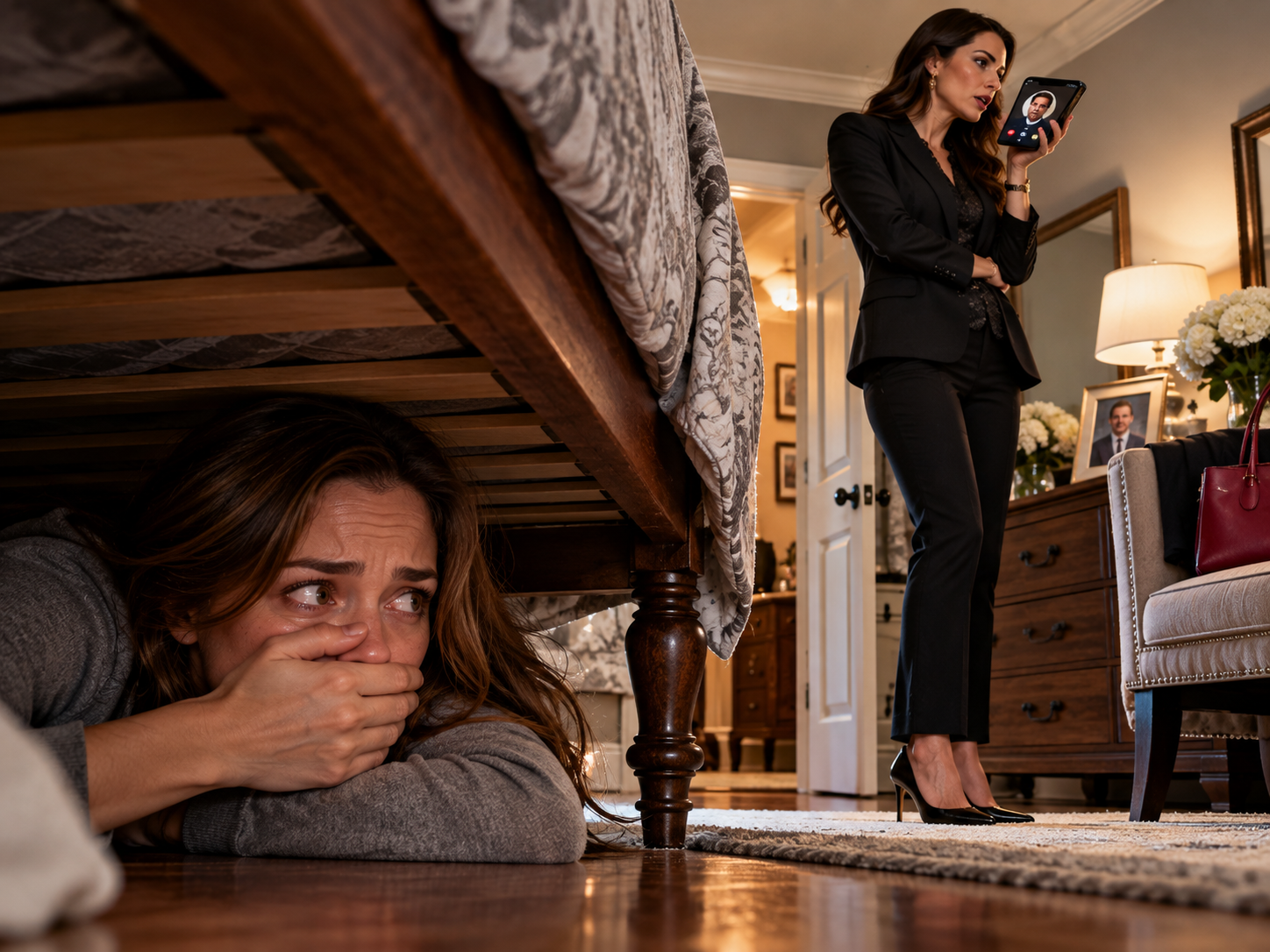
“Does Laura suspect anything yet?”
The question came from the phone resting in a woman’s hand, but the voice answering from its speaker belonged to a man who had been buried two years earlier. I knew the slight rasp at the end of his words, the soft pause before my name, even the impatient breath he took when someone failed to answer him quickly enough. I had heard that voice beside me in bed, across restaurant tables, and through late-night calls when business kept him away from home. I had listened to it break into a thousand memories after the funeral. Now it was three feet from my face, coming from a phone in the hand of a stranger standing in my bedroom.
I lay beneath the bed with my cheek pressed against the cold hardwood. Dust scratched my nose. My right hand enclosed my own phone, and the brightness of its screen threatened to betray me through the narrow gap beneath the mattress. I had entered the house that morning expecting to catch a burglar, perhaps a desperate person who had found a way inside. I had not prepared myself to hear my dead husband asking whether I suspected him of something.
The woman wore black pumps and tailored trousers. Her red handbag rested on the chair where Mark used to leave his dress shirts after work. She looked around my bedroom with the easy familiarity of someone inspecting a room she had paid to decorate. Nothing in her manner suggested she was frightened of being discovered. If anything, she seemed irritated that something in her carefully arranged routine had changed.
“Yes,” she told the phone. “And the worst part is that she stayed home today.”
Silence followed. I heard a faint electronic hum from the speaker, then Mark’s voice again.
“Did she see you?”
“No. I’m telling you, I checked. She left the house at eight, just as she always does. I only learned she came back because Mrs. Gable saw her car disappear and then reappear.”
My neighbor’s name struck me almost as hard as Mark’s voice. Mrs. Gable had complained about the screaming because she believed someone was being hurt inside my house. Her warning had brought me home. Now the woman in my bedroom was discussing my neighbor as if she were an inconvenience in a plan that had been running for some time.
“Be careful,” Mark said. “If Laura has started asking questions, we can’t keep doing this.”
The woman gave a short, humorless laugh. “You should have thought about that before you started calling me during the day.”
“Not now, Vanessa.”
Vanessa. I knew the name. Or rather, I knew a Vanessa who had worked in the same insurance company as Mark years earlier. He had described her as a colleague with an impressive memory for figures and a talent for finding problems other people missed. I had met her only once at a holiday gathering. She had worn a silver necklace and spoken politely about the weather. I remembered her because Mark had seemed unusually tense while introducing us, then spent the ride home insisting she was difficult to work with.
The woman beside my bed was not wearing a silver necklace. She wore a thin gold chain and a watch that caught the light whenever she moved her wrist. I could not see her face from my hiding place, but I could see the careful way she avoided stepping on the loose floorboard beside the dresser. She knew exactly where the house creaked.
“Tell me what you want me to do,” Vanessa said.
“Keep the schedule. Don’t touch anything she might notice.”
“She already noticed something.”
“What?”
“The mug.”
For a moment, the room seemed to shrink around me. Mark’s blue mug had been on the drying rack that morning. It had a narrow crack near the handle, and he had refused to replace it because, according to him, a new mug never held coffee at quite the right temperature. I had found it clean despite remembering that I had left no dishes in the sink the previous night. I had stood in the kitchen staring at it until my coffee went cold.
Mark said nothing for several seconds.
“Put it back where it belongs,” he finally replied.
Vanessa glanced toward the hallway. “You always say that. Put it back. Leave everything as it was. Do you know how difficult it is to make a house look untouched when someone keeps living in it?”
“She doesn't live in it properly anymore,” he said. “She comes home, eats something, and goes to bed. She barely notices what's around her.”
My throat tightened. He spoke about my life as if he had been observing it from a distance, reducing my days to a handful of habits that could be predicted and exploited. Two years of grief, and he knew enough about my loneliness to use it as a disguise.
I wanted to crawl out and demand an explanation. I wanted to see his face, to discover whether he was alive, whether the voice was a recording, whether someone had stolen his identity and learned his speech. But the woman was still standing close enough that I could see the pointed toes of her shoes. One movement would expose me. One startled breath might be enough.
Vanessa lowered herself into the chair beside the bed. The leather creaked beneath her weight.
“You told me this would be finished before summer,” she said. “It's October. The documents are still here, the accounts are still open, and I'm the one who has to come in every afternoon while you sit somewhere else pretending you're dead.”
“I am dead to everyone who matters.”
“Not to me.”
The words were quiet, but they carried a resentment that made my skin prickle. She was not merely helping a criminal imitate Mark. Whatever existed between them was personal, and it had been going on long enough for resentment to replace secrecy.
He answered more softly. “Vanessa, please.”
“No. You don't get to ask me to be patient every time something goes wrong. I kept your secret when the police questioned me. I kept it when Laura called the office to ask about your last day at work. I kept it when your mother wanted to know why your insurance paperwork had taken so long. I have done everything you asked.”
I closed my eyes. The funeral returned in fragments: white lilies, the polished lid of the coffin, my hands clasped so tightly that my nails left marks in my palms. Mark's mother had held my shoulders while people filed past us. No one had allowed me to see him clearly after the crash. They had said the damage was severe and that it would be kinder to remember him as he had been.
At the time, I had thought their caution was mercy. Now it felt like the first lie in a chain that had swallowed two years of my life.
“What about the policy?” Vanessa asked.
“Still active.”
“And the house?”
“Still hers.”
“Then why are we doing this?”
“Because the accounts aren't as simple as I expected. And because I need one more document.”
I pressed my lips together to stop them trembling. My work as an insurance analyst had taught me that a single missing document could delay a claim for months. It had also taught me that financial records often concealed the most important part of a story. Mark had always handled our household investments himself, though he insisted that everything was straightforward. After his death, I had been too exhausted to examine more than the paperwork necessary to pay the bills.
“What document?” Vanessa asked.
“The original authorization. The one she signed before the accident.”
“I thought you destroyed it.”
“I destroyed the copy.”
A chair leg scraped across the floor. Vanessa stood.
“You said she signed it willingly.”
“She did.”
“Then why hide it?”
“Because she never understood what she was signing.”
I felt something cold settle beneath my ribs. I remembered the papers Mark had placed before me during the final months of his life. He had called them routine financial authorizations, necessary because he traveled frequently and needed someone to manage our accounts if anything happened to him. I had skimmed the pages after a long day at work and signed where he pointed. He had kissed my forehead and joked that marriage was mostly about trusting someone with the boring details.
I had trusted him.
Vanessa moved toward the dresser. A drawer slid open, then another. I heard the soft shuffle of paper.
“It's not here,” she said.
“Check the bottom drawer.”
“I did.”
“Then look behind the folder marked taxes.”
“You could come and look yourself.”
“Not yet.”
“Not yet,” she repeated, her voice sharpening. “That's all you ever say.”
The drawer slammed shut. I flinched before I could stop myself, and the mattress above me gave the faintest tremor. Vanessa went still.
For several seconds, neither of them spoke.
I held my breath until my lungs began to burn. A tiny thread of dust floated down near my nose. The woman took one step toward the bed.
“What was that?” she whispered.
“What's what?” Mark asked through the phone.
“I heard something.”
“Probably the heating.”
“The heating doesn't make the mattress move.”
I stared at the dark underside of the bed frame. There was nowhere to go. If I tried to slide toward the other side, my shoulder would catch against a wooden support. If I reached for the phone to call for help, the screen might light up beneath me. I had never understood how large a bedroom could feel until I was trapped beneath its smallest piece of furniture.
Vanessa bent slightly. I saw the shadow of her hand fall across the floor.
Then a vehicle passed outside, tires hissing over the damp street. Somewhere beyond my window, a dog barked twice. Vanessa straightened, apparently distracted by the noise.
“I'm not staying here,” she said into the phone. “We need another plan.”
“You'll stay until you find the document.”
“And if Laura comes back?”
“She won't. She has work tomorrow.”
“You sound very sure.”
“I know my wife.”
The words hurt more than they should have. They were delivered with the same confidence Mark had once used to predict what I would order at a restaurant or which route I would take home. He had mistaken familiarity for ownership, and now he was using the knowledge of my habits to decide how safely he could move through the life he had abandoned.
Vanessa picked up her handbag. “I'll search again this evening.”
“No. Not tonight.”
“Why?”
“Because if she's suspicious, she'll check the house.”
“Then tell me where you're going.”
“Somewhere you don't need to know about.”
Her silence was so complete that I could hear the faint buzz of the phone's speaker. When she finally answered, her voice had lost its professional calm.
“You promised you wouldn't shut me out after all this.”
“I promised you a future. I'm trying to make sure we get one.”
“And Laura?”
“She has her own future.”
A bitter laugh escaped Vanessa. “You buried yourself and left her standing beside an empty coffin. Don't pretend you care what happens to her.”
The call ended abruptly. A moment later, I heard the phone being slipped into a pocket. Vanessa crossed the room, paused by the nightstand, and picked up the framed photograph of Mark and me taken on our fifth anniversary. I could see her fingers around its edge.
“You really did love him,” she murmured, almost as if she were speaking to the photograph.
She put it down facing the wall.
Then she left the bedroom. I heard her pour the remainder of her drink into the kitchen sink, open the front door, and lock it behind her. The sound of her car engine followed, growing faint as she drove away.
I stayed beneath the bed for another twenty minutes. My body had gone stiff, and when I finally crawled out, my knees trembled so badly that I had to sit on the floor. The room looked exactly as it had before she arrived, except for the photograph turned toward the wall and the drawer left slightly open.
I took pictures of everything. The handbag had left no visible mark on the chair, but I photographed it anyway. I recorded the position of the drawers, the glass in the kitchen, and the blue mug on the drying rack. Then I opened my phone and played back the voice memo I had managed to start before Vanessa entered the room.
Most of the recording was silence, fabric rustling, and the muffled sound of footsteps. But Mark's voice came through clearly enough for me to recognize every syllable.
I listened once. Then again.
I did not cry. I was afraid that if I started, I would lose the ability to think. Instead, I opened the small lockbox in my bedroom closet where I kept our marriage certificate, the funeral documents, and the insurance papers I had never examined closely. The box was undisturbed. Inside, beneath the certificate, lay the policy packet Mark had asked me to sign before his death.
I spread the pages across the bed and read them carefully for the first time. One document granted him authority over certain financial accounts. Another referred to a separate investment arrangement I did not recognize. At the bottom of the final page, my signature appeared beneath a paragraph about contingent beneficiaries and account access.
There was a handwritten note in the margin, in Mark's familiar narrow script: Original authorization filed separately.
I photographed the note and every page. Then I called the police.
The dispatcher listened while I explained that someone had entered my house with a key, searched my belongings, and spoken to a man whose voice I believed belonged to my deceased husband. I heard the hesitation in her questions. She asked whether I was certain about the voice, whether I had been sleeping properly, whether I had taken any medication that might affect my judgment.
I answered as calmly as I could. I had a recording. I had a witness who had heard screams. I had evidence of an unauthorized entry.
An officer arrived forty minutes later. He examined the locks and windows, took my statement, and looked at the recording. He did not dismiss me, but neither did he pretend that a familiar voice proved a dead man was alive. He advised me to change the locks and preserve the documents. Before leaving, he gave me a case number and told me to call immediately if the woman returned.
I thanked him, then watched his patrol car disappear beyond the trees.
The house fell quiet again. Yet the silence no longer felt empty. It felt occupied, as if the walls had been listening to conversations I had never been meant to hear.
At seven that evening, I went back to the policy packet. I found the insurer's claim number, the date of Mark's reported death, and a signature from the physician who had certified the death. I also found something I had overlooked: a reference to a supplemental file that had never been included in the packet.
The next morning, I intended to contact the insurer and ask for the entire claim record. Before I could reach the telephone, an envelope slid through the narrow opening of my front door.
There was no stamp and no return address. My name had been printed on the front in black ink.
Inside lay a single photograph.
It showed Mark standing beside a silver sedan outside a roadside motel. He was wearing the dark jacket I had last seen him wear on the night he supposedly died. His hair was longer than I remembered, but his face was unmistakable. The date printed in the corner was from three weeks earlier.
On the back, someone had written six words.
Stop looking, or he'll know you're alive to him.
I read the sentence twice, then turned the photograph over and studied Mark's expression. He was not looking at the camera. He was looking at someone standing just outside the frame.
And behind him, reflected in the motel window, I could make out the unmistakable shape of a red handbag.
Click here to continue reading: PART 2: The Insurance File Contained a Missing Signature, an Unexplained Payment, and a Secret My Husband Had Taken Great Pains to Bury
The Woman Who Entered My House Without Knocking Knew My Husband’s Habits Better Than Anyone Should
Part 1 of 20

