
I spent the next hour looking at the photograph until every detail seemed permanently fixed in my mind. The motel sign was partly obscured by a tree, but the last four letters were clear enough to identify the place as somewhere outside the town of Mount Laurel. Mark stood beside the silver sedan with his hands in his pockets. His expression was neither cheerful nor frightened. He looked like a man waiting for someone who was late.
The date mattered more than anything else. Three weeks earlier, Mark had supposedly been dead for nearly two years. Whoever had taken the photograph wanted me to understand that my husband was alive, but the warning on the back suggested that knowing this could put me in danger. I placed the photograph inside a clear plastic sleeve and wrote down where I had found it, the date printed on it, and the exact wording of the note. Then I put it beside the policy documents and forced myself to eat a piece of toast.
At the office, I spent my days examining claims, verifying signatures, and identifying inconsistencies that other people overlooked. I knew how to separate evidence from assumption. I could not yet prove that Mark had faked his death, but I had enough information to know that someone was concealing the truth. My first task was to determine what that person wanted.
I called the insurance company responsible for Mark's life policy. I explained that I was his widow and needed a complete copy of the claim file, including the supplemental documents referenced in the paperwork I had found. The representative asked me to verify my identity, then informed me that the file had been archived. Certain records, she said, required review before they could be released.
“Which records?” I asked.
“The beneficiary authorization and the final verification documents.”
“Why do those require additional review?”
There was a pause while she typed. “The file contains an internal notation indicating that the beneficiary information was amended shortly before the claim was processed.”
I gripped the edge of the kitchen counter. “Amended by whom?”
“I can't disclose that without completing the review.”
“I am the named beneficiary.”
“Yes, ma'am. I understand. I can submit a request for expedited review.”
I gave her the case number and asked for written confirmation. She promised to email it within the hour. When I hung up, I stared at the blue mug beside the sink. Mark had been so careful to preserve the appearance of an ordinary household that he had overlooked the possibility that I might finally examine the paperwork he had once convinced me to sign without reading.
The email arrived shortly afterward. It confirmed that a supplemental file existed and that the beneficiary information had been changed twelve days before Mark's reported death. The name of the person who had requested the amendment was redacted pending verification, but the date was clear. Twelve days. I remembered that period vividly because Mark had spent several evenings at the dining table with a stack of papers, telling me he was preparing for a business trip.
He had also asked me to sign an authorization allowing him to manage certain investments in my name. I remembered the pen, the warm light over the table, and the way he had covered the lower half of the page with his hand while pointing to the signature line. At the time, it had seemed like an ordinary favor between spouses. Now I wondered whether he had used my signature to create access to money I had never knowingly agreed to surrender.
I took the afternoon off and drove to the police station. The officer who had visited my house the previous day was unavailable, so another investigator reviewed my statement and the photograph. She introduced herself as Detective Harris and listened without interrupting as I described the woman, the phone call, and the voice I believed belonged to Mark.
When I played the recording, she leaned closer to the computer. She listened to the exchange about the missing authorization twice, then asked me to send her the original file rather than a compressed copy. She did not tell me that Mark was alive. She also did not tell me that I was imagining things.
“Did you recognize the woman?” she asked.
“Not immediately. Her name is Vanessa. I believe she used to work with my husband.”
“Do you know her last name?”
“Not yet.”
“Did she take anything?”
“I don't know. She searched the drawers, but I haven't found anything obviously missing.”
Detective Harris wrote something in her notebook. “We'll look into the unauthorized entry. In the meantime, don't confront either person you suspect. If someone is entering your home with a key, that person may have access to more than one copy.”
I told her about the photograph and the warning. Her expression changed slightly when she read the handwritten message.
“Keep the original somewhere secure,” she said. “And don't assume the person who sent it is trying to help you. They may simply be trying to control what you do next.”
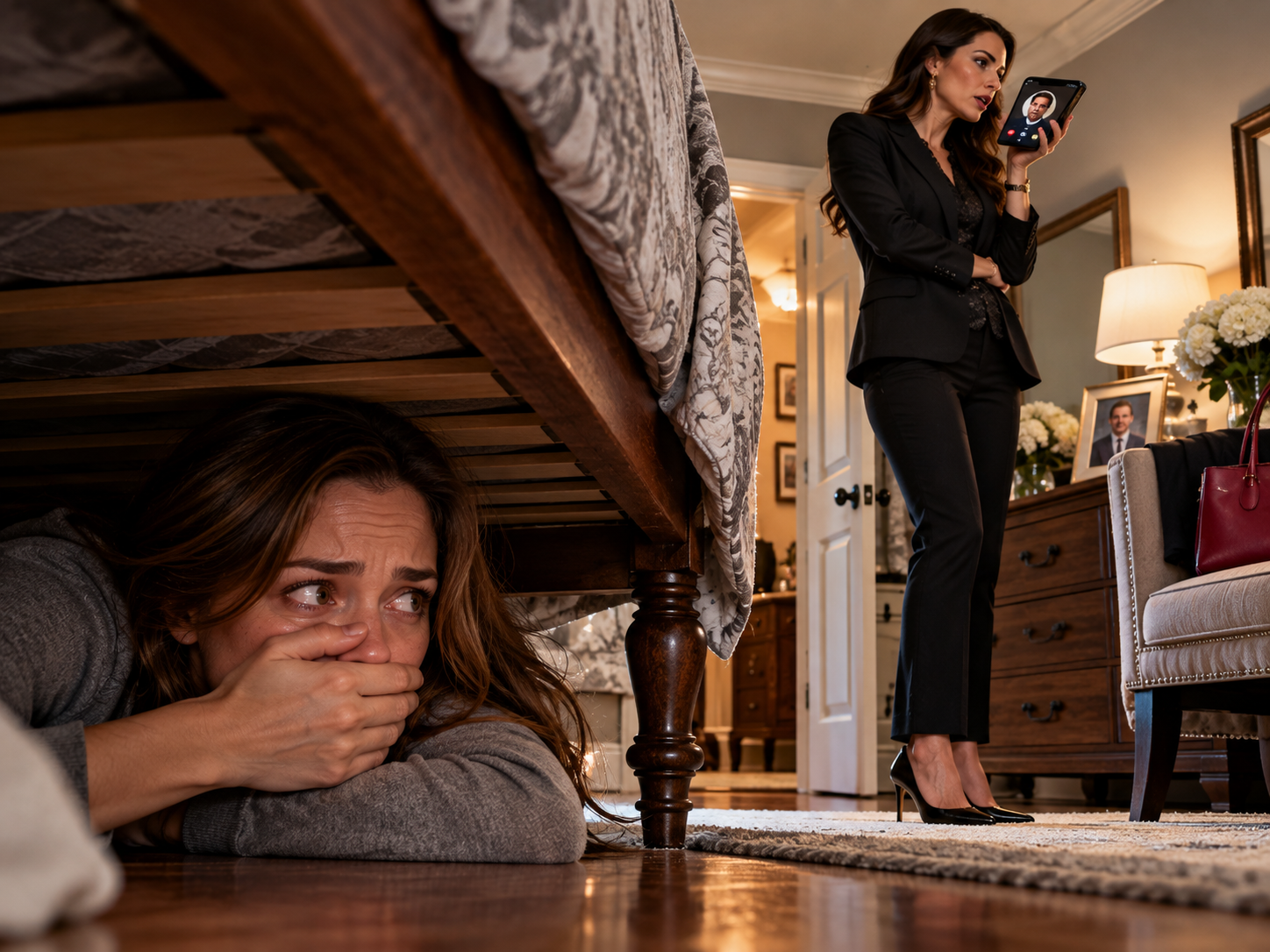
On the drive home, I kept checking the rearview mirror. Every silver sedan made my pulse jump. I knew fear could distort ordinary details, but I could not convince myself that the danger was imaginary. Someone had entered my bedroom, searched my drawers, and discussed my behavior with a man who was supposed to be dead.
That evening, I changed the password on my email, froze the credit cards I rarely used, and contacted my bank. I asked whether any accounts had been opened or altered since Mark's death. The representative found no new credit accounts, but she did discover an investment account linked to a joint authorization I had signed before the accident.
The account had been closed six months earlier. A substantial sum had been transferred out shortly before the closure, and the receiving institution was listed under a holding company I did not recognize.
“Can you tell me who authorized the transfer?” I asked.
“The record shows authorization under the account's management agreement.”
“Was it authorized electronically?”
“It appears to have been processed through a signed instruction.”
“Can you send me a copy?”
She said the bank would need to verify the request. I submitted the required forms and asked for the original instruction, not merely a transaction summary. When I finished, I opened the folder containing my old tax returns and began searching for any reference to the holding company.
I found its name in a document from the year before Mark died. It had been listed as an administrative service connected to one of his investments. The amount involved was modest at the time, and I remembered Mark saying that the company handled routine paperwork. I had never questioned it.
At the bottom of the page was an address in Philadelphia.
The following morning, I searched public business records and discovered that the company had been dissolved. Its registered agent was a law firm that had changed its name twice in five years. The address on the old document now belonged to a different business. None of this proved fraud, but the pattern was consistent with someone who had deliberately made a financial trail difficult to follow.
I called my closest friend, Elaine, and asked whether she remembered anything unusual about Mark's final weeks. Elaine had been with me after the accident, helping me answer condolence messages and sorting through the sympathy cards that filled the dining room. She had also been the person who drove me home from the funeral because I could barely see through my tears.
She went quiet when I mentioned Vanessa.
“I remember her,” she said. “She called you twice after Mark died. You never returned the calls.”
“I don't remember that.”
“You were barely sleeping. You kept saying you couldn't talk to anyone from his office.”
“Did she leave messages?”
“One of them said she had some paperwork Mark wanted you to have. The other was just a request to call her back.”
“Why didn't you tell me?”
“I did. You said you couldn't deal with it, and I didn't push.” Her voice softened. “Laura, you were grieving. You weren't yourself.”
I looked at the photograph on the table. “What if she was trying to tell me something?”
“Then we'll find out. But please don't go looking for her alone.”
I promised I would be careful. I did not tell Elaine that I had already begun considering a visit to the motel in the photograph. I needed to know whether the location was real, whether the car was still registered to someone connected to Mark, and whether anyone remembered seeing him there.
That afternoon, I drove to Mount Laurel and found the motel after following two side roads through a commercial district. It was a low building with faded beige walls and a sign whose red letters had begun to peel. The parking lot was half empty. Near the office, a vending machine rattled beneath a buzzing fluorescent light.
I showed the manager a copy of the photograph and asked whether he recognized the man. He studied it for a long moment before looking at me.
“I can't discuss guests,” he said.
“I'm his wife.”
“I'm sorry.”
“He was reported dead two years ago. This photograph was taken three weeks ago.”
The manager's face tightened. He placed the photograph on the counter and turned it so the image faced him again.
“I remember the car,” he said at last. “Not the man. The car stayed here a few times. Someone paid in cash.”
“Recently?”
He looked toward the office door behind him. “I don't want trouble.”
“I don't either. I just need to know whether he's alive.”
The manager did not answer. Instead, he reached beneath the counter and brought out a small business card. It bore the name of a private investigator and a telephone number written in blue ink.
“Someone else asked about that car,” he said. “A woman. Red handbag. She said she was looking for a missing person. I gave her the same card.”
“When was that?”
“Last week.”
I took the card and thanked him. Before I reached the door, he called after me.
“Ma'am, one thing. If you find the man you're looking for, don't assume he's the one who sent you.”
I turned, but the manager had already retreated into his office.
The private investigator's number led to a small firm in Cherry Hill. I called from my car and explained that I had received a photograph of my supposedly deceased husband at a motel. The receptionist took my details and said the investigator would return my call.
He called twenty minutes later. His name was Daniel Price, and he remembered the silver sedan. A client had hired him to locate a man who was believed to have died in a highway accident. He refused to identify the client over the phone, but he agreed to meet me at a public café the next morning.
I almost canceled twice. I had spent so long believing that Mark's death was a closed chapter that the possibility of opening it frightened me more than I wanted to admit. If he was alive, every memory I had preserved would change. If he was not, someone was using his face and voice to manipulate me.
Daniel arrived carrying a thin folder. He was in his fifties, with a weathered face and the cautious manner of someone accustomed to listening to stories that did not fit together. He examined my photograph and compared it with several pictures in his folder.
“This man was using more than one name,” he said. “The client believed he was connected to a financial scheme involving insurance proceeds and investment accounts.”
“Who was the client?”
“I can't tell you yet. I have a confidentiality agreement.”
“Then why meet me?”
“Because the client stopped answering my calls, and I found out the man I was following may have been connected to your husband's death.”
He slid one photograph across the table. It showed the silver sedan parked outside a storage facility. A man stood beside the driver's door, his face partly obscured by a baseball cap. The date stamp was from four months earlier.
I recognized the posture before I recognized the face. Mark always leaned slightly to one side when he stood still, favoring his right leg after an old sports injury. The man in the photograph held himself in precisely the same way.
Daniel watched me study it.
“Do you recognize him?”
“Yes.”
“Are you certain?”
I looked at the photograph again. “I would recognize that stance anywhere.”
He opened his folder and removed a photocopy of a document bearing the name of the dissolved holding company. Beneath it was a transaction reference and a handwritten note that appeared to have been added by his client.
The note contained a name.
Vanessa Reed.
I read it aloud. Daniel nodded.
“She was the person who hired me,” he said. “She told me your husband had stolen money and disappeared. She wanted proof that he was alive.”
“Why would she hire you if she's working with him?”
“That's what I was trying to determine.”
He explained that Vanessa had given him the motel photograph and asked him to establish the man's current identity. Before he could finish his investigation, she had contacted him to cancel the assignment. She claimed the matter had been resolved, but she never collected the documents he had gathered.
“Did you tell her you found me?” I asked.
“No.”
“Could she know I'm here?”
“Not from me.”
I stared at the name on the page. Vanessa had searched my bedroom while speaking to Mark. She had complained about the money and the documents. Yet she had also hired a private investigator to find him. Perhaps she had been his accomplice until something changed. Perhaps she had been trying to escape him. Or perhaps the entire investigation was another part of a plan to lead me somewhere dangerous.
Daniel pushed the folder toward me.
“I made copies,” he said. “Take these. And don't contact Vanessa until we know what she wants.”
I left the café with the folder tucked beneath my coat. In my car, I opened it again and found a final page that Daniel had not discussed. It was a copy of an old accident report, partially obscured by a stamp indicating that the file had been amended.
The original report listed Mark as the driver of the silver sedan. The amended version referred to an unidentified driver and a passenger whose name had been withheld pending notification of family.
The date of the amendment was six days after the funeral.
At the bottom of the page was a signature I recognized from the insurance paperwork.
Vanessa Reed.
Click here to continue reading: PART 3: The Woman Who Had Helped Bury My Husband’s Secret Finally Revealed Why She Needed Me to Find the Original Document
The Woman Who Entered My House Without Knocking Knew My Husband’s Habits Better Than Anyone Should
Part 2 of 20

