
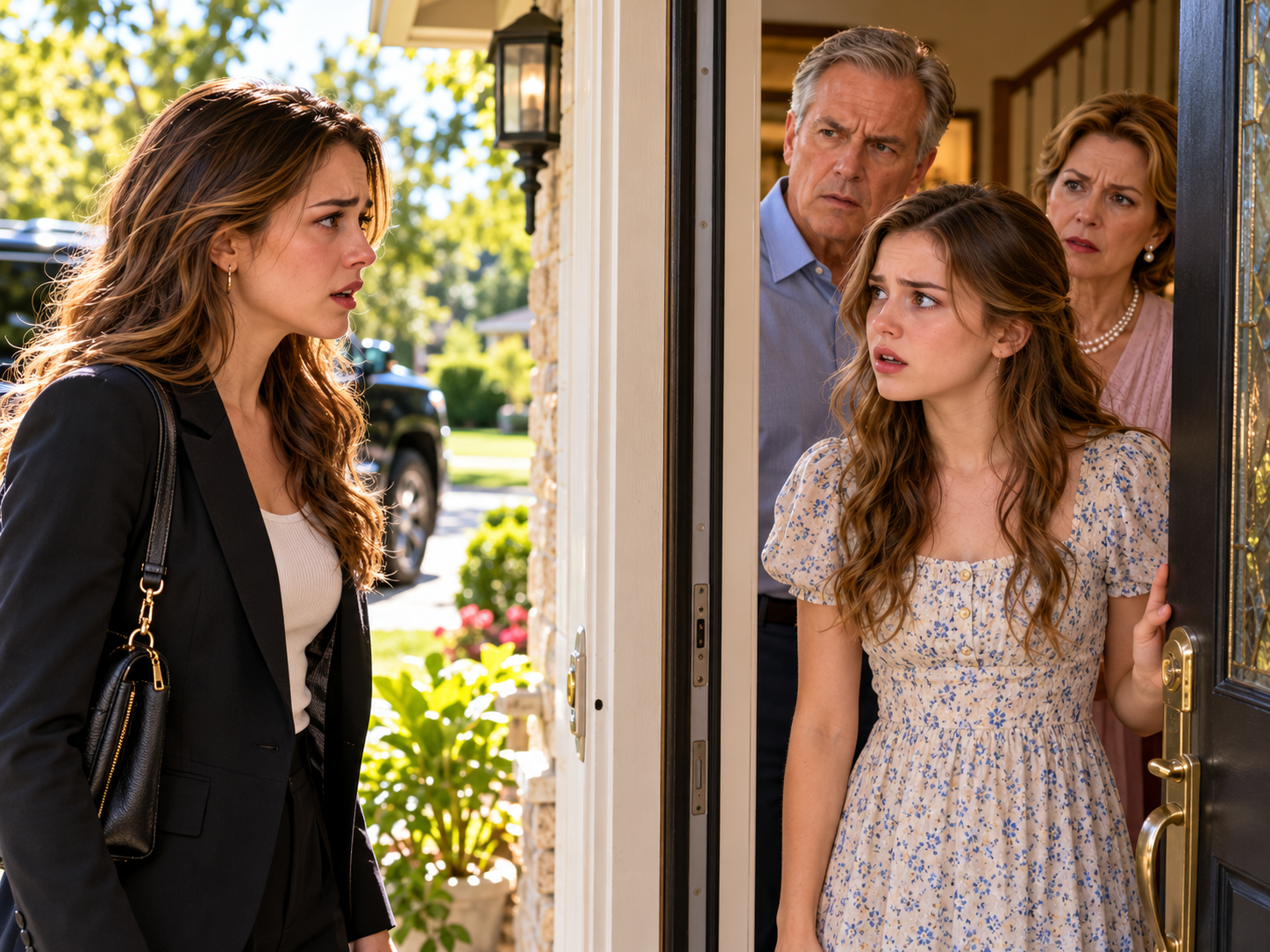
The girl standing behind my parents’ screen door had my face. Not a resemblance that might have made me smile at a family reunion, not the familiar curve of a nose shared by distant cousins. She had the same dark eyes, the same stubborn line to her mouth, and the same crease between her eyebrows that appeared whenever she suspected someone was hiding something from her.
For several seconds, neither of us spoke.
A fly buzzed against the window beside her head. Somewhere behind the house, a lawn mower sputtered and died. I could feel the late-afternoon Alabama heat gathering beneath my collar, but the rest of me had gone strangely cold.
“Can I help you?” she asked again.
Her voice was younger than mine, naturally, but there was something in its guarded tone that made my stomach tighten. I had used that exact tone as a teenager whenever my father demanded an explanation he had already decided not to believe.
I had driven nearly a thousand miles to stand on this porch. I had rehearsed what I would say through the mountains, across state lines, and along the narrow county road that led into the town where I had grown up. I had prepared for my mother’s disapproval, my father’s silence, even the possibility that one of them would pretend not to recognize me.
I had not prepared for this girl.
“I'm looking for Richard and Elaine Whitmore,” I said.
The girl’s expression changed at the names. It was subtle, just a brief tightening around her eyes, but I caught it.
“Who wants to know?”
I almost laughed. Not because anything was funny, but because twenty years earlier I had stood on the other side of this very door, soaked to the skin, listening to my mother tell me that I had brought disgrace into her home. Now I was a successful businesswoman wearing a tailored jacket and shoes that cost more than everything I had owned when she threw me out.
And the first thing I had encountered was another young woman who looked as if she had stepped directly out of my past.
“My name is Anna,” I answered. “Anna Whitmore.”
She went completely still.
Before she could respond, a man’s voice called from somewhere inside the house.
“Who’s at the door, Lily?”
The girl glanced over her shoulder.
“Someone asking for Grandma and Grandpa.”
Grandma and Grandpa.
I gripped the strap of my handbag so tightly that the leather pressed into my palm.
My parents had never met my son. They had never held him, never heard him cry, never watched him take his first steps or struggled to understand the strange, beautiful logic of his childhood questions. They had never received a birthday card from him because I had never sent one. For years, I had imagined that they might one day regret what they had done, but I had stopped expecting them to change.
Now there was a girl in their house calling them grandparents, and she looked like the person I had been when they abandoned me.
The man appeared in the hallway. He was older, with a thickening waist and gray hair, but I recognized him immediately. My father had always carried himself as if every room belonged to him. Even now, he stood with one hand against the wall, looking past Lily toward the porch.
Then his eyes found mine.
The color drained from his face.
“Anna?”
He said it as though he had opened a door onto something he had buried and never expected to see again.
Lily turned sharply toward him. “You know her?”
My father didn't answer. His gaze moved over my face, my jacket, the expensive car parked beside the cracked driveway. I could almost see him searching for the frightened sixteen-year-old he remembered—or the version of me he had decided to remember.
I waited for him to say something human.
He looked instead at Lily.
“Go inside.”
“Why?”
“Lily, I said go inside.”
She didn't move. Her eyes shifted between us, and I watched suspicion settle over her features.
“I think she deserves to know who I am,” I said.
My father’s jaw tightened. “This isn't the time.”
“You had twenty years to choose a time.”
The words came out quietly. I had expected anger to rise in me when I finally saw him again, something hot and sharp that would make every sentence feel like a weapon. Instead, my voice sounded almost ordinary, and that made the moment more painful.
He stepped onto the porch and pulled the screen door closed behind him.
“Why are you here?”
I looked past him into the hallway. The wallpaper had changed, but the narrow staircase remained where it had always been. I remembered sitting on the third step to finish my homework because the kitchen table was occupied by my father's newspaper and my mother's neatly folded church bulletins. I remembered the smell of supper drifting through the house, and how ordinary everything had looked on the afternoon my pregnancy test changed my life.
“I wanted to see you,” I said. “Both of you.”
“Your mother isn't feeling well.”
“That doesn't answer my question.”
He looked older than I remembered, but not in a way that softened him. His shoulders had begun to slope, and the skin around his mouth had loosened. Yet the same impatience lived in his eyes, the familiar expression that had once convinced me that asking for anything was an act of disrespect.
“You shouldn't have come back after all this time.”
I looked at the rusted fence, the weeds along the foundation, and the porch railing that had begun to peel. When I was a girl, my mother spent every spring scrubbing the steps and planting red geraniums in white pots. She wanted the neighbors to see a respectable home. The lawn had to be trimmed. The curtains had to hang evenly. No one outside the house was supposed to know that we had problems.
And when I became the problem she couldn't hide, she had thrown me away.
“You're right about one thing,” I said. “I shouldn't have waited this long.”
My father flinched, although he quickly disguised it with a dismissive movement of his hand.
“Anna, whatever you came here expecting, we can't change the past.”
“I didn't come here to ask you to change it.”
“Then what do you want?”
Before I could answer, Lily pushed the screen door open again.
“Grandpa, why does she have the same last name as you?”
He turned toward her so quickly that she took half a step back.
“Inside. Now.”
“No.”
The single word hung in the warm air.
I stared at her. She was barely nineteen, perhaps younger, and there was a stubbornness in the way she lifted her chin that made my chest ache. I had done the same thing once, standing in our kitchen with a positive pregnancy test in my trembling hand, believing that if I explained myself carefully enough, my parents would eventually remember that they loved me.
Lily looked at me again.
“Are you really related to us?”
“Yes,” I said. “I'm Richard and Elaine's daughter.”
My father closed his eyes for a moment.
Lily's face changed, but not into the recognition I had expected. It was closer to disbelief, followed by something that looked almost like fear.
“You're the daughter they never talk about?”
The question struck harder than an accusation.
My father reached for the door. Lily caught its edge before he could shut it.
“Grandpa, wait. You told me Mom was the only child in this family.”
The world seemed to narrow around those words.
Mom.
I looked at Lily, then at my father. He had gone so pale that the freckles across his nose stood out. For the first time since I had arrived, he seemed genuinely frightened—not of me, but of what this girl might ask next.
“Where is your mother?” I asked.
Lily swallowed.
“She died when I was little.”
The answer came so softly that I nearly missed it.
“I'm sorry,” I said automatically.
She studied me, her eyes bright with an emotion she seemed determined not to show. “You don't even know who she was.”
“No,” I admitted. “I don't.”
My father moved between us.
“That's enough. Both of you.”
But I was no longer looking at him. I was looking at Lily's face, at the familiar shape of her eyes and the small scar near her left eyebrow. I had a faint scar in the same place, left by a fall from my bicycle when I was seven.
Coincidences existed. Families shared features. I knew that.
Still, I could not ignore the way Lily was watching me, as if something about my presence had confirmed a suspicion she had carried for years.
“Lily,” my father said, his voice suddenly strained, “go to the kitchen. I'll explain everything later.”
“You always say later.”
He stopped.
She folded her arms across her chest. “You told me I wasn't allowed to ask about my mother. You told me there were things I didn't need to know. Now a woman shows up who looks like me, and you're acting like the house is on fire.”
I felt an unexpected surge of sympathy for her. I knew what it was like to live in a home where silence was treated as obedience and questions were treated as betrayal.
“What's your mother's name?” I asked.
My father stared at me.
Lily hesitated, then answered.
“Sarah.”
The name meant nothing to me at first. Then she added a detail that made my heart stumble.
“Sarah Whitmore. That's what her name was on her birth certificate.”
I turned toward my father.
He looked away.
I had come to Alabama expecting to confront two people who had rejected me. I had imagined myself standing in front of them with every year of my survival behind me, finally able to say that their cruelty had not destroyed me.
Instead, I was standing on their porch listening to a young woman describe a mother whose name I had never heard, in a house where my father seemed terrified of the truth.
“Richard,” I said, using his first name for the first time in my life. “Who is Sarah?”
He opened his mouth, but no answer came.
Then, from somewhere deeper inside the house, my mother's voice called out.
“Richard? Who are you talking to?”
My father turned toward the hallway. For one brief instant, I saw something in his expression that I had never seen when I was a child.
Panic.
“Stay here,” he told Lily.
She ignored him and stepped onto the porch beside me.
The sound of my mother's footsteps grew louder. I watched the dark doorway, remembering another night, another storm, and the sound of my own backpack striking the wet grass.
When Elaine Whitmore finally appeared, she was carrying a dish towel in one hand.
She looked at me.
The towel slipped from her fingers.
And for the first time in twenty years, my mother had no words.
Click here to continue reading: PART 2: The Secret Behind the Girl in My Parents’ House Was Something Neither of Them Could Afford to Let Me Discover
Twenty Years After Being Thrown Into the Storm, I Returned to the House That Had Erased Me From Its Memory
Part 1 of 20

