
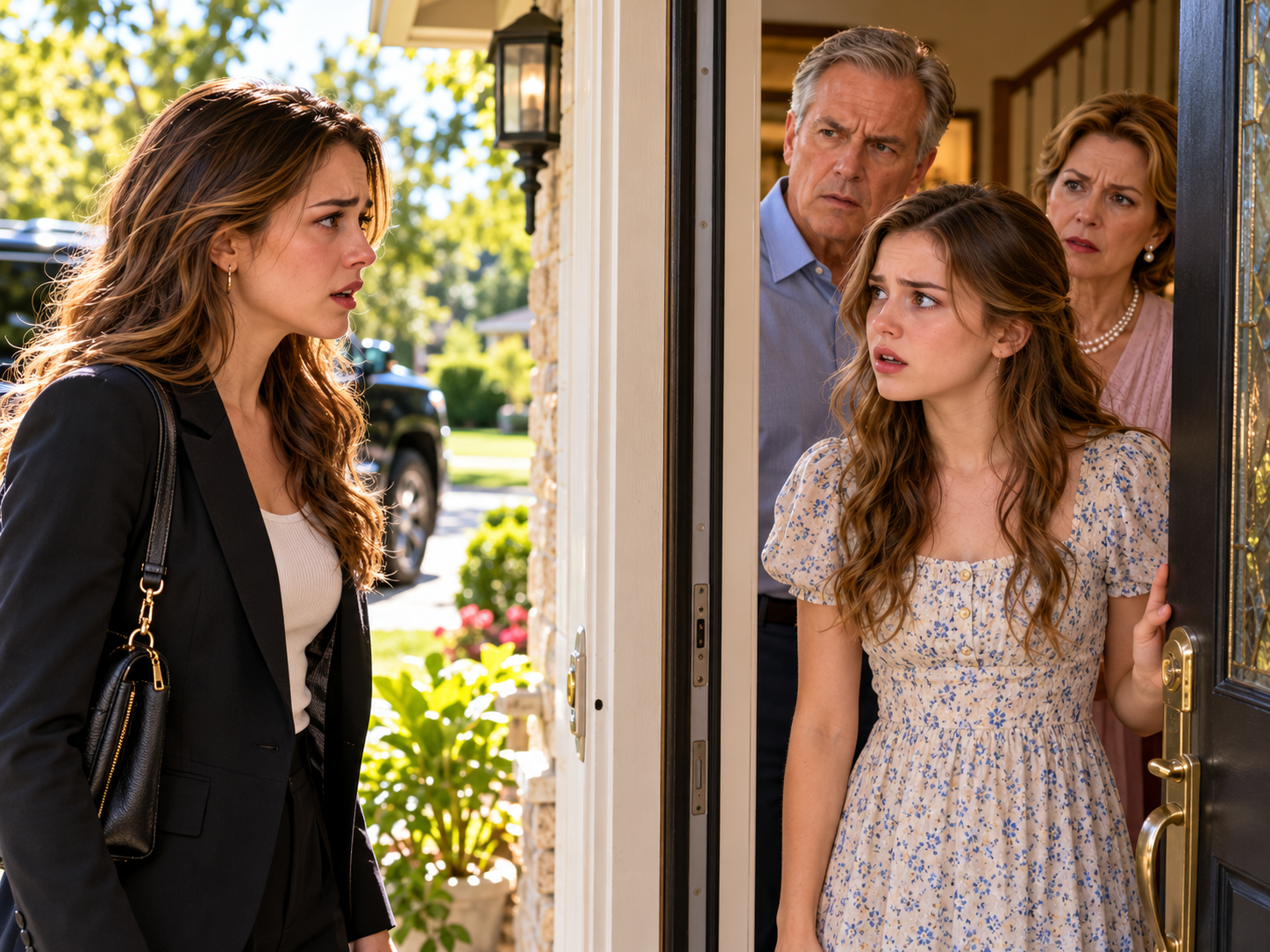
My mother stood in the doorway as if the years between us had vanished, leaving her face exactly as it had been on the night she sent me away. Her hair was thinner now, carefully brushed into place, and the lines around her mouth had deepened. She wore the same small gold cross I remembered from church, its chain disappearing beneath the collar of her blouse.
For a moment, I thought she might reach for me.
Instead, she looked at Lily and said, “Go upstairs.”
Lily let out a short, humorless laugh. “Of course. Another conversation I'm not allowed to hear.”
“Lily, please.”
It was the please that caught my attention. My mother rarely pleaded with anyone. When I was sixteen, she could have watched me cry until I couldn't speak and still insisted that I apologize for making her uncomfortable. Now she was looking at a girl young enough to be my daughter with an expression close to desperation.
Lily glanced at me. “I'm not going anywhere until someone tells me what's happening.”
My mother pressed her lips together.
I had imagined this reunion a thousand times. In some versions, I shouted until every neighbor on the road knew what they had done. In others, I calmly laid out the facts of my life: the rented rooms, the lonely delivery, the nights I had counted coins before buying groceries, the years I spent building a company from almost nothing.
I had expected to tell them how much it had hurt.
But standing there, watching my parents exchange frightened looks, I realized they were hiding something that had nothing to do with my success.
“Let her stay,” I said.
My father rounded on me. “You don't get to make decisions in this house.”
“No,” I replied. “I learned that twenty years ago.”
His face reddened. My mother looked toward the neighbors' houses, although no one was outside. Even now, appearances mattered to her more than the people standing in front of her.
“Come into the kitchen,” she said. “We shouldn't be doing this on the porch.”
I almost refused. Every part of me wanted to remain where the whole town could see us, where they couldn't quietly shut the door and pretend nothing had happened. Yet I wanted answers more than I wanted an audience.
I stepped inside.
The house smelled of furniture polish, old wood, and the faint sweetness of the cinnamon air freshener my mother had always favored. A clock ticked above the living-room mantel. The photographs had changed, but the arrangement had not: family portraits, church gatherings, carefully framed images of people whose lives seemed to have unfolded without difficulty.
There were no photographs of me.
Not one.
I had known what to expect, of course. Twenty years was enough time to remove pictures, box up school certificates, and forget where a child's report cards had been stored. But seeing the empty space where my childhood had once belonged still hurt.
Lily noticed me looking.
“They don't keep old pictures around,” she said. “Grandma says they're clutter.”
My mother busied herself with the dish towel she had retrieved from the floor. “There's no reason to discuss photographs.”
“Then let's discuss the girl who opened the door,” I said.
My father pulled out a chair but remained standing behind it. “Lily is family. That's all you need to know.”
“She's family, but I'm not?”
His silence answered before he could.
I took a seat. Lily sat opposite me, leaning forward with her elbows near the edge of the table. My mother remained by the counter, rubbing her hands together beneath the towel.
“Tell me about Sarah,” I said.
My mother looked at my father. He gave the smallest shake of his head.
I saw it.
So did Lily.
“Why does everyone act like that name is forbidden?” she demanded. “You told me Mom died when I was little. You told me there was nothing more to say.”
“There are painful things in every family,” my father replied.
“That's not an answer.”
“You're too young to understand.”
“I'm nineteen, Grandpa. I'm old enough to know when you're lying.”
The sentence landed with such force that my father actually stepped back.
I recognized the anger in her face, but beneath it was something more fragile. Lily wasn't merely curious about me. She was looking at a door that had always been locked and realizing that the people who held the key had been standing in front of it all along.
“Lily,” I said gently, “what did they tell you about your mother?”
She looked down at her hands.
“Her name was Sarah. She died when I was little. That's what Grandma says whenever I ask. Grandpa says I should be grateful for the life I've had instead of digging up things that can't be changed.”
“And do you have any photographs of her?”
“One. I found it in an old box when I was twelve. Grandma took it away.”
My mother stopped rubbing her hands.
“What did Sarah look like?” I asked.
Lily lifted her eyes to mine.
“I don't remember her. In the picture, she had dark hair and a little scar here.” She touched the skin above her left eyebrow. “She was young. Younger than you are now, I guess.”
My fingers tightened around the edge of the table.
I had the same scar.
It came from a bicycle accident when I was seven, a memory so ordinary that I had never considered it might matter to anyone else. My mother had taken me to the emergency room, where I had received three stitches and a lecture about riding too fast down our street.
“Where's the picture now?” I asked.
“Grandma put it away.”
“Elaine,” I said.
My mother finally looked at me.
“Where is it?”
“You've been here five minutes, Anna. You have no right to interrogate me.”
“No right?” I repeated. “You threw me out when I was a child. You told me I was dead to you. Now I find a girl in your house who looks exactly like me, and you expect me to leave without asking why.”
“I did what I thought was best.”
The words came out automatically, as if she had been carrying them around for years.
I stared at her. “For whom?”
She had no answer.
My father walked to the window and moved the curtain aside. His attention was fixed on the street, but I knew he was listening to every word.
Lily stood abruptly.
“I'm getting that photograph.”
“Lily, sit down,” my mother ordered.
“No.”
She walked past my father before he could stop her and disappeared down the hallway. A moment later, we heard footsteps on the stairs.
My mother followed her to the doorway.
“Don't touch anything in that room!”
Lily's voice came from upstairs. “Then tell me where it is!”
The argument continued out of sight. My father remained beside the window, one hand pressed against the frame. I watched his reflection in the glass.
“What happened to Sarah?” I asked.
He didn't turn around.
“Your mother told you. She died.”
“Then why can't you look at me when you say it?”
His shoulders stiffened.
For years, I had remembered my father as a man who never hesitated. He could make a decision about another person's life without blinking, then sit down to supper as though nothing important had happened. I had feared that certainty when I was young. I had mistaken it for strength.
Now I wondered whether it had always been cowardice.
“Whatever you think you know,” he said, “you should leave it alone.”
“Why?”
“Because some things can't be undone.”
“That sounds like something a guilty man would say.”
He turned then, and I saw genuine anger in his face.
“You think money makes you important? You think driving back here in that car means you can come into our home and judge us?”
I glanced toward the front window. My car was visible through the peeling curtains, clean and unfamiliar against the tired house.
“No,” I said. “I think being someone's parent means you don't abandon them in a thunderstorm because you're embarrassed by their circumstances.”
He looked as though I had struck him.
My mother returned to the kitchen before he could answer. She had gone pale, and her eyes were fixed on the staircase.
“Lily has been through enough,” she said. “She lost her mother. She doesn't need you upsetting her with old family grievances.”
“Then give her the truth.”
“There is no truth you need to know.”
I rose from the chair.
“Twenty years ago, you decided I wasn't your daughter. I accepted that decision because I had no choice. I built a life without either of you. I didn't come here asking for your house, your money, or your forgiveness.”
My voice faltered on the last word, and I hated that it did.
“I came because I wanted to look you in the eye and understand how you could do it.”
My mother stared at the floor.
“And now,” I continued, “I find a girl who looks like me and has a photograph of a young woman you refuse to discuss. If you think I'm going to drive away without knowing why, you never understood me at all.”
Footsteps sounded on the stairs.
Lily returned holding a small, faded photograph between both hands. The corners were bent, and a pale crease ran through the middle. She placed it on the table without sitting down.
“That's her,” she said.
I reached for the photograph.
The young woman in it stood beside a white hospital bassinet, her hair pulled back, her face thin with exhaustion. She wore a plain cotton gown, and her eyes were swollen as if she had been crying for hours.
I recognized the face immediately.
It was mine.
Not the woman I had become, but the sixteen-year-old who had walked through the rain with a backpack containing two pairs of clothes. The girl who had given birth alone, with no mother beside her and no father waiting outside the hospital room.
The photograph trembled in my hands.
On the back, someone had written a date.
Twenty years earlier.
Beneath it were two words in blue ink.
“Baby Anna.”
I read them twice.
Then I looked at my mother.
“Where did you get this?”
She pressed a hand over her mouth.
My father moved away from the window, and for the first time since I had arrived, he looked at me not with anger but with the exhausted fear of a man whose secret had finally found its way into the light.
Lily leaned over the table.
“Why does that woman look like you?”
I couldn't answer.
Because the girl in the photograph wasn't simply a young woman who resembled me.
She was me.
And I had never seen that photograph before.
Click here to continue reading: PART 3: The Photograph Revealed What My Parents Had Stolen From Me, and the Girl Beside Me Was About to Learn Why
Twenty Years After Being Thrown Into the Storm, I Returned to the House That Had Erased Me From Its Memory
Part 2 of 20

