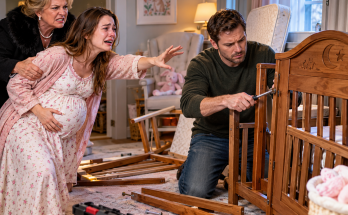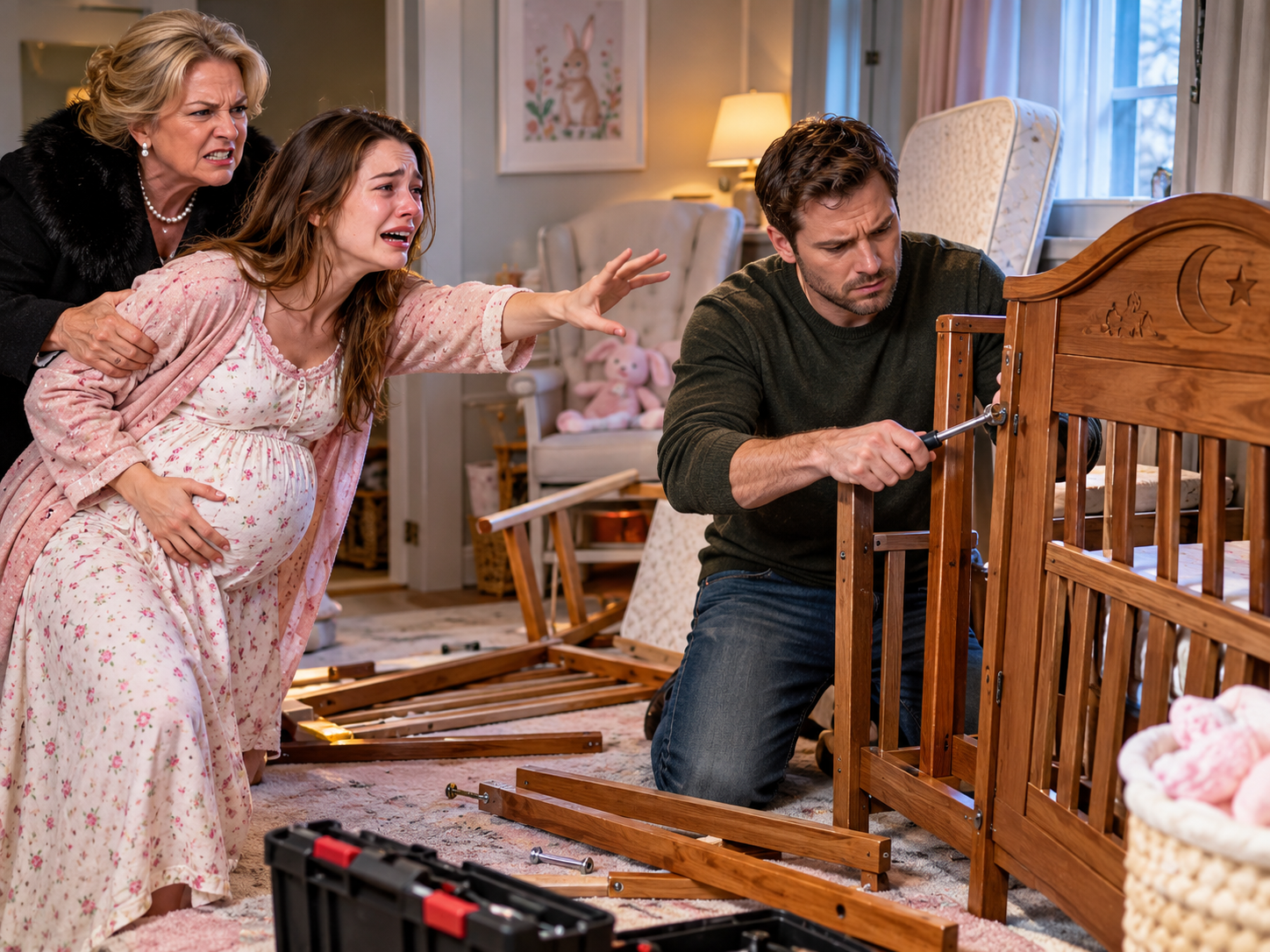
Evan carried the final crib panel downstairs while I followed close behind him.
I had stopped crying. My face felt tight, and the skin beneath my eyes burned, but the tears had given way to a quiet, concentrated anger. It was not the sort of anger that made me want to shout. It made me notice details: the way Evan avoided looking at me, the way he kept his body between me and the door, the way Patricia watched us as if she were supervising a delivery.
Outside, the wind pushed loose snow across the porch.
"Leave the panel inside," I said.
Evan ignored me and stepped over the threshold.
I followed him into the cold.
My slippers offered almost no protection from the icy boards beneath my feet. I had put on my robe over my nightgown that morning because I had expected to spend the day washing baby clothes and arranging the last items in the nursery. Now the robe flapped around my legs, and the cold air slipped through the thin fabric.
"Evan, please."
He lifted the panel toward the truck.
"Stop saying please as though I'm doing something terrible."
I looked at him in disbelief.
"You are taking apart a crib made by my dying father. You are taking it away three days before our daughter is due. What would you call it?"
"Helping my sister."
"Then help her without taking this."
Patricia came down the porch steps, careful to keep her expensive boots away from the slush. "Must you turn every family decision into a tragedy?"
I turned toward her.
"Would you let someone take something your husband built for Rachel's baby?"
"Don't bring Rachel into this."
"She's already in it. You both put her here."
Patricia's lips pressed into a thin line. She had a way of going very still when she was angry, as though she were waiting for the other person to make a mistake she could use against them.
"You have no idea how fortunate you are," she said. "Evan provides for you. You have a nice home, a comfortable life, and a husband who works hard. Yet you behave as though the entire world owes you something."
I glanced at Evan.
He was securing the panel against the side of the truck with a strap.
"Tell her to stop."
He pulled the strap tighter.
"Mom, just let it go."
For one brief second, I thought he meant the crib.
Then he looked at me.
"Mia, go inside."
"No."
"I'm not doing this with you out here."
"Then bring the crib back inside."
He gave a short laugh, shook his head, and returned to the truck for the remaining pieces.
I followed him along the porch.
My breathing had become shallow, partly from the cold and partly because the baby was pressing against my ribs. I stopped to steady myself against the railing, waiting for the discomfort to pass.
Patricia noticed.
"See? This is why you need to calm down. You're upsetting yourself over nothing."
I looked at her. "I'm not upset over nothing."
"You're pregnant. You're emotional. You need to stop letting your feelings dictate your behavior."
"My feelings are not the problem."
She gave me a look of contempt.
"That is exactly what people like you always say."
People like me.
I wondered what she meant by it. Was I the woman who had married her son without enough money? The woman whose father had worked with his hands instead of managing a company? The woman who had never learned to smile through an insult because she still believed family should not require that kind of endurance?
Perhaps it was all of those things.
Whatever the reason, Patricia had never accepted that Evan's life belonged to him as much as it belonged to her. When we married, she continued to expect him at every family gathering, every weekend dinner, and every emergency Rachel declared. If I objected, I was controlling. If I stayed home, I was antisocial. If I went along, I was expected to be grateful for the invitation.
Evan had never established a boundary she could not cross.
Now she was standing in my yard, deciding what my unborn daughter could keep.
"Please just leave," I said. "Take the pieces you already removed if you must, but stop. I can't do this anymore."
Patricia looked at the truck, then at me.
"You don't get to dictate when we're finished."
I could hear Evan moving around in the truck bed. He was arranging the pieces carefully, placing the smaller rails beneath the larger panels. He handled my father's work with more care than he had shown me.
That detail hurt more than I expected.
"Evan," I called. "Please come here."
He appeared beside the truck, pulling off one glove with his teeth.
"What now?"
"I need you to look at me."
He hesitated, then walked toward the porch.
I waited until he stood close enough that I could see the small crease between his eyebrows.
"I need to know whether you understand what you're doing."
He sighed.
"Yes, Mia. I understand. Rachel needs a crib, and we have one."
"Our daughter needs one too."
"We'll buy another."
"With what money?"
His expression hardened.
"Don't start that again."
"Then answer me."
He looked toward his mother.
Patricia made a dismissive gesture. "You don't owe her an accounting of every dollar you earn."
I kept my eyes on him.
"Is that what you believe?"
For a moment, he seemed trapped between the answer he wanted to give and the consequences of giving it. Then his face settled into the familiar expression of irritation.
"We'll discuss it later."
"There's always a later with you."
He stepped back.
"You're impossible."
I could not remember the last time he had called me that without eventually asking me to apologize for upsetting him.
Perhaps there had never been a time.
The thought came with an unexpected sense of clarity. I had spent so much energy trying to identify the moment our marriage had gone wrong that I had overlooked how often I had been asked to accept the wrong thing as normal.
I had believed that if I explained myself better, he would understand. If I waited until he was less stressed, he would listen. If I stopped crying, stopped asking, stopped making him feel guilty, he would become the husband I had thought I married.
But he had heard every word I had said that morning.
He simply did not agree that my wishes mattered.
"I am asking you one last time," I said. "Bring the crib back inside."
Evan's face went cold.
"No."
The answer was quiet and final.
I felt the baby shift against my palm. A wave of pressure moved through my lower abdomen, and I bent slightly, waiting for it to ease.
Patricia noticed but seemed unmoved.
"That's enough," she said. "We're leaving."
She turned toward the truck.
Something in me resisted the idea of watching them drive away with my father's gift as though nothing had happened. I stepped between Patricia and the porch steps, not touching her, simply refusing to let her pass without hearing me.
"You don't get to take this from me."
She stopped.
For several seconds, neither of us spoke.
Then she smiled.
It was not a warm smile. It was the small, satisfied expression she wore when she believed she had found the exact place where another person was vulnerable.
"You're being selfish, Mia."
I swallowed.
"Wanting my daughter to have the bed her grandfather made for her isn't selfish."
"You think the world revolves around you because you're having a baby."
"No. I think this baby deserves parents who put her first."
Evan came around the side of the truck.
"That's enough."
I looked at him.
"Then stop her."
He did not answer.
Patricia stepped closer. The fur at her collar brushed against her cheek as the wind lifted it. She looked at me with the same expression she had worn when she first entered the nursery: annoyance sharpened into contempt.
"You married into this family," she said. "You should have learned by now that you don't get to tell us what to do."
I felt my hands begin to shake.
"I am not your servant."
Her eyes narrowed.
"No. You're worse. At least a servant understands when it's time to be grateful."
The words should have made me step away. Instead, I remained where I was, stunned by the sheer ugliness of them.
Then Patricia reached for my shoulder.
I thought she meant to move me aside.
Her hand struck me with enough force to turn my body toward the steps.
My slipper slid on the ice.
For an instant, I felt nothing beneath my feet. I reached for the railing, catching only the edge of my sleeve against the post. The world tilted sharply, and Patricia's face disappeared above me.
I fell backward.
The porch seemed to stretch away, the white sky opening over my head. My hip struck the edge of a step, then my side hit the concrete with a force that drove every breath from my lungs.
I heard a sound, distant and unfamiliar.
It took me a moment to realize it was coming from my own mouth.
Pain spread across my abdomen, immediate and frightening. I curled instinctively around my stomach, trying to protect the baby, but even that small movement sent another wave of agony through me.
For several seconds, I could not breathe.
The cold concrete pressed against my cheek. Snow had blown into the space beneath the porch railing, and tiny crystals melted against my skin. I tried to push myself upright, but my arms trembled and failed.
"Evan."
My voice barely carried.
He stood near the truck, the last crib rail still in his hands.
He looked at me.
I saw his face change. His mouth opened, and for one moment I thought he was going to rush toward me.
Then Patricia spoke.
"She's fine. She slipped."
I tried to inhale. The pain in my stomach made me gasp.
"Evan, please."
He dropped the rail into the truck bed.
"Mom, what did you do?"
Patricia's expression sharpened.
"Don't you dare start blaming me. She was standing in my way, and she lost her footing."
I tried to move my legs. One knee responded, but the other seemed distant and heavy. I could not tell whether the wetness beneath me came from melting snow or something else.
Then another pain tore through my abdomen, so sharp that my vision blurred.
I screamed.
This time, Evan took a step toward me.
Patricia caught his arm.
"Don't be ridiculous. She wants you to come running every time she cries."
He stared at me over his mother's shoulder.
I had never seen him look so uncertain. The expression frightened me more than his anger. He was trying to decide whether the woman he had married was genuinely hurt or merely inconveniencing him.
I wanted to tell him that I could not feel my baby moving.
I wanted to tell him that something was terribly wrong.
But I could barely draw air into my lungs, and when I tried to speak, another scream escaped me.
"Evan, call an ambulance!"
Patricia released his arm and stepped toward the truck.
"We're leaving. If she needs help, she can call someone."
I watched her climb into the passenger seat.
Evan remained beside the open driver's door, looking at me. The truck engine started, and the sound seemed impossibly loud in the winter silence.
"Please," I whispered.
He looked down at the snow.
For one terrible moment, I thought he might turn off the engine and come back.
Instead, he shut the door.
The truck began to move.
I tried to lift my head, but the movement sent pain through my body so intense that I collapsed against the concrete. The rear tires crunched across the driveway. The wooden pieces of my father's crib shifted in the truck bed, knocking softly against one another.
I watched them disappear down the road.
Only after the truck was gone did I realize that the snow beneath my body was changing color.
A thin red line spread from beneath my robe, widening into the white around my hip.
I stared at it, unable to understand what I was seeing.
Then I felt another deep, tearing pain inside my abdomen.
And I screamed for my daughter.
Click here to continue reading: PART 4: As the Ambulance Raced Toward the Hospital, the Secret Behind My Husband’s Betrayal Became the Least of the Truths We Had to Face
Three Days Before My Daughter Was Born, I Discovered My Husband Had Decided Her Most Precious Possession Belonged to His Sister
Part 3 of 12