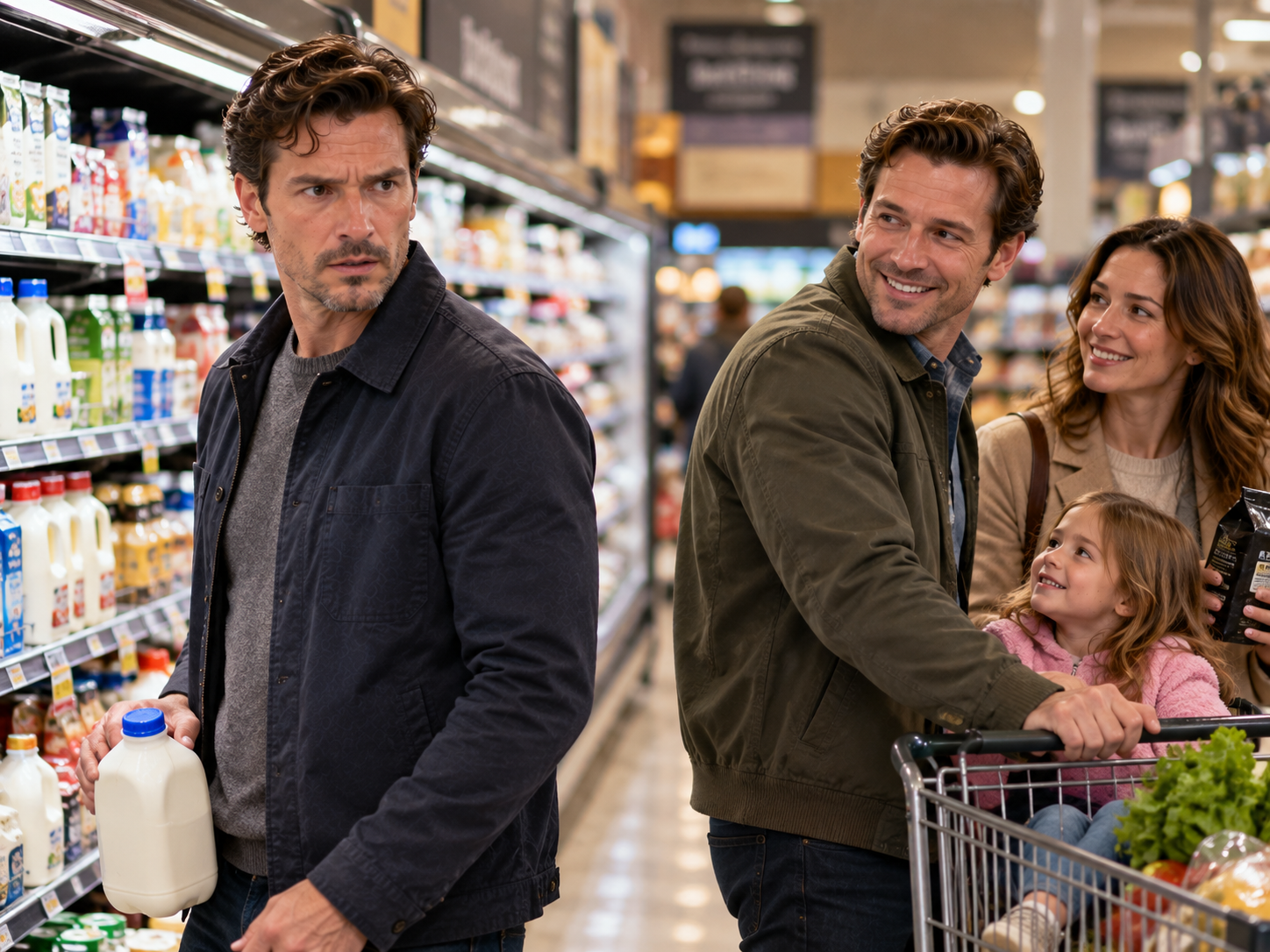
Years later, I still remembered the grocery store.
Not every day.
Not even every month.
But sometimes.
A smell.
A parking lot.
A carton of milk.
A familiar aisle.
Something small could bring it back.
The difference was that the memory no longer arrived like an emergency.
It arrived like weather.
It passed.
I had learned not to fight it.
I had also learned not to feed it.
That was the balance I had been missing.
One morning, I found myself thinking about the first time I saw the other man.
I remembered his smile.
The family beside him.
The way he didn't recognize me.
The weakness in my knees.
The shaking in the car.
The crying.
Four years earlier, I had believed that moment proved I had never healed.
Now I understood it differently.
It had shown me that healing was not a straight line.
It had shown me that buried pain could surface without destroying the life built afterward.
Most importantly, it had forced me to ask whether I was actually living honestly.
The answer, eventually, had been no.
I was staying in a marriage because I was afraid that leaving would make the affair the final word.
But the affair was not the final word.
My choices afterward were.
I stayed.
I tried.
I forgave.
I struggled.
I left.
I rebuilt.
Each decision mattered.
None erased the others.
That was what I had failed to understand when I was younger.
People wanted clean narratives.
A betrayal happens.
Someone leaves.
Someone heals.
The end.
Real life wasn't like that.
Healing overlapped with anger.
Forgiveness overlapped with grief.
Love overlapped with separation.
Regret overlapped with gratitude.
Nothing arrived in neat chapters.
One evening, I received a message from my former wife.
She had returned to the city for a visit.
She asked whether I wanted coffee.
I considered it.
Then agreed.
We met at a quiet café.
When she arrived, we smiled.
She looked well.
So did I.
We sat across from each other.
“I wasn't sure you'd come,” she said.
“Neither was I.”
She laughed.
“Fair.”
We ordered coffee.
For several minutes, we talked about ordinary things.
Her work.
My work.
Friends.
Family.
Then she looked at me.
“Do you ever think about that day?”
“The grocery store?”
“Yes.”
“Sometimes.”
“So do I.”
I waited.
“I hate that seeing him hurt you so much.”
“It wasn't really him.”
“What do you mean?”
“He was the trigger.”
She nodded.
“But the pain was already there.”
“Yes.”
She looked down.
“I sometimes wonder whether I should have done more.”
“You did what you could.”
“Was it enough?”
“No.”
She nodded.
“I thought so.”
“But that doesn't mean you did nothing.”
She looked at me.
“I think that's the fairest thing you've ever said to me.”
I smiled.
“I've had practice.”
She laughed.
Then the conversation became quiet.
Finally she asked, “Are you happy?”
I looked out the window.
“Yes.”
She smiled.
“Good.”
“Are you?”
“Yes.”
I believed her.
There was no reason not to.
We finished our coffee.
Before leaving, she said, “I'm glad we didn't end by hating each other.”
“So am I.”
She stood.
“Take care.”
“You too.”
She walked away.
I watched for only a second.
Then I looked back at my coffee.
The moment was ordinary.
That was what made it meaningful.
There was no dramatic final goodbye.
No hidden confession.
No desire to reverse anything.
Just peace.
On the way home, I stopped at a grocery store.
Different store.
Different neighborhood.
I bought milk.
I stood in line.
People moved around me.
A child complained.
Someone laughed.
The cashier asked whether I needed a receipt.
“Yes, please.”
I paid.
Walked outside.
Sat in my car.
I smiled.
The first grocery store had once represented the worst thing that had happened to me.
Now another grocery store was simply where I bought milk.
That was how far I had come.
I drove home.
The woman I had been seeing was waiting for me.
She asked how coffee had gone.
“Fine.”
“Just fine?”
“Peaceful.”
She smiled.
“That's better.”
“Yes.”
We ate dinner.
Later, I opened the window.
The city was quiet.
I thought about the question I had asked myself after seeing the other man.
Was I being too sensitive?
No.
My pain had been real.
Was seeing him reason enough to leave?
Not by itself.
It was the event that forced me to confront what I had been avoiding.
And was I foolish for staying?
No.
I had stayed because I believed the marriage might survive.
It didn't.
But trying to save it did not make me foolish.
Leaving when I realized I could no longer stay honestly did not make me cruel.
The affair had changed my life.
But it had not destroyed my future.
That distinction mattered.
I had once thought the other man had taken something from me.
He hadn't.
My former wife had made a choice that broke trust.
I had made choices afterward.
Those choices were mine.
My healing was mine.
My future was mine.
And eventually, so was my peace.
I returned to the notebook one last time.
The pages were filled.
Be honest.
Give each other space.
Stop punishing each other.
Don't pretend.
Do not confuse endurance with healing.
Let memories exist without turning them into emergencies.
Keep living.
Do not turn the past into a permanent courtroom.
I added one final sentence.
“Let the story be finished without needing it to be erased.”
I closed the notebook.
I didn't put it away.
I left it on the shelf.
The past could remain accessible without being in control.
That night, I went to bed without checking my phone.
I didn't wonder where my former wife was.
I didn't think about the other man.
I didn't replay the affair.
I slept.
In the morning, sunlight entered the room.
I woke slowly.
There was no revelation.
No dramatic feeling.
Just morning.
I made coffee.
Opened the window.
Listened to the city.
And I realized something simple.
I had spent years waiting to feel completely untouched by what happened.
That day would probably never come.
But I didn't need it to.
The wound could exist.
The scar could remain.
The memory could return.
None of those things had to become my identity.
I was no longer the man standing outside a grocery store unable to breathe.
I was the man who had walked through what came after.
I had learned that forgiveness did not mean forgetting.
That trust did not mean certainty.
That love did not mean staying forever.
That leaving did not mean failure.
And that remembering did not mean going back.
I took my coffee to the window.
The morning was ordinary.
The world had no idea what I had survived.
It didn't need to.
I no longer needed the world to know.
I only needed to know that I was here.
Still living.
Still choosing.
Still moving forward.
And finally, finally, I was no longer asking the past for permission.
Click here to continue reading: PART 21: I Thought Peace Meant Forgetting What Happened, Until an Ordinary Morning Showed Me That Memory Could Stay Without Controlling the Rest of My Life
I Thought Four Years Had Been Enough to Bury Her Affair, Until a Familiar Stranger Smiled at Me in a Grocery Store
Part 20 of 28